

Bispecific Antibody Cancer Therapy Market Report 2026
Global Outlook – By Mechanism (T Cell Engager, Natural Killer Cell Engagers, Checkpoint Inhibitor Bispecifics, Antibody Drug Conjugate Bispecific Hybrids), By Cancer Indication (Hematologic Malignancies, Lung Cancer, Colorectal Cancer, Prostate Cancer, Ovarian Cancer), By Format (Immunoglobulin G Like Bispecific, Fragment Based Bispecific T Cell Engager, Nanobody Based, Trispecific), By End User (Hospitals, Specialty Oncology Centers, Research And Academic Institutes, Pharmaceutical And Biotechnology Companies) – Market Size, Trends, Strategies, and Forecast to 2030
Bispecific Antibody Cancer Therapy Market Overview
• Bispecific Antibody Cancer Therapy market size has reached to $7.71 billion in 2025 • Expected to grow to $21.76 billion in 2030 at a compound annual growth rate (CAGR) of 23.1% • Growth Driver: Increasing Prevalence Of Cancer Driving The Growth Of The Market Due To Rising Aging Population And Associated Cancer Risk Factors • Market Trend: Advancing Targeted Immune-Based Cancer Treatments Using Next-Generation Bispecific Antibody Therapies • North America was the largest region in 2025 and Asia-Pacific is the fastest growing region.What Is Covered Under Bispecific Antibody Cancer Therapy Market?
Bispecific antibody cancer therapy is an advanced immuno-oncology approach that uses engineered antibodies designed to simultaneously bind to two different antigens, typically one on cancer cells and one on immune cells. This mechanism helps redirect and activate the body’s immune system to specifically recognize and destroy malignant cells more effectively than traditional single-target therapies. It is primarily used in precision oncology to improve treatment outcomes in various types of cancers. The main mechanisms of bispecific antibody cancer therapy include T cell engager, natural killer cell engagers, checkpoint inhibitor bispecifics, and antibody drug conjugate bispecific hybrids. T cell engager refers to bispecific antibodies designed to simultaneously bind cancer cells and T cells, promoting targeted immune-mediated destruction of tumor cells. These therapies are used across cancer indications including hematologic malignancies, lung cancer, colorectal cancer, prostate cancer, and ovarian cancer. These are available in formats such as immunoglobulin G like bispecific, fragment based bispecific T cell engager, nanobody based, and trispecific, serving end users including hospitals, specialty oncology centers, research and academic institutes, and pharmaceutical and biotechnology companies.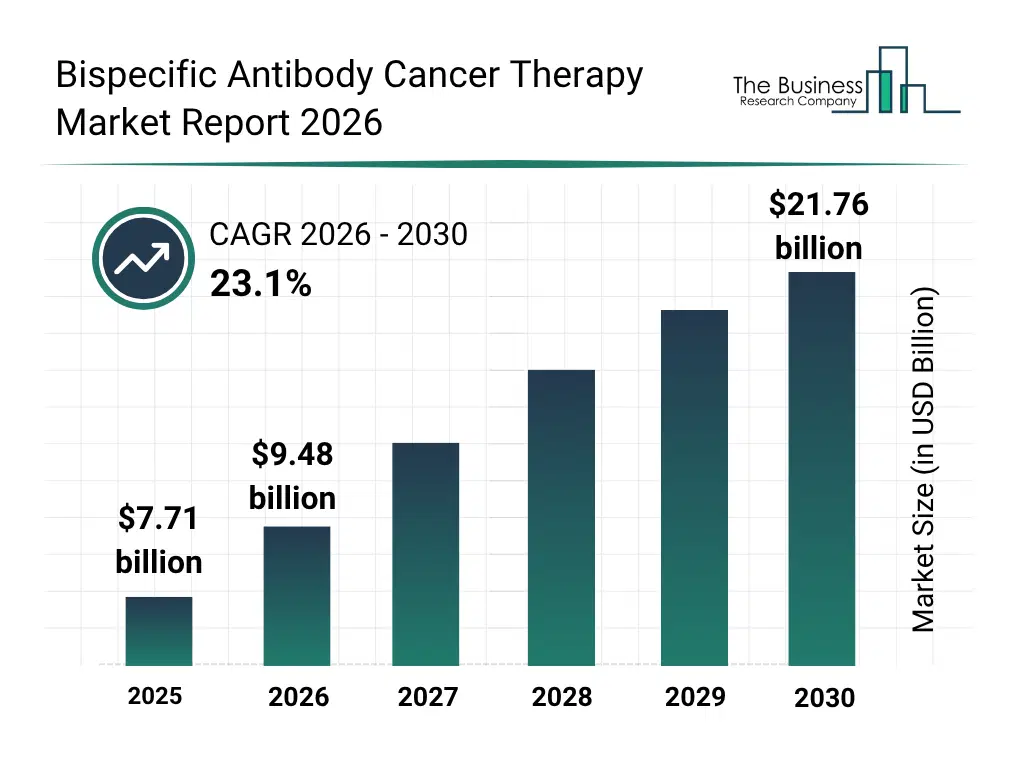
What Is The Bispecific Antibody Cancer Therapy Market Size and Share 2026?
The bispecific antibody cancer therapy market size has grown exponentially in recent years. It will grow from $7.71 billion in 2025 to $9.48 billion in 2026 at a compound annual growth rate (CAGR) of 22.9%. The growth in the historic period can be attributed to rising incidence of cancers such as Colorectal Cancer, increasing use of monoclonal antibody therapies in oncology, growth of immune checkpoint inhibitor adoption in clinical practice, expansion of targeted cancer therapy research programs, development of early t cell engager antibody platforms.What Is The Bispecific Antibody Cancer Therapy Market Growth Forecast?
The bispecific antibody cancer therapy market size is expected to see exponential growth in the next few years. It will grow to $21.76 billion in 2030 at a compound annual growth rate (CAGR) of 23.1%. The growth in the forecast period can be attributed to increasing demand for precision immunotherapy solutions, growth in personalized oncology treatment approaches, rising investment in bispecific antibody pipeline development, expansion of combination immunotherapy regimens, advancement in next generation engineered antibody technologies for solid tumors. Major trends in the forecast period include expansion of trispecific antibody constructs for enhanced multi antigen cancer targeting, increasing adoption of dual checkpoint inhibition bispecific therapies in solid tumors, rising development of nanobody based bispecific platforms for improved tumor penetration, growth of antibody drug conjugate bispecific hybrids for precision cytotoxic delivery, advancement of personalized immuno oncology regimens using engineered T cell engager antibodies.
Global Bispecific Antibody Cancer Therapy Market Segmentation
1) By Mechanism: T Cell Engager, Natural Killer Cell Engagers, Checkpoint Inhibitor Bispecifics, Antibody Drug Conjugate Bispecific Hybrids 2) By Cancer Indication: Hematologic Malignancies, Lung Cancer, Colorectal Cancer, Prostate Cancer, Ovarian Cancer 3) By Format: Immunoglobulin G Like Bispecific, Fragment Based Bispecific T Cell Engager, Nanobody Based, Trispecific 4) By End User: Hospitals, Specialty Oncology Centers, Research And Academic Institutes, Pharmaceutical And Biotechnology Companies Subsegments: 1) By T Cell Engager: Cluster Of Differentiation 3 Redirecting Antibodies, Dual Tumor Antigen Targeting Antibodies, Immune Synapse Forming Antibodies, Hematologic Cancer Targeting Antibodies, Solid Tumor Targeting Antibodies 2) By Natural Killer Cell Engagers: Cluster Of Differentiation 16 Activating Antibodies, Natural Killer Group Receptor Targeting Antibodies, Cytokine Enhanced Natural Killer Cell Antibodies, Tumor Directed Natural Killer Cell Engagers, Innate Immune Activating Antibodies 3) By Checkpoint Inhibitor Bispecifics: Programmed Death Receptor Targeting Antibodies, Programmed Death Ligand Targeting Antibodies, Cytotoxic T Lymphocyte Associated Protein Targeting Antibodies, Lymphocyte Activation Gene Targeting Antibodies, Dual Immune Checkpoint Blocking Antibodies 4) By Antibody Drug Conjugate Bispecific Hybrids: Dual Payload Conjugated Antibodies, Targeted Cytotoxic Delivery Antibodies, Tumor Microenvironment Responsive Conjugates, Immune Activating Drug Conjugates, Multi Antigen Targeting Drug ConjugatesWhat Is The Driver Of The Bispecific Antibody Cancer Therapy Market?
The increasing prevalence of cancer is expected to propel the growth of the bispecific antibody cancer therapy market going forward. Cancer refers to the uncontrolled growth and spreads of abnormal cells in the body that can invade or destroy healthy tissue and can be developed in almost any organ or tissue and may spread to other parts of the body through the blood and lymph systems. Prevalence of cancer is rising due to an aging population, as older individuals are more likely to develop cancer, with the gradual accumulation of genetic damage and long-term exposure to risk factors over time. Bispecific antibody cancer therapy enhances cancer treatment by simultaneously binding to cancer cells and immune cells, bringing them into close proximity to activate the immune system and improve targeted destruction of tumor cells. For instance, in February 2024, according to the World Health Organization, a Switzerland-based international organization specializing in global health policy and public health initiatives, over 35 million new cancer cases are predicted in 2050, a 77% increase from the estimated 20 million cases in 2022. Therefore, the increasing prevalence of cancer is driving the growth of bispecific antibody cancer therapy industry.Key Players In The Global Bispecific Antibody Cancer Therapy Market
Major companies operating in the bispecific antibody cancer therapy market are Johnson & Johnson, F. Hoffmann-La Roche AG, Pfizer Inc., AbbVie Inc., Merck & Co. Inc., AstraZeneca PLC, Bristol-Myers Squibb Company, Sanofi S.A., GSK plc, Amgen Inc., Daiichi Sankyo Company, Regeneron Pharmaceuticals Inc., BeiGene Ltd., BioNTech SE, Jazz Pharmaceuticals plc, Genmab A/S, Summit Therapeutics Inc., Innovent Biologics Inc., Akeso Inc., NovaBridge Biosciences, Zymeworks Inc., Xencor Inc., MacroGenics Inc., Merus N.V., Compass Therapeutics Inc.Global Bispecific Antibody Cancer Therapy Market Trends and Insights
Major companies operating in the bispecific antibody cancer therapy market are focusing on developing innovative treatments, such as first-in-class bispecific T-cell engaging antibodies, to improve immune system targeting of cancer cells and address unmet needs in relapsed and refractory cancers. First-in-class bispecific T-cell engaging antibodies are novel immunotherapy drugs that simultaneously bind to cancer cells and T-cells to activate the immune system for direct tumor cell destruction, helping improve targeted cancer killing in patients with difficult-to-treat or relapsed cancers. For instance, In August 2023, Johnson & Johnson, a US-based healthcare and pharmaceutical company, received U.S. Food and Drug Administration (FDA) accelerated approval for TALVEY (talquetamab-tgvs), a first-in-class bispecific antibody therapy developed for the treatment of adult patients with relapsed or refractory multiple myeloma who have undergone multiple prior lines of therapy. TALVEY is designed to target both GPRC5D on multiple myeloma cells and CD3 on T-cells, enabling immune-mediated tumor cell destruction. The therapy is administered via subcutaneous injection and incorporates step-up dosing to manage cytokine release syndrome, a common immune-related side effect.What Are Latest Mergers And Acquisitions In The Bispecific Antibody Cancer Therapy Market?
In January 2026, Abbvie Inc., a US-based biopharmaceutical company, partnered with Remegen Co. Ltd., to develop, manufacture, and commercialize RC148, a novel investigational PD-1/VEGF-targeted bispecific antibody for advanced solid tumors. With this partnership, abbvie and remegen aim to advance a new class of cancer therapy that helps the immune system fight tumors more effectively by blocking both PD-1 and VEGF simultaneously, while exploring combination regimens with antibody-drug conjugates (adcs) across multiple solid tumors with high unmet need, including non-small cell lung cancer and colorectal cancer. Remegen Co., Ltd. is a China-based innovative biopharmaceutical company that specializes in providing RC148, a PD-1/VEGF bispecific antibody.Regional Outlook
North America was the largest region in the bispecific antibody cancer therapy market in 2025. Asia-Pacific is expected to be the fastest-growing region in the forecast period. The regions covered in this market report are Australia, Brazil, China, France, Germany, India, Indonesia, Japan, Taiwan, Russia, South Korea, UK, USA, Canada, Italy, Spain. The countries covered in this market report are Australia, Brazil, China, France, Germany, India, Indonesia, Japan, Taiwan, Russia, South Korea, UK, USA, Canada, Italy, Spain.What Defines the Bispecific Antibody Cancer Therapy Market?
The bispecific antibody cancer therapy market consists of revenues earned by entities by providing services such as research and development of bispecific antibodies, clinical trials, biologic drug development, immunotherapy design, and therapeutic innovation in oncology. The market value includes the value of related goods sold by the service provider or included within the service offering. The bispecific antibody cancer therapy market also includes sales of bispecific antibody drugs, engineered biologics, monoclonal antibody platforms, recombinant protein-based therapeutics, and associated biopharmaceutical products. Values in this market are ‘factory gate’ values, that is, the value of goods sold by the manufacturers or creators of the goods, whether to other entities (including downstream manufacturers, wholesalers, distributors, and retailers) or directly to end customers. The value of goods in this market includes related services sold by the creators of the goods.How is Market Value Defined and Measured?
The market value is defined as the revenues that enterprises gain from the sale of goods and/or services within the specified market and geography through sales, grants, or donations in terms of the currency (in USD unless otherwise specified). The revenues for a specified geography are consumption values that are revenues generated by organizations in the specified geography within the market, irrespective of where they are produced. It does not include revenues from resales along the supply chain, either further along the supply chain or as part of other products.What Key Data and Analysis Are Included in the Bispecific Antibody Cancer Therapy Market Report 2026?
The bispecific antibody cancer therapy market research report is one of a series of new reports from The Business Research Company that provides bispecific antibody cancer therapy market statistics, including bispecific antibody cancer therapy industry global market size, regional shares, competitors with a bispecific antibody cancer therapy market share, detailed bispecific antibody cancer therapy market segments, market trends and opportunities, and any further data you may need to thrive in the bispecific antibody cancer therapy industry. This bispecific antibody cancer therapy market research report delivers a complete perspective of everything you need, with an in-depth analysis of the current and future scenario of the industry.Bispecific Antibody Cancer Therapy Market Report Forecast Analysis
| Report Attribute | Details |
|---|---|
| Market Size Value In 2026 | $9.48 billion |
| Revenue Forecast In 2030 | $21.76 billion |
| Growth Rate | CAGR of 23.1% from 2026 to 2030 |
| Base Year For Estimation | 2025 |
| Actual Estimates/Historical Data | 2020-2025 |
| Forecast Period | 2026 - 2030 |
| Market Representation | Revenue in USD Billion and CAGR from 2026 to 2030 |
| Segments Covered | Mechanism, Cancer Indication, Format, End User |
| Regional Scope | Asia-Pacific, Western Europe, Eastern Europe, North America, South America, Middle East, Africa |
| Country Scope | The countries covered in the bispecific antibody cancer therapy market report are Australia, Brazil, China, France, Germany, India, Indonesia, Japan, Taiwan, Russia, South Korea, UK, USA, Canada, Italy, Spain. |
| Key Companies Profiled | Johnson & Johnson, F. Hoffmann-La Roche AG, Pfizer Inc., AbbVie Inc., Merck & Co. Inc., AstraZeneca PLC, Bristol-Myers Squibb Company, Sanofi S.A., GSK plc, Amgen Inc., Daiichi Sankyo Company, Regeneron Pharmaceuticals Inc., BeiGene Ltd., BioNTech SE, Jazz Pharmaceuticals plc, Genmab A/S, Summit Therapeutics Inc., Innovent Biologics Inc., Akeso Inc., NovaBridge Biosciences, Zymeworks Inc., Xencor Inc., MacroGenics Inc., Merus N.V., Compass Therapeutics Inc. |
| Customization Scope | Request for Customization |
| Pricing And Purchase Options | Explore Purchase Options |