
Bleaching Clay Market Report 2026
Global Outlook – By Type (Activated Bauxite, Activated Clays, Fuller's Earth), By Application (Industrial Oil, Mineral Oil And Waxes, Vegetable Oil And Animal Fats), By End-User Industry (Food And Beverage, Cosmetics And Personal Care, Chemicals, Other End-user Industries) – Market Size, Trends, Strategies, and Forecast to 2030
Bleaching Clay Market Overview
• Bleaching Clay market size has reached to $1.58 billion in 2025 • Expected to grow to $2.19 billion in 2030 at a compound annual growth rate (CAGR) of 6.6% • Growth Driver: Surging Demand For Refined Vegetable Oil Fuels Growth In The Bleaching Clay Market • Market Trend: Major Players Focus On Advanced Purification Solutions To Enhance Oil And Wax Quality • Asia-Pacific was the largest region in 2025 and North America is the fastest growing region.What Is Covered Under Bleaching Clay Market?
Bleaching clay refers to an adsorbent clay or earth, used to remove the coloring matter from liquids such as oils. It is used in various industries, including edible oils, biofuels, and paraffin wax. The main types of bleaching clay are activated bauxite, activated clays, and fuller's earth. Activated bauxite is an effective adsorbent for purifying or recreating hydrocarbons, where the natural state of bauxite is very inactive and is heat-treated to make activated bauxite. Activated bauxite is used in the petroleum industry as a drying agent for gases and organic liquids, whereas thermally activated bauxite is used to refine lubricant oils and waxes. It is used in various applications such as industrial oil, mineral oil and waxes, vegetable oil, and animal fats, by the food and beverage, cosmetics and personal care, chemicals, and other end-user industries.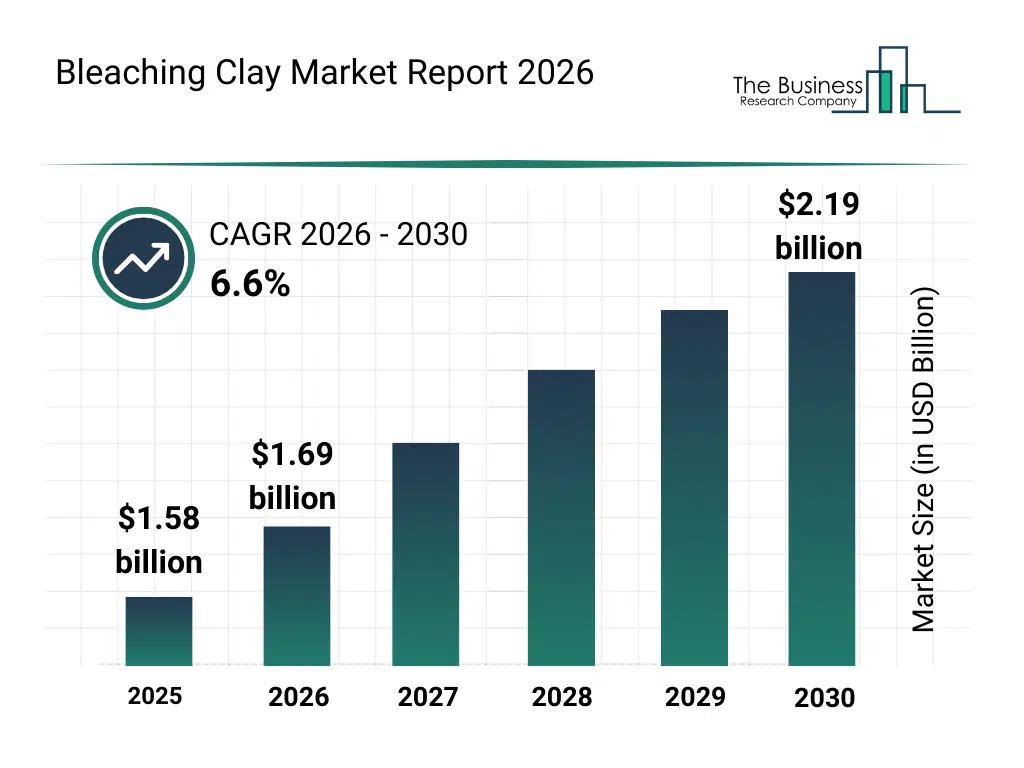
What Is The Bleaching Clay Market Size and Share 2026?
The bleaching clay market size has grown strongly in recent years. It will grow from $1.58 billion in 2025 to $1.69 billion in 2026 at a compound annual growth rate (CAGR) of 6.9%. The growth in the historic period can be attributed to growth in edible oil consumption, increasing use of vegetable oils in food processing, expansion of industrial oil refining activities, availability of natural clay reserves, advancements in clay activation processes.What Is The Bleaching Clay Market Growth Forecast?
The bleaching clay market size is expected to see strong growth in the next few years. It will grow to $2.19 billion in 2030 at a compound annual growth rate (CAGR) of 6.6%. The growth in the forecast period can be attributed to rising demand for biofuels, increasing focus on food quality and safety standards, growth of cosmetics and personal care industries, development of high-efficiency synthetic activated clays, expansion of industrial processing in emerging economies. Major trends in the forecast period include rising demand for high-purity edible oil refining, growing adoption of activated clays in industrial oils, increasing use of bleaching clay in biofuel processing, expansion of mineral oil and wax purification applications, rising focus on efficient adsorbent materials.
Global Bleaching Clay Market Segmentation
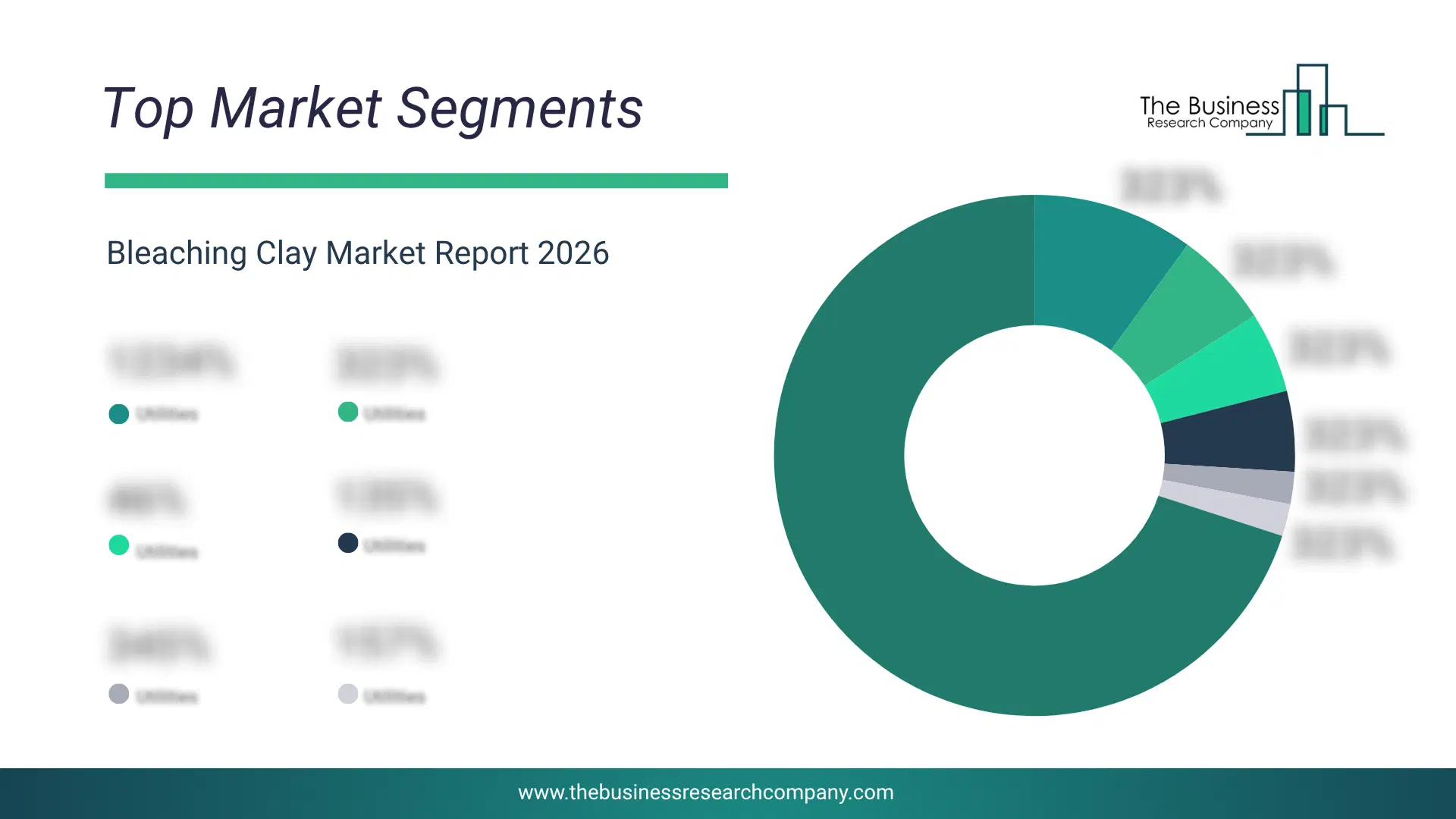
1) By Type: Activated Bauxite, Activated Clays, Fuller's Earth 2) By Application: Industrial Oil, Mineral Oil And Waxes, Vegetable Oil And Animal Fats 3) By End-User Industry: Food And Beverage, Cosmetics And Personal Care, Chemicals, Other End-user Industries Subsegments: 1) By Activated Bauxite: Calcined Bauxite, Non-Calcined Bauxite 2) By Activated Clays: Natural Activated Clays, Synthetic Activated Clays 3) By Fuller's Earth: Calcium-Based Fuller's Earth, Sodium-Based Fuller's EarthWhat Are The Drivers Of The Bleaching Clay Market?
The increasing demand for refined vegetable oil is expected to propel the bleaching clay market. Refined vegetable oil refers to vegetable oil that has been degummed, deacidified, decolored, and deodorized. Bleaching clay, primarily made of montmorillonite, is used to bleach vegetable oils as an adsorbent clay which eliminates impurities that negatively affect the appearance and functionality of these triacylglycerol-based materials to achieve the high-quality oil standards necessary for edible applications. For instance, in January 2025, according to the International Olive Oil Council, a Spain-based intergovernmental association of states that produce olives, global olive oil consumption is projected to exceed approximately 3,064,500 tonnes in the 2024/25 crop year, marking about a 10.0% increase compared to the 2023/24 crop year. Thus, increasing demand for refined vegetable oil drives the bleaching clay industry. The rise in biofuel demand is expected to propel the growth of the bleaching clay market going forward. Biofuel is a type of renewable energy derived from organic materials, such as plants, crops, or animal waste. Bleaching clay is used in biofuel production to remove impurities and colorants from biodiesel, enhancing the quality and stability of the final fuel product. For instance, in February 2024, according to the International Energy Agency (IEA), a US-based government agency, the demand for biofuel is expected to rise to 38 billion liters over the following five years and will actually increase by 23% to 200 billion liters by 2028, a nearly 30% increase over the previous five-year period. Therefore, the rise in biofuel demand is driving the bleaching clay industry.Key Players In The Global Bleaching Clay Market
Major companies operating in the bleaching clay market report are Clariant AG, Ashapura Perfoclay Limited, Oil-Dri Corporation of America, EP Minerals LLC, Refoil Earth Private Limited, Korvi Activated Earth, Sinoma Attapulgite Clay Co Ltd., Indian Clay & Mineral Co., Manek Active Clay Private Limited, 20 Microns Limited, AMCOL International Corporation, Gujarat Clay Mills Private Limited, Kutch Minerals, S&B Industrial Minerals S.A., Southern Clay Products Inc., Geohellas S.A., Ashwin Chemicals, Taiko Group of Companies, Musim Mas Holdings Pte Ltd, HRP Industries Inc., The W Clay Industries Sdn. Bhd., Kemira Oyj, Minerals Technologies Inc.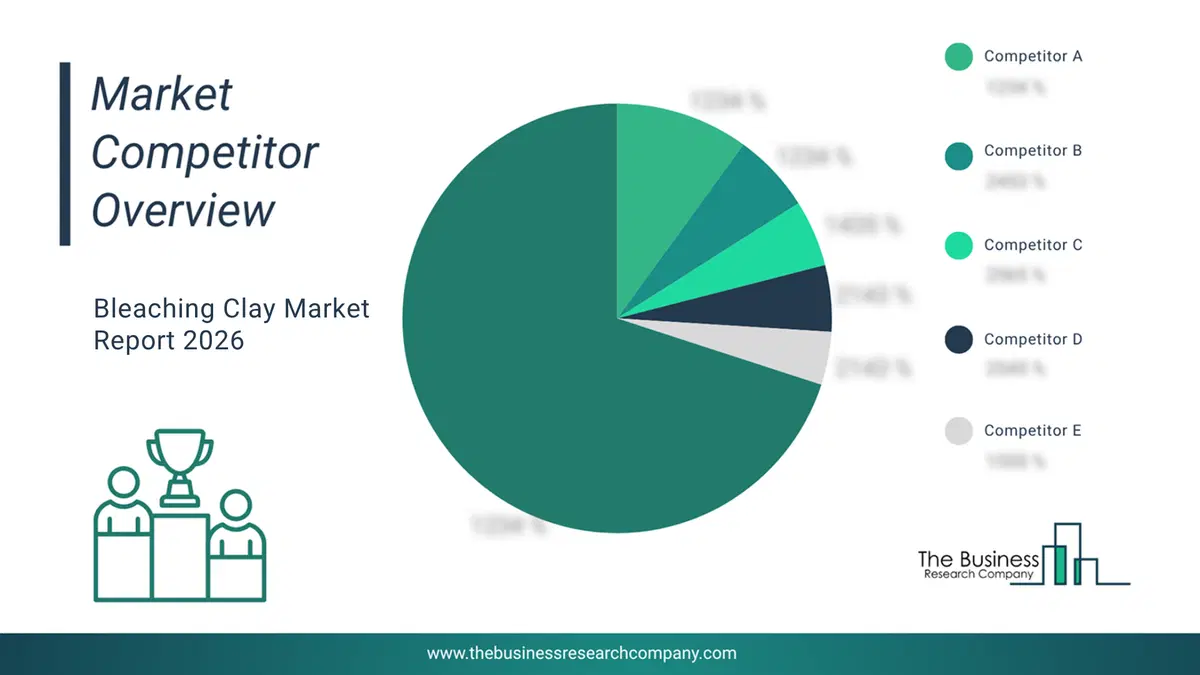
This chart is for illustrative purposes; the full report includes a detailed competitor analysis and comprehensive overview of the top 10 companies in the market.
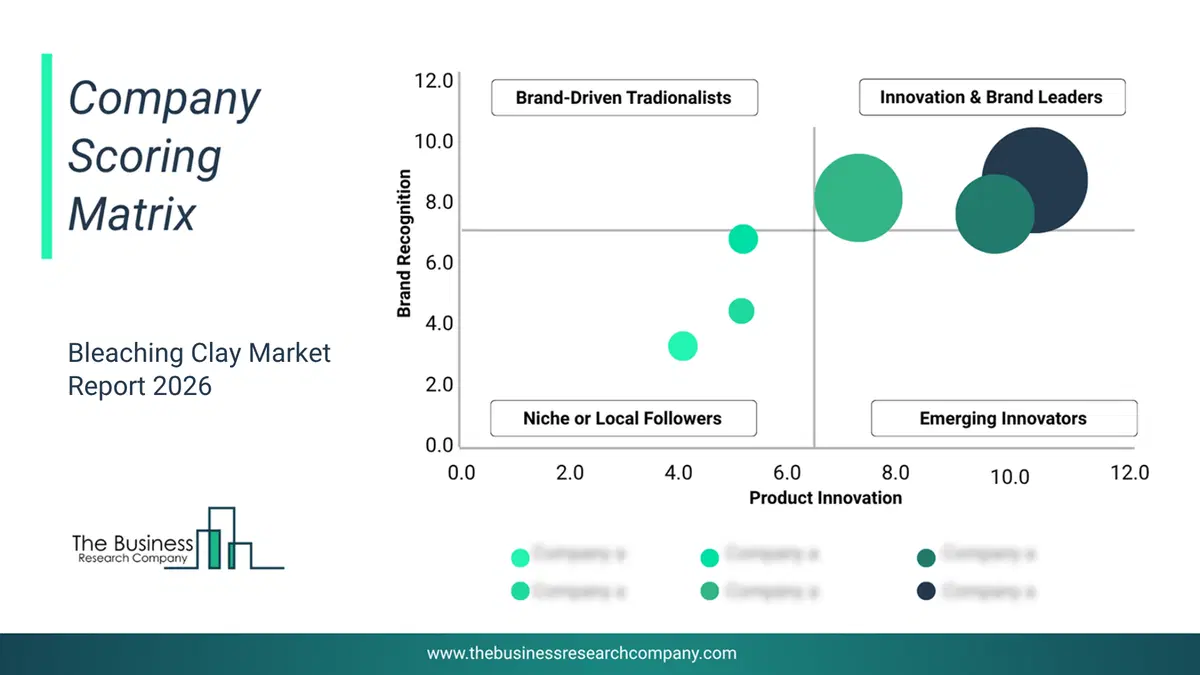
This chart maps companies by product innovation and brand strength, with bubble size indicating relative revenue, helping identify market leaders, challengers, and niche players. This is an illustrative chart; the full report provides a complete and accurate competitive analysis.
Global Bleaching Clay Market Trends and Insights
Major companies operating in the Bleaching Clay Market are focusing on developing advanced solutions such as high-efficiency purification systems to enhance oil and wax clarity and stability. High-efficiency purification involves the use of ultra-fine activated clay with a high adsorption capacity that removes impurities, pigments, and trace metals from oils and waxes, ensuring consistent product quality and operational efficiency. For instance, in 2025, Paraffin Vaseline Pure Plus Company, an Iran-based company, launched UltraPure 75 Bleaching Earth featuring advanced oil and wax purification technology. The product is engineered for industrial-scale refinement of edible oils, industrial lubricants, and cosmetic-grade waxes. It delivers crystal-clear results by removing chlorophyll, carotenoids, oxidation byproducts, and heavy metals without compromising product integrity. UltraPure 75 is available in multilayer moisture-resistant bags suitable for private labeling and international shipping. It supports bulk buyers, exporters, and distributors with fast delivery, scalable supply, competitive pricing, and full export documentation. The clay’s high adsorption capacity reduces the need for secondary filtration, improving production efficiency and lowering operational costs. Proven performance in batch and continuous systems makes it ideal for manufacturers in food, pharmaceutical, and chemical sectors.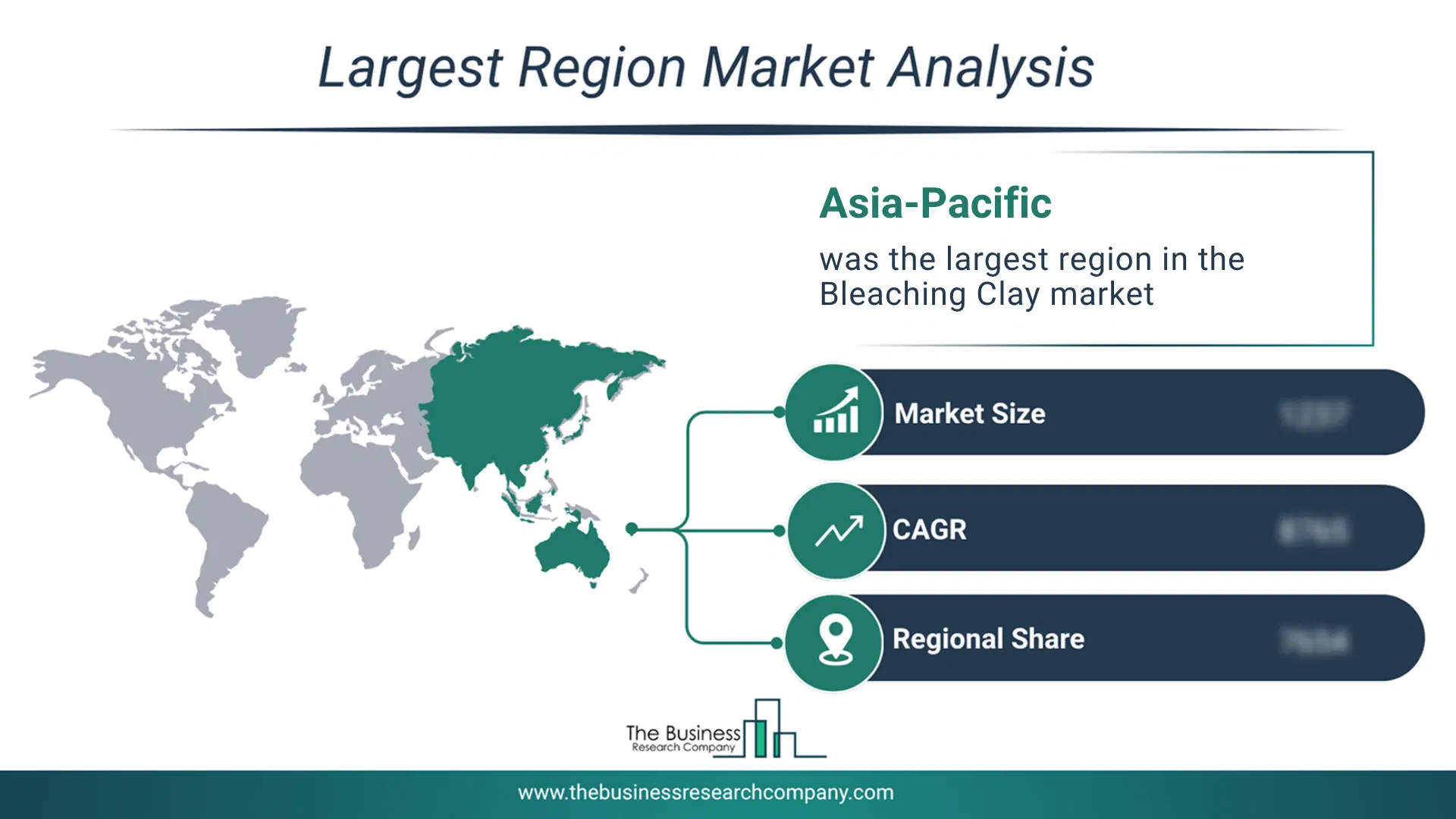
Regional Outlook
Asia-Pacific was the largest region in the bleaching clay market share in 2025. North America was the second-largest region in the bleaching clay market analysis. The regions covered in the bleaching clay market are Asia-Pacific, South East Asia, Western Europe, Eastern Europe, North America, South America, Middle East, Africa. The countries covered in the bleaching clay market are Australia, Brazil, China, France, Germany, India, Indonesia, Japan, Taiwan, Russia, South Korea, UK, USA, Canada, Italy, Spain.What Defines the Bleaching Clay Market?
The bleaching clay market consists of sales of natural and activated bleaching clays. Values in this market are ‘factory gate’ values, that is the value of goods sold by the manufacturers or creators of the goods, whether to other entities (including downstream manufacturers, wholesalers, distributors, and retailers) or directly to end customers. The value of goods in this market includes related services sold by the creators of the goods.How is Market Value Defined and Measured?
The market value is defined as the revenues that enterprises gain from the sale of goods and/or services within the specified market and geography through sales, grants, or donations in terms of the currency (in USD unless otherwise specified). The revenues for a specified geography are consumption values that are revenues generated by organizations in the specified geography within the market, irrespective of where they are produced. It does not include revenues from resales along the supply chain, either further along the supply chain or as part of other products.
This chart presents market attractiveness based on a quantitative evaluation of growth, competition, strategic alignment, and risk, offering a clear view of opportunity areas for decision-making. This chart is for illustrative purposes; the full report contains the complete analysis.

This chart highlights the Total Addressable Market (TAM) by estimating the maximum revenue opportunity using an assumption-driven approach, supporting strategic planning and opportunity sizing across markets. The chart is illustrative; the full report provides a more comprehensive analysis.
What Key Data and Analysis Are Included in the Bleaching Clay Market Report 2026?
The bleaching clay market research report is one of a series of new reports from The Business Research Company that provides market statistics, including Market Report 2026?global market size, regional shares, competitors with the market share, detailed market segments, market trends and opportunities, and any further data you may need to thrive in the bleaching clay Market Report 2026? The market research report delivers a complete perspective of everything you need, with an in-depth analysis of the current and future state of the Market Report 2026?Bleaching Clay Market Report Forecast Analysis
| Report Attribute | Details |
|---|---|
| Market Size Value In 2026 | $1.69 billion |
| Revenue Forecast In 2030 | $2.19 billion |
| Growth Rate | CAGR of 6.9% from 2026 to 2030 |
| Base Year For Estimation | 2025 |
| Actual Estimates/Historical Data | 2020-2025 |
| Forecast Period | 2026 - 2030 |
| Market Representation | Revenue in USD Billion and CAGR from 2026 to 2030 |
| Segments Covered | Type, Application, End-User Industry |
| Regional Scope | Asia-Pacific, Western Europe, Eastern Europe, North America, South America, Middle East, Africa |
| Country Scope | The countries covered in the report are Australia, Brazil, China, France, Germany, India, Indonesia, Japan, Taiwan, Russia, South Korea, UK, USA, Canada, Italy, Spain. |
| Key Companies Profiled | Clariant AG, Ashapura Perfoclay Limited, Oil-Dri Corporation of America, EP Minerals LLC, Refoil Earth Private Limited, Korvi Activated Earth, Sinoma Attapulgite Clay Co Ltd., Indian Clay & Mineral Co., Manek Active Clay Private Limited, 20 Microns Limited, AMCOL International Corporation, Gujarat Clay Mills Private Limited, Kutch Minerals, S&B Industrial Minerals S.A., Southern Clay Products Inc., Geohellas S.A., Ashwin Chemicals, Taiko Group of Companies, Musim Mas Holdings Pte Ltd, HRP Industries Inc., The W Clay Industries Sdn. Bhd., Kemira Oyj, Minerals Technologies Inc. |
| Customization Scope | Request for Customization |
| Pricing And Purchase Options | Explore Purchase Options |