
Blockchain In Telecom Market Report 2026
Global Outlook – By Deployment Type (On-Premise, Cloud-Based), By Provider (Application Providers, Middleware Providers, Infrastructure Providers), By Organization Size (Small And Medium-Sized Enterprises, Large Enterprises), By Application (Identity Management, Payment And Billing, Smart Contract, Connectivity Provisioning, Other Applications) – Market Size, Trends, Strategies, and Forecast to 2030
Blockchain In Telecom Market Overview
• Blockchain In Telecom market size has reached to $2.5 billion in 2025 • Expected to grow to $14.66 billion in 2030 at a compound annual growth rate (CAGR) of 42.2% • Growth Driver: Surge In Digitization Of Telecom Sector Fueling The Growth Of The Market Due To Enhancing Connectivity Efficiency And Demand For Secure Automation • Market Trend: Enhancing Security And Transparency In Telecommunications With Blockchain • North America was the largest region in 2025 and Asia-Pacific is the fastest growing region.What Is Covered Under Blockchain In Telecom Market?
Blockchain in telecommunication (telecom) is a decentralized ledger technology that enhances security, transparency, and efficiency in telecommunications operations. It uses smart contracts and strong encryption to prevent fraud, simplify billing between carriers, and manage user identities safely. This technology builds trust, lowers costs, and improves the overall performance of telecom services. The main deployment types of blockchain in telecommunications (telecom) are on-premise and cloud-based. On-premise deployment installs and runs blockchain applications on a company’s infrastructure, ensuring full control over security, compliance, and data governance. It is provided by various providers such as application providers, middleware providers, and infrastructure providers for several organization sizes, including small and medium-sized enterprises and large enterprises, for various applications such as identity management, payment and billing, smart contracts, connectivity provisioning, and others.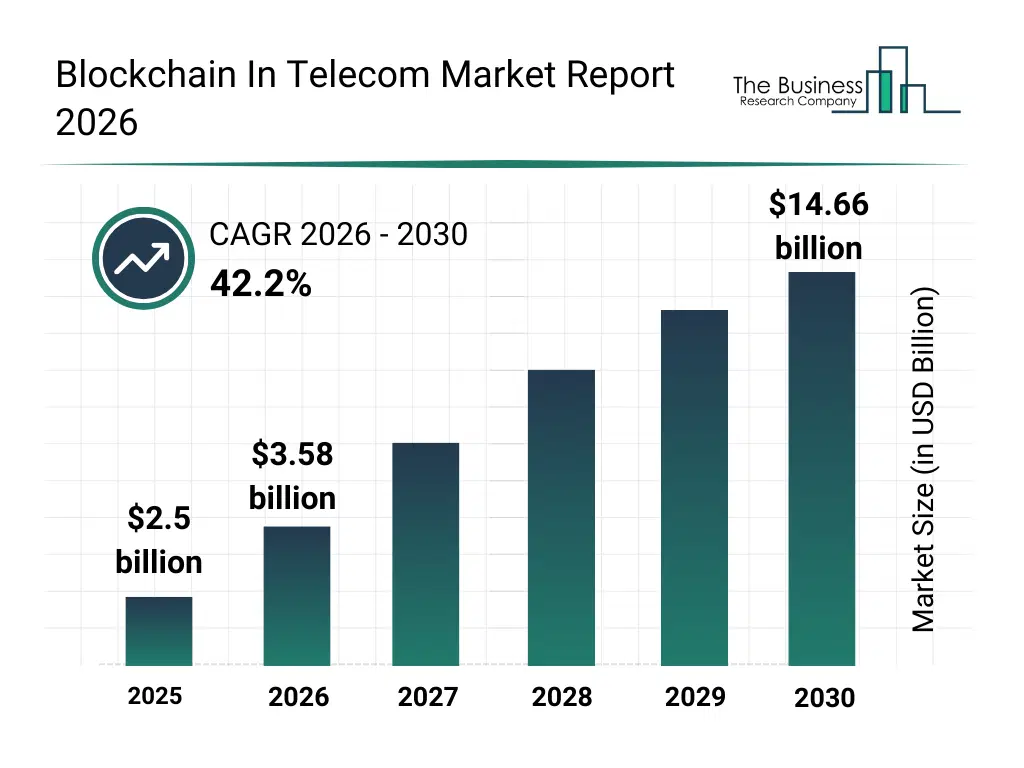
What Is The Blockchain In Telecom Market Size and Share 2026?
The blockchain in telecom market size has grown exponentially in recent years. It will grow from $2.5 billion in 2025 to $3.58 billion in 2026 at a compound annual growth rate (CAGR) of 43.0%. The growth in the historic period can be attributed to telecom fraud incidents, complexity of inter carrier settlements, early blockchain proof of concepts, increasing digital identity needs, growth in telecom data volumes.What Is The Blockchain In Telecom Market Growth Forecast?
The blockchain in telecom market size is expected to see exponential growth in the next few years. It will grow to $14.66 billion in 2030 at a compound annual growth rate (CAGR) of 42.2%. The growth in the forecast period can be attributed to 5G network expansion, increasing IoT connectivity, demand for automated settlements, regulatory compliance pressure, adoption of decentralized security frameworks. Major trends in the forecast period include blockchain based identity management, smart contract driven billing systems, fraud prevention through distributed ledgers, decentralized roaming settlement, secure telecom data sharing.
Global Blockchain In Telecom Market Segmentation
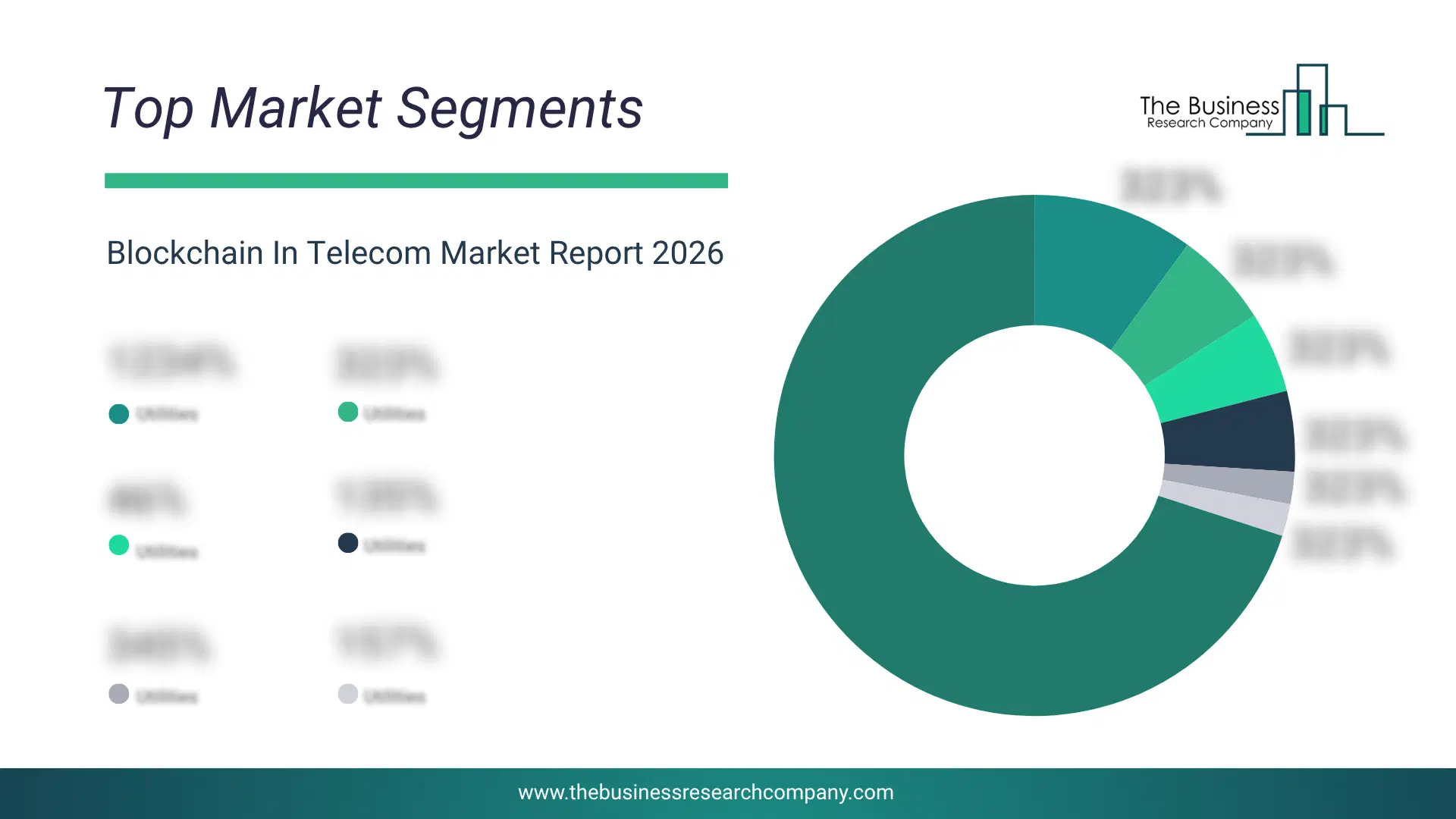
1) By Deployment Type: On-Premise, Cloud-Based 2) By Provider: Application Providers, Middleware Providers, Infrastructure Providers 3) By Organization Size: Small And Medium-Sized Enterprises, Large Enterprises 4) By Application: Identity Management, Payment And Billing, Smart Contract, Connectivity Provisioning, Other Applications Subsegments: 1) By On-Premise: Private Blockchain Infrastructure, Internal Data Center Integration, Customized Security Protocols, Dedicated Hardware And Network Infrastructure 2) By Cloud-Based: Public Cloud, Private Cloud, Hybrid Cloud, Blockchain-As-A-Service (BaaS)What Is The Driver Of The Blockchain In Telecom Market?
The growth in digitization of the telecom sector is expected to propel the growth of the blockchain in telecom market going forward. Digitization of telecom refers to the transformation of traditional communication networks into digital systems, enabling faster, more efficient, and data-driven services. The digitization of the telecom sector is driven by increasing demand for high-speed data, as users seek seamless connectivity for streaming, remote work, and digital services. Telecom digitization boosts blockchain adoption by enhancing security, transparency, and automation. With 5G, IoT, and smart contracts, blockchain streamlines billing, identity management, and data security, driving a more efficient telecom ecosystem. For instance, in June 2024, according to Ericsson, a Sweden-based company specializing in networking and telecommunications, the global 5G population coverage outside mainland China is projected to increase significantly, rising from 40% at the end of 2023 to 80% by the close of 2029. Therefore, growth in the digitization of the telecom sector is driving the growth of the blockchain in telecom industry.Key Players In The Global Blockchain In Telecom Market
Major companies operating in the blockchain in telecom market are Microsoft Corporation, Verizon Communications Inc., Deutsche Telekom AG, Huawei Technologies Co. Ltd., Deloitte Touche Tohmatsu Limited (Deloitte), Accenture plc, Orange S.A., Oracle Corporation, Nokia Corporation, British Telecommunications Group, Ericsson, Infosys Limited, Bharti Airtel Limited, Telstra Corporation Limited, Wipro Limited, Cegeka Group, Sigma Telecom LLC, Subex Limited, Zeeve Inc., TBCASoft Inc., Webisoft.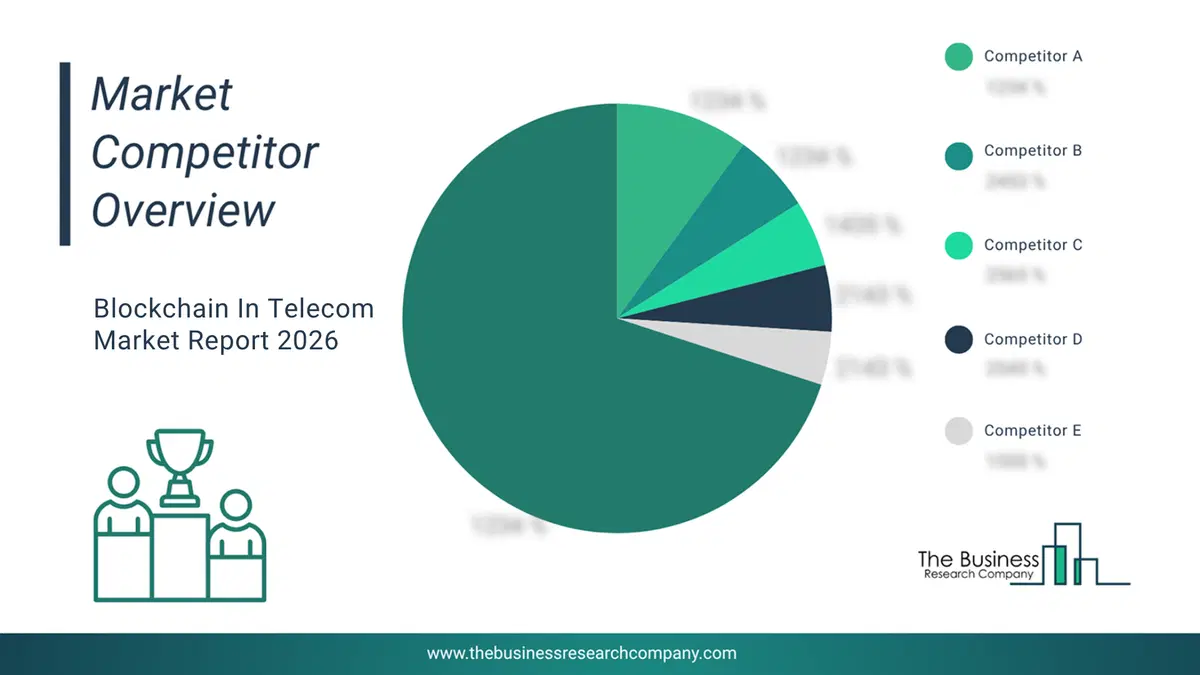
This chart is for illustrative purposes; the full report includes a detailed competitor analysis and comprehensive overview of the top 10 companies in the market.
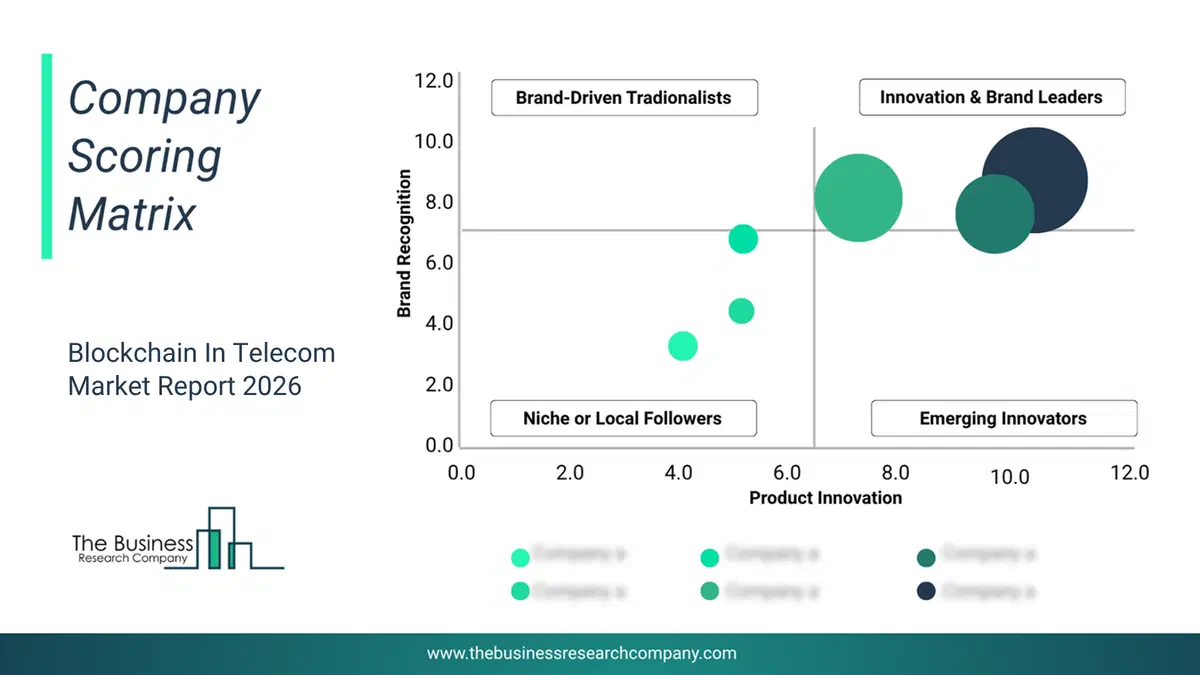
This chart maps companies by product innovation and brand strength, with bubble size indicating relative revenue, helping identify market leaders, challengers, and niche players. This is an illustrative chart; the full report provides a complete and accurate competitive analysis.
Global Blockchain In Telecom Market Trends and Insights
Major companies operating in the blockchain in telecom market are developing strategic partnerships to enhance security, transparency, and efficiency in telecommunications operations. A strategic partnership is a cooperative agreement between organizations to utilize each other’s strengths for mutual growth and competitive edge. It enables businesses to expand markets, share resources, drive innovation, and achieve long-term goals while remaining independent. For instance, in January 2025, Jio Platforms, an India-based technology company, partnered with Polygon Protocols, an India-based blockchain platform for application development, to launch Web3 blockchain solutions in India. This collaboration aims to integrate Web3 capabilities into JPL's existing applications and services, enhancing digital experiences for Jio's over 450 million customers. By leveraging Polygon's advanced blockchain technology, Jio seeks to offer innovative services that provide users with greater control over their data and access to decentralized applications. This partnership marks a significant milestone in Jio's journey towards digital excellence.What Are Latest Mergers And Acquisitions In The Blockchain In Telecom Market?
In June 2024, zenGate, an Ireland-based technology company, partnered with Minutes Network to revolutionize commodity and telecommunications trading with blockchain transparency. This collaboration aims to tokenize telecommunications minutes while leveraging the Palmyra Platform's blockchain infrastructure to improve transparency and efficiency in commodity trading. Minutes Network is a UK-based provider of blockchain-based telecommunications services.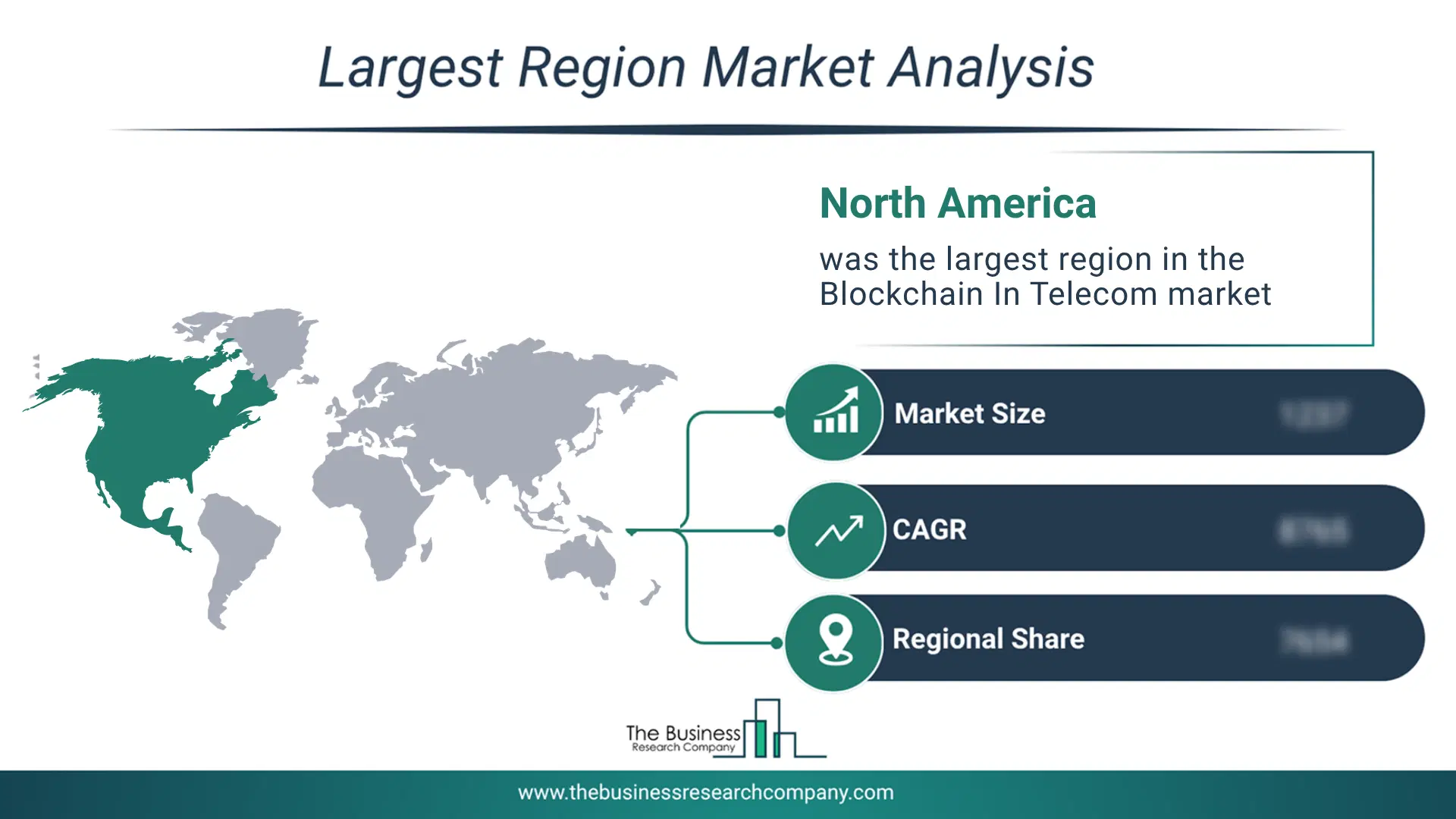
Regional Insights
North America was the largest region in the blockchain in telecom market in 2025. Asia-Pacific is expected to be the fastest-growing region in the forecast period. The regions covered in this market report are Asia-Pacific, South East Asia, Western Europe, Eastern Europe, North America, South America, Middle East, Africa. The countries covered in this market report are Australia, Brazil, China, France, Germany, India, Indonesia, Japan, Taiwan, Russia, South Korea, UK, USA, Canada, Italy, Spain.What Defines the Blockchain In Telecom Market?
The blockchain in telecom market consists of revenues earned by entities by providing services such as roaming and inter-carrier settlement, network management and optimization, supply chain management, and customer data management and privacy. The market value includes the value of related goods sold by the service provider or included within the service offering. The blockchain in telecom market also includes sales of blockchain nodes, cryptographic hardware modules, edge computing devices, and mining rigs. Values in this market are ‘factory gate’ values, that is, the value of goods sold by the manufacturers or creators of the goods, whether to other entities (including downstream manufacturers, wholesalers, distributors, and retailers) or directly to end customers. The value of goods in this market includes related services sold by the creators of the goods.How is Market Value Defined and Measured?
The market value is defined as the revenues that enterprises gain from the sale of goods and/or services within the specified market and geography through sales, grants, or donations in terms of the currency (in USD unless otherwise specified). The revenues for a specified geography are consumption values that are revenues generated by organizations in the specified geography within the market, irrespective of where they are produced. It does not include revenues from resales along the supply chain, either further along the supply chain or as part of other products.
This chart presents market attractiveness based on a quantitative evaluation of growth, competition, strategic alignment, and risk, offering a clear view of opportunity areas for decision-making. This chart is for illustrative purposes; the full report contains the complete analysis.

This chart highlights the Total Addressable Market (TAM) by estimating the maximum revenue opportunity using an assumption-driven approach, supporting strategic planning and opportunity sizing across markets. The chart is illustrative; the full report provides a more comprehensive analysis.
What Key Data and Analysis Are Included in the Blockchain In Telecom Market Report 2026?
The blockchain in telecom market research report is one of a series of new reports from The Business Research Company that provides market statistics, including industry global market size, regional shares, competitors with the market share, detailed market segments, market trends and opportunities, and any further data you may need to thrive in the blockchain in telecom industry. The market research report delivers a complete perspective of everything you need, with an in-depth analysis of the current and future state of the industry.Blockchain In Telecom Market Report Forecast Analysis
| Report Attribute | Details |
|---|---|
| Market Size Value In 2026 | $3.58 billion |
| Revenue Forecast In 2030 | $14.66 billion |
| Growth Rate | CAGR of 42.2% from 2026 to 2030 |
| Base Year For Estimation | 2025 |
| Actual Estimates/Historical Data | 2020-2025 |
| Forecast Period | 2026 - 2030 |
| Market Representation | Revenue in USD Billion and CAGR from 2026 to 2030 |
| Segments Covered | Deployment Type, Provider, Organization Size, Application |
| Regional Scope | Asia-Pacific, Western Europe, Eastern Europe, North America, South America, Middle East, Africa |
| Country Scope | The Countries Covered In This Market Report Are Australia, Brazil, China, France, Germany, India, Indonesia, Japan, Taiwan, Russia, South Korea, Uk, Usa, Canada, Italy, Spain. |
| Key Companies Profiled | Microsoft Corporation, Verizon Communications Inc., Deutsche Telekom AG, Huawei Technologies Co. Ltd., Deloitte Touche Tohmatsu Limited (Deloitte), Accenture plc, Orange S.A., Oracle Corporation, Nokia Corporation, British Telecommunications Group, Ericsson, Infosys Limited, Bharti Airtel Limited, Telstra Corporation Limited, Wipro Limited, Cegeka Group, Sigma Telecom LLC, Subex Limited, Zeeve Inc., TBCASoft Inc., Webisoft. |
| Customization Scope | Request for Customization |
| Pricing And Purchase Options | Explore Purchase Options |