
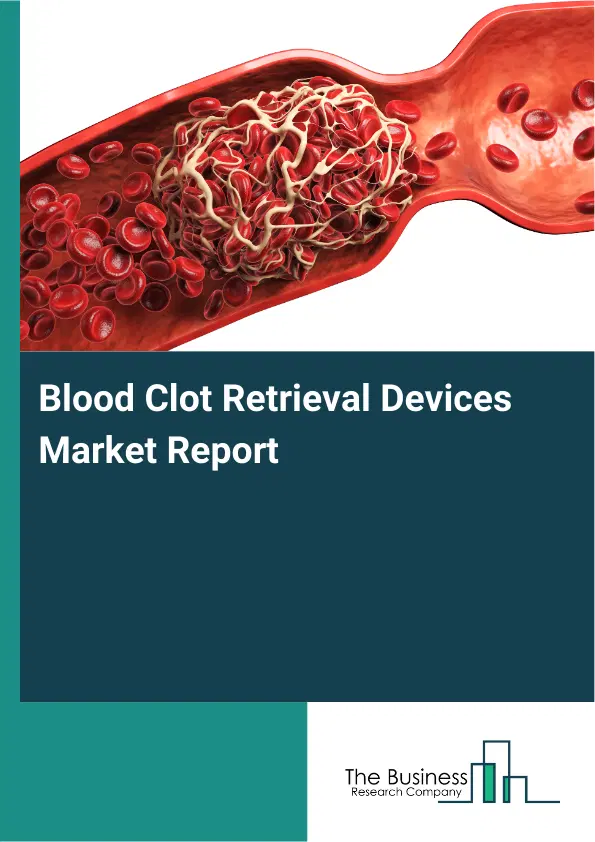
Blood Clot Retrieval Devices Market Report 2026
Global Outlook – By Device Type (Mechanical Embolus Removal Device, Penumbra Blood Clot Retrieval Devices, Stent Retrievers, Aspiration Device, Ultrasound Assisted Devices), By Technology (Mechanical Thrombectomy, Chemical Thrombectomy, Ultrasound-Assisted Thrombectomy, Laser-Assisted Thrombectomy), By Stroke Type (Ischemic Stroke, Pulmonary Embolism, Deep Vein Thrombosis, Transient Ischemic Attack, Other Stroke Types), By Application (Coronary Arteries, Peripheral Arteries, Cerebral Arteries), By End-User (Hospitals, Diagnostic Centers, Specialty Clinics, Ambulatory Surgical Centers, Other End Users) – Market Size, Trends, Strategies, and Forecast to 2030
Blood Clot Retrieval Devices Market Overview
• Blood Clot Retrieval Devices market size has reached to $2.37 billion in 2025 • Expected to grow to $5.25 billion in 2030 at a compound annual growth rate (CAGR) of 17.2% • Growth Driver: Rising Stroke Incidences Drive Demand For Blood Clot Retrieval Devices Due To Aging Population And Increasing Cardiovascular Risks • Market Trend: Next-Generation Dual-Mechanism Thrombectomy Systems Improve Clot Removal And Reduce Complications • North America was the largest region in 2025 and Asia Pacific is the fastest growing region.What Is Covered Under Blood Clot Retrieval Devices Market?
Blood clot retrieval devices are specialized medical tools designed to remove blood clots from blood vessels, particularly in cases of ischemic stroke. These devices help restore normal blood flow by mechanically capturing and extracting the clot. They are typically used in emergency procedures to reduce brain damage and improve patient outcomes. The main types of blood clot retrieval devices include mechanical embolus removal devices, Penumbra blood clot retrieval devices, stent retrievers, aspiration devices, and ultrasound-assisted devices. A mechanical embolus removal device is a minimally invasive tool that physically extracts blood clots from vessels to rapidly restore blood flow. These devices use various technologies, including mechanical thrombectomy, chemical thrombectomy, ultrasound-assisted thrombectomy, and laser-assisted thrombectomy. They are primarily used to treat conditions such as ischemic stroke, hemorrhagic stroke, pulmonary embolism, deep vein thrombosis, transient ischemic attack, and other types of strokes. Applications include coronary arteries, peripheral arteries, and cerebral arteries, with end users such as hospitals, diagnostic centers, specialty clinics, ambulatory surgical centers, and other healthcare facilities.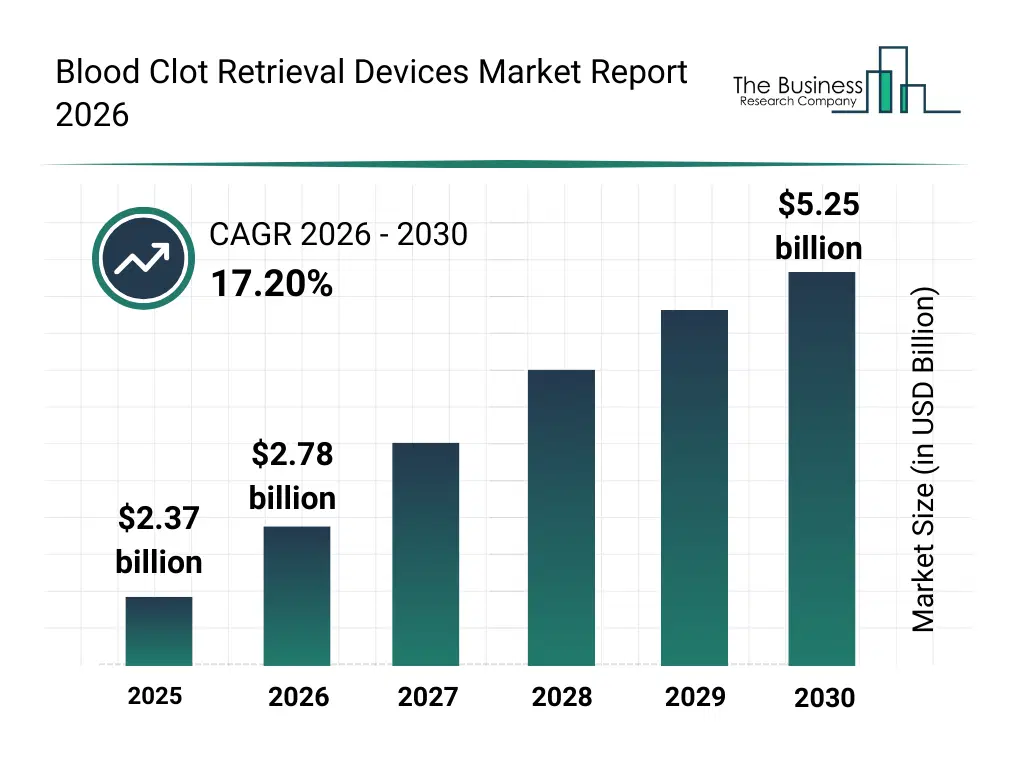
What Is The Blood Clot Retrieval Devices Market Size and Share 2026?
The blood clot retrieval devices market size has grown rapidly in recent years. It will grow from $2.37 billion in 2025 to $2.78 billion in 2026 at a compound annual growth rate (CAGR) of 17.5%. The growth in the historic period can be attributed to high incidence of ischemic stroke, limited treatment options, conventional thrombectomy limitations, lack of portable devices, low adoption of imaging-guided procedures.What Is The Blood Clot Retrieval Devices Market Growth Forecast?
The blood clot retrieval devices market size is expected to see rapid growth in the next few years. It will grow to $5.25 billion in 2030 at a compound annual growth rate (CAGR) of 17.2%. The growth in the forecast period can be attributed to adoption of ai-assisted devices, growth of minimally invasive techniques, integration of real-time imaging, development of portable thrombectomy systems, expansion of specialty stroke centers globally. Major trends in the forecast period include AI-assisted thrombectomy systems, development of minimally invasive devices, enhanced catheter and stent technology, real-time imaging integration, portable blood clot removal solutions.
Global Blood Clot Retrieval Devices Market Segmentation
1) By Device Type: Mechanical Embolus Removal Device, Penumbra Blood Clot Retrieval Devices, Stent Retrievers, Aspiration Device, Ultrasound Assisted Devices 2) By Technology: Mechanical Thrombectomy, Chemical Thrombectomy, Ultrasound-Assisted Thrombectomy, Laser-Assisted Thrombectomy 3) By Stroke Type: Ischemic Stroke, Pulmonary Embolism, Deep Vein Thrombosis, Transient Ischemic Attack, Other Stroke Types 4) By Application: Coronary Arteries, Peripheral Arteries, Cerebral Arteries 5) By End-User: Hospitals, Diagnostic Centers, Specialty Clinics, Ambulatory Surgical Centers, Other End Users Subsegments: 1) By Mechanical Embolus Removal Device: Rotational Thrombectomy Systems, Suction Based Systems, Rheolytic Thrombectomy Systems 2) By Penumbra Blood Clot Retrieval Devices: Aspiration Systems, Separator Devices, Reperfusion Catheters 3) By Stent Retrievers: Self Expanding Stent Retrievers, Retrievable Stent Systems, Balloon Expandable Stent Retrievers 4) By Aspiration Device: Large Bore Aspiration Catheters, Vacuum Assisted Aspiration Systems, Manual Aspiration Syringe Systems 6) By Ultrasound Assisted Devices: External Ultrasound Assisted Thrombolysis Systems, Catheter Directed Ultrasound Assisted Systems, Portable Ultrasound Assisted DevicesWhat Is The Driver Of The Blood Clot Retrieval Devices Market?
The rising incidences of stroke are expected to propel the growth of the blood clot retrieval devices market going forward. Stroke refers to a medical condition in which the blood supply to a part of the brain is interrupted or reduced, preventing brain tissue from getting oxygen and nutrients. The rise in strokes is driven by an aging population, as older adults face higher risks of hypertension and vascular conditions that contribute to stroke incidence. Blood clot retrieval devices help stroke patients by rapidly removing obstructive clots from brain arteries, restoring blood flow and reducing the risk of long-term disability. For instance, in May 2024, according to the Centers for Disease Control and Prevention, a US-based government agency, around 795,000 people in the US have a stroke each year. Therefore, the rising incidences of stroke are driving the growth of the blood clot retrieval devices industry.Key Players In The Global Blood Clot Retrieval Devices Market
Major companies operating in the blood clot retrieval devices market are Johnson & Johnson, Abbott Laboratories, Medtronic plc, Becton Dickinson and Company, Stryker Corporation, Boston Scientific Corporation, Terumo Corporation, Edwards Lifesciences Corporation, Cook Medical LLC, Merit Medical Systems Inc., Penumbra Inc., Surmodics Inc., AngioDynamics Inc., B. Braun Melsungen AG, Acandis GmbH, Phenox GmbH, Rapid Medical Ltd., Argon Medical Devices Inc., Shape Memory Medical Inc., Vesalio Inc.
This chart is for illustrative purposes; the full report includes a detailed competitor analysis and comprehensive overview of the top 10 companies in the market.
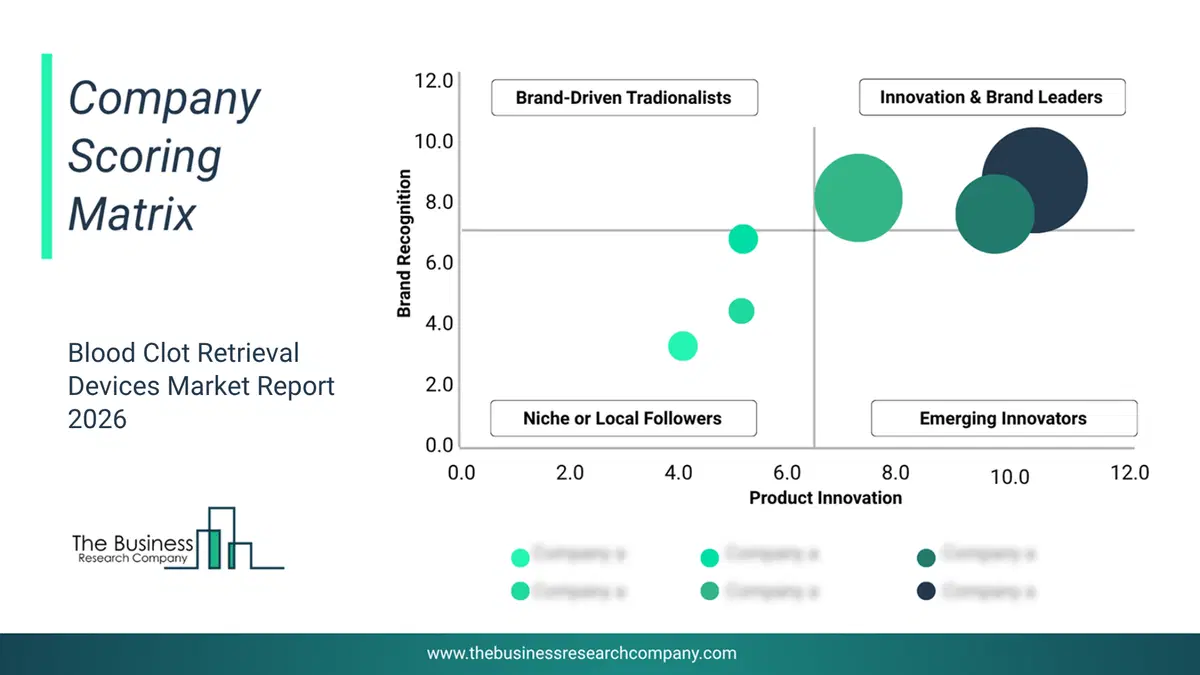
This chart maps companies by product innovation and brand strength, with bubble size indicating relative revenue, helping identify market leaders, challengers, and niche players. This is an illustrative chart; the full report provides a complete and accurate competitive analysis.
Global Blood Clot Retrieval Devices Market Trends and Insights
Major companies operating in the blood clot retrieval devices market are focusing on developing innovative solutions such as dual-mechanism thrombectomy systems to improve clot removal efficiency and reduce procedural complications. Dual-mechanism thrombectomy systems are devices that combine mechanical clot extraction and aspiration (suction) techniques in a single system, helping to remove acute-to-chronic blood clots more effectively, minimize clot migration, and reduce the need for multiple procedures. For instance, in March 2025, Inari Medical Inc., a US-based medical technologies company, launched the Artix Thrombectomy System, a dual-mechanism arterial thrombectomy device designed to address a wide spectrum of arterial clots. The system combines aspiration and mechanical clot extraction in a single procedure, featuring an over-the-wire mechanical element, a low-profile kink-resistant sheath, and a covered nitinol mesh funnel to minimize clot migration. The device is intended to provide physicians with greater procedural control and versatility, allowing for the effective removal of both acute and chronic clots while maintaining vessel access throughout the intervention.What Are Latest Mergers And Acquisitions In The Blood Clot Retrieval Devices Market?
In February 2025, Stryker, a US-based medical technology company, acquired Inari Medical for an undisclosed amount. With this acquisition, Stryker aims to strategically expand its interventional endovascular portfolio, strengthen its presence in the fast-growing peripheral vascular and venous thromboembolism (VTE) treatment market, and leverage Inari Medical’s innovative mechanical thrombectomy technologies to improve patient outcomes worldwide while complementing Stryker’s existing Neurovascular business. Inari Medical Inc. is a US-based medical technology company that specializes in providing blood clot retrieval devices.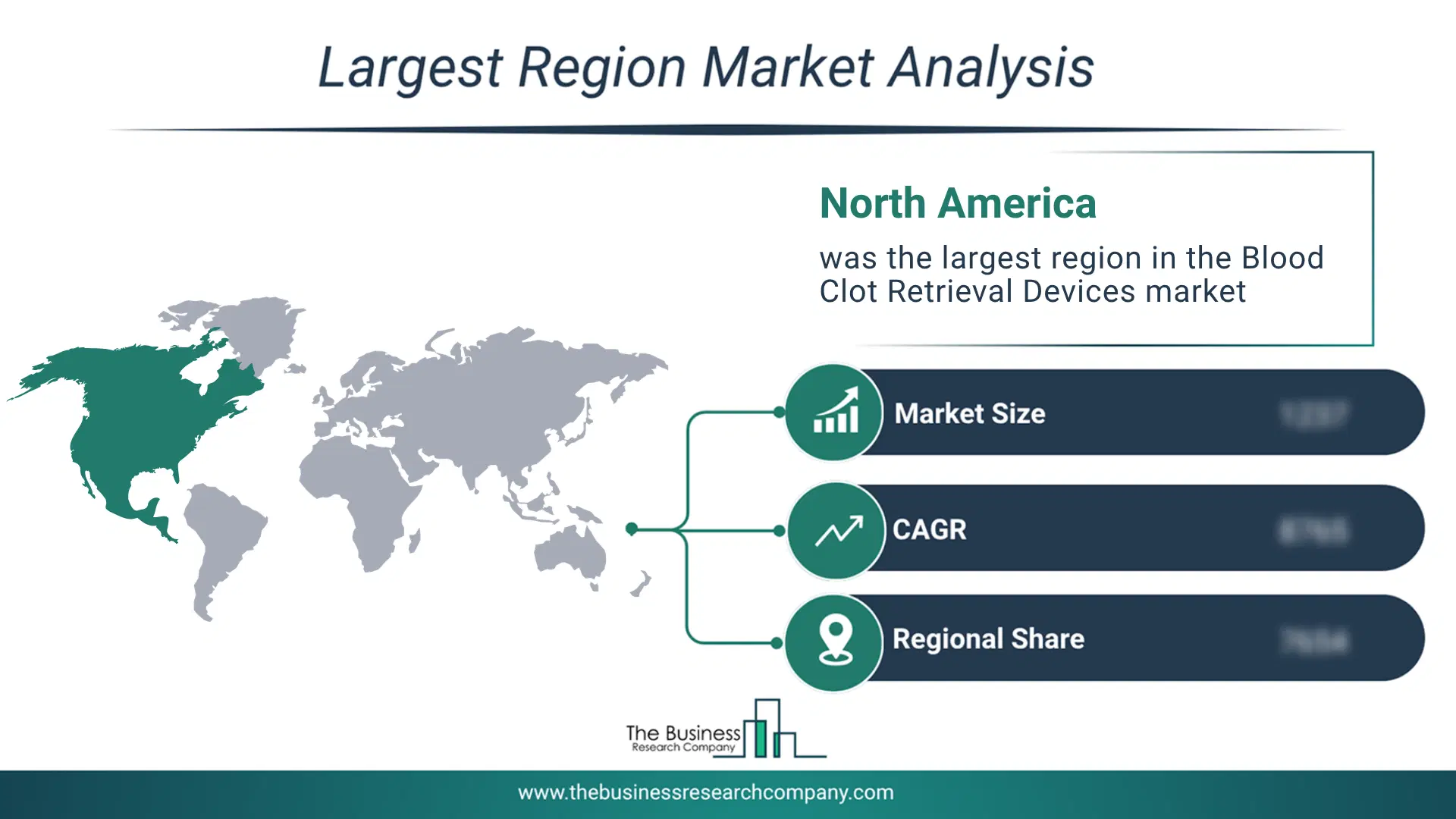
Regional Outlook
North America was the largest region in the blood clot retrieval devices market in 2025. Asia-Pacific is expected to be the fastest-growing region in the forecast period. The regions covered in this market report are Asia-Pacific, South East Asia, Western Europe, Eastern Europe, North America, South America, Middle East, Africa. The countries covered in this market report are Australia, Brazil, China, France, Germany, India, Indonesia, Japan, Taiwan, Russia, South Korea, UK, USA, Canada, Italy, SpainWhat Defines the Blood Clot Retrieval Devices Market?
The blood clot retrieval devices market consists of revenues earned by entities by providing services such as manufacturing and supplying clot retrieval devices, offering clinical training and procedural support, conducting research and technological innovation, assisting with regulatory approvals and market access. The market value includes the value of related goods sold by the service provider or included within the service offering. The blood clot retrieval devices market also includes sales of mechanical thrombectomy devices, aspiration catheters, and stent retrievers. Values in this market are ‘factory gate’ values, that is, the value of goods sold by the manufacturers or creators of the goods, whether to other entities (including downstream manufacturers, wholesalers, distributors, and retailers) or directly to end customers. The value of goods in this market includes related services sold by the creators of the goods.How is Market Value Defined and Measured?
The market value is defined as the revenues that enterprises gain from the sale of goods and/or services within the specified market and geography through sales, grants, or donations in terms of the currency (in USD unless otherwise specified). The revenues for a specified geography are consumption values that are revenues generated by organizations in the specified geography within the market, irrespective of where they are produced. It does not include revenues from resales along the supply chain, either further along the supply chain or as part of other products.
This chart presents market attractiveness based on a quantitative evaluation of growth, competition, strategic alignment, and risk, offering a clear view of opportunity areas for decision-making. This chart is for illustrative purposes; the full report contains the complete analysis.

This chart highlights the Total Addressable Market (TAM) by estimating the maximum revenue opportunity using an assumption-driven approach, supporting strategic planning and opportunity sizing across markets. The chart is illustrative; the full report provides a more comprehensive analysis.
What Key Data and Analysis Are Included in the Blood Clot Retrieval Devices Market Report 2026?
The blood clot retrieval devices market research report is one of a series of new reports from The Business Research Company that provides market statistics, including industry global market size, regional shares, competitors with the market share, detailed market segments, market trends and opportunities, and any further data you may need to thrive in the blood clot retrieval devices industry. The market research report delivers a complete perspective of everything you need, with an in-depth analysis of the current and future state of the industry.Blood Clot Retrieval Devices Market Report Forecast Analysis
| Report Attribute | Details |
|---|---|
| Market Size Value In 2026 | $2.78 billion |
| Revenue Forecast In 2030 | $5.25 billion |
| Growth Rate | CAGR of 17.2% from 2026 to 2030 |
| Base Year For Estimation | 2025 |
| Actual Estimates/Historical Data | 2020-2025 |
| Forecast Period | 2026 - 2030 |
| Market Representation | Revenue in USD Billion and CAGR from 2026 to 2030 |
| Segments Covered | Device Type, Technology, Stroke Type, Application, End-User |
| Regional Scope | Asia-Pacific, Western Europe, Eastern Europe, North America, South America, Middle East, Africa |
| Country Scope | The countries covered in the report are Australia, Brazil, China, France, Germany, India, Indonesia, Japan, Taiwan, Russia, South Korea, UK, USA, Canada, Italy, Spain. |
| Key Companies Profiled | Johnson & Johnson, Abbott Laboratories, Medtronic plc, Becton Dickinson and Company, Stryker Corporation, Boston Scientific Corporation, Terumo Corporation, Edwards Lifesciences Corporation, Cook Medical LLC, Merit Medical Systems Inc., Penumbra Inc., Surmodics Inc., AngioDynamics Inc., B. Braun Melsungen AG, Acandis GmbH, Phenox GmbH, Rapid Medical Ltd., Argon Medical Devices Inc., Shape Memory Medical Inc., Vesalio Inc. |
| Customization Scope | Request for Customization |
| Pricing And Purchase Options | Explore Purchase Options |