

Body Control Module Market Report 2026
Global Outlook – By Type ( Control Area Network (CAN) Bus, Local Interconnect Network (LIN) Bus), By Component ( Hardware, Software), By Vehicle Type ( Passenger Car, Electric Vehicle, Commercial Vehicle), By Power Distribution Components ( Relays, Fuses), By Application ( Interior, Exterior) – Market Size, Trends, Strategies, and Forecast to 2030
Body Control Module Market Overview
• Body Control Module market size has reached to $33.08 billion in 2025 • Expected to grow to $39.08 billion in 2030 at a compound annual growth rate (CAGR) of 3.5% • Growth Driver: The Impact Of IOT Technology On The Automotive Body Control Module Market • Market Trend: Innovations In Body Control Modules Transforming The Automotive Landscape • Asia-Pacific was the largest region in 2025.Market Gains By 2030 – Top Opportunities By Segment
Market Gain identifies the most promising market opportunities by highlighting the segments or products expected to generate the highest incremental revenue growth over the next five years.
What Is Covered Under Body Control Module Market?
The body control module represents a comprehensive system that coordinates and communicates all electronic module activity throughout the vehicle. They communicate with various automobile electronic control units (ECUs). The main body control module types are control area network (CAN) bus, and local interconnect network (LIN) bus. Control area network (CAN) bus refers to a message-based protocol developed to allow Electronic Control Units (ECUs) in automobiles, as well as other devices, to interact with one another in a dependable, priority-driven manner. The various components are hardware, and software, which are used in vehicle types such as passenger car, electric vehicle, and commercial vehicle. The power distribution components are relays, and fuses applied in interior, and exterior purposes.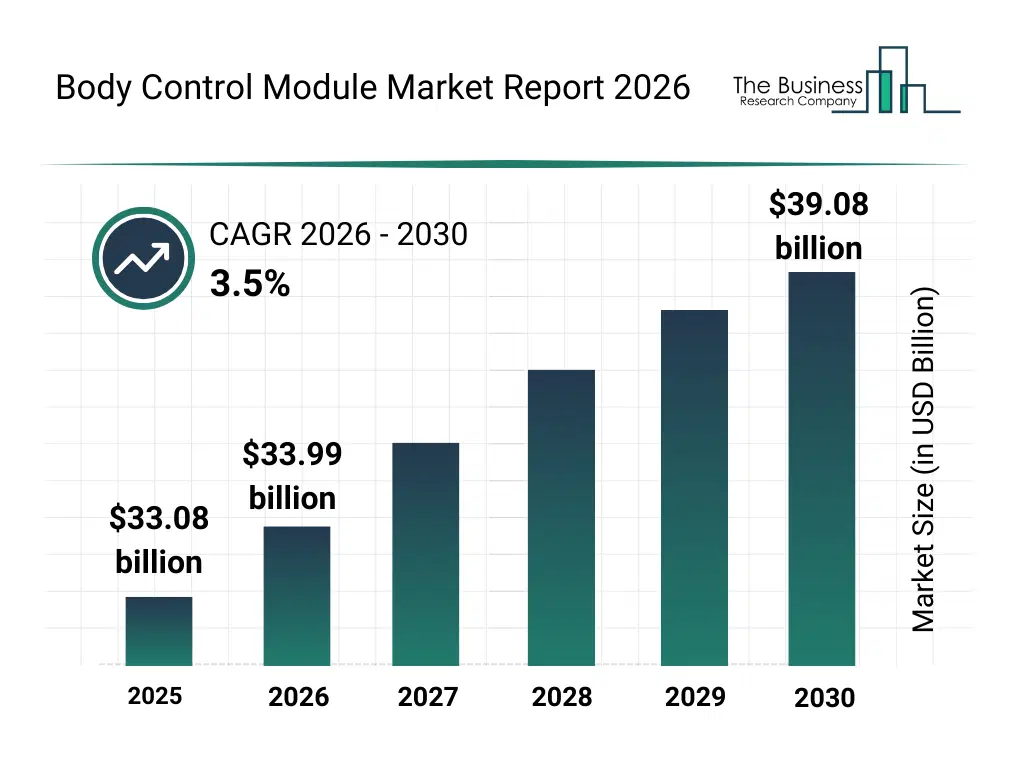
What Is The Body Control Module Market Size 2026 And Growth Rate?
The body control module market size has grown steadily in recent years. It will grow from $33.08 billion in 2025 to $33.99 billion in 2026 at a compound annual growth rate (CAGR) of 2.8%. The growth in the historic period can be attributed to early adoption in basic vehicle electronic modules, reliance on traditional relay-based control systems, expansion of distributed ecu networks, growth in interior and exterior electronics control, development of early can and lin bus platforms.What Is The Body Control Module Market Growth Forecast?
The body control module market size is expected to see steady growth in the next few years. It will grow to $39.08 billion in 2030 at a compound annual growth rate (CAGR) of 3.5%. The growth in the forecast period can be attributed to rising demand for centralized automotive electronic control, expansion of ev and smart car platforms, increasing integration of advanced driver-assist features, growth in cloud-linked bcm architectures, development of predictive maintenance-enabled control systems. Major trends in the forecast period include adoption of intelligent bcm control architectures, expansion of IoT-enabled vehicle communication systems, advancement of autonomous-ready electronic control platforms, integration of AI-based predictive vehicle diagnostics, development of cloud-connected automotive body systems.
Global Body Control Module Market Segmentation
1) By Type: Control Area Network (CAN) Bus, Local Interconnect Network (LIN) Bus 2) By Component: Hardware, Software 3) By Vehicle Type: Passenger Car, Electric Vehicle, Commercial Vehicle 4) By Power Distribution Components: Relays, Fuses 5) By Application: Interior, Exterior Subsegments: 1) By Control Area Network (CAN) Bus: High-Speed CAN, Low-Speed CAN, CAN-FD (Flexible Data Rate) 2) By Local Interconnect Network (LIN) Bus: LIN 1.3, LIN 2.0, LIN 2.1 The top segments in the body control module market will be: • Control Area Network (CAN) Bus will reach $26.09 Billion by 2030. • Local Interconnect Network (LIN) Bus will reach $13 Billion by 2030.What Is The Driver Of The Body Control Module Market?
The increasing adoption of IoT technology is expected to propel the growth of the body control module market going forward. The Internet of Things (IoT) refers to a network of interconnected physical devices, vehicles, buildings, and other objects embedded with sensors, software, and network connectivity, enabling them to collect and exchange data. The integration of IoT (Internet of Things) technology in body control modules (BCMs) within the automotive industry offers enhanced connectivity, remote monitoring, over-the-air (OTA) updates, predictive maintenance, improved security features, and allows for the customization and personalization of vehicle settings and preferences. For instance, in March 2023, according to Exploding Topics, a US-based online platform that provides insights into emerging and trending topics, by 2030, it is anticipated that there will be 25.4 billion IoT devices. Therefore, the increasing adoption of IoT technology is driving the growth of the body control module industry.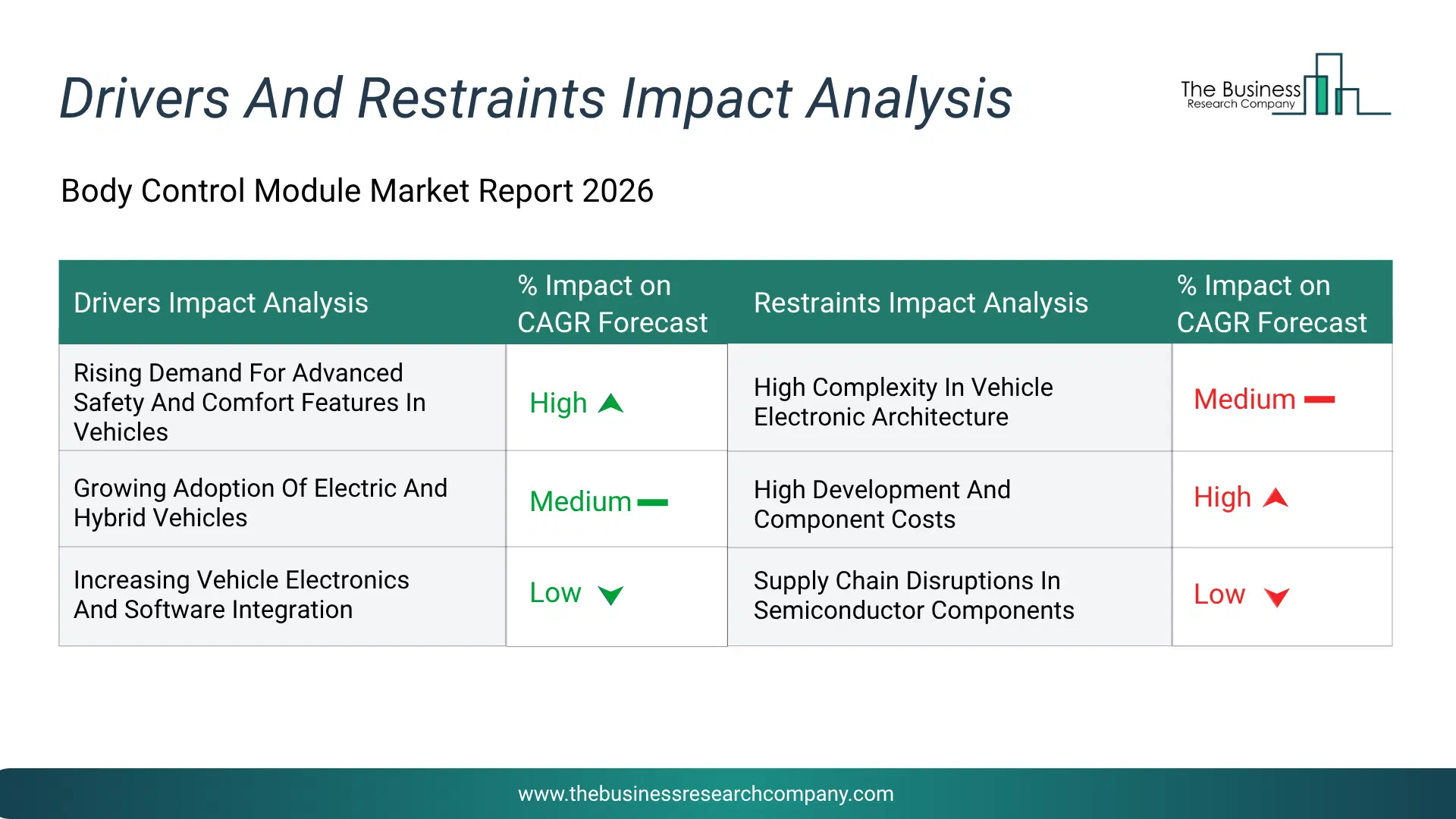
Infographic Chart Showing Key Market Drivers Analysis And Restraints For Body Control Module Market
The chart presents an impact analysis of key drivers and restraints, quantifying their relative influence on the market's growth rate and helping assess the balance between growth enablers and limiting factors. This chart offers a high-level perspective; the full report contains more detailed insights.
How Will The Drivers Impact Growth In The Global Body Control Module Market?
• Rising Demand For Advanced Safety And Comfort Features In Vehicles (High) – During the forecast period, the rising demand for advanced safety and comfort features in vehicles is expected to become a key growth driver for the body control module market by 2030. Modern vehicles are increasingly equipped with electronic features such as automatic lighting systems, power windows, smart entry systems, climate control, and centralized locking mechanisms that rely heavily on body control modules for seamless operation. Consumers are prioritizing convenience, enhanced driving experiences, and integrated vehicle functionalities, encouraging OEMs to expand electronic feature integration across both premium and mass-market vehicles. As automakers continue to develop intelligent cabin and body electronics systems, the demand for advanced body control modules is accelerating steadily. • Growing Adoption Of Electric And Hybrid Vehicles (Medium) – During the forecast period, the growing adoption of electric and hybrid vehicles is expected to emerge as a major factor driving the expansion of the body control module market by 2030. Electrified vehicles require sophisticated electronic control systems capable of managing multiple vehicle functions while optimizing energy consumption and operational efficiency. Body control modules play a critical role in coordinating lighting systems, battery-related auxiliary functions, thermal management interfaces, and electronic access systems in EV platforms. Increasing investments in vehicle electrification and the rapid introduction of next-generation electric mobility solutions are encouraging greater deployment of advanced electronic control units. • Increasing Vehicle Electronics And Software Integration (Low) – During the forecast period, the increasing vehicle electronics and software integration is expected to act as a key growth catalyst for the body control module market by 2030. Automotive manufacturers are transitioning toward centralized electronic architectures and software-defined vehicle platforms that require highly integrated body control systems capable of managing complex electronic operations. The growing use of digital interfaces, connected vehicle technologies, over-the-air software updates, and intelligent diagnostics is increasing the importance of body control modules within modern automotive ecosystems. In addition, advancements in semiconductor technologies and embedded automotive software are enabling more efficient communication between vehicle subsystems.How Will The Restraints Impact Growth In The Global Body Control Module Market?
• High Complexity In Vehicle Electronic Architecture (High) – During the forecast period, the high complexity in vehicle electronic architecture is restraining growth in the body control module market as modern vehicles contain numerous interconnected sensors, controllers, communication networks, and software systems that must operate seamlessly together. Integrating body control modules into these advanced architectures increases design challenges, testing requirements, troubleshooting difficulty, and the risk of system failures, leading to higher development costs and longer production cycles. • High Development And Component Costs (Medium) – During the forecast period, the high development and component costs are restraining growth in the body control module market as manufacturers must invest heavily in advanced microcontrollers, semiconductors, software development, sensors, and communication technologies. These rising costs increase overall vehicle production expenses, pressure profit margins, and can limit adoption in price-sensitive vehicle segments and emerging markets. • Supply Chain Disruptions In Semiconductor Components (Low) – During the forecast period, the supply chain disruptions in semiconductor components are restraining growth in the body control module market as shortages of microchips, controllers, and other electronic parts can delay module production and vehicle assembly schedules. Limited component availability increases procurement costs, extends lead times, and creates uncertainty for automakers and suppliers, affecting overall market expansion.Key Players In The Global Body Control Module Market
Major companies operating in the body control module market are Robert Bosch GmbH, ZF Friedrichshafen AG, Denso Corporation, Continental AG, Mitsubishi Electric Corporation, HyundAI Mobis Co Ltd., Calsonic Kansei Corporation, Mazda Motor Corporation, Valeo Groupe, Lear Corporation, Texas Instruments Incorporated, Aptiv PLC, STMicroelectronics NV, Infineon Technologies AG, Yazaki Corporation, Magneti Marelli S.p.A., Renesas Electronics Corporation, Harman International Industries Inc., Hella KGaA Hueck & Co, Omron Corporation, Visteon Corporation, Visteon Corporation, Delphi Automotive PLC, Tata Elxsi Ltd.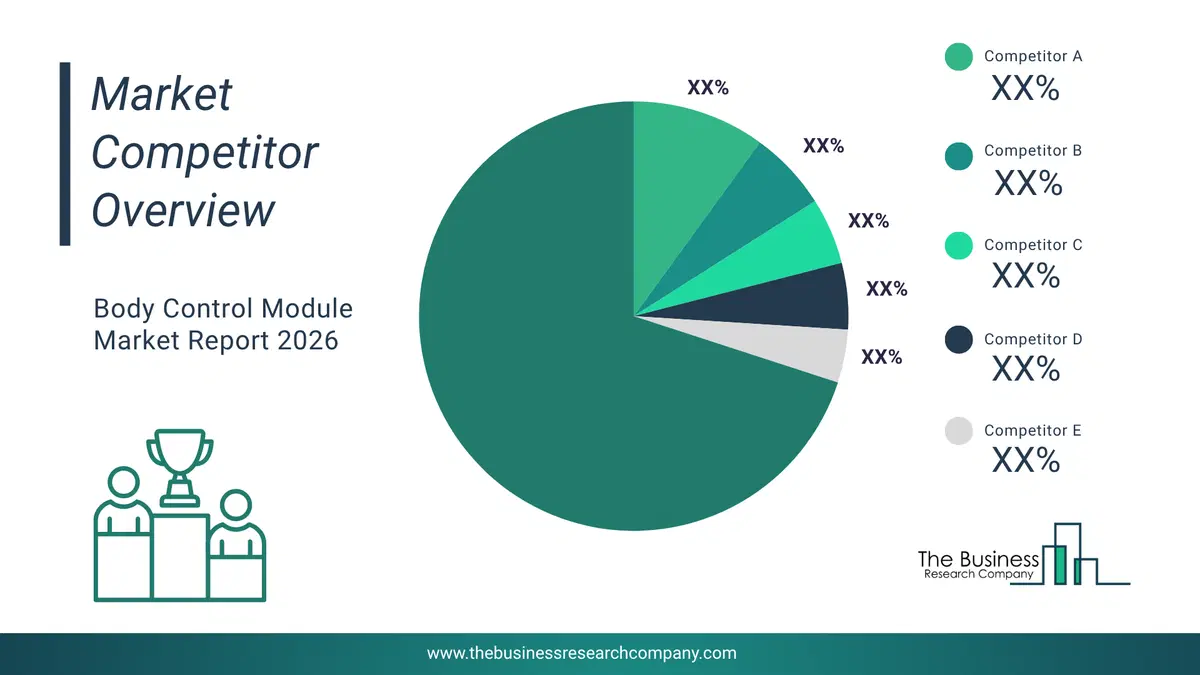
This chart is for illustrative purposes; the full report includes a detailed competitor analysis and comprehensive overview of the top 10 companies in the market.
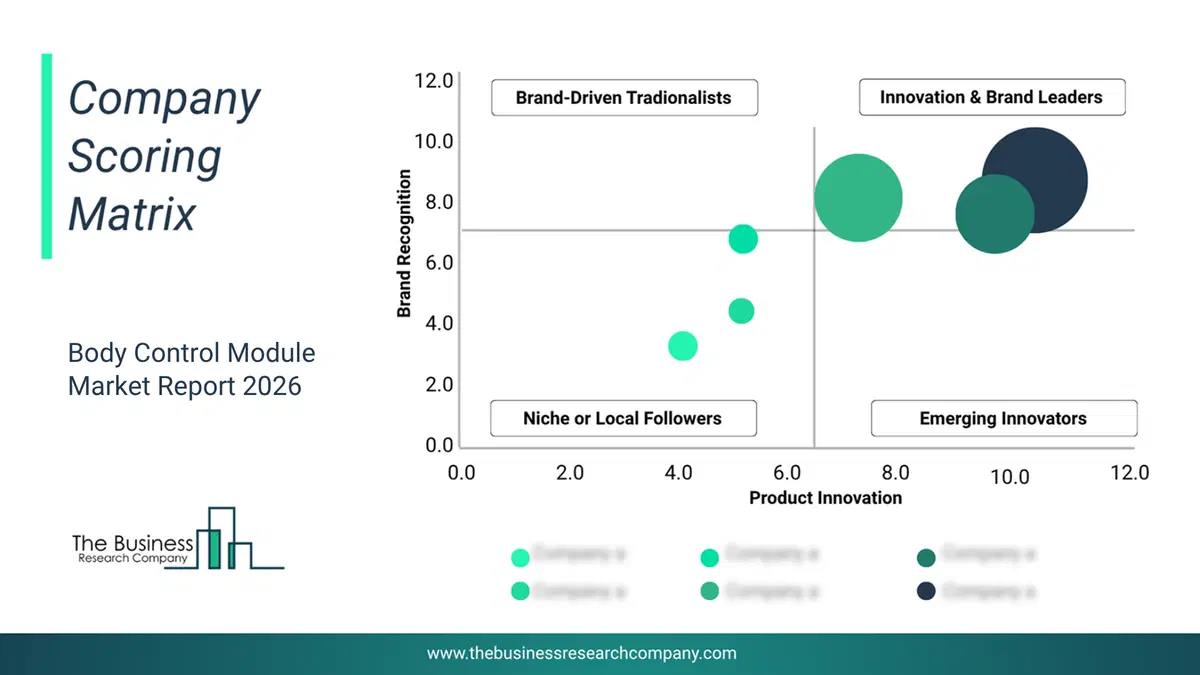
This chart maps companies by product innovation and brand strength, with bubble size indicating relative revenue, helping identify market leaders, challengers, and niche players. This is an illustrative chart; the full report provides a complete and accurate competitive analysis.
Global Body Control Module Market Trends and Insights
Major companies operating in the body control module market are focusing on developing innovative solutions such as electro-hydraulic adaptive suspension system to enhance ride comfort, vehicle stability, and overall driving experience. An electro-hydraulic adaptive suspension system is a vehicle suspension that uses electronic controls and hydraulic actuators to automatically adjust damping and stiffness for optimal comfort and stability. For instance, in April 2023, BYD, a China-based automotive manufacturer, launched the BYD DiSus intelligent body control system for new energy vehicles (NEVs). The self-developed complete-stack BYD DiSus System is solely designed for NEVs, making BYD the first Chinese automobile company to fully own intelligent vehicle body control technologies from development to implementation. The system dramatically improves the driving experience through its three specialized branches: the intelligent damping body control system (DiSus-C), the intelligent air body control system (DiSus-A), and the intelligent hydraulic body control system (DiSus-P). By integrating these intelligent systems, BYD enhances ride comfort, stability, and overall vehicle performance, setting a benchmark for next-generation automotive technologies.What Are Latest Mergers And Acquisitions In The Body Control Module Market?
In May 2023, Infineon Technologies AG, a Germany-based manufacturer of semiconductors, acquired Imagimob AB for an undisclosed amount. With this acquisition, Infineon is able to strengthen its position as a provider of top-notch machine learning (ML) solutions and greatly enhance its artificial intelligence (AI) capabilities. his acquisition is in line with Infineon's plan to use its products and solutions to accelerate decarbonization and digitization, especially in the fields of power systems and IoT. Imagimob AB is a Sweden-based company specializing in edge AI (Artificial Intelligence) solutions for industrial applications.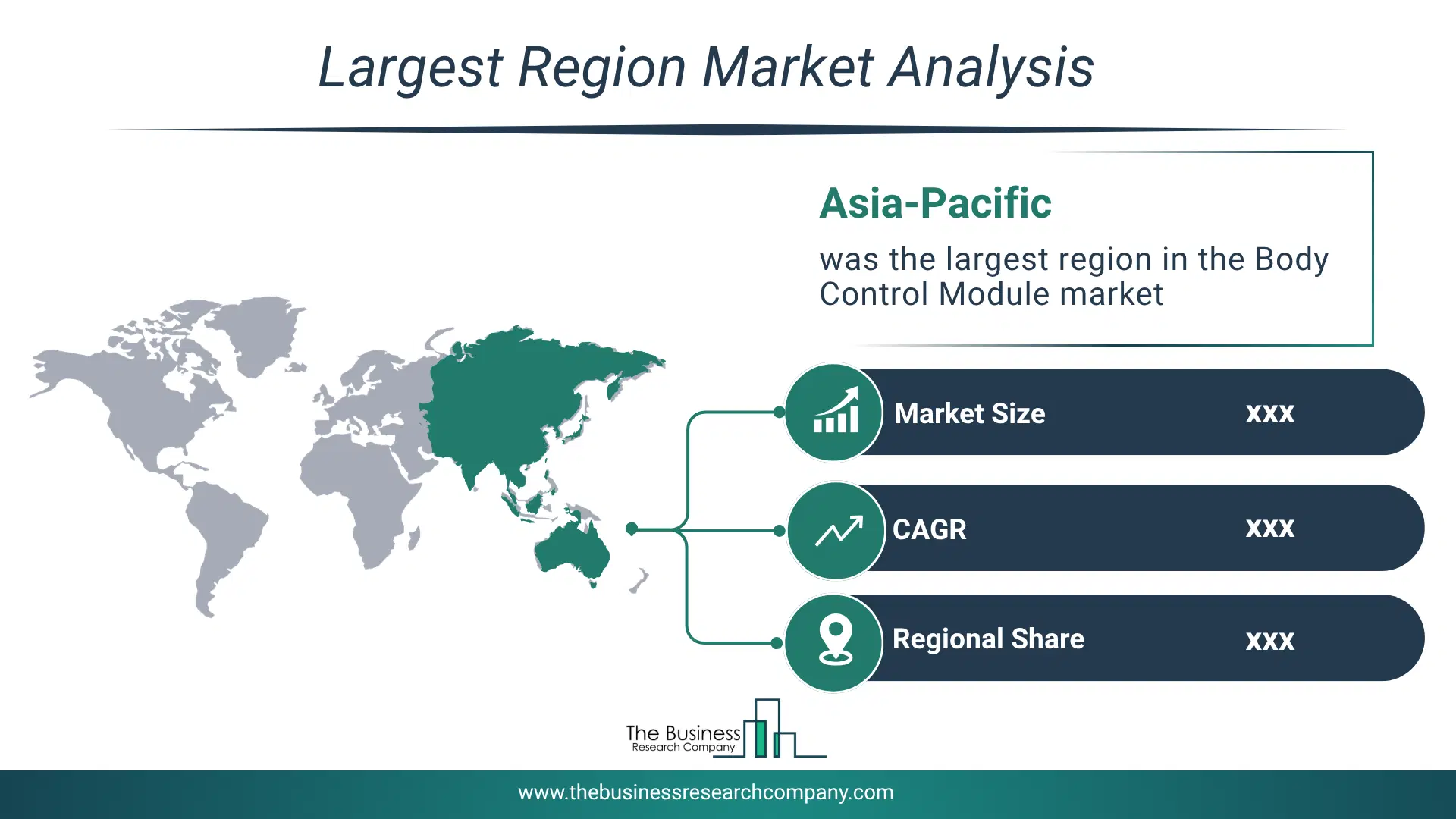
Regional Outlook
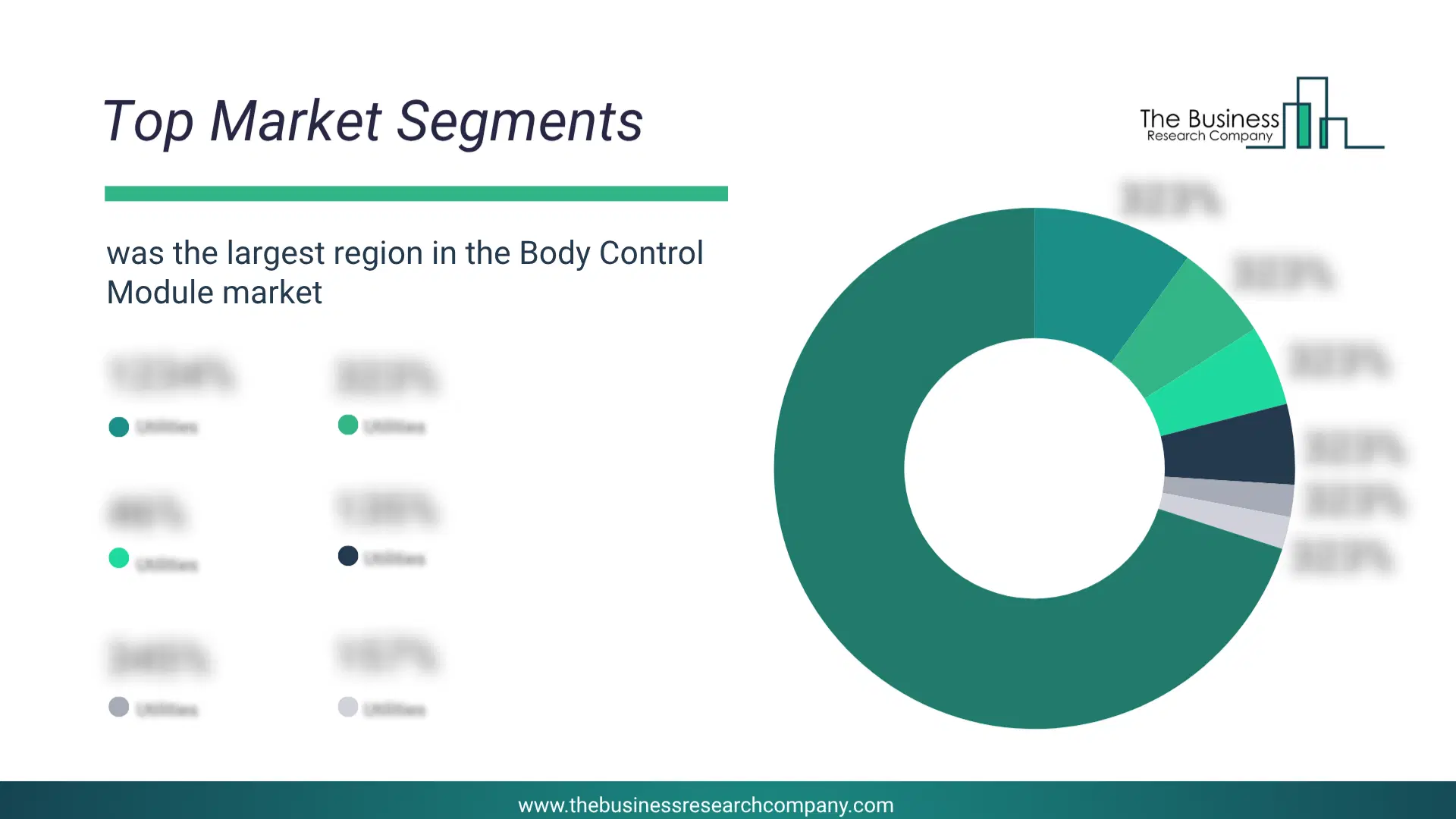
Asia-Pacific was the largest region in the body control module market in 2025. The regions covered in this market report are Asia-Pacific, South East Asia, Western Europe, Eastern Europe, North America, South America, Middle East, Africa. The countries covered in this market report are Australia, Brazil, China, France, Germany, India, Indonesia, Japan, Taiwan, Russia, South Korea, UK, USA, Canada, Italy, Spain.What Defines the Body Control Module Market?
The body control module market consists of revenues earned by entities providing climate control services and electric vehicle energy management services. The market value includes the value of related goods sold by the service provider or included within the service offering. The body control module market also includes sales of electronic control units (ECUs), sensors and actuators. Values in this market are ‘factory gate’ values, that is the value of goods sold by the manufacturers or creators of the goods, whether to other entities (including downstream manufacturers, wholesalers, distributors and retailers) or directly to end customers. The value of goods in this market includes related services sold by the creators of the goods.How is Market Value Defined and Measured?
The market value is defined as the revenues that enterprises gain from the sale of goods and/or services within the specified market and geography through sales, grants, or donations in terms of the currency (in USD unless otherwise specified). The revenues for a specified geography are consumption values that are revenues generated by organizations in the specified geography within the market, irrespective of where they are produced. It does not include revenues from resales along the supply chain, either further along the supply chain or as part of other products.
This chart presents market attractiveness based on a quantitative evaluation of growth, competition, strategic alignment, and risk, offering a clear view of opportunity areas for decision-making. This chart is for illustrative purposes; the full report contains the complete analysis.

This chart highlights the Total Addressable Market (TAM) by estimating the maximum revenue opportunity using an assumption-driven approach, supporting strategic planning and opportunity sizing across markets. The chart is illustrative; the full report provides a more comprehensive analysis.
What Key Data and Analysis Are Included in the Body Control Module Market Report 2026?
The body control module market research report is one of a series of new reports from The Business Research Company that provides market statistics, including industry global market size, regional shares, competitors with the market share, detailed market segments, market trends and opportunities, and any further data you may need to thrive in the body control module industry. The market research report delivers a complete perspective of everything you need, with an in-depth analysis of the current and future state of the industry.Body Control Module Market Report Forecast Analysis Market Report Forecast Analysis
| Report Attribute | Details |
|---|---|
| Market Size Value In 2026 | $33.99 billion |
| Revenue Forecast In 2030 | $39.08 billion |
| Growth Rate | CAGR of 2.8% from 2026 to 2030 |
| Base Year For Estimation | 2025 |
| Actual Estimates/Historical Data | 2020-2025 |
| Forecast Period | 2026 - 2030 |
| Market Representation | Revenue in USD Billion and CAGR from 2026 to 2030 |
| Segments Covered | Type, Component, Vehicle Type, Power Distribution Components, Application |
| Regional Scope | Asia-Pacific, Western Europe, Eastern Europe, North America, South America, Middle East, Africa |
| Country Scope | The countries covered in the report are Australia, Brazil, China, France, Germany, India, Indonesia, Japan, Taiwan, Russia, South Korea, UK, USA, Canada, Italy, Spain. |
| Key Companies Profiled | Robert Bosch GmbH, ZF Friedrichshafen AG, Denso Corporation, Continental AG, Mitsubishi Electric Corporation, HyundAI Mobis Co Ltd., Calsonic Kansei Corporation, Mazda Motor Corporation, Valeo Groupe, Lear Corporation, Texas Instruments Incorporated, Aptiv PLC, STMicroelectronics NV, Infineon Technologies AG, Yazaki Corporation, Magneti Marelli S.p.A., Renesas Electronics Corporation, Harman International Industries Inc., Hella KGaA Hueck & Co, Omron Corporation, Visteon Corporation, Visteon Corporation, Delphi Automotive PLC, Tata Elxsi Ltd. |
| Customization Scope | Request for Customization |
| Pricing And Purchase Options | Explore Purchase Options |