
Bottled Water Testing Equipment Market Report 2026
Global Outlook – By Technology (Traditional, Rapid), By Component (Instruments, Consumables And Reagents, Reference Materials ), By Test Type (Microbiological, Physical, Chemical, Radiological), By Application (Laboratory, Industrial, Environmental, Government ) – Market Size, Trends, Strategies, and Forecast to 2030
Bottled Water Testing Equipment Market Overview
• Bottled Water Testing Equipment market size has reached to $7.33 billion in 2025 • Expected to grow to $9.97 billion in 2030 at a compound annual growth rate (CAGR) of 6.4% • Growth Driver: Surge In Bottled Water Consumption Fuels Growth Of Bottled Water Testing Equipment Market • Market Trend: Product Innovations Transforming The Bottled Water Testing Equipment Market • North America was the largest region in 2025 and Asia-Pacific is the fastest growing region.What Is Covered Under Bottled Water Testing Equipment Market?
Bottled water testing equipment refers to instruments used to detect the presence of microbial, physical, chemical, and other contamination in water using various analytical methods. The main technologies involved in bottled water testing equipment are traditional and rapid technologies. Traditional methods refer to the identification of color, turbidity, total solids, dissolved solids, suspended solids, and odor present in water using physical tests. Several components used in bottled water testing equipment are instruments, consumables and reagents, and reference materials. There are different types of bottled water testing, such as microbiological, physical, chemical, and radiological tests. This testing is used by various applications, such as laboratory, industrial, environmental, and government.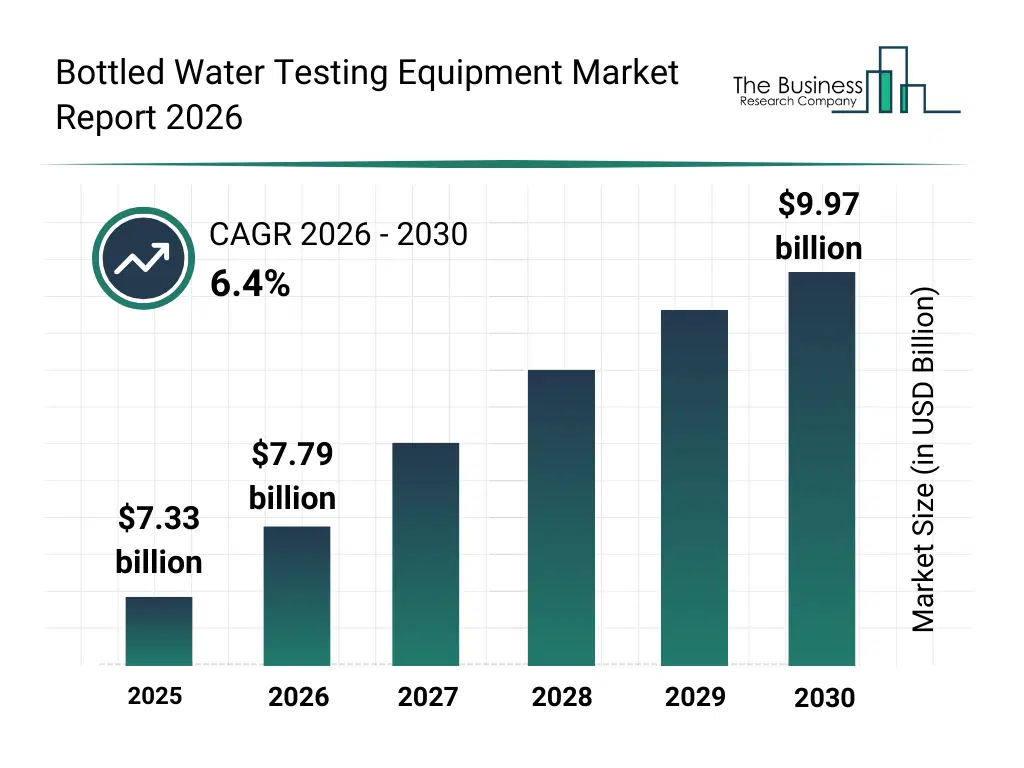
What Is The Bottled Water Testing Equipment Market Size and Share 2026?
The bottled water testing equipment market size has grown strongly in recent years. It will grow from $7.33 billion in 2025 to $7.79 billion in 2026 at a compound annual growth rate (CAGR) of 6.2%. The growth in the historic period can be attributed to increasing bottled water consumption, expansion of quality assurance laboratories, rising regulatory standards for drinking water, growth of laboratory-based analytical testing, increasing awareness of water contamination.What Is The Bottled Water Testing Equipment Market Growth Forecast?
The bottled water testing equipment market size is expected to see strong growth in the next few years. It will grow to $9.97 billion in 2030 at a compound annual growth rate (CAGR) of 6.4%. The growth in the forecast period can be attributed to increasing investments in automated testing systems, rising demand for real-time water quality monitoring, expansion of bottled water production facilities, growing adoption of portable testing kits, increasing focus on data-driven quality control. Major trends in the forecast period include increasing adoption of rapid water testing technologies, rising integration of automated and digital testing instruments, growing demand for high-accuracy contaminant detection, expansion of portable and on-site testing solutions, enhanced focus on regulatory compliance.Tariff Impact On Bottled Water Testing Equipment Market
Tariffs are impacting the bottled water testing equipment market by increasing costs of imported analytical instruments, sensors, reagents, and electronic components used in microbiological, chemical, and physical testing systems. Laboratory and industrial testing facilities in North America and Europe are most affected due to reliance on imported high-precision instruments, while Asia-Pacific faces pricing pressure on manufacturing and export of testing equipment. These tariffs are raising capital and operating costs for testing laboratories and bottled water producers. However, they are also encouraging local instrument manufacturing, regional reagent production, and development of cost-efficient rapid testing solutions.
Global Bottled Water Testing Equipment Market Segmentation
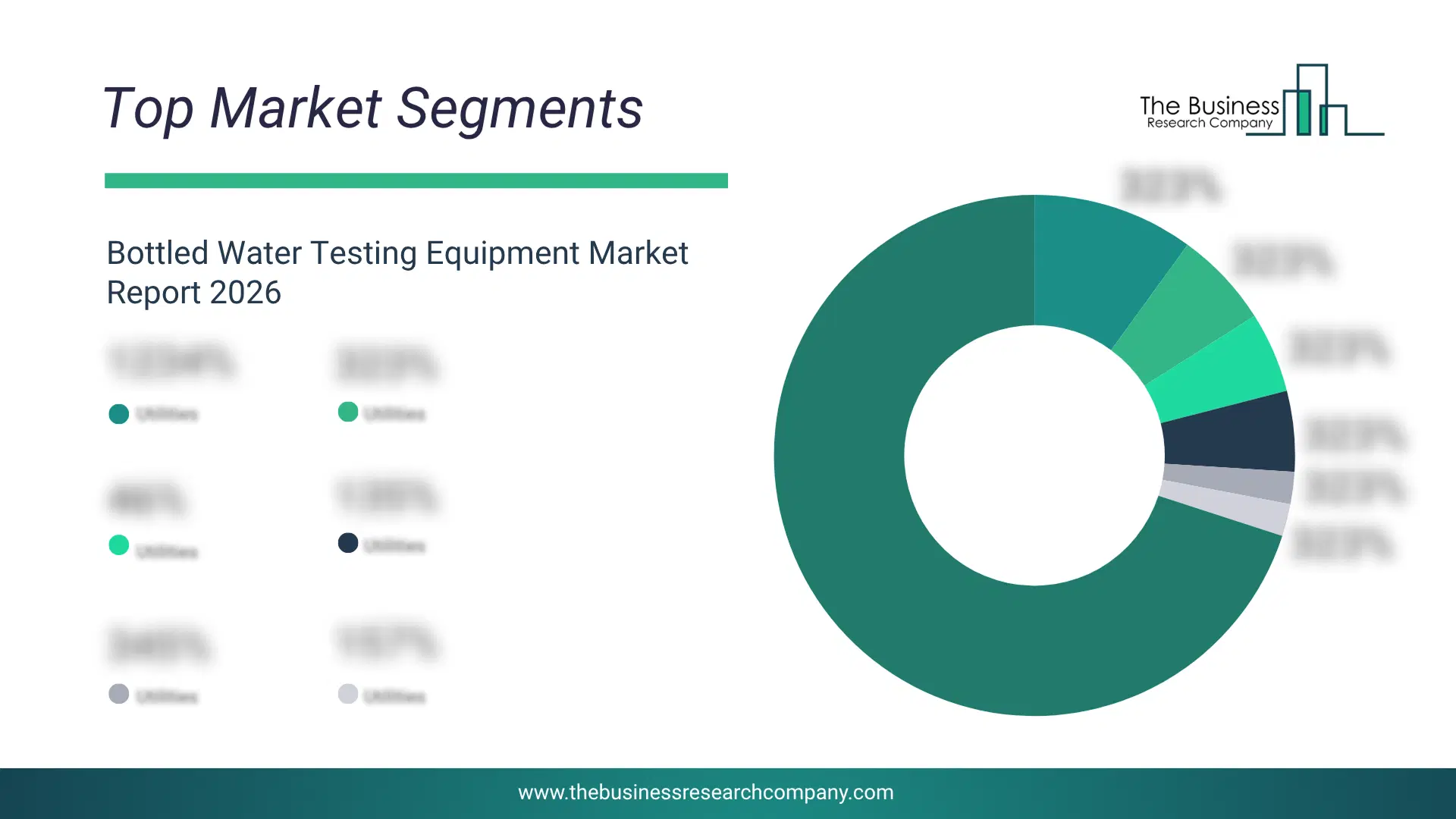
1) By Technology: Traditional, Rapid 2) By Component: Instruments, Consumables And Reagents, Reference Materials 3) By Test Type: Microbiological, Physical, Chemical, Radiological 4) By Application: Laboratory, Industrial, Environmental, Government Subsegments: 1) By Traditional: Laboratory Testing Equipment, Standardized Testing Methods 2) By Rapid: Portable Testing Kits, Automated Testing SystemsWhat Are The Drivers Of The Bottled Water Testing Equipment Market?
A rapid increase in the consumption of bottled water is expected to propel the growth of the bottled water testing equipment market. Bottled water is a type of water that has been treated to make it extremely clean or originates from a unique location. The discontent with the taste of tap water and issues about the safety of drinking tap water have increased the consumption of bottled water. Bottled water testing equipment is used to provide clean water and reduce contamination compared to regular water. For instance, in March 2024, according to the International Bottled Water Association (IBWA), a US-based trade association, industry advocacy, and standards, bottled water sales in the United States reached a record 15.94 billion gallons, with retail sales surpassing US$48 billion. The growth continued in 2024, when bottled water consumption in the U.S. rose to 16.4 billion gallons, a 2.9% increase over the previous year. Therefore, a rapid increase in the consumption of bottled water is expected to drive the bottled water testing equipment industry. The stringent government regulations on bottled water is expected to propel the growth of bottled water testing equipment market going forward. Government regulations necessitate compliance with quality and safety standards. These regulations enhance consumer confidence, promote health and safety, and drive the need for continuous testing to ensure compliance. Additionally, they encourage research and innovation in testing technology and support market expansion by facilitating access to global markets and reinforcing brand reputation. For instance, in April 2025, according to the U.S. Food and Drug Administration (FDA), a U.S.-based government agency, results from its 2023–2024 sampling of 197 bottled water products (purified, spring, mineral, artesian, domestic, and imported) showed that 10 samples contained detectable levels of PFAS, although none exceeded the maximum contaminant levels (MCLs) set by the U.S. Environmental Protection Agency (EPA) for drinking water. Therefore, the detection of PFAS in bottled water is driving the growth of the bottled water testing equipment industry.Key Players In The Global Bottled Water Testing Equipment Market
Major companies operating in the bottled water testing equipment market are Agilent Technologies Inc., Bio-Rad Laboratories Inc., Accepta Ltd., PerkinElmer Inc., Thermo Fisher Scientific Inc., Danaher Corporation, Shimadzu Corporation, LaMotte Chemical Products Company, Hach Company, Tintometer India Pvt. Ltd., Palintest Ltd., Hanna Instruments Inc., Horiba Ltd., Endress+Hauser AG, Xylem Inc., YSI Inc., Metrohm India Private Ltd., Myron L Company, AquaPhoenix Scientific Inc., Aqua Solutions Inc., AquaPro Solutions LLC., Applied Membranes Inc., AquaLabo, Beckman Coulter Inc., CEM Corporation, CHEMetrics Inc., Cole-Parmer Instrument Company, EMD Millipore Corporation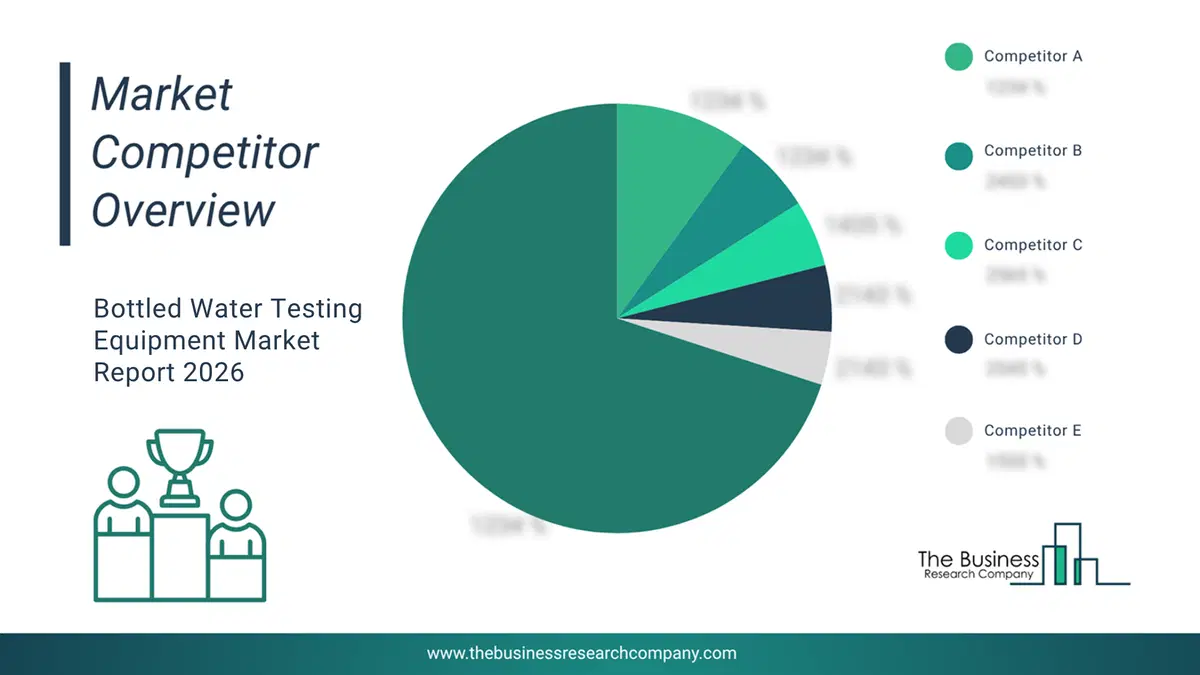
This chart is for illustrative purposes; the full report includes a detailed competitor analysis and comprehensive overview of the top 10 companies in the market.
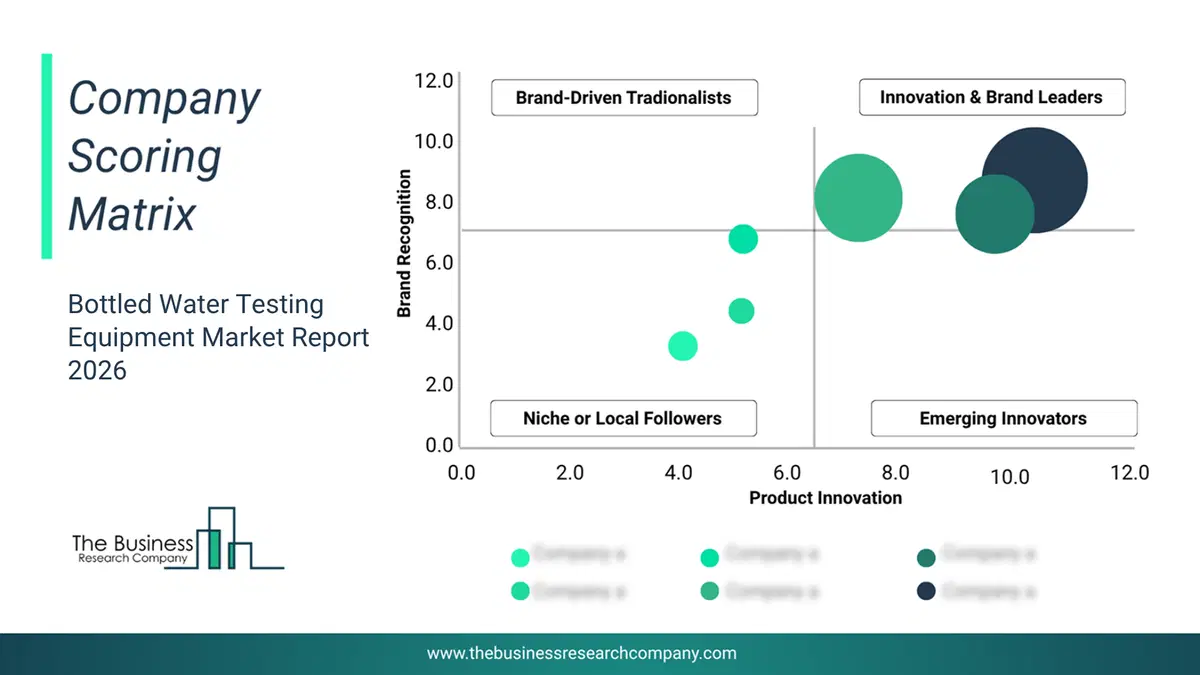
This chart maps companies by product innovation and brand strength, with bubble size indicating relative revenue, helping identify market leaders, challengers, and niche players. This is an illustrative chart; the full report provides a complete and accurate competitive analysis.
Global Bottled Water Testing Equipment Market Trends and Insights
Major companies operating in the bottled water testing equipment market are developing new, easy-to-use testing solutions to gain a competitive edge in the market. Easy-to-use testing solutions in bottled water testing equipment provide efficient and user-friendly methods for analyzing water quality, ensuring accurate results with minimal complexity. For instance, in August 2023, Lovibond, a Germany-based water testing equipment company, launched a range of Lovibond Test Kits tailored for industrial use, addressing the growing importance of water management and compliance. These kits, comprising 44 varieties, cater to diverse industrial processes, offering essential equipment and reagents for accurate water analysis, including boiler and cooling water monitoring, disinfection, and more. The user-friendly design ensures precise results, and the compact, portable cases make them suitable for on-site use.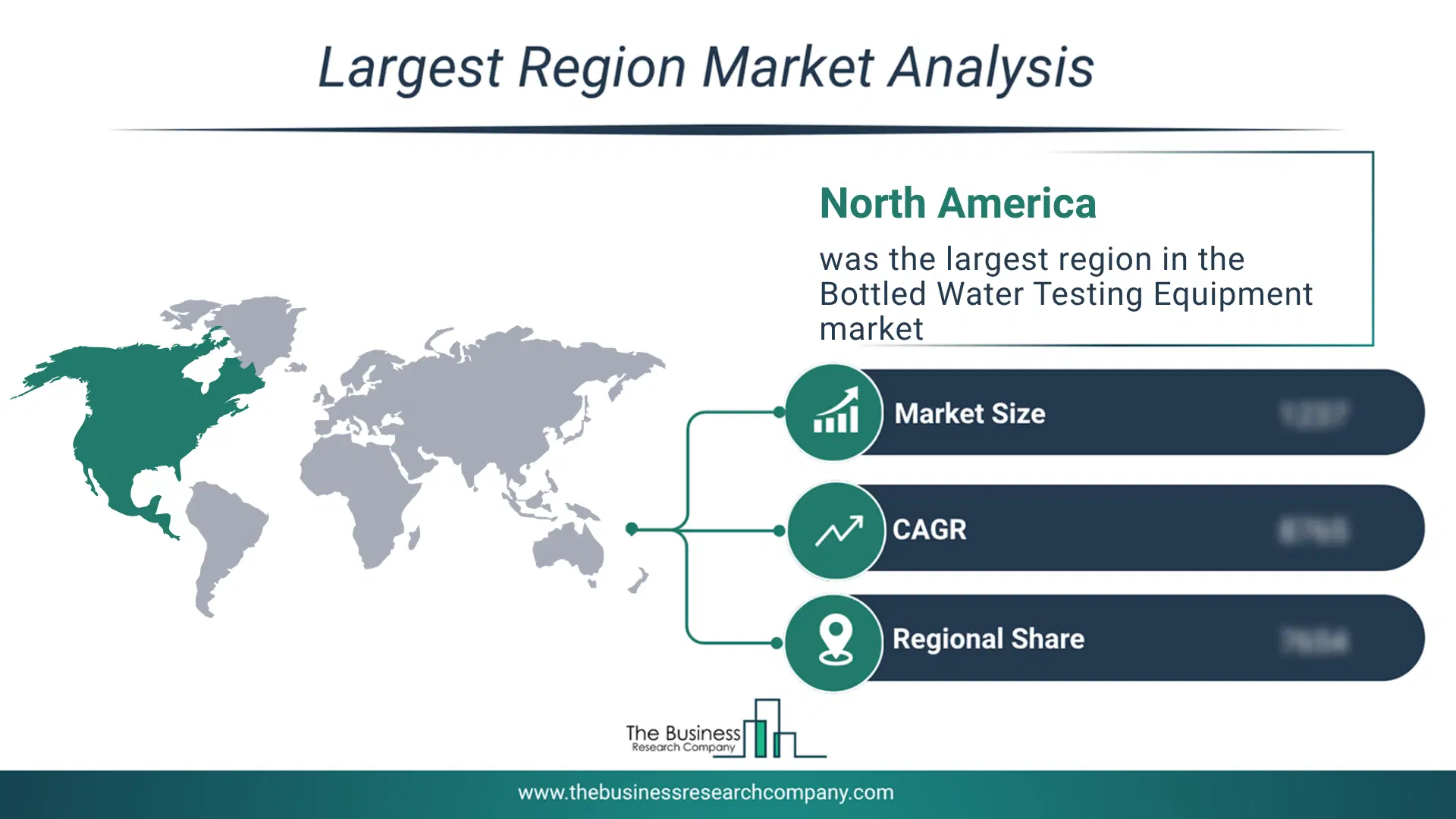
Regional Outlook
North America was the largest region in the bottled water testing equipment market in 2025. Asia-Pacific is expected to be the fastest-growing region in the forecast period. The regions covered in this market report are Asia-Pacific, South East Asia, Western Europe, Eastern Europe, North America, South America, Middle East, Africa The countries covered in this market report are Australia, Brazil, China, France, Germany, India, Indonesia, Japan, Taiwan, Russia, South Korea, UK, USA, Canada, Italy, Spain.What Defines the Bottled Water Testing Equipment Market?
The bottled water testing equipment market consists of sales of pH meters, conductometers, colorimeters, and turbidimeters, used for P.H. tests, dissolved oxygen tests, conductivity tests, turbidity tests, and T.D.C. tests. Values in this market are ‘factory gate’ values, that is, the value of goods sold by the manufacturers or creators of the goods, whether to other entities (including downstream manufacturers, wholesalers, distributors, and retailers) or directly to end customers. The value of goods in this market includes related services sold by the creators of the goods.How is Market Value Defined and Measured?
The market value is defined as the revenues that enterprises gain from the sale of goods and/or services within the specified market and geography through sales, grants, or donations in terms of the currency (in USD unless otherwise specified). The revenues for a specified geography are consumption values that are revenues generated by organizations in the specified geography within the market, irrespective of where they are produced. It does not include revenues from resales along the supply chain, either further along the supply chain or as part of other products.
This chart presents market attractiveness based on a quantitative evaluation of growth, competition, strategic alignment, and risk, offering a clear view of opportunity areas for decision-making. This chart is for illustrative purposes; the full report contains the complete analysis.

This chart highlights the Total Addressable Market (TAM) by estimating the maximum revenue opportunity using an assumption-driven approach, supporting strategic planning and opportunity sizing across markets. The chart is illustrative; the full report provides a more comprehensive analysis.
What Key Data and Analysis Are Included in the Bottled Water Testing Equipment Market Report 2026?
The bottled water testing equipment market research report is one of a series of new reports from The Business Research Company that provides market statistics, including industry global market size, regional shares, competitors with the market share, detailed market segments, market trends and opportunities, and any further data you may need to thrive in the bottled water testing equipment industry. The market research report delivers a complete perspective of everything you need, with an in-depth analysis of the current and future state of the industry.Bottled Water Testing Equipment Market Report Forecast Analysis
| Report Attribute | Details |
|---|---|
| Market Size Value In 2026 | $7.79 billion |
| Revenue Forecast In 2030 | $9.97 billion |
| Growth Rate | CAGR of 6.4% from 2026 to 2030 |
| Base Year For Estimation | 2025 |
| Actual Estimates/Historical Data | 2020-2025 |
| Forecast Period | 2026 - 2030 |
| Market Representation | Revenue in USD Billion and CAGR from 2026 to 2030 |
| Segments Covered | Technology, Component, Test Type, Application |
| Regional Scope | Asia-Pacific, Western Europe, Eastern Europe, North America, South America, Middle East, Africa |
| Key Companies Profiled | Agilent Technologies Inc., Bio-Rad Laboratories Inc., Accepta Ltd., PerkinElmer Inc., Thermo Fisher Scientific Inc., Danaher Corporation, Shimadzu Corporation, LaMotte Chemical Products Company, Hach Company, Tintometer India Pvt. Ltd., Palintest Ltd., Hanna Instruments Inc., Horiba Ltd., Endress+Hauser AG, Xylem Inc., YSI Inc., Metrohm India Private Ltd., Myron L Company, AquaPhoenix Scientific Inc., Aqua Solutions Inc., AquaPro Solutions LLC., Applied Membranes Inc., AquaLabo, Beckman Coulter Inc., CEM Corporation, CHEMetrics Inc., Cole-Parmer Instrument Company, EMD Millipore Corporation |
| Customization Scope | Request for Customization |
| Pricing And Purchase Options | Explore Purchase Options |