
Brain Computer Interface Market Report 2026
Global Outlook – By Type (Invasive Brain Computer Interface, Partially Invasive Brain Computer Interface, Non Invasive Brain Computer Interface, Other Types), By Component (Hardware, Software), By Application (Healthcare, Disabilities Restoration, Brain Function Repair, Communication and Control) - Market Size, Trends, Strategies, and Forecast to 2030
Brain Computer Interface Market Overview
• Brain Computer Interface market size has reached to $2.36 billion in 2025 • Expected to grow to $4.66 billion in 2030 at a compound annual growth rate (CAGR) of 14.4% • Growth Driver: Rising Geriatric Population A Catalyst For Brain-Computer Interface Expansion • Market Trend: Neurable Launches Smart Brain-Computer Headphones with EEG Technology • North America was the largest region in 2025 and Asia-Pacific is the fastest growing region.What Is Covered Under Brain Computer Interface Market?
Brain-computer interface (BCI) refers to a computer-based system that collects brain signals, analyses them, and converts them into commands that are sent to an output device to perform a desired activity. The interface enables a direct communication pathway between the brain and the object to be controlled. The main goal of BCI is to replace or restore useful function to people disabled by neuromuscular disorders such as amyotrophic lateral sclerosis, cerebral palsy, stroke, or spinal cord injury. The main types of brain-computer interfaces are invasive brain-computer interface, partially invasive brain-computer interface, non-invasive brain-computer interface, and other types. Invasive brain-computer interface (BCI) refers to a computer-based system in which electrodes are implanted directly onto the brain of the patient via surgery to collect brain signals, analyze them, and convert them into commands to form a communication channel with external devices. The components involved are hardware and software that are used for healthcare, disabilities restoration, brain function repair, smart home control, communication and control, entertainment, and gaming applications. The different end users include medical, military, and others.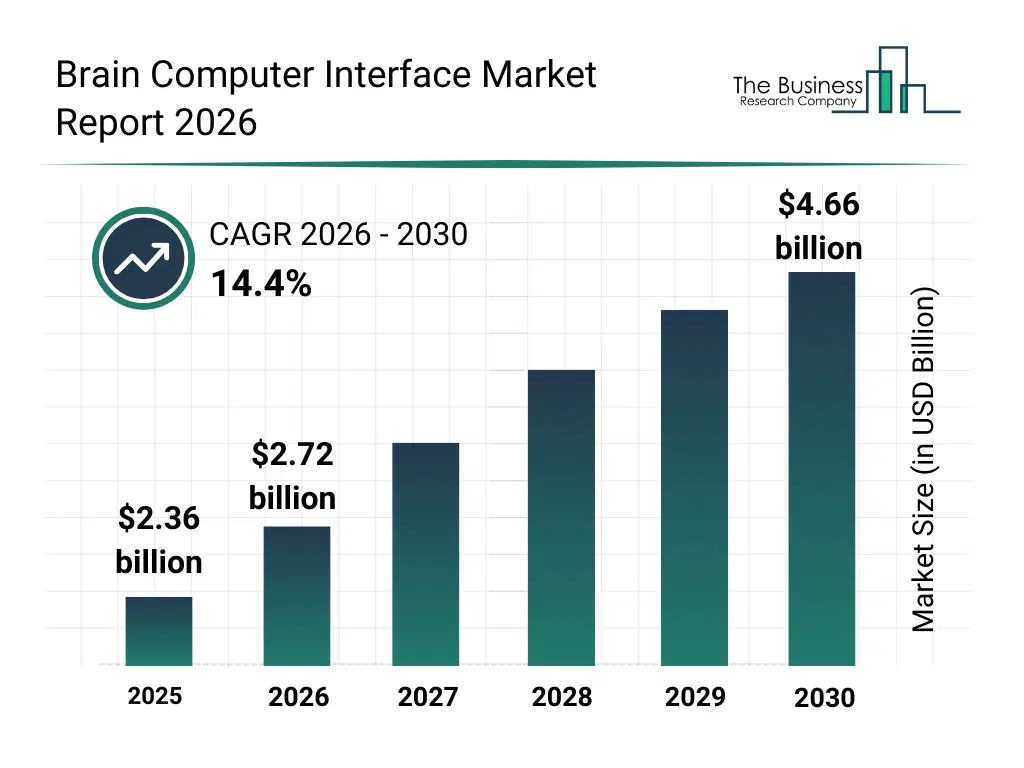
What Is The Brain Computer Interface Market Size and Share 2026?
The brain computer interface market size has grown rapidly in recent years. It will grow from $2.36 billion in 2025 to $2.72 billion in 2026 at a compound annual growth rate (CAGR) of 15.1%. The growth in the historic period can be attributed to advancements in neuroscience research, early adoption in disability restoration therapies, increasing prevalence of neurological disorders, growth of academic and clinical research programs, availability of brain signal acquisition technologies.What Is The Brain Computer Interface Market Growth Forecast?
The brain computer interface market size is expected to see rapid growth in the next few years. It will grow to $4.66 billion in 2030 at a compound annual growth rate (CAGR) of 14.4%. The growth in the forecast period can be attributed to increasing investments in neurotechnology startups, rising demand for assistive communication devices, expansion of bci use in smart environments, growing focus on personalized neurotherapies, technological improvements in neural data processing. Major trends in the forecast period include increasing development of non-invasive bci systems, rising integration of AI-based signal processing, growing adoption of wireless brain interfaces, expansion of bci applications beyond healthcare, enhanced focus on neurorehabilitation solutions.
Global Brain Computer Interface Market Segmentation
1) By Type: Invasive Brain Computer Interface, Partially Invasive Brain Computer Interface, Non Invasive Brain Computer Interface, Other Types 2) By Component: Hardware, Software 3) By Application: Healthcare, Disabilities Restoration, Brain Function Repair, Communication and Control Subsegments: 1) By Invasive Brain Computer Interface: Intracortical Interfaces, Deep Brain Stimulation Systems 2) By Partially Invasive Brain Computer Interface: ECoG (Electrocorticography) Interfaces, Subdural Grid Interfaces 3) By Non-Invasive Brain Computer Interface: EEG (Electroencephalography) Interfaces, fNIRS (Functional Near-Infrared Spectroscopy) Interfaces, MEG (Magnetoencephalography) Interfaces 4) By Other Types: Hybrid Interfaces, Wireless Brain Computer InterfacesWhat Is The Driver Of The Brain Computer Interface Market?
The increase in global geriatric population is expected to propel the growth of brain-computer interfaces going forward. The geriatric population refers to the elderly population with people aged 65 and over. As populations are growing and aging, the prevalence of major disabling neurological disorders steeply increases with age which increases the demand for treatment, rehabilitation, and support services for neurological disorders such as brain-computer interfaces. In the geriatric population, brain-computer interfaces are used in training elderly people's motor/cognitive abilities for preventing the aging effects, controlling home appliances, communicating with others during daily activities, controlling an exoskeleton to enhance the strength of the body's joints, and other day-to-day tasks. For instance, in January 2024, according to a published Pew Research Center, a US-based organization, 0.2% of the geriatric population will increase to 0.5% in 2054. Therefore, the increasing global geriatric population driving the growth of the brain-computer interfaces market.Key Players In The Global Brain Computer Interface Market
Major companies operating in the brain computer interface market are Natus Medical Incorporated, NextMind SAS, Compumedics Neuroscan, Brain Products GmbH, Integra LifeSciences Corporation, Emotiv Inc., NeuroSky Inc., ANT Neuro GmbH, Neuroelectrics, Nihon Kohden Corporation, Blackrock Neurotech, Cadwell Industries Inc., Advanced Brain Monitoring Inc., NIRx Medical Technologies LLC, g.tec medical engineering GmbH, Medtronic plc, MindMaze, CGX A Cognionics Company, CorTec GmbH, Neuralink Corp., ClearPoint Neuro Co., Paradromics Inc., BrainScope Co. Inc., InteraXon Inc., Syncron International AB, Wispr AI, Inner Cosmos Inc., Neurolutions Inc.
This chart is for illustrative purposes; the full report includes a detailed competitor analysis and comprehensive overview of the top 10 companies in the market.
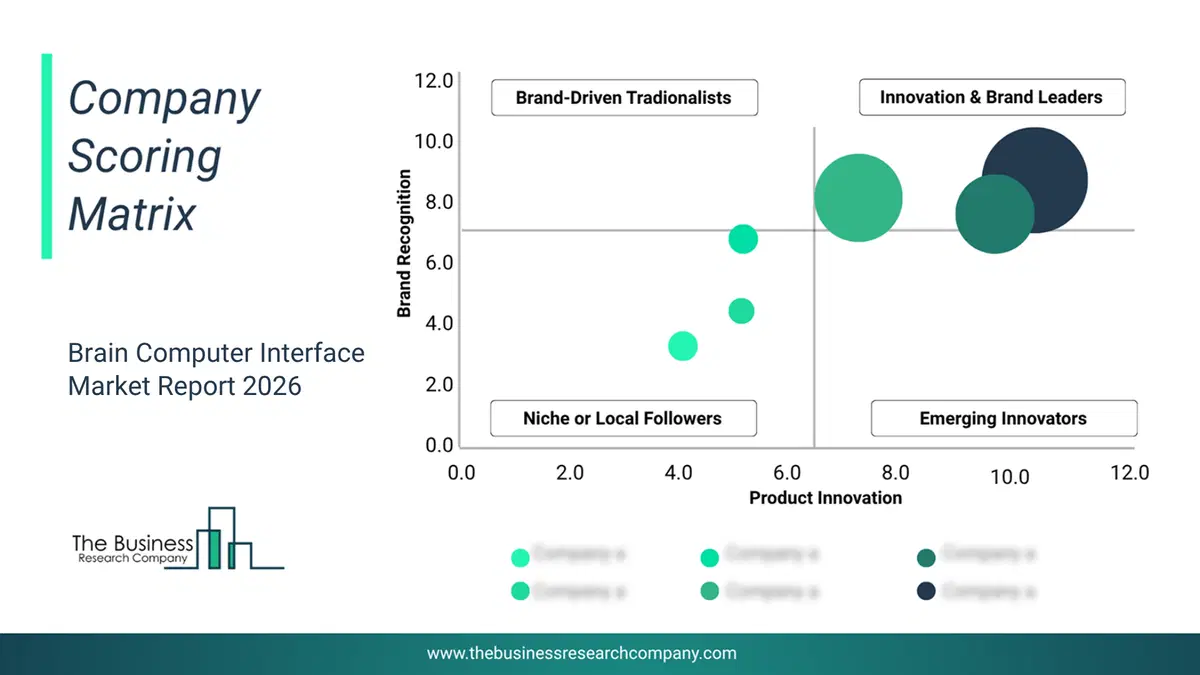
This chart maps companies by product innovation and brand strength, with bubble size indicating relative revenue, helping identify market leaders, challengers, and niche players. This is an illustrative chart; the full report provides a complete and accurate competitive analysis.
Global Brain Computer Interface Market Trends and Insights
Major companies operating in the Brain-Computer Interface market are focusing on technological advancements such as electroencephalography (EEG) sensors, advanced machine learning algorithms, and non-invasive neural signal processing techniques to enhance the accuracy and usability of BCI systems, ultimately enabling more intuitive interactions between users and technology. Electroencephalography (EEG) sensors are non-invasive devices that measure electrical activity in the brain through electrodes placed on the scalp, enabling real-time monitoring of cognitive states. For instance, in September 2024, Neurable Inc US-based leader in neurotechnology that specializes in AI-powered tools launched First Smart Brain-Computer. The headphones incorporate electroencephalography (EEG) sensors embedded in the ear pads, which capture and analyze brain signals. This allows for the generation of detailed brainwave data that provides insights into focus levels and cognitive performance.What Are Latest Mergers And Acquisitions In The Brain Computer Interface Market?
In June 2025, Cognixion, Inc., a US-based non-invasive brain-computer interface company, entered a strategic partnership with Pupil Labs GmbH to enhance next-generation eye-tracking and neural interaction technologies. Through this partnership, Cognixion and Pupil Labs aim to integrate electroencephalography (EEG)-based neural interfaces with high-precision eye-tracking systems to enable simultaneous measurement of brain activity and visual attention, enhancing communication and control for users with neurological or motor impairments. Pupil Labs is a Germany-based company that provides research-grade eye-tracking solutions. Pupil Labs GmbH is a Germany-based company specializing in wearable eye-tracking technology.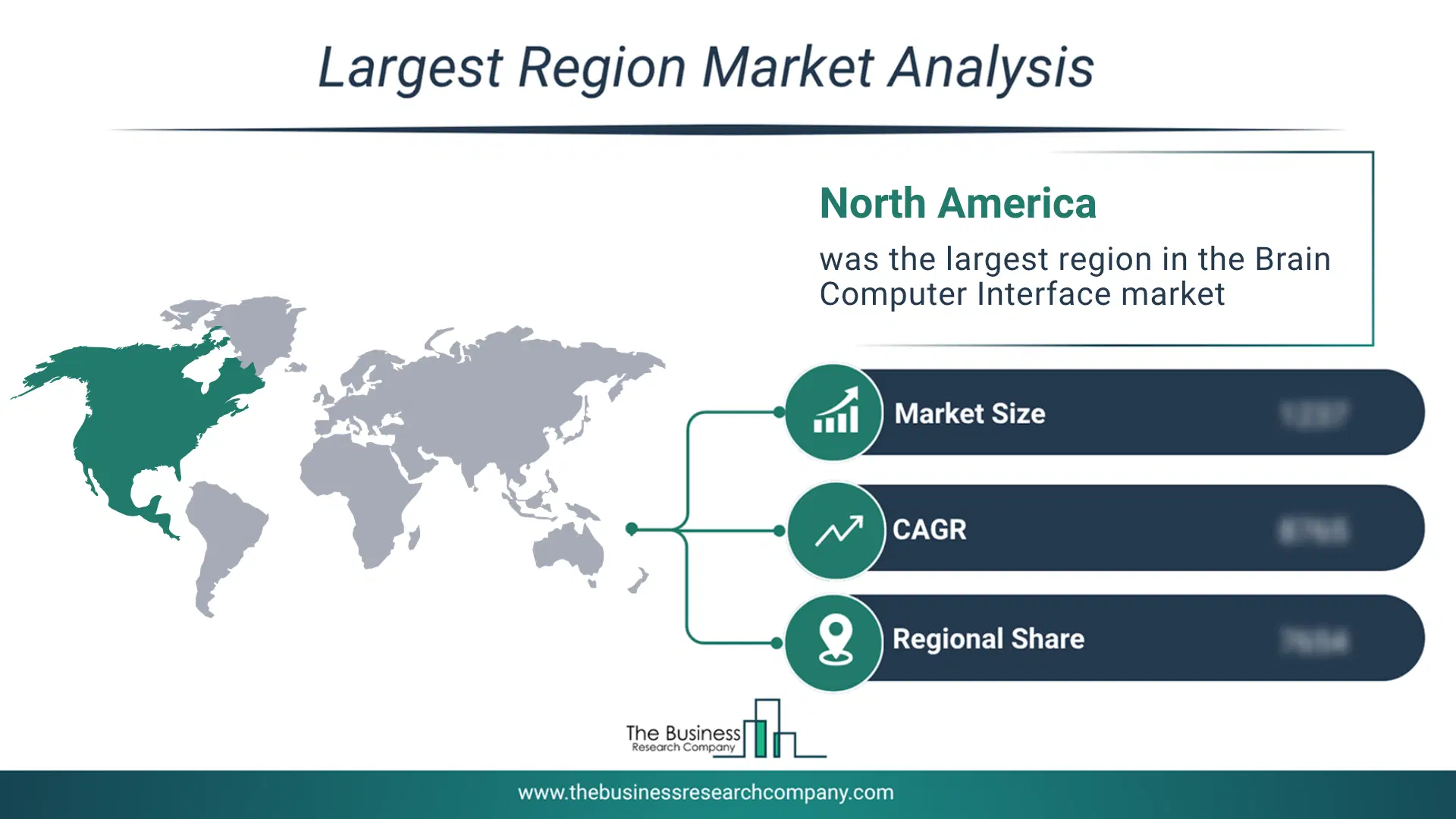
Regional Outlook
North America was the largest region in the brain computer interface market in 2025. Asia-Pacific is expected to be the fastest-growing region in the forecast period. The regions covered in this market report are Asia-Pacific, South East Asia, Western Europe, Eastern Europe, North America, South America, Middle East, Africa. The countries covered in this market report are Australia, Brazil, China, France, Germany, India, Indonesia, Japan, Taiwan, Russia, South Korea, UK, USA, Canada, Italy, Spain.What Defines the Brain Computer Interface Market?
The brain-computer interface (BCI) market consists of sales of electroencephalogram (EEG)-based BCI, BCI based on electrocorticography (ECoG), intracranial electroencephalography (Ieeg), magnetoencephalography (MEG)-based BCI, functional magnetic resonance imaging (Fmri), functional near-infrared spectroscopy (Fnirs), convolutional neural network (CNN), and magnetic resonance imaging-CBI. Values in this market are ‘factory gate’ values, that is the value of goods sold by the manufacturers or creators of the goods, whether to other entities (including downstream manufacturers, wholesalers, distributors, and retailers) or directly to end customers. The value of goods in this market includes related services sold by the creators of the goods.How is Market Value Defined and Measured?
The market value is defined as the revenues that enterprises gain from the sale of goods and/or services within the specified market and geography through sales, grants, or donations in terms of the currency (in USD unless otherwise specified). The revenues for a specified geography are consumption values that are revenues generated by organizations in the specified geography within the market, irrespective of where they are produced. It does not include revenues from resales along the supply chain, either further along the supply chain or as part of other products.
This chart presents market attractiveness based on a quantitative evaluation of growth, competition, strategic alignment, and risk, offering a clear view of opportunity areas for decision-making. This chart is for illustrative purposes; the full report contains the complete analysis.

This chart highlights the Total Addressable Market (TAM) by estimating the maximum revenue opportunity using an assumption-driven approach, supporting strategic planning and opportunity sizing across markets. The chart is illustrative; the full report provides a more comprehensive analysis.
What Key Data and Analysis Are Included in the Brain Computer Interface Market Report 2026?
The brain computer interface market research report is one of a series of new reports from The Business Research Company that provides market statistics, including industry global market size, regional shares, competitors with the market share, detailed market segments, market trends and opportunities, and any further data you may need to thrive in the brain computer interface industry. The market research report delivers a complete perspective of everything you need, with an in-depth analysis of the current and future state of the industry.Brain Computer Interface Market Report Forecast Analysis
| Report Attribute | Details |
|---|---|
| Market Size Value In 2026 | $2.72 billion |
| Revenue Forecast In 2030 | $4.66 billion |
| Growth Rate | CAGR of 14.4% from 2026 to 2030 |
| Base Year For Estimation | 2025 |
| Actual Estimates/Historical Data | 2020-2025 |
| Forecast Period | 2026 - 2030 |
| Market Representation | Revenue in USD Billion and CAGR from 2026 to 2030 |
| Segments Covered | Type, Component, Application |
| Regional Scope | Asia-Pacific, Western Europe, Eastern Europe, North America, South America, Middle East, Africa |
| Country Scope | The countries covered in the report are Australia, Brazil, China, France, Germany, India, Indonesia, Japan, Taiwan, Russia, South Korea, UK, USA, Canada, Italy, Spain |
| Key Companies Profiled | Natus Medical Incorporated, NextMind SAS, Compumedics Neuroscan, Brain Products GmbH, Integra LifeSciences Corporation, Emotiv Inc., NeuroSky Inc., ANT Neuro GmbH, Neuroelectrics, Nihon Kohden Corporation, Blackrock Neurotech, Cadwell Industries Inc., Advanced Brain Monitoring Inc., NIRx Medical Technologies LLC, g.tec medical engineering GmbH, Medtronic plc, MindMaze, CGX A Cognionics Company, CorTec GmbH, Neuralink Corp., ClearPoint Neuro Co., Paradromics Inc., BrainScope Co. Inc., InteraXon Inc., Syncron International AB, Wispr AI, Inner Cosmos Inc., Neurolutions Inc. |
| Customization Scope | Request for Customization |
| Pricing And Purchase Options | Explore Purchase Options |