
Brain-Computer Interface Implants Market Report 2026
Global Outlook – By Component (Hardware, Software, Services), By Technology (Functional Near Infrared Spectroscopy, Electroencephalography, Electrocorticography, Magnetoencephalography, Other Technologies), By Application (Healthcare, Smart Home Control, Communication And Control, Entertainment And Gaming, Brain Function Repair, Disabilities Restoration), By End Users (Military, Medical, Manufacturing, Research Center, Other End Users) – Market Size, Trends, Strategies, and Forecast to 2030
Brain-Computer Interface Implants Market Overview
• Brain-Computer Interface Implants market size has reached to $1.05 billion in 2025 • Expected to grow to $2.39 billion in 2030 at a compound annual growth rate (CAGR) of 17.7% • Growth Driver: Rising Prevalence Of Neurological Disorders And Paralysis Cases Fueling The Growth Of The Market Due To Increasing Demand For Advanced Neurocommunication And Assistive Technologies • Market Trend: Real-Time Brain-To-Device Communication Advancing Neurotechnology Development • North America was the largest region in 2025 and Asia-Pacific is the fastest growing region.What Is Covered Under Brain-Computer Interface Implants Market?
A brain-computer interface implants (BCII) is a technology that enables direct communication between the human brain and an external device. It works by capturing and interpreting brain signals using sensors such as EEG or implanted electrodes. These signals are then translated into commands to control computers, prosthetics, or other machines. BCIs are widely used in healthcare to support patients with neurological disorders or physical disabilities. The main components of brain-computer interface implants include hardware, software, and services. Hardware refers to implanted or external devices that capture, process, and transmit neural signals between the brain and digital systems. These systems utilize technologies including functional near infrared spectroscopy, electroencephalography, electrocorticography, magnetoencephalography, and other technologies. They find application in healthcare, smart home control, communication and control, entertainment and gaming, brain function repair, and disabilities restoration, serving end users including military, medical, manufacturing, research center, and others.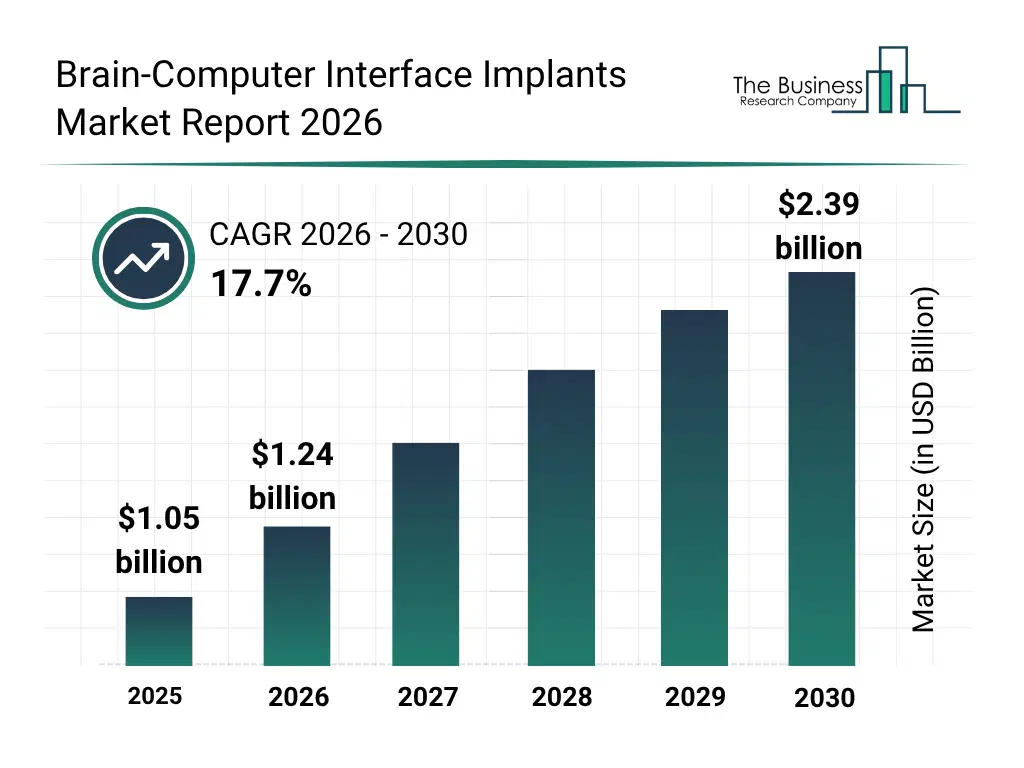
What Is The Brain-Computer Interface Implants Market Size and Share 2026?
The brain-computer interface implants market size has grown rapidly in recent years. It will grow from $1.05 billion in 2025 to $1.24 billion in 2026 at a compound annual growth rate (CAGR) of 18.2%. The growth in the historic period can be attributed to advancements in neuroscience research enabling early brain signal interpretation methods, increasing prevalence of neurological disorders driving need for assistive technologies, development of eeg based non invasive brain monitoring systems, rising investment in medical device innovation for disability support, growing academic research in neurotechnology and brain mapping.What Is The Brain-Computer Interface Implants Market Growth Forecast?
The brain-computer interface implants market size is expected to see rapid growth in the next few years. It will grow to $2.39 billion in 2030 at a compound annual growth rate (CAGR) of 17.7%. The growth in the forecast period can be attributed to increasing adoption of ai driven neural interface systems for precision healthcare applications, rising demand for advanced prosthetics with direct brain control capabilities, expansion of neurorehabilitation and brain injury recovery technologies, growing integration of brain computer interfaces in defense and communication systems, increasing investment in next generation implantable neurotechnology platforms. Major trends in the forecast period include ai powered neural decoding algorithms for improved brain signal interpretation accuracy, increasing adoption of minimally invasive and implantable brain sensing devices for medical applications, rising integration of real time neural feedback systems for prosthetic and assistive device control, expansion of cloud connected brain signal processing platforms for remote monitoring and analysis, growing development of high density electrode arrays for enhanced brain signal resolution and precision.
Global Brain-Computer Interface Implants Market Segmentation
1) By Component: Hardware; Software; Services 2) By Technology: Functional Near Infrared Spectroscopy; Electroencephalography; Electrocorticography; Magnetoencephalography; Other Technologies 3) By Application: Healthcare; Smart Home Control; Communication And Control; Entertainment And Gaming; Brain Function Repair; Disabilities Restoration 4) By End Users: Military; Medical; Manufacturing; Research Center; Other End Users Subsegments: 1) By Hardware: Neural Implants; Electrodes; Brain Computer Interface Headsets; Signal Amplifiers; Signal Acquisition Devices; Processing Units; Communication Modules 2) By Software: Signal Processing Software; Data Analysis Software; Machine Learning Algorithms; Neural Decoding Software; User Interface Software; Application Software; Calibration Software 3) By Services: Installation And Integration Services; Maintenance And Support Services; Consulting Services; Training And Education Services; Research And Development Services; Cloud Based ServicesWhat Is The Driver Of The Brain-Computer Interface Implants Market?
The rising prevalence of neurological disorders and paralysis cases is expected to propel growth of the brain computer interface market during the forecast period. Neurological disorders and paralysis cases refer to medical conditions that affect the brain, spinal cord, and nervous system, leading to impaired motor, sensory, or cognitive functions. The increasing prevalence of neurological disorders and paralysis cases is rising due to stroke incidences and the growing burden of neurodegenerative diseases. Brain computer interface technology helps address the challenges associated with neurological disorders and paralysis by enabling direct communication between the brain and external devices, improving mobility, communication, and independence for affected individuals. For instance, in April 2024, according to the Alzheimer's Association, a US-based voluntary health organization focused on Alzheimer’s care and research, approximately 6.9 million Americans aged 65 years and older were living with Alzheimer’s dementia in 2024, and this number is projected to rise to 13.8 million by 2060 due to the rapidly aging population. Therefore, the rising neurological disorders and paralysis cases are driving the growth of the brain-computer interface market.Key Players In The Global Brain-Computer Interface Implants Market
Major companies operating in the brain-computer interface implants market are Medtronic plc; Abbott Laboratories; Boston Scientific Corporation; Neuralink Corp.; NeuroPace Inc.; Synchron Inc.; Science Corporation; Precision Neuroscience Corporation; Paradromics Inc.; CorTec GmbH; Aleva Neurotherapeutics SA; NeuroOne Medical Technologies Corporation; INBRAIN Neuroelectronics S.L.; ONWARD Medical N.V.; Bioinduction Ltd.; Neurosoft Bioelectronics SA; Inner Cosmos Inc.; Axoft Inc.; Nia Therapeutics Inc.; CereGate GmbHGlobal Brain-Computer Interface Implants Market Trends and Insights
Major companies operating in the brain-computer interface market are focusing on developing advanced neural decoding and minimally invasive implant technologies, such as invasive neurotechnology development to improve neural signal accuracy, enable real-time brain-to-device communication, restore motor and cognitive functions, and expand applications in neurorehabilitation and assistive communication. Invasive neurotechnology development refers to the design and advancement of implantable devices and systems that directly interface with the brain or nervous system to monitor, decode, stimulate, or transmit neural signals for medical, therapeutic, or assistive applications. For instance, in January 2026, Neuralink Corp., a US-based neurotechnology company, announced the first successful human implantation of its N1 Brain-Computer Interface (BCI) device, marking a key milestone in invasive neurotechnology development. Designed to record and interpret neural activity from the motor cortex, the implant enables users with severe paralysis to control digital interfaces such as computer cursors through thought-based signals, representing an early shift toward clinical-grade assistive communication systems.What Are Latest Mergers And Acquisitions In The Brain-Computer Interface Implants Market?
In April 2024, Science Corporation, a US-based neurotechnology company, acquired the PRIMA retinal implant assets of Pixium Vision for an undisclosed amount. Through this acquisition, Science Corporation aims to strengthen its vision-restoration brain–computer interface portfolio and accelerate the development of implantable neuroprosthetic technologies for patients with severe vision impairment. Pixium Vision is a France-based bioelectronics company specializing in retinal implant systems and bionic vision technologies for degenerative retinal diseases.Regional Outlook
North America was the largest region in the brain-computer interface implants market in 2025. Asia-Pacific is expected to be the fastest-growing region in the forecast period. The regions covered in this market report are Asia-Pacific, South East Asia, Western Europe, Eastern Europe, North America, South America, Middle East, Africa. The countries covered in this market report are Australia, Brazil, China, France, Germany, India, Indonesia, Japan, Taiwan, Russia, South Korea, UK, USA, Canada, Italy, Spain.What Defines the Brain-Computer Interface Implants Market?
The brain-computer interface implants market consists of sales of neural interfaces, brain signal recording devices, EEG headsets, intracortical implants, and neurostimulation devices. Values in this market are ‘factory gate’ values, that is the value of goods sold by the manufacturers or creators of the goods, whether to other entities (including downstream manufacturers, wholesalers, distributors and retailers) or directly to end customers. The value of goods in this market includes related services sold by the creators of the goods.How is Market Value Defined and Measured?
The market value is defined as the revenues that enterprises gain from the sale of goods and/or services within the specified market and geography through sales, grants, or donations in terms of the currency (in USD unless otherwise specified). The revenues for a specified geography are consumption values that are revenues generated by organizations in the specified geography within the market, irrespective of where they are produced. It does not include revenues from resales along the supply chain, either further along the supply chain or as part of other products.What Key Data and Analysis Are Included in the Brain-Computer Interface Implants Market Report 2026?
The brain-computer interface implants market research report is one of a series of new reports from The Business Research Company that provides market statistics, including industry global market size, regional shares, competitors with the market share, detailed market segments, market trends and opportunities, and any further data you may need to thrive in the brain-computer interface implants industry. The market research report delivers a complete perspective of everything you need, with an in-depth analysis of the current and future state of the industry.Brain-Computer Interface Implants Market Report Forecast Analysis
| Report Attribute | Details |
|---|---|
| Market Size Value In 2026 | $1.24 billion |
| Revenue Forecast In 2030 | $2.39 billion |
| Growth Rate | CAGR of 17.7% from 2026 to 2030 |
| Base Year For Estimation | 2025 |
| Actual Estimates/Historical Data | 2020-2025 |
| Forecast Period | 2026 - 2030 |
| Market Representation | Revenue in USD Billion and CAGR from 2026 to 2030 |
| Segments Covered | Component, Technology, Application, End Users |
| Regional Scope | Asia-Pacific, Western Europe, Eastern Europe, North America, South America, Middle East, Africa |
| Country Scope | The countries covered in the report are Australia, Brazil, China, France, Germany, India, ... |
| Key Companies Profiled | Medtronic plc; Abbott Laboratories; Boston Scientific Corporation; Neuralink Corp.; NeuroPace Inc.; Synchron Inc.; Science Corporation; Precision Neuroscience Corporation; Paradromics Inc.; CorTec GmbH; Aleva Neurotherapeutics SA; NeuroOne Medical Technologies Corporation; INBRAIN Neuroelectronics S.L.; ONWARD Medical N.V.; Bioinduction Ltd.; Neurosoft Bioelectronics SA; Inner Cosmos Inc.; Axoft Inc.; Nia Therapeutics Inc.; CereGate GmbH |
| Customization Scope | Request for Customization |
| Pricing And Purchase Options | Explore Purchase Options |