
Brain Monitoring Market Report 2026
Global Outlook – By Product (Magnetoencephalograph, Electroencephalograph, Cerebral Oximeters, Intracranial Pressure Monitoring Devices), By Procedure (Invasive, Non-invasive), By Application (Parkinson’s Disease, Traumatic Brain Injury, Epilepsy, Dementia, Sleep Disorders, Other Applications), By End User (Hospitals and Clinics, Neurology Centers, Diagnostic Centers) – Market Size, Trends, Strategies, and Forecast to 2030
Brain Monitoring Market Overview
• Brain Monitoring market size has reached to $8.74 billion in 2025 • Expected to grow to $14.26 billion in 2030 at a compound annual growth rate (CAGR) of 10.2% • Growth Driver: Rising Neurological Disorders Drive Growth In The Brain Monitoring Market • Market Trend: Adoption Of Portable Point-of-Care EEG Systems To Enhance Neurocritical Care • North America was the largest region in 2025 and Asia-Pacific is the fastest growing region.What Is Covered Under Brain Monitoring Market?
Brain monitoring refers to a set of continuous online monitoring, which substantially measures the particle velocity of cerebral blood flow and volume wave in the brain. Brain monitoring is used for individualized patient management such as brain and neuro-related diagnostics and treatment purposes. The main product types in brain monitoring are magnetoencephalography, electroencephalography, cerebral oximeters, functional magnetic resonance imaging (fMRI), intracranial pressure monitoring devices, and others. Magnetoencephalography refers to the noninvasive technique that detects and records the magnetic field associated with electrical activity in the brain. The procedures used are invasive and non-invasive. The applications involved are Parkinson’s disease, traumatic brain injury, epilepsy, dementia, sleep disorders, and others. The various end-users involved are hospitals and clinics, neurology centers, ambulatory surgery centers, diagnostic centers, and others.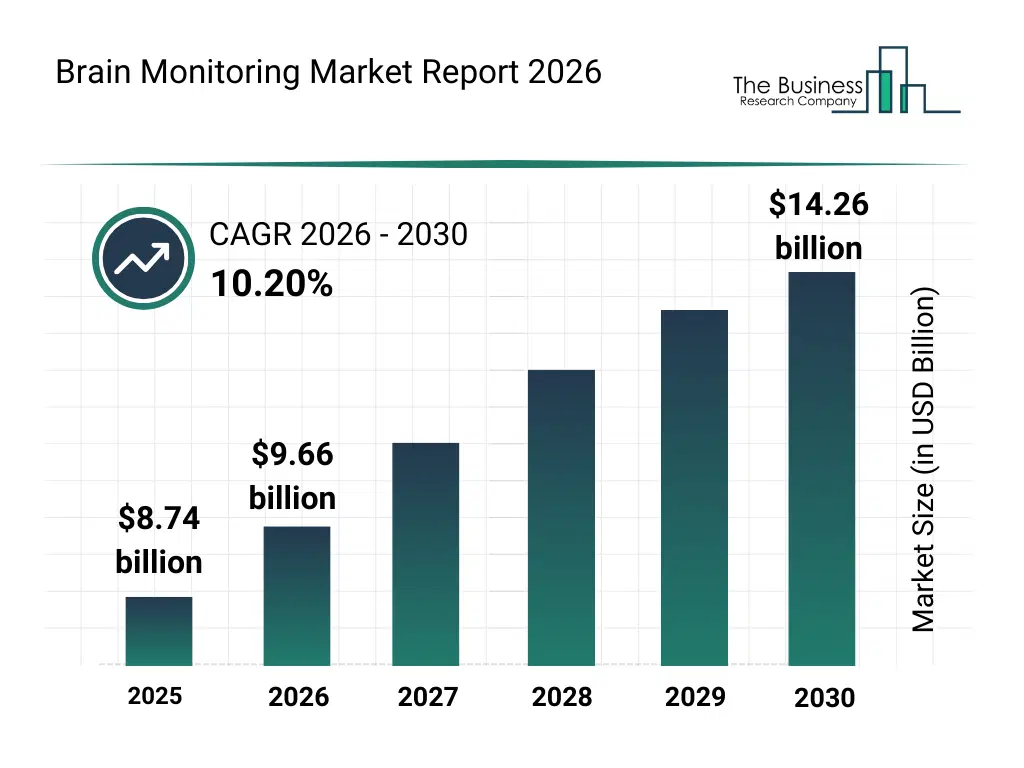
What Is The Brain Monitoring Market Size and Share 2026?
The brain monitoring market size has grown rapidly in recent years. It will grow from $8.74 billion in 2025 to $9.66 billion in 2026 at a compound annual growth rate (CAGR) of 10.6%. The growth in the historic period can be attributed to rising prevalence of neurological disorders, expansion of critical care monitoring practices, increasing adoption of EEG-based diagnostics, growth in neuroimaging infrastructure, improved availability of brain monitoring technologies.What Is The Brain Monitoring Market Growth Forecast?
The brain monitoring market size is expected to see rapid growth in the next few years. It will grow to $14.26 billion in 2030 at a compound annual growth rate (CAGR) of 10.2%. The growth in the forecast period can be attributed to increasing demand for personalized neurological treatment, rising investments in neurotechnology research, expansion of remote patient monitoring, growing use of ai-assisted brain diagnostics, increasing adoption of wearable brain monitoring systems. Major trends in the forecast period include increasing adoption of portable and wireless brain monitoring devices, rising use of continuous cerebral oxygen monitoring, growing integration of multimodal brain imaging systems, expansion of non-invasive neurodiagnostic techniques, enhanced focus on real-time brain data analysis.
Global Brain Monitoring Market Segmentation
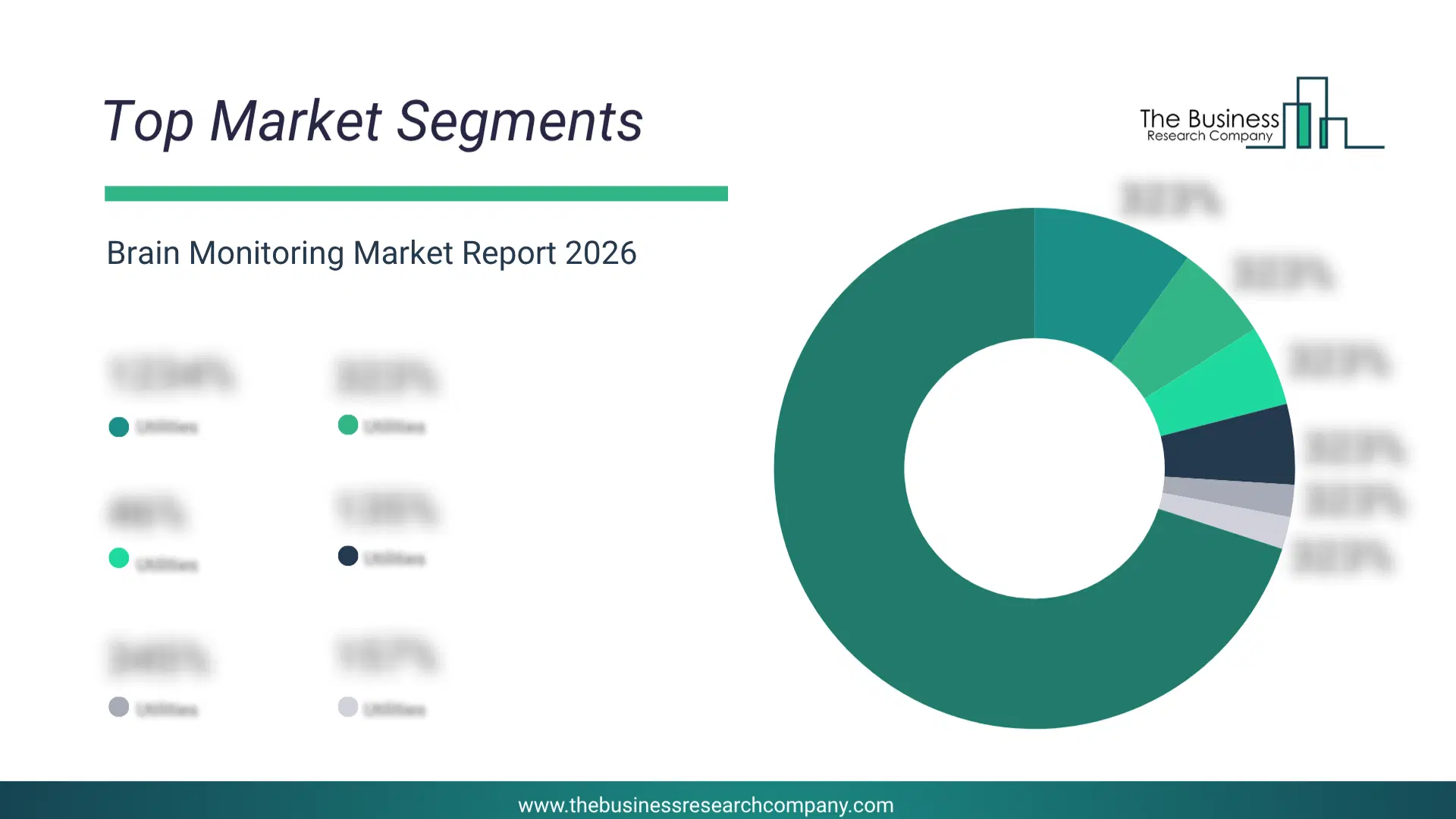
1) By Product: Magnetoencephalograph, Electroencephalograph, Cerebral Oximeters, Intracranial Pressure Monitoring Devices 2) By Procedure: Invasive, Non-invasive 3) By Application: Parkinson’s Disease, Traumatic Brain Injury, Epilepsy, Dementia, Sleep Disorders, Other Applications 4) By End User: Hospitals and Clinics, Neurology Centers, Diagnostic Centers Subsegments: 1) By Magnetoencephalograph (MEG): Whole-Head MEG Systems, Biomagnetic Measurement Systems 2) By Electroencephalograph (EEG): Portable EEG Devices, Clinical EEG Systems, Wireless EEG Systems 3) By Cerebral Oximeters: Near-Infrared Spectroscopy (NIRS) Devices, Continuous Cerebral Oxygen Monitoring Devices 4) By Intracranial Pressure Monitoring Devices: Intraventricular Catheters, Subdural and Epidural SensorsWhat Is The Driver Of The Brain Monitoring Market?
The increasing incidence and prevalence of neurological disorders are expected to propel the growth of the brain monitoring market going forward. Brain monitoring is defined as the use of instrumentation for the evaluation of a neurologic injury. Brain monitoring is used in neurological disorders to provide improved accuracy and reliability of information about the intensity of the neurologic injury. For instance, in April 2024, according to the National Institutes of Health (NIH), a US-based government’s premier biomedical research agency, an estimated 6.9 million Americans aged 65 and older are currently living with Alzheimer’s dementia, and this figure is projected to nearly double to 13.8 million by 2060. Therefore, the rising demand for increasing incidence and prevalence of neurological disorders is driving the growth of the brain monitoring industry.Key Players In The Global Brain Monitoring Market
Major companies operating in the brain monitoring market are Natus Medical Incorporated, Nihon Kohden Corporation, Philips Healthcare N.V., GE Healthcare Technologies Incorporated, Compumedics Limited, Medtronic Public Limited Company, Masimo Corporation, Spiegelberg GmbH & Co. KG, Cadwell Industries Incorporated, Elekta AB, Drägerwerk AG & Co. KGaA, Electrical Geodesics Incorporated, Integra LifeSciences Corporation, Siemens AG, CAS Medical Systems Incorporated, Neural Analytics Incorporated, BrainScope Company Incorporated, NeuroWave Systems Incorporated, Brain Products GmbH, ANT Neuro B.V., Blackrock Microsystems LLC, Cognionics Incorporated, Emotiv Incorporated, G.TEC Medical Engineering GmbH, Neurosoft Company, Advanced Brain Monitoring, NeuroSky Incorporated, OpenBCI Incorporated, Qneuro Private Limited, A.St.A. World-Wide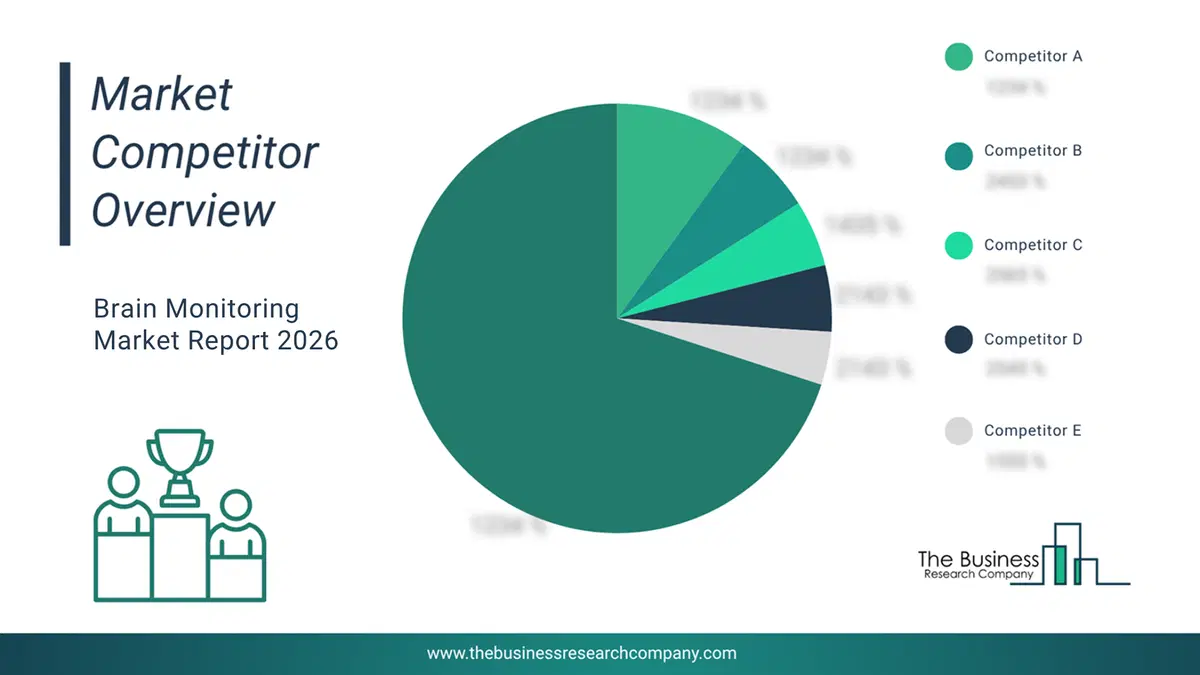
This chart is for illustrative purposes; the full report includes a detailed competitor analysis and comprehensive overview of the top 10 companies in the market.
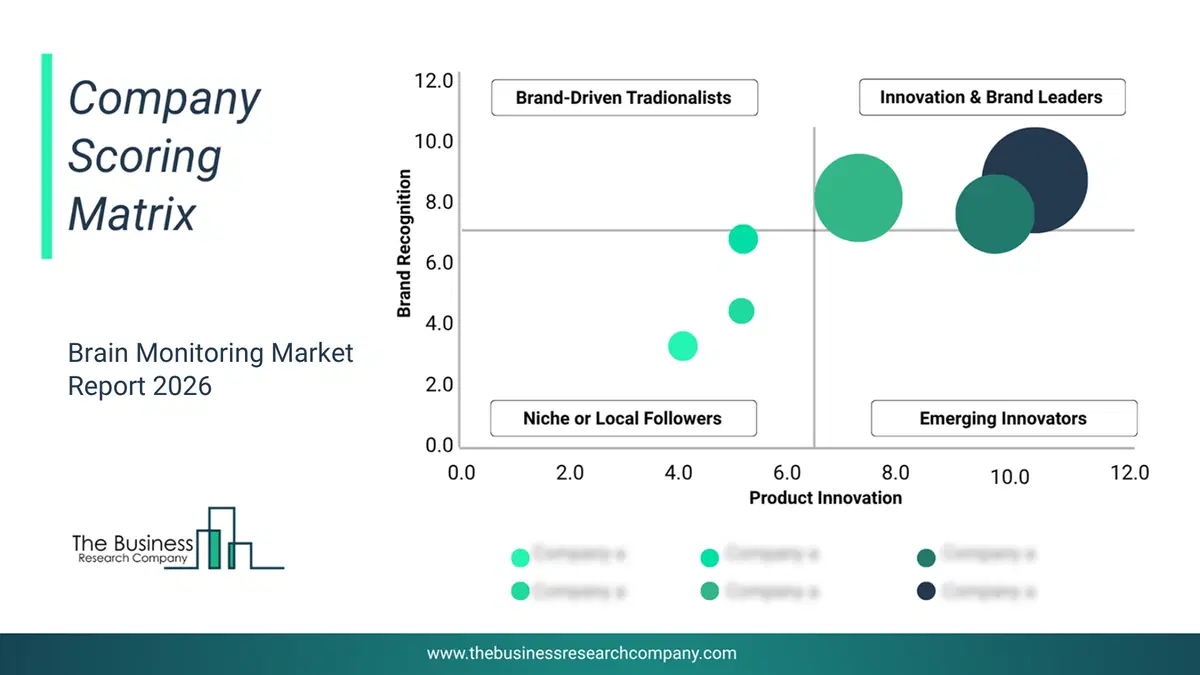
This chart maps companies by product innovation and brand strength, with bubble size indicating relative revenue, helping identify market leaders, challengers, and niche players. This is an illustrative chart; the full report provides a complete and accurate competitive analysis.
Global Brain Monitoring Market Trends and Insights
Major companies are operating in the brain monitoring market, focusing on developing technological advancements such as portable, point-of-care EEG systems for rapid neurodiagnostics to enhance patient monitoring, improve clinical decision-making, and enable remote neurological care. A point-of-care EEG system uses wireless, head-worn electrodes with cloud-based analytics—unlike traditional stationary EEG machines, it allows quick setup, continuous monitoring, and real-time alerts for neurological events. For instance, in May 2025, Natus Medical Incorporated, a U.S.-based neurodiagnostics company, launched BrainWatch, a wearable point-of-care EEG system optimized for emergency departments and intensive care units. The product features high-quality wireless EEG electrodes, can be set up in under five minutes, streams data to Natus NeuroWorks software, and integrates Persyst AI algorithms for real-time seizure detection—helping clinical teams rapidly identify non-convulsive seizures, collaborate remotely with neurologists, and improve patient outcomes.What Are Latest Mergers And Acquisitions In The Brain Monitoring Market?
In January 2024, Aditxt Inc., a US-based biotech company that focuses on developing advanced brain-computer interface (BCI) solutions, acquired Brain Scientific Inc. for an undisclosed amount. With this acquisition, Aditxt, Inc., aims to revolutionize healthcare through innovative solutions that enhance immune monitoring and health management. Brain Scientific Inc. is a US-based neurotechnology company that specializes in developing advanced medical devices and software for brain health monitoring.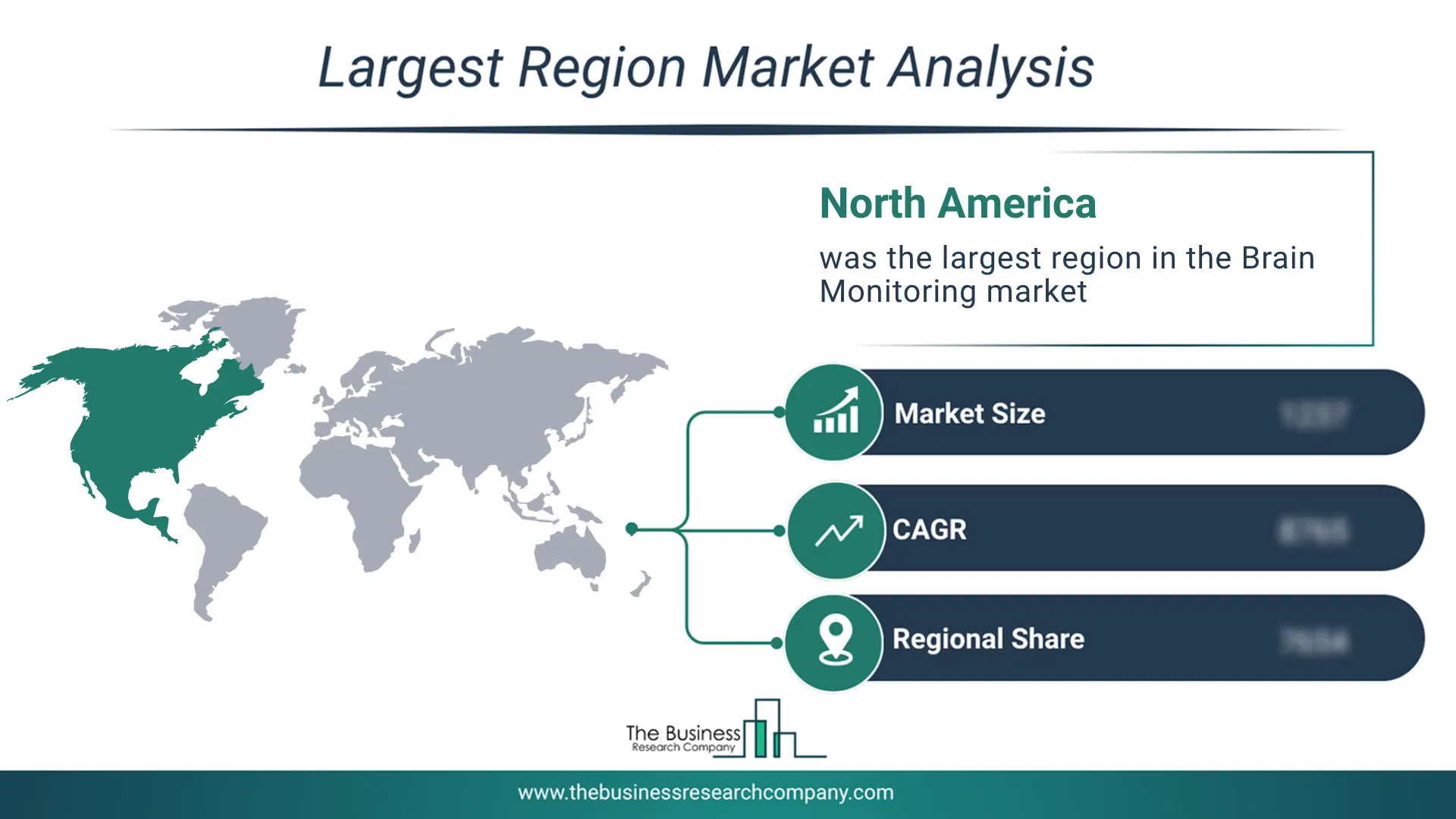
Regional Outlook
North America was the largest region in the brain monitoring market in 2025. Asia-Pacific is expected to be the fastest-growing region in the forecast period. The regions covered in this market report are Asia-Pacific, South East Asia, Western Europe, Eastern Europe, North America, South America, Middle East, Africa. The countries covered in this market report are Australia, Brazil, China, France, Germany, India, Indonesia, Japan, Taiwan, Russia, South Korea, UK, USA, Canada, Italy, SpainWhat Defines the Brain Monitoring Market?
The brain monitoring market includes revenue earned by entities by functional magnetic resonance imaging (FMRI), magnetoencephalography (MEG) and electroencephalography (EEG).The market value includes the value of related goods sold by the service provider or included within the service offering. Only goods and services traded between entities or sold to end consumers are included.How is Market Value Defined and Measured?
The market value is defined as the revenues that enterprises gain from the sale of goods and/or services within the specified market and geography through sales, grants, or donations in terms of the currency (in USD unless otherwise specified). The revenues for a specified geography are consumption values that are revenues generated by organizations in the specified geography within the market, irrespective of where they are produced. It does not include revenues from resales along the supply chain, either further along the supply chain or as part of other products.
This chart presents market attractiveness based on a quantitative evaluation of growth, competition, strategic alignment, and risk, offering a clear view of opportunity areas for decision-making. This chart is for illustrative purposes; the full report contains the complete analysis.

This chart highlights the Total Addressable Market (TAM) by estimating the maximum revenue opportunity using an assumption-driven approach, supporting strategic planning and opportunity sizing across markets. The chart is illustrative; the full report provides a more comprehensive analysis.
What Key Data and Analysis Are Included in the Brain Monitoring Market Report 2026?
The brain monitoring market research report is one of a series of new reports from The Business Research Company that provides market statistics, including industry global market size, regional shares, competitors with the market share, detailed market segments, market trends and opportunities, and any further data you may need to thrive in the brain monitoring industry. The market research report delivers a complete perspective of everything you need, with an in-depth analysis of the current and future state of the industry.Brain Monitoring Market Report Forecast Analysis
| Report Attribute | Details |
|---|---|
| Market Size Value In 2026 | $9.66 billion |
| Revenue Forecast In 2030 | $14.26 billion |
| Growth Rate | CAGR of 10.2% from 2026 to 2030 |
| Base Year For Estimation | 2025 |
| Actual Estimates/Historical Data | 2020-2025 |
| Forecast Period | 2026 - 2030 |
| Market Representation | Revenue in USD Billion and CAGR from 2026 to 2030 |
| Segments Covered | Product, Procedure, Application, End User |
| Regional Scope | Asia-Pacific, Western Europe, Eastern Europe, North America, South America, Middle East, Africa |
| Country Scope | The countries covered in the report are Australia, Brazil, China, France, Germany, India, Indonesia, Japan, Taiwan, Russia, South Korea, UK, USA, Canada, Italy, Spain. |
| Key Companies Profiled | Natus Medical Incorporated, Nihon Kohden Corporation, Philips Healthcare N.V., GE Healthcare Technologies Incorporated, Compumedics Limited, Medtronic Public Limited Company, Masimo Corporation, Spiegelberg GmbH & Co. KG, Cadwell Industries Incorporated, Elekta AB, Drägerwerk AG & Co. KGaA, Electrical Geodesics Incorporated, Integra LifeSciences Corporation, Siemens AG, CAS Medical Systems Incorporated, Neural Analytics Incorporated, BrainScope Company Incorporated, NeuroWave Systems Incorporated, Brain Products GmbH, ANT Neuro B.V., Blackrock Microsystems LLC, Cognionics Incorporated, Emotiv Incorporated, G.TEC Medical Engineering GmbH, Neurosoft Company, Advanced Brain Monitoring, NeuroSky Incorporated, OpenBCI Incorporated, Qneuro Private Limited, A.St.A. World-Wide |
| Customization Scope | Request for Customization |
| Pricing And Purchase Options | Explore Purchase Options |