
Brake Fluids Market Report 2026
Global Outlook – By Product Type (DOT 3 Brake Fluid, DOT 4 Brake Fluid, DOT 5 Brake Fluid, DOT 5.1 Brake Fluid, Other Product Types), By Sales Channel (Original Equipment Manufacturers, Aftermarket), By Application (Automotive, Construction Equipment, Agricultural Machinery, Mining Equipment, Other Application) – Market Size, Trends, Strategies, and Forecast to 2035
Brake Fluids Market Overview
• Brake Fluids market size has reached to $2.53 billion in 2025 • Expected to grow to $3.45 billion in 2030 at a compound annual growth rate (CAGR) of 6.3% • Growth Driver: Surge In Vehicle Production Fueling The Growth Of The Market Due To Increasing Demand For Hydraulic Fluids • Market Trend: Advanced DOT 4 Racing Brake Fluid Innovations Improve High-Performance Braking Reliability • North America was the largest region in 2025 and Asia-Pacific is the fastest growing region.What Is Covered Under Brake Fluids Market?
Brake fluids are specialized hydraulic fluids used to transmit force from the brake pedal or actuator to the vehicle’s braking mechanisms. They are formulated to provide a high boiling point, thermal stability, corrosion protection, and compatibility with braking-system materials. Their properties help minimize the risk of vapor formation, maintain hydraulic performance under high temperatures, and provide consistent braking operation throughout the system’s service life. The main product types of brake fluids include DOT 3 brake fluid, DOT 4 brake fluid, DOT 5 brake fluid, DOT 5.1 brake fluid, and other product types. DOT 3 brake fluid refers to a glycol ether based hydraulic fluid designed to transfer pressure within vehicle braking systems and maintain reliable braking performance under varying operating temperatures. They are supplied through original equipment manufacturers and aftermarket channels and are used end use applications in automotive, construction equipment, agricultural machinery, mining equipment, and others.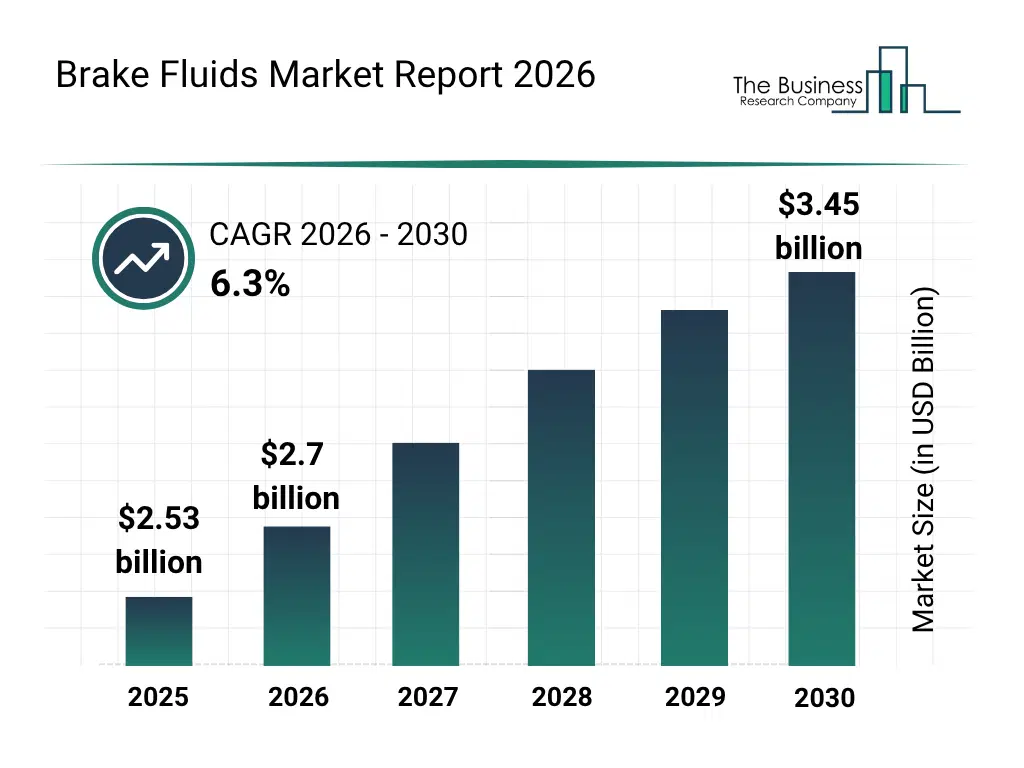
What Is The Brake Fluids Market Size and Share 2026?
The brake fluids market size has grown strongly in recent years. It will grow from $2.53 billion in 2025 to $2.7 billion in 2026 at a compound annual growth rate (CAGR) of 6.7%. The growth in the historic period can be attributed to increasing vehicle production and parc, rising demand for routine brake fluid replacement, growing focus on vehicle braking safety, increasing use of hydraulic braking systems, expanding aftermarket automotive maintenance.What Is The Brake Fluids Market Growth Forecast?
The brake fluids market size is expected to see strong growth in the next few years. It will grow to $3.45 billion in 2030 at a compound annual growth rate (CAGR) of 6.3%. The growth in the forecast period can be attributed to increasing demand for high-performance braking systems, rising adoption of low-viscosity brake fluids, growing demand for advanced brake fluid formulations, expanding commercial and off-highway vehicle fleets, increasing need for longer-lasting brake fluid performance. Major trends in the forecast period include increasing demand for high-boiling-point brake fluids, rising adoption of low-viscosity brake fluids, growing demand for moisture-resistant brake fluid formulations, increasing use of high-performance brake fluids in heavy-duty applications, rising demand for extended-service-life brake fluid formulations.Tariff Impact On Brake Fluids Market
Tariffs are impacting the brake fluid Market by increasing the cost of imported glycol ethers, silicone compounds, specialty additives, packaging materials, and other chemical inputs used in brake fluid production. This is raising production and distribution costs across DOT 3, DOT 4, DOT 5, and DOT 5.1 brake fluids, particularly in regions dependent on imported chemical feedstocks such as Asia-Pacific, Europe, and North America. Product segments using specialized formulations and high-performance additives are most affected due to international chemical supply chain dependencies. However, tariffs are also encouraging domestic chemical production, regional supplier diversification, and increased local sourcing of raw materials, strengthening long-term supply chain resilience in the market.
Global Brake Fluids Market Segmentation
2) By Sales Channel: Original Equipment Manufacturers, Aftermarket 3) By Application: Automotive, Construction Equipment, Agricultural Machinery, Mining Equipment, Other Application Subsegments: 1) By DOT 3 Brake Fluid: Conventional Glycol Ether Brake Fluid, Low Moisture Absorption DOT 3 Brake Fluid, Heavy-Duty DOT 3 Brake Fluid 2) By DOT 4 Brake Fluid: Standard DOT 4 Brake Fluid, Low-Viscosity DOT 4 Brake Fluid, Racing DOT 4 Brake Fluid 3) By DOT 5 Brake Fluid: Silicone-Based DOT 5 Brake Fluid, Military-Grade DOT 5 Brake Fluid, Collector Vehicle DOT 5 Brake Fluid 4) By DOT 5.1 Brake Fluid: Standard DOT 5.1 Brake Fluid, Low-Viscosity DOT 5.1 Brake Fluid, High-Performance DOT 5.1 Brake Fluid 5) By Other Product Types: Mineral Oil Brake Fluid, Synthetic Ester Brake Fluid, Specialty Hydraulic Brake FluidWhat Is The Driver Of The Brake Fluids Market?
The rising global vehicle production is expected to propel the growth of the brake fluids market going forward. Vehicle production refers to the total number of passenger vehicles, commercial vehicles, and other motor vehicles manufactured worldwide during a specific period. The rising global vehicle production is driven by increasing consumer demand for personal mobility, encouraging automakers to expand manufacturing capacity and boost vehicle output worldwide. The rising global vehicle production supports brake fluids by increasing the demand for hydraulic braking systems in newly manufactured vehicles, driving higher consumption of brake fluids for factory fill and ongoing maintenance. For instance, in February 2026, according to the Society of Motor Manufacturers and Traders, a UK-based trade association, more than 717,371 cars, 47,344 commercial vehicles, and 1.60 million engines were manufactured in the UK in 2025. Therefore, the rising global vehicle production is driving the growth of the brake fluids industry.Key Players In The Global Brake Fluids Market
Major companies operating in the brake fluids market are China Petroleum & Chemical Corporation, China National Petroleum Corporation, Exxon Mobil Corporation, Shell plc, TotalEnergies SE, BP plc, Chevron Corporation, BASF SE, Dow Inc., ENEOS Corporation, Idemitsu Kosan Co. Ltd., Petroliam Nasional Berhad, Robert Bosch GmbH, Continental AG, ZF Friedrichshafen AG, Aisin Corporation, LANXESS AG, FUCHS SE, Brembo S.p.A., Motul S.A., Eurol B.V., Prestone Products Corporation, Ferdinand Bilstein GmbH + Co. KG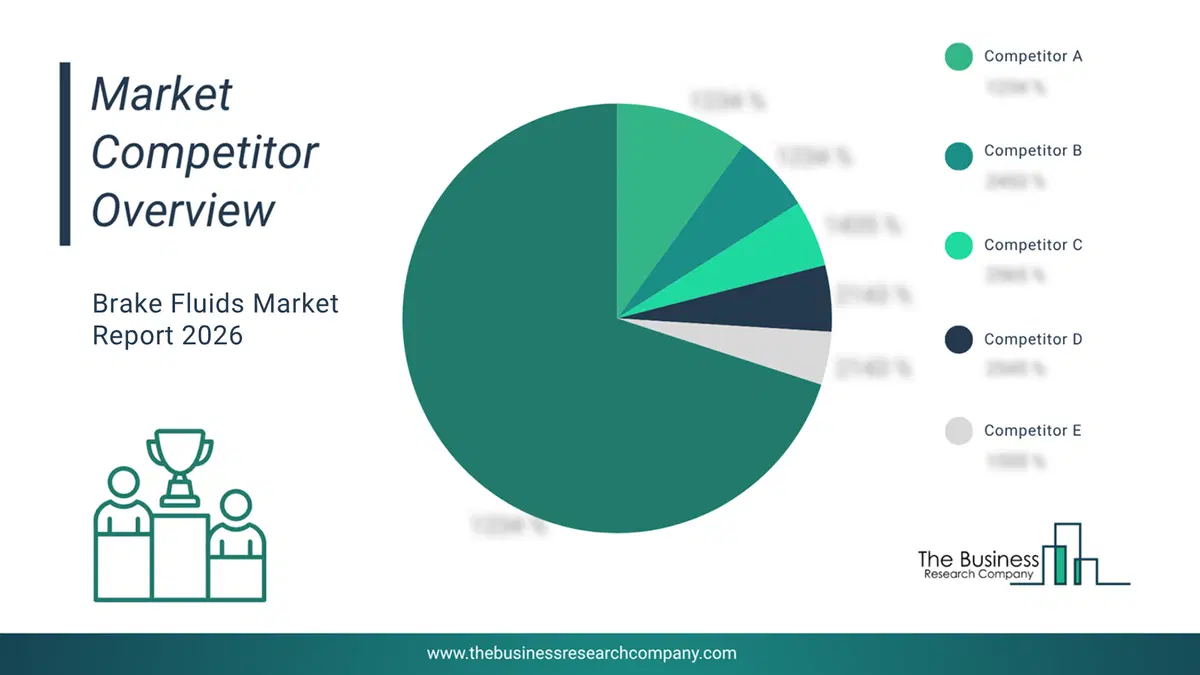
This chart is for illustrative purposes; the full report includes a detailed competitor analysis and comprehensive overview of the top 10 companies in the market.
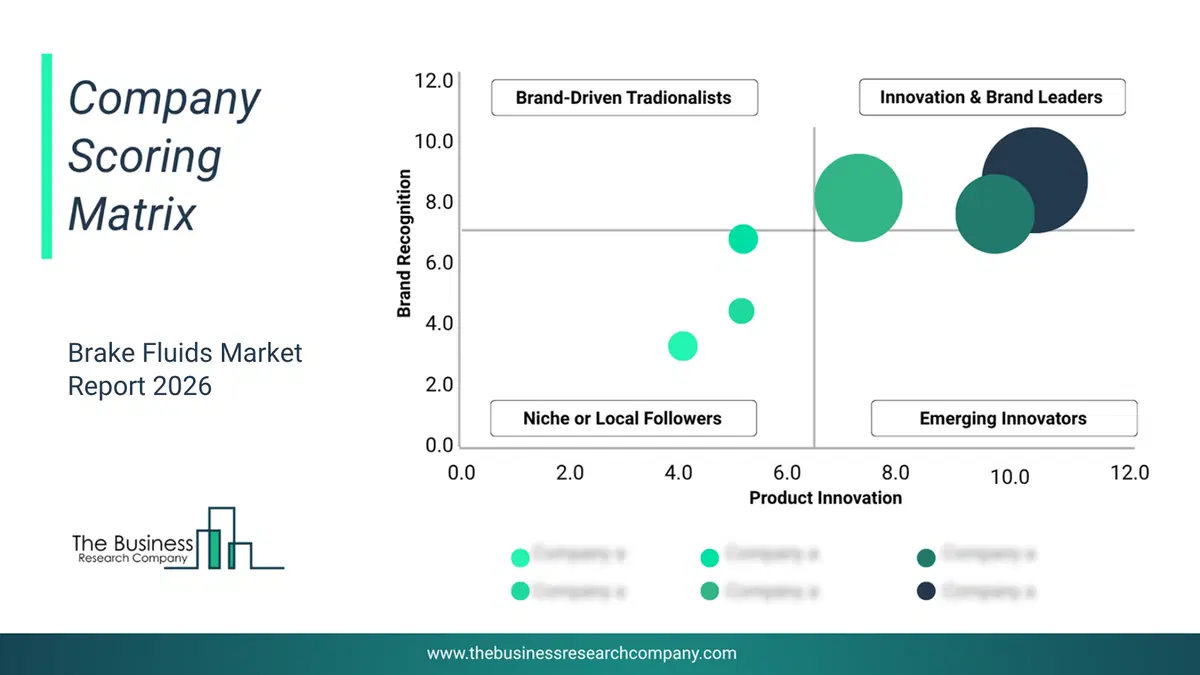
This chart maps companies by product innovation and brand strength, with bubble size indicating relative revenue, helping identify market leaders, challengers, and niche players. This is an illustrative chart; the full report provides a complete and accurate competitive analysis.
Global Brake Fluids Market Trends and Insights
Major companies operating in the brake fluids market are focusing on developing advanced DOT 4 racing brake fluid to improve braking consistency, thermal stability, and hydraulic response under extreme driving conditions. DOT 4 racing brake fluid is a high-performance hydraulic fluid with a high boiling point and excellent thermal stability, designed to deliver consistent braking performance under extreme racing conditions. For instance, in June 2026, Halo By Orthene, a UK-based brake fluid manufacturer, launched Halo GT, a DOT 4 racing brake fluid derived from its Halo P1 chemistry. The fluid features a 336°C dry boiling point and ultra-low viscosity, providing faster hydraulic response, consistent pedal feel, and improved brake modulation. It is designed for high-performance road vehicles and racing applications, including sprint racing and track day use.What Are Latest Mergers And Acquisitions In The Brake Fluids Market?
In April 2025, AO Racing, a US-based sports car racing team, partnered with Halo By Orthene to use Halo P1 brake fluid in its 2025 IMSA WeatherTech SportsCar Championship campaign. Through this partnership, AO Racing and Halo By Orthene aim to enhance braking consistency and racing performance by using advanced brake fluid designed to maintain high boiling-point performance and pedal feel under extreme racing conditions. Halo By Orthene is a UK-based brake fluid specialist providing high-performance motorsport brake fluids relevant to automotive braking applications.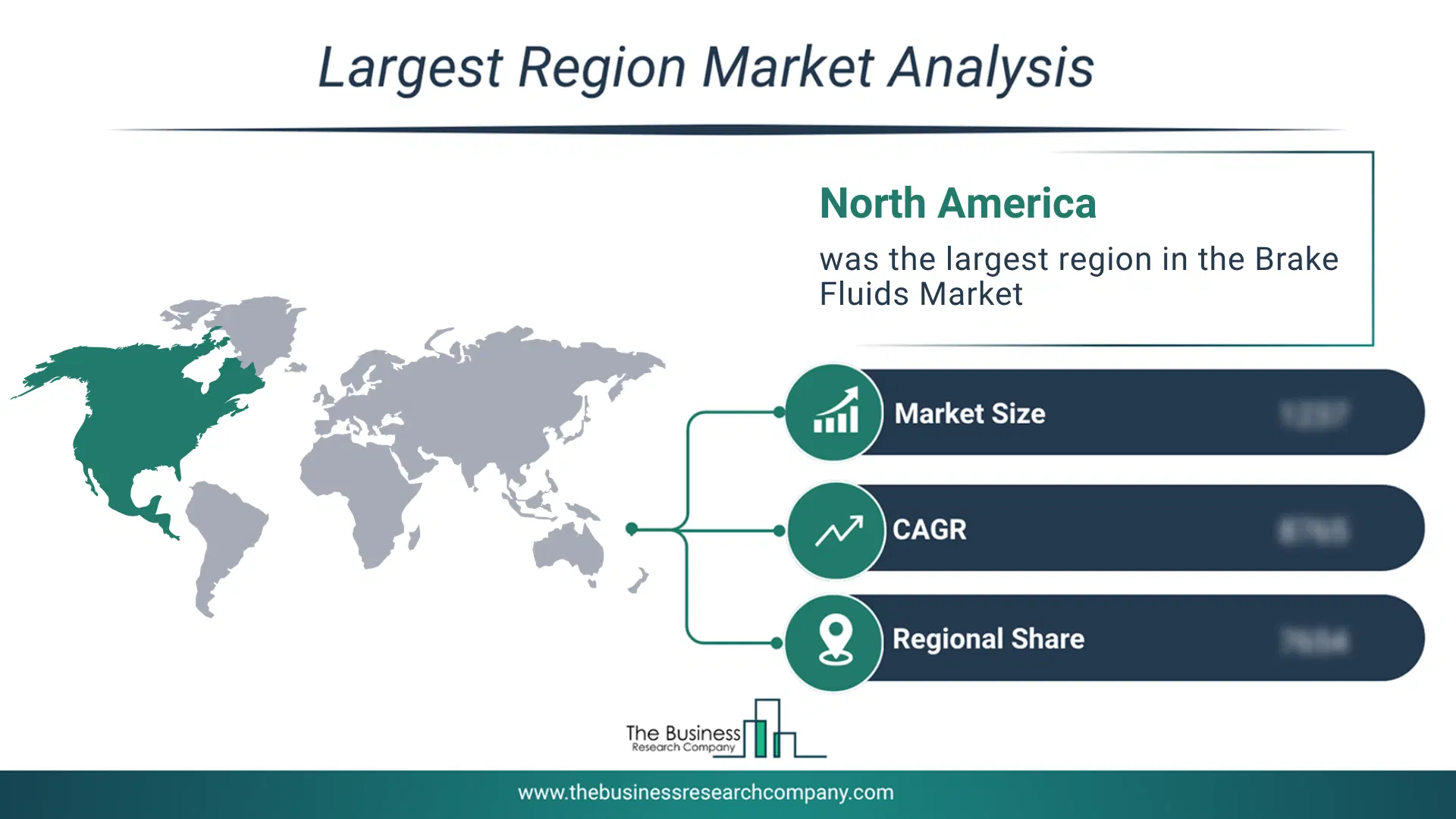
Regional Outlook/Insights
North America was the largest region in the brake fluids market in 2025. Asia-Pacific is expected to be the fastest-growing region in the forecast period. The regions covered in this market report are Asia-Pacific, South East Asia, Western Europe, Eastern Europe, North America, South America, Middle East, Africa. The countries covered in this market report are Australia, Brazil, China, France, Germany, India, Indonesia, Japan, Taiwan, Russia, South Korea, UK, USA, Canada, Italy, Spain.What Defines the Brake Fluids Market?
The brake fluid market consists of sales of hydraulic brake fluids, synthetic brake fluids, mineral-based brake fluids, and brake system flushing fluids. Values in this market are ‘factory gate’ values, that is, the value of goods sold by the manufacturers or creators of the goods, whether to other entities (including downstream manufacturers, wholesalers, distributors, and retailers) or directly to end customers. The value of goods in this market includes related services sold by the creators of the goods.How is Market Value Defined and Measured?
The market value is defined as the revenues that enterprises gain from the sale of goods and/or services within the specified market and geography through sales, grants, or donations in terms of the currency (in USD unless otherwise specified). The revenues for a specified geography are consumption values that are revenues generated by organizations in the specified geography within the market, irrespective of where they are produced. It does not include revenues from resales along the supply chain, either further along the supply chain or as part of other products.
This chart presents market attractiveness based on a quantitative evaluation of growth, competition, strategic alignment, and risk, offering a clear view of opportunity areas for decision-making. This chart is for illustrative purposes; the full report contains the complete analysis.

This chart highlights the Total Addressable Market (TAM) by estimating the maximum revenue opportunity using an assumption-driven approach, supporting strategic planning and opportunity sizing across markets. The chart is illustrative; the full report provides a more comprehensive analysis.
What Key Data and Analysis Are Included in the Brake Fluids Market Report 2026?
The brake fluids market research report is one of a series of new reports from The Business Research Company that provides market statistics, including industry global market size, regional shares, competitors with the market share, detailed market segments, market trends and opportunities, and any further data you may need to thrive in the brake fluids industry. The market research report delivers a complete perspective of everything you need, with an in-depth analysis of the current and future state of the industry.Brake Fluids Market Report Forecast Analysis
| Report Attribute | Details |
|---|---|
| Market Size Value In 2026 | $2.7 billion |
| Revenue Forecast In 2030 | $3.45 billion |
| Growth Rate | CAGR of 6.3% from 2026 to 2035 |
| Base Year For Estimation | 2025 |
| Actual Estimates/Historical Data | 2020-2025 |
| Forecast Period | 2026 - 2030 |
| Market Representation | Revenue in USD Billion and CAGR from 2026 to 2030 |
| Segments Covered | Product Type, Sales Channel, Application |
| Regional Scope | Asia-Pacific, Western Europe, Eastern Europe, North America, South America, Middle East, Africa |
| Country Scope | The countries covered in the report are Australia, Brazil, China, France, Germany, India, Indonesia, Japan, Taiwan, Russia, South Korea, UK, USA, Canada, Italy, Spain. |
| Customization Scope | Request for Customization |
| Pricing And Purchase Options | Explore Purchase Options |