
Brake Friction Products Market Report 2026
Global Outlook – By Product Type (Brake Pad, Shoe Liner), By Vehicle Type (Passenger Car, Lightweight Commercial Vehicle, Truck, Bus), By Distribution Channel (OEM (Original Equipment Manufacturer), Aftermarket) – Market Size, Trends, Strategies, and Forecast to 2030
Brake Friction Products Market Overview
• Brake Friction Products market size has reached to $11.59 billion in 2025 • Expected to grow to $14.6 billion in 2030 at a compound annual growth rate (CAGR) of 4.6% • Growth Driver: Autonomous Vehicles Driving Growth In Brake Friction Products Market • Market Trend: Innovative Brake Friction Products Enhance Safety And Performance • Asia-Pacific was the largest region in 2025 and North America is the fastest growing region.What Is Covered Under Brake Friction Products Market?
Brake friction products are materials used in braking systems to generate friction, which slows down or stops a vehicle. They typically include brake pads, shoes, and linings made from various composites, ceramics, and metals. These products are designed to withstand high temperatures and provide consistent performance under different driving conditions. The main product types of brake friction products are brake discs, pads, drums, and shoe liners. A brake disc is a circular metal disc that rotates with the wheel, against which brake pads apply friction to slow or stop the vehicle. The various disc materials include metallic discs and ceramic discs that are used by vehicle types such as passenger cars, lightweight commercial vehicles, trucks, bus.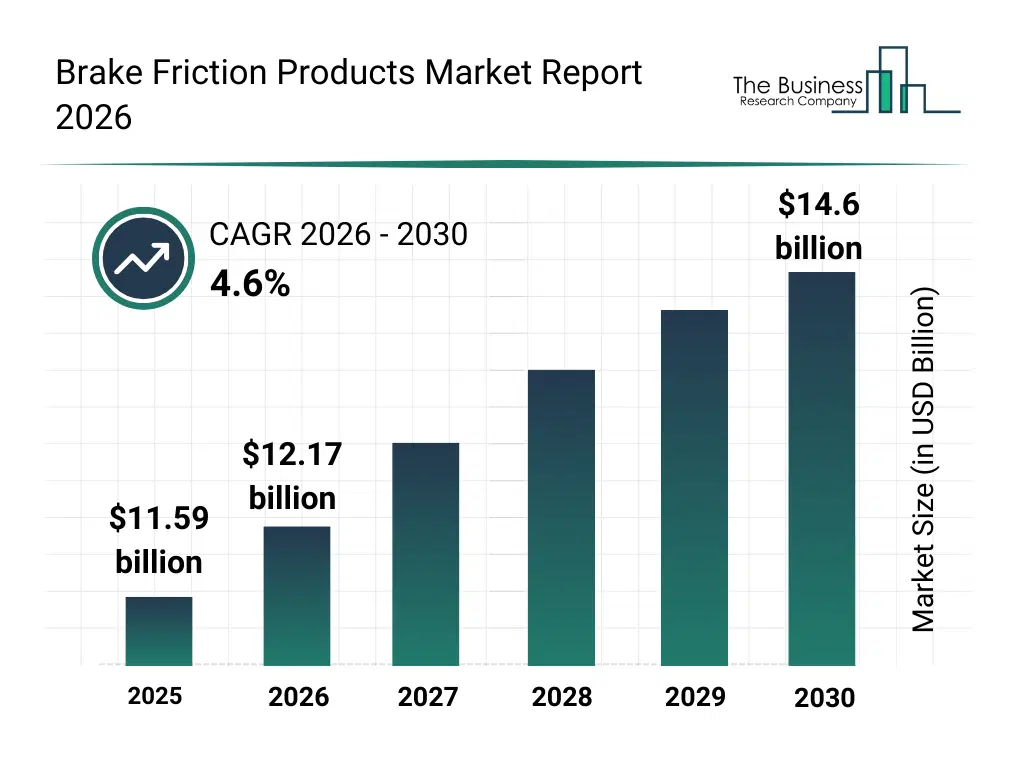
What Is The Brake Friction Products Market Size and Share 2026?
The brake friction products market size has grown strongly in recent years. It will grow from $11.59 billion in 2025 to $12.17 billion in 2026 at a compound annual growth rate (CAGR) of 5.0%. The growth in the historic period can be attributed to vehicle parc growth, regulatory ban on asbestos, demand for durable braking, expansion of automotive manufacturing, traditional friction materials.What Is The Brake Friction Products Market Growth Forecast?
The brake friction products market size is expected to see steady growth in the next few years. It will grow to $14.6 billion in 2030 at a compound annual growth rate (CAGR) of 4.6%. The growth in the forecast period can be attributed to EV adoption driving new friction needs, lightweight material innovation, demand for longer pad life, sustainability-driven formulations, advanced braking technologies. Major trends in the forecast period include demand for low-noise brake materials, adoption of asbestos-free products, growth of ceramic brake pads, rising focus on vehicle safety, expansion of electric vehicle brake systems.
Global Brake Friction Products Market Segmentation
1) By Product Type: Brake Pad, Shoe Liner 2) By Vehicle Type: Passenger Car, Lightweight Commercial Vehicle, Truck, Bus 3) By Distribution Channel: OEM (Original Equipment Manufacturer), Aftermarket Subsegments: 1) By Brake Pad: Organic Brake Pads, Semi-Metallic Brake Pads, Ceramic Brake Pads, Low-Metallic Nao (Non-Asbestos Organic) Pads 2) By Shoe Liner: Asbestos-Free Shoe Liners, Non-Asbestos Shoe Liners, Ceramic Shoe Liners, Organic Shoe LinersWhat Is The Driver Of The Brake Friction Products Market?
The increasing number of autonomous vehicles is expected to propel the growth of the brake friction products market going forward. Autonomous vehicles are self-driving cars that employ advanced sensor technologies, computer systems, and artificial intelligence to operate and navigate without constant human intervention or monitoring. The increasing number of autonomous vehicles is due to advancements in artificial intelligence and sensor technology, along with substantial investment and support from private companies and governments to enhance safety and efficiency in transportation. Brake friction products are vital for the safe, reliable, and efficient operation of autonomous vehicles, ensuring precise and controlled braking, integrating seamlessly with advanced driving systems, and contributing to the overall performance and durability of autonomous vehicles. For instance, in March 2024, according to the DQS Global, a Germany-based auditing and certification company, the United States is expected to have around 3.5 million autonomous vehicles on its roads by 2025, with this figure projected to increase to 4.5 million by 2030. Therefore, the increasing number of autonomous vehicles is driving the growth of the brake friction products industry.Key Players In The Global Brake Friction Products Market
Major companies operating in the brake friction products market report include Robert Bosch GmbH, TMD Friction Holdings GmbH, Brembo S.p.A., Nisshinbo Holdings Inc., Akebono Brake Industry Co., Ltd., ADVICS Co., Ltd., Federal-Mogul LLC, Aisin Corporation, Hitachi Astemo, Ltd., Mando Corporation, Sangsin Brake Co., Ltd., Fras-le S.A., MAT Holdings, Inc., EBC Brakes, Ferodo Racing Ltd., SBS Friction A/S, TRW Automotive Holdings Corp., Allied Nippon Limited, ITT Inc., Carlisle Brake & Friction Inc.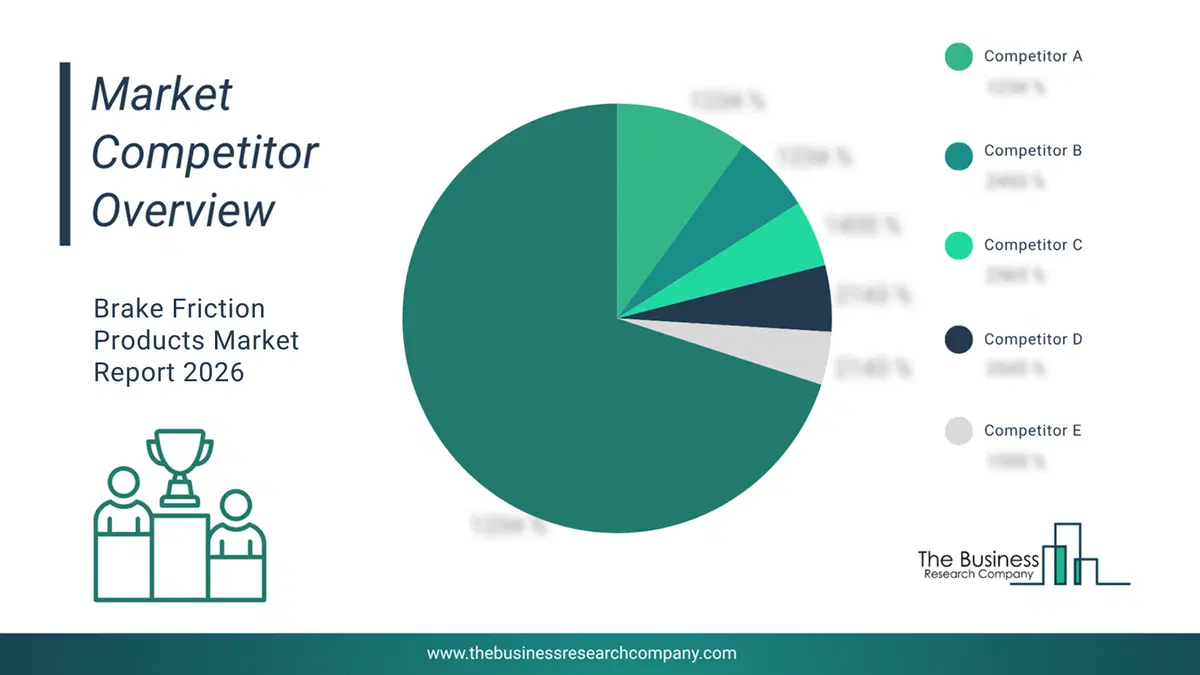
This chart is for illustrative purposes; the full report includes a detailed competitor analysis and comprehensive overview of the top 10 companies in the market.
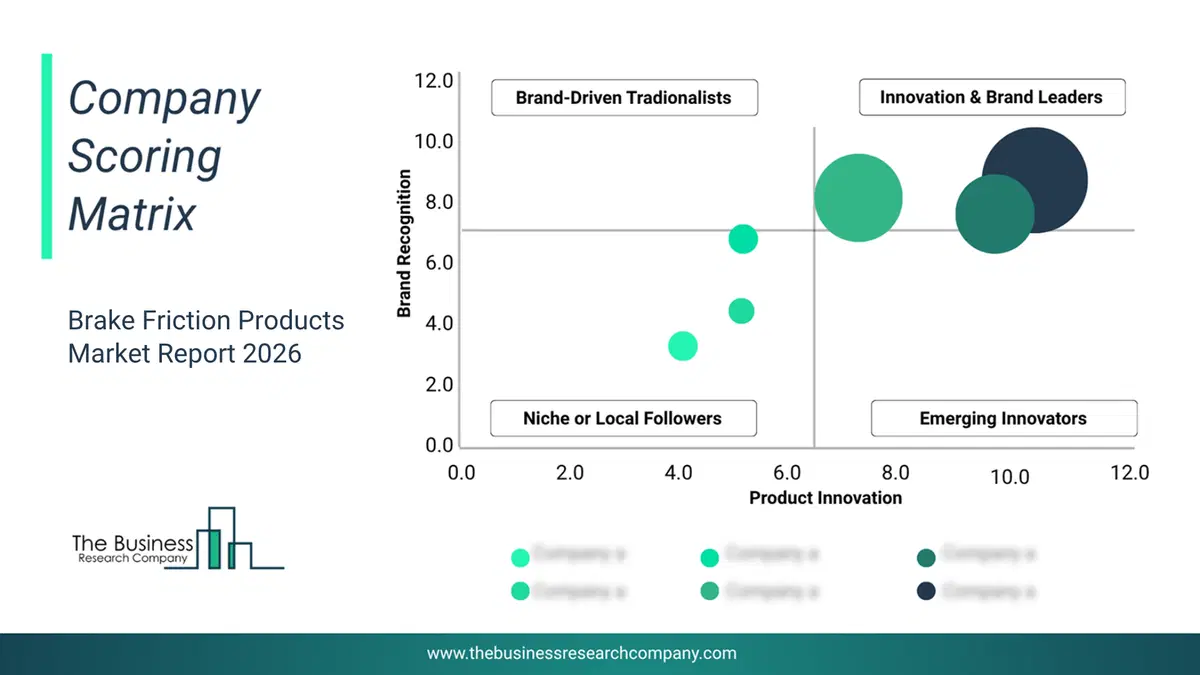
This chart maps companies by product innovation and brand strength, with bubble size indicating relative revenue, helping identify market leaders, challengers, and niche players. This is an illustrative chart; the full report provides a complete and accurate competitive analysis.
Global Brake Friction Products Market Trends and Insights
Major companies operating in brake friction products are developing innovative products using advanced absorbent glass mat (AGM) technology, ensuring greater safety and reliability for both conventional and autonomous vehicles. Advanced absorbent glass mat (AGM) technology is a type of lead-acid battery design that utilizes a glass fiber mat to absorb and hold the battery's acid, which improves the performance and reliability of electronic components within braking systems. For instance, in July 2023, Bosch, a Germany-based engineering company, launched Blue Line brake pads, which are considered next-gen auto parts. These brake pads are designed as an excellent alternative to original equipment (OE) brake pads, offering great friction stability, low noise and vibration suppression, and asbestos-free formulas. They are engineered to provide high braking performance, excellent thermal stability, and quiet braking, making them a reliable choice for everyday drivers.What Are Latest Mergers And Acquisitions In The Brake Friction Products Market?
In May 2025, SAF-HOLLAND, a Germany-based supplier of commercial vehicle components and systems, acquired full ownership of Haldex India for an undisclosed amount. With this acquisition, SAF-HOLLAND aims to strengthen its presence in the Indian commercial vehicle market, enhance its product portfolio in braking and suspension systems, optimize local operations, and drive long-term growth in the region. Haldex India is an India-based manufacturer specializing in vehicle braking solutions and air suspension systems.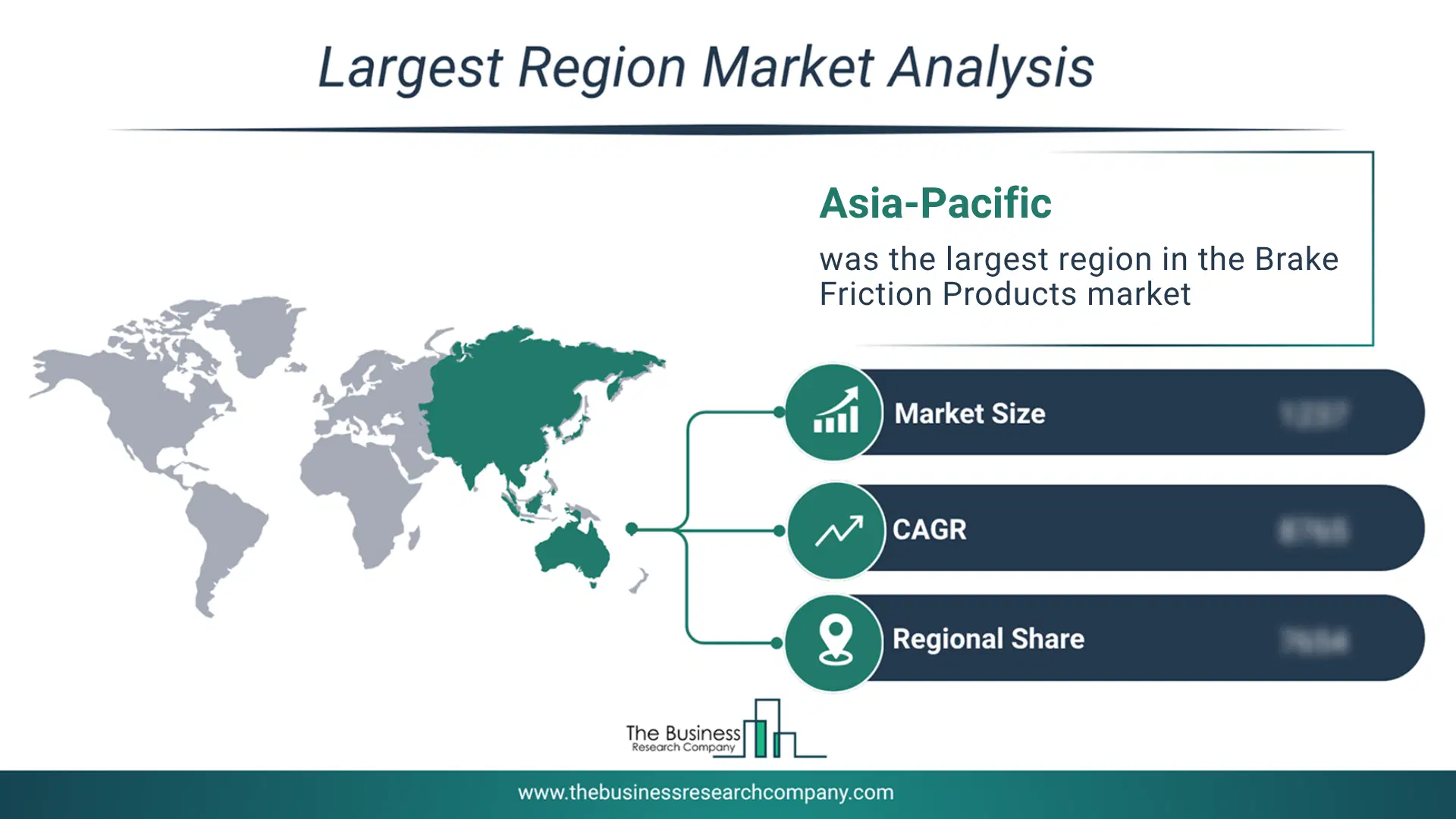
Regional Outlook
Asia-Pacific was the largest region in the brake friction products market in 2025. North America is expected to be the fastest-growing region in the forecast period. The regions covered in this market report include Asia-Pacific, South East Asia, Western Europe, Eastern Europe, North America, South America, Middle East, Africa. The countries covered in this market report include Australia, Brazil, China, France, Germany, India, Indonesia, Japan, Taiwan, Russia, South Korea, UK, USA, Canada, Italy, SpainWhat Defines the Brake Friction Products Market?
The brake friction products market consists of sales of hybrid brake pads, glass, fillers, and high-temperature resins. Values in this market are ‘factory gate’ values, that is, the value of goods sold by the manufacturers or creators of the goods, whether to other entities (including downstream manufacturers, wholesalers, distributors, and retailers) or directly to end customers.How is Market Value Defined and Measured?
The market value is defined as the revenues that enterprises gain from the sale of goods and/or services within the specified market and geography through sales, grants, or donations in terms of the currency (in USD unless otherwise specified). The revenues for a specified geography are consumption values that are revenues generated by organizations in the specified geography within the market, irrespective of where they are produced. It does not include revenues from resales along the supply chain, either further along the supply chain or as part of other products.
This chart presents market attractiveness based on a quantitative evaluation of growth, competition, strategic alignment, and risk, offering a clear view of opportunity areas for decision-making. This chart is for illustrative purposes; the full report contains the complete analysis.

This chart highlights the Total Addressable Market (TAM) by estimating the maximum revenue opportunity using an assumption-driven approach, supporting strategic planning and opportunity sizing across markets. The chart is illustrative; the full report provides a more comprehensive analysis.
What Key Data and Analysis Are Included in the Brake Friction Products Market Report 2026?
The brake friction products market research report is one of a series of new reports from The Business Research Company that provides market statistics, including industry global market size, regional shares, competitors with the market share, detailed market segments, market trends and opportunities, and any further data you may need to thrive in the brake friction products industry. The market research report delivers a complete perspective of everything you need, with an in-depth analysis of the current and future state of the industry.Brake Friction Products Market Report Forecast Analysis
| Report Attribute | Details |
|---|---|
| Market Size Value In 2026 | $12.17 billion |
| Revenue Forecast In 2030 | $14.6 billion |
| Growth Rate | CAGR of 5.0% from 2026 to 2030 |
| Base Year For Estimation | 2025 |
| Actual Estimates/Historical Data | 2020-2025 |
| Forecast Period | 2026 - 2030 - 2030 |
| Market Representation | Revenue in USD Billion and CAGR from 2026 to 2030 |
| Segments Covered | Product Type, Vehicle Type, Distribution Channel |
| Regional Scope | Asia-Pacific, Western Europe, Eastern Europe, North America, South America, Middle East, Africa |
| Country Scope | The countries covered in the report are Australia, Brazil, China, France, Germany, India, Indonesia, Japan, Taiwan, Russia, South Korea, UK, USA, Canada, Italy, Spain. |
| Key Companies Profiled | Robert Bosch GmbH, TMD Friction Holdings GmbH, Brembo S.p.A., Nisshinbo Holdings Inc., Akebono Brake Industry Co., Ltd., ADVICS Co., Ltd., Federal-Mogul LLC, Aisin Corporation, Hitachi Astemo, Ltd., Mando Corporation, Sangsin Brake Co., Ltd., Fras-le S.A., MAT Holdings, Inc., EBC Brakes, Ferodo Racing Ltd., SBS Friction A/S, TRW Automotive Holdings Corp., Allied Nippon Limited, ITT Inc., Carlisle Brake & Friction Inc. |
| Customization Scope | Request for Customization |
| Pricing And Purchase Options | Explore Purchase Options |