
Breast Imaging Devices Market Report 2026
Global Outlook – By Product Type (Tomosynthesis, Breast Ultrasound, Breast Magnetic Resonance Imaging (MRI), Mammography, Nuclear Imaging, Other Product Types), By Technology (Ionizing, Non Ionizing), By End User (Hospitals And Clinics, Breast Care Centers, Diagnostic Imaging Centers) – Market Size, Trends, Strategies, and Forecast to 2030
Breast Imaging Devices Market Overview
• Breast Imaging Devices market size has reached to $5.27 billion in 2025 • Expected to grow to $7.24 billion in 2030 at a compound annual growth rate (CAGR) of 6.7% • Growth Driver: Rising Prevalence Of Breast Cancer In Breast Imaging Devices Market • Market Trend: Innovations in Breast Imaging Devices Enhancing Early Detection and Diagnostic Accuracy for Breast Cancer • North America was the largest region in 2025 and Asia-Pacific is the fastest growing region.What Is Covered Under Breast Imaging Devices Market?
Breast imaging devices refer to medical equipment used to provide screening, diagnostic, surgical, and support services for breast health and cancerous and noncancerous breast disease. The use of these devices is essential in the early detection and treatment of breast cancer. The main product types in breast imaging devices are tomosynthesis, breast ultrasound, breast MRI, mammography, nuclear imaging, and others. Tomosynthesis is an imaging method that is utilized to screen for early signs of breast cancer in people with no symptoms. This kind of imaging can also be utilized as a diagnostic tool for a person who is experiencing breast cancer symptoms. The technologies involved in breast imaging devices are ionizing and non-ionizing. These are used in hospitals and clinics, breast care centers, and diagnostic imaging centers.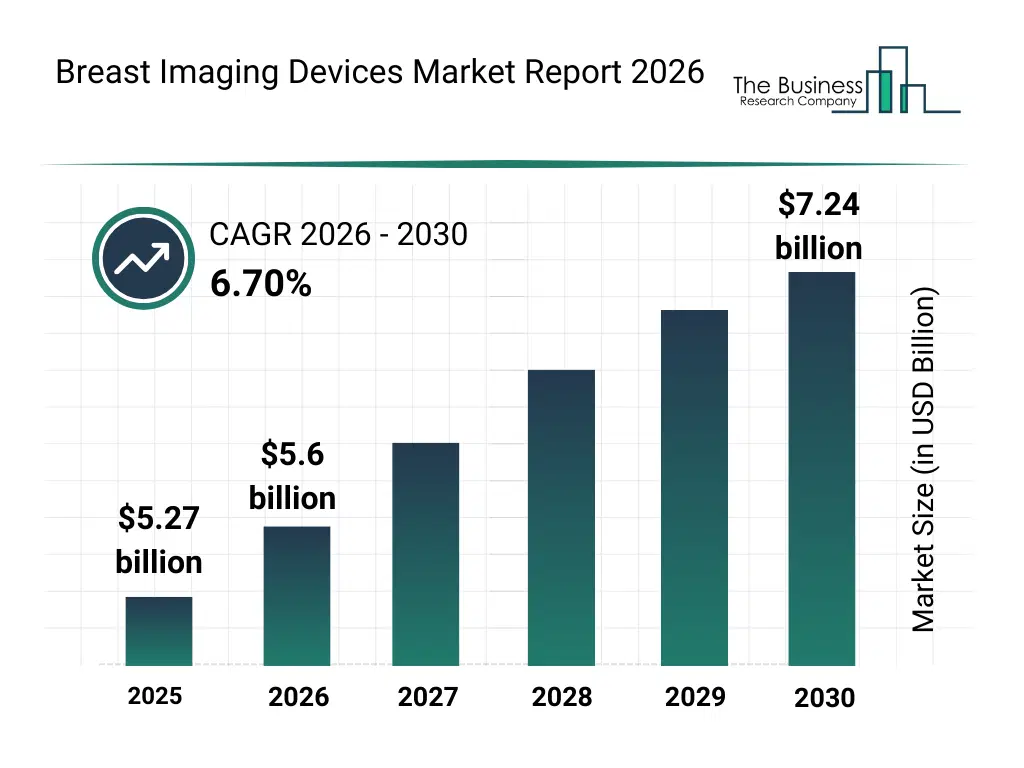
What Is The Breast Imaging Devices Market Size and Share 2026?
The breast imaging devices market size has grown strongly in recent years. It will grow from $5.27 billion in 2025 to $5.6 billion in 2026 at a compound annual growth rate (CAGR) of 6.3%. The growth in the historic period can be attributed to rising breast cancer screening awareness, expansion of diagnostic imaging centers, increasing availability of digital mammography systems, growing healthcare expenditure, adoption of advanced ultrasound technologies.What Is The Breast Imaging Devices Market Growth Forecast?
The breast imaging devices market size is expected to see strong growth in the next few years. It will grow to $7.24 billion in 2030 at a compound annual growth rate (CAGR) of 6.7%. The growth in the forecast period can be attributed to increasing investments in ai-enabled diagnostic tools, rising demand for early cancer detection solutions, expansion of outpatient imaging services, growing focus on personalized breast care, technological advancements in non-ionizing imaging systems. Major trends in the forecast period include increasing adoption of ai-assisted image analysis, rising use of 3D and digital breast tomosynthesis, growing integration of multimodal imaging platforms, expansion of minimally invasive diagnostic imaging, enhanced focus on early-stage cancer detection.
Global Breast Imaging Devices Market Segmentation
1) By Product Type: Tomosynthesis, Breast Ultrasound, Breast Magnetic Resonance Imaging (MRI), Mammography, Nuclear Imaging, Other Product Types 2) By Technology: Ionizing, Non Ionizing 3) By End User: Hospitals And Clinics, Breast Care Centers, Diagnostic Imaging Centers Subsegments: 1) By Tomosynthesis: Digital Breast Tomosynthesis (DBT), 3D Mammography Systems 2) By Breast Ultrasound: Handheld Ultrasound, Automated Breast Ultrasound System (ABUS), Elastography 3) By Breast Magnetic Resonance Imaging (MRI): Contrast-Enhanced MRI, Functional MRI 4) By Mammography: Digital Mammography, Film Mammography, 2D Mammography 5) By Nuclear Imaging: Positron Emission Tomography (PET), Single Photon Emission Computed Tomography (SPECT) 6) By Other Product Types: Infrared Imaging, Molecular Imaging Systems, Stereotactic Breast Biopsy DevicesWhat Is The Driver Of The Breast Imaging Devices Market?
The rising prevalence of breast cancer is anticipated to contribute to the breast imaging device market’s growth. A growing number of hormone replacement therapies (HRT), hormonal imbalances, menopause, and various reproductive disorders have significantly increased the risk of breast cancer. According to the World Health Organization (WHO), breast cancer is the most common cancer in women, impacting 2.1 million women annually. Breast cancer causes the highest number of cancer-related deaths among women. For instance, in February 2023, according to the American Society of Clinical Oncology (ASCO), a US-based professional organization that publishes patient information on the cancer.net website, women are diagnosed with breast cancer in the United States for 1 in 3 new female cancers annually, and in 2023, an estimated 297,790 women in the United States will be diagnosed with invasive breast cancer and 55,720 with non-invasive (in situ) breast cancer. Therefore, the rising prevalence of breast cancer driving the growth of the breast imaging devices equipment market.Key Players In The Global Breast Imaging Devices Market
Major companies operating in the breast imaging devices market are Siemens Healthineers AG, Hologic Inc, GE Healthcare, FUJIFILM Holdings Corporation, Canon Medical Systems Corporation, Koninklijke Philips N.V, Aurora Imaging Technology Inc, Delphinus Medical Technologies Inc, Micrima Limited, SonoCiné Inc, Planmed Oy, Carestream Health Inc, Dilon Technologies Inc, Toshiba Medical Systems Corporation, SuperSonic Imagine SA, IMS Giotto (Giotto Imaging), Samsung Medison Co Ltd, Hitachi Ltd, Koning Corporation, Metaltronica S.p.A, CMT Medical Technologies Ltd, Gamma Medica Inc, KUB Technologies Inc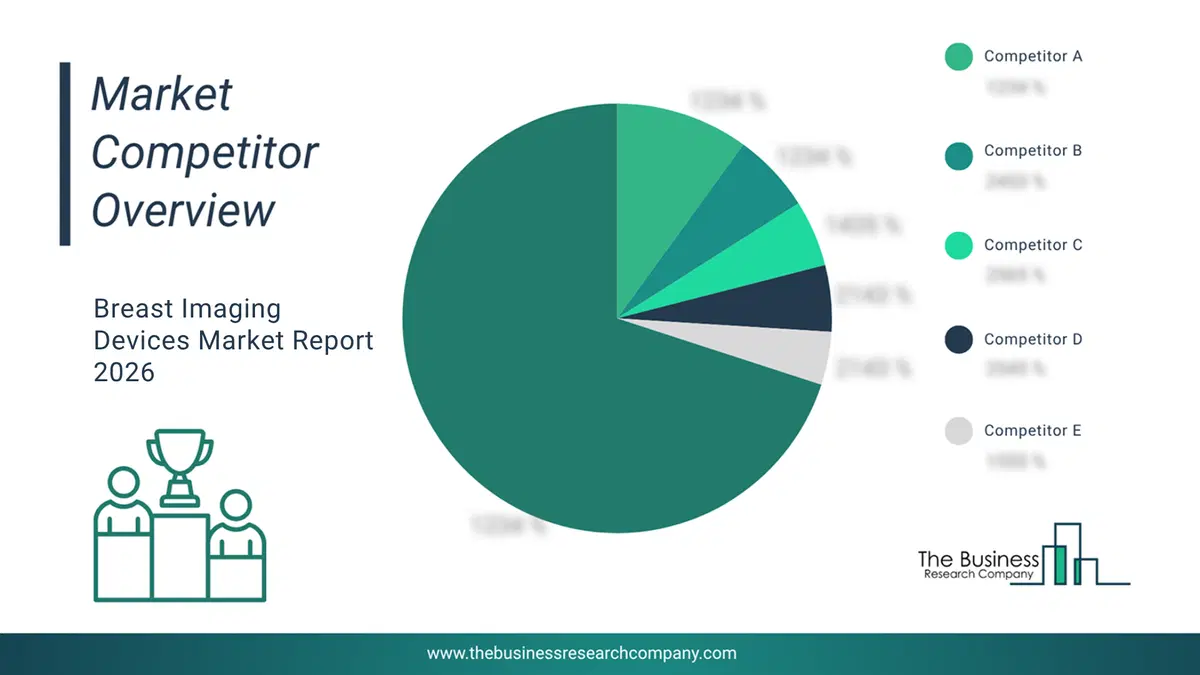
This chart is for illustrative purposes; the full report includes a detailed competitor analysis and comprehensive overview of the top 10 companies in the market.
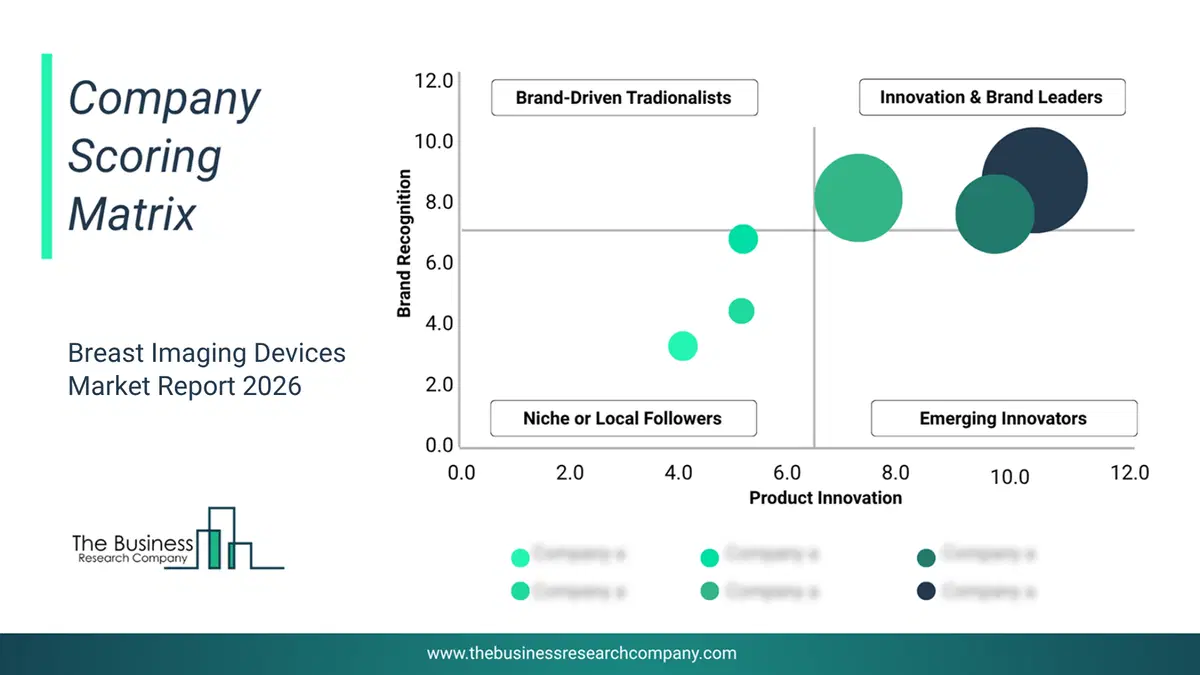
This chart maps companies by product innovation and brand strength, with bubble size indicating relative revenue, helping identify market leaders, challengers, and niche players. This is an illustrative chart; the full report provides a complete and accurate competitive analysis.
Global Breast Imaging Devices Market Trends and Insights
Major companies operating in the breast imaging devices market are focusing on developing technologically advanced solutions, such as advanced imaging techniques, to enhance early detection and improve diagnostic accuracy for breast cancer. Advanced imaging techniques refer to sophisticated methods used to visualize internal structures of the body with greater detail and precision, such as digital mammography, 3D tomosynthesis, and magnetic resonance imaging (MRI). For instance, in October 2024, StoneSprings Hospital Centre, a US-based healthcare hospital, launched new breast imaging technology. The new technology utilizes state-of-the-art imaging modalities, including digital mammography and 3D tomosynthesis, which provide clearer and more detailed images of breast tissue. This advancement helps in identifying abnormalities that may not be visible with traditional 2D mammography. The system is designed to integrate artificial intelligence (AI) algorithms that assist radiologists in interpreting images more accurately. AI can help flagging potential areas of concern, thereby reducing the chances of missed diagnoses and improving overall accuracy.What Are Latest Mergers And Acquisitions In The Breast Imaging Devices Market?
In May 2024, Lunit, a South Korea-based medical AI company that develops software for cancer screening and treatment, acquired Volpara Health Technologies Limited for an undisclosed amount with this acquisition. Lunit aims to enhance its AI-driven cancer diagnostics, expand its market presence in the U.S., and develop innovative solutions for early cancer detection and improved patient outcomes. Volpara Health Technologies Limited is a New Zealand-based software company that enhances breast imaging devices with innovative software for improved cancer detection.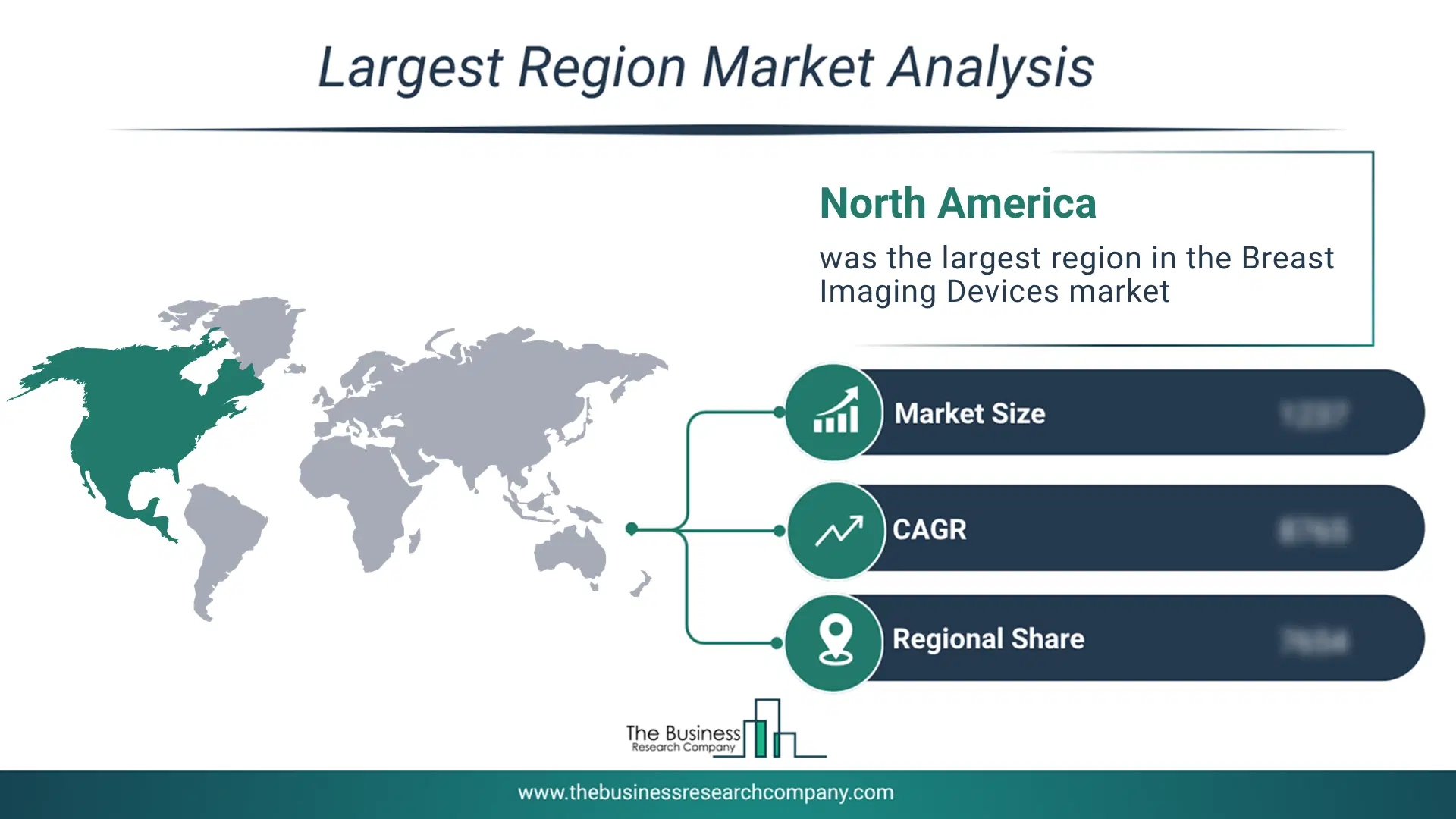
Regional Outlook
North America was the largest region in the breast imaging devices market in 2025. Asia-Pacific was the second largest market in the global breast imaging devices market report. The regions covered in this market report are Asia-Pacific, South East Asia, Western Europe, Eastern Europe, North America, South America, Middle East, Africa. The countries covered in this market report are Australia, Brazil, China, France, Germany, India, Indonesia, Japan, Taiwan, Russia, South Korea, UK, USA, Canada, Italy, SpainWhat Defines the Breast Imaging Devices Market?
The breast imaging devices market consists of sales of imaging equipment such as breast ultrasound, breast MRI, mammography, nuclear imaging, and others. Values in this market are factory gate values, that is the value of goods sold by the manufacturers or creators of the goods, whether to other entities (including downstream manufacturers, wholesalers, distributors, and retailers) or directly to end customers. The value of goods in this market includes related services sold by the creators of the goods.How is Market Value Defined and Measured?
The market value is defined as the revenues that enterprises gain from the sale of goods and/or services within the specified market and geography through sales, grants, or donations in terms of the currency (in USD unless otherwise specified). The revenues for a specified geography are consumption values that are revenues generated by organizations in the specified geography within the market, irrespective of where they are produced. It does not include revenues from resales along the supply chain, either further along the supply chain or as part of other products.
This chart presents market attractiveness based on a quantitative evaluation of growth, competition, strategic alignment, and risk, offering a clear view of opportunity areas for decision-making. This chart is for illustrative purposes; the full report contains the complete analysis.

This chart highlights the Total Addressable Market (TAM) by estimating the maximum revenue opportunity using an assumption-driven approach, supporting strategic planning and opportunity sizing across markets. The chart is illustrative; the full report provides a more comprehensive analysis.
What Key Data and Analysis Are Included in the Breast Imaging Devices Market Report 2026?
The breast imaging devices market research report is one of a series of new reports from The Business Research Company that provides market statistics, including industry global market size, regional shares, competitors with the market share, detailed market segments, market trends and opportunities, and any further data you may need to thrive in the breast imaging devices industry. The market research report delivers a complete perspective of everything you need, with an in-depth analysis of the current and future state of the industry.Breast Imaging Devices Market Report Forecast Analysis
| Report Attribute | Details |
|---|---|
| Market Size Value In 2026 | $5.6 billion |
| Revenue Forecast In 2030 | $7.24 billion |
| Growth Rate | CAGR of 6.7% from 2026 to 2030 |
| Base Year For Estimation | 2025 |
| Actual Estimates/Historical Data | 2020-2025 |
| Forecast Period | 2026 - 2030 |
| Market Representation | Revenue in USD Billion and CAGR from 2026 to 2030 |
| Segments Covered | Product Type, Technology, End User |
| Regional Scope | Asia-Pacific, Western Europe, Eastern Europe, North America, South America, Middle East, Africa |
| Country Scope | The countries covered in the report are Australia, Brazil, China, France, Germany, India, Indonesia, Japan, Taiwan, Russia, South Korea, UK, USA, Canada, Italy, Spain. |
| Key Companies Profiled | Siemens Healthineers AG, Hologic Inc, GE Healthcare, FUJIFILM Holdings Corporation, Canon Medical Systems Corporation, Koninklijke Philips N.V, Aurora Imaging Technology Inc, Delphinus Medical Technologies Inc, Micrima Limited, SonoCiné Inc, Planmed Oy, Carestream Health Inc, Dilon Technologies Inc, Toshiba Medical Systems Corporation, SuperSonic Imagine SA, IMS Giotto (Giotto Imaging), Samsung Medison Co Ltd, Hitachi Ltd, Koning Corporation, Metaltronica S.p.A, CMT Medical Technologies Ltd, Gamma Medica Inc, KUB Technologies Inc |
| Customization Scope | Request for Customization |
| Pricing And Purchase Options | Explore Purchase Options |