

Bridge Anti-Climb Barriers Market Report 2026
Global Outlook – By Product Type ( Welded Mesh Barriers, Palisade Barriers, Expanded Metal Barriers, Other Product Types), By Material ( Steel, Aluminum, Composite Materials, Other Materials), By Installation Type ( Permanent, Temporary), By Application ( Highway Bridges, Railway Bridges, Pedestrian Bridges, Other Applications), By End-User ( Government, Transportation Authorities, Commercial, Other End-Users) – Market Size, Trends, Strategies, and Forecast to 2030
Bridge Anti-Climb Barriers Market Overview
• Bridge Anti-Climb Barriers market size has reached to $1.29 billion in 2025 • Expected to grow to $1.94 billion in 2030 at a compound annual growth rate (CAGR) of 8.5% • Growth Driver: Rising Transportation Infrastructure Modernization Investments Are Driving The Market Due To Increasing Bridge Construction, Safety Enhancements, And Demand For Advanced Protective Solutions • North America was the largest region in 2025 and Asia-Pacific is the fastest growing region.What Is Covered Under Bridge Anti-Climb Barriers Market?
Bridge anti-climb barriers are safety installations on bridges designed to prevent unauthorized access over railings or parapets. They are commonly constructed using steel mesh, vertical bars, or curved extensions that restrict footholds and climbing attempts. Their main function is to improve safety by minimizing fall risks, deterring trespassing, and protecting both infrastructure and the safe movement of pedestrians and vehicles. The main product types of bridge anti-climb barriers include welded mesh barriers, palisade barriers, expanded metal barriers, and other product types. Welded mesh barriers refer to high-strength protective fencing systems designed to prevent unauthorized climbing and enhance safety on bridge structures. They are categorized by material including steel, aluminum, composite materials, and other materials and by installation type including permanent and temporary. The various applications involved are highway bridges, railway bridges, pedestrian bridges, and others, and they are used by several end users such as government, transportation authorities, commercial, and others.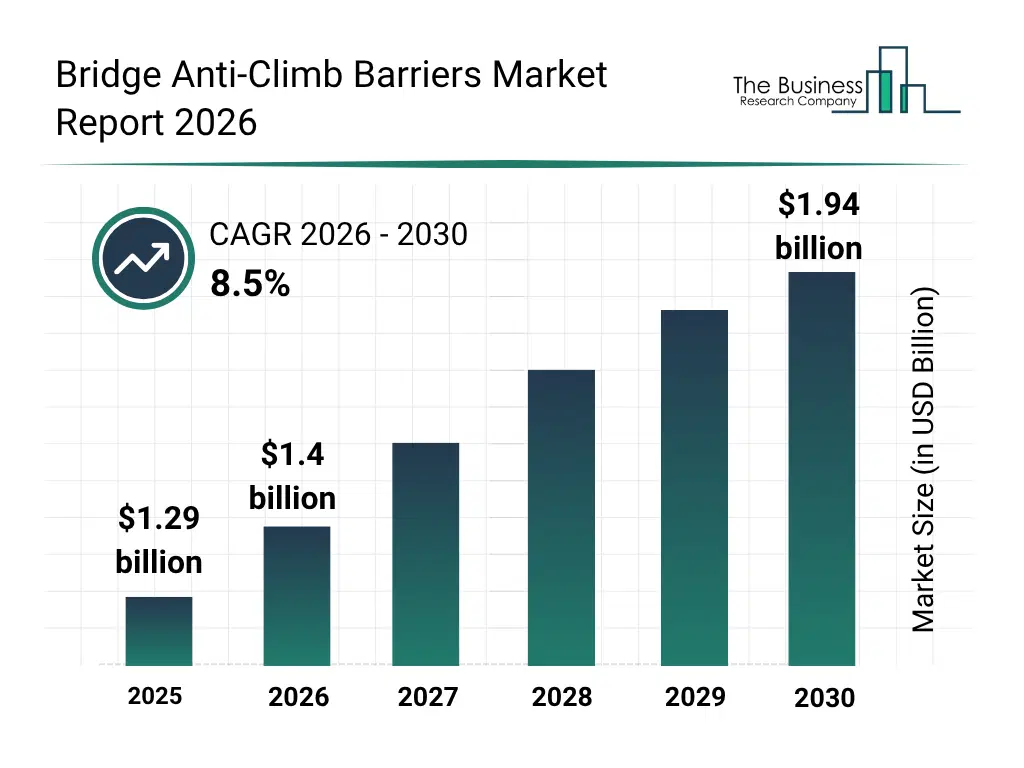
What Is The Bridge Anti-Climb Barriers Market Size and Share 2026?
The bridge anti-climb barriers market size has grown strongly in recent years. It will grow from $1.29 billion in 2025 to $1.4 billion in 2026 at a compound annual growth rate (CAGR) of 8.3%. The growth in the historic period can be attributed to increasing investments in public infrastructure safety, rising urbanization and bridge construction activities, growing concerns regarding bridge trespassing incidents, expansion of transportation infrastructure modernization projects, increasing adoption of durable metal barrier systems.What Is The Bridge Anti-Climb Barriers Market Growth Forecast?
The bridge anti-climb barriers market size is expected to see strong growth in the next few years. It will grow to $1.94 billion in 2030 at a compound annual growth rate (CAGR) of 8.5%. The growth in the forecast period can be attributed to growing demand for smart bridge safety infrastructure, rising investments in sustainable and corrosion-resistant materials, increasing deployment of modular infrastructure protection systems, expansion of railway and highway bridge safety projects, growing focus on long-term infrastructure maintenance and security solutions. Major trends in the forecast period include increasing adoption of high-security anti-climb barrier systems for critical bridge infrastructure, rising demand for corrosion-resistant bridge safety barriers in harsh environmental conditions, growing installation of modular anti-climb barrier systems for rapid infrastructure upgrades, expansion of transparent anti-climb barriers for improved bridge aesthetics and visibility, increasing use of heavy-duty welded mesh barriers for highway and railway bridge protection.
Global Bridge Anti-Climb Barriers Market Segmentation
1) By Product Type: Welded Mesh Barriers, Palisade Barriers, Expanded Metal Barriers, Other Product Types 2) By Material: Steel, Aluminum, Composite Materials, Other Materials 3) By Installation Type: Permanent, Temporary 4) By Application: Highway Bridges, Railway Bridges, Pedestrian Bridges, Other Applications 5) By End-User: Government, Transportation Authorities, Commercial, Other End-Users Subsegments: 1) By Welded Mesh Barriers: Galvanized Welded Mesh Barriers, Stainless Steel Welded Mesh Barriers, Polyvinyl Chloride Coated Welded Mesh Barriers, Powder Coated Welded Mesh Barriers, High Security Welded Mesh Barriers 2) By Palisade Barriers: D Section Pales Palisade Barriers, W Section Pales Palisade Barriers, I Section Pales Palisade Barriers, Angle Iron Palisade Barriers, Galvanized Palisade Barriers, Powder Coated Palisade Barriers 3) By Expanded Metal Barriers: Raised Expanded Metal Barriers, Flattened Expanded Metal Barriers, Heavy Duty Expanded Metal Barriers, Decorative Expanded Metal Barriers, Galvanized Expanded Metal Barriers, Stainless Steel Expanded Metal Barriers 4) By Other Product Types: Hybrid Composite Anti Climb Barriers, Polycarbonate Transparent Anti Climb Barriers, Modular Panel Anti Climb Barriers, Wire Rope Mesh Anti Climb Barriers, Concrete Integrated Anti Climb Barriers, Hybrid Metal Polymer Anti Climb BarriersWhat Are The Drivers Of The Bridge Anti-Climb Barriers Market?
The growing investment in transportation infrastructure modernization is expected to propel the growth of the bridge anti-climb barriers market going forward. Investment in transportation infrastructure modernization involves allocating funds to upgrade and integrate advanced technologies and systems to enhance the efficiency, safety, and sustainability of transport networks. Rising investment in transportation infrastructure is driven by rapid urbanization and population growth, increasing pressure on existing systems, prompting governments to expand capacity, reduce congestion, and ensure efficient movement of people and goods to sustain economic productivity. Investment in transportation infrastructure increases bridge construction and upgrades, driving demand for anti-climb barriers to enhance safety and prevent unauthorized access, while enabling the use of advanced, durable designs that meet safety standards. For instance, in October 2024, according to the United States Department of Transportation, a US-based federal transport authority, they announced nearly $635 million for 22 bridge projects, adding to the broader bridge program’s $8.1 billion investment across 100 projects in 44 states. Therefore, the growing investment in transportation infrastructure modernization is driving the bridge anti-climb-barrier market. The growth in vehicle density and traffic congestion is expected to propel the growth of the bridge anti-climb barriers market going forward. Vehicle density and traffic congestion refer to the number of registered motor vehicles operating within a given area, often concentrated around major road infrastructure such as bridges, overpasses, and urban transit corridors. The rising vehicle density and traffic congestion is largely driven by rapid urbanization, as expanding city populations generate higher demand for personal vehicle ownership, putting sustained pressure on road infrastructure and increasing the accessibility of critical assets such as bridges to unauthorized access. As more vehicles and people converge around bridges and elevated road structures, the risk of trespass, vandalism, and security breaches intensifies, directly accelerating the adoption of physical deterrent systems such as anti-climb barriers to protect these high-traffic assets. For instance, in August 2024, according to the Federal Highway Administration (FHWA), a U.S.-based agency operating under the U.S. Department of Transportation, the Travel Time Index (TTI) rose from 1.22 in 2022 to 1.24 in 2023, reflecting an increase in per-trip travel delays due to worsening traffic congestion. Therefore, growth in vehicle density and traffic congestion is driving the growth of the bridge anti-climb barriers industry. The expansion of smart cities is expected to propel the growth of the bridge anti-climb barrier market going forward. Smart cities refer to urban areas that use advanced digital technologies and data-driven solutions to enhance infrastructure, safety, and quality of life. The expansion of smart cities is rising due to rapid urban population growth, which requires more efficient and secure infrastructure systems to manage increasing mobility and public safety demands. Bridge anti-climb barriers enhance safety in smart cities by preventing unauthorized access and reducing risks on bridges while supporting integration with smart monitoring systems for improved surveillance and efficient infrastructure management. For instance, in January 2024, according to the Institute of the Americas, a US-based non-profit organization, global spending on smart city initiatives in 2023 would surpass $190 billion. Therefore, the expansion of smart cities is driving the growth of the bridge anti-climb barriers industry.Key Players In The Global Bridge Anti-Climb Barriers Market
Major companies operating in the bridge anti-climb barriers market are Bekaert NV, Ameristar Perimeter Security (ASSA ABLOY Group), Betafence, A-1 Fence Products, Jacksons Fencing, CLD Fencing Systems, Procter Contracts, Steelway Fensecure, Lang+Fulton, Zaun Ltd, Gregory Industries, Betafence USA, Maccaferri, Hebei Jinbiao Construction Materials, Gibraltar Perimeter SecurityRegional Outlook
North America was the largest region in the bridge anti-climb barriers market in 2025. Asia-Pacific is expected to be the fastest-growing region in the forecast period.The regions covered in this market report are Asia-Pacific, South East Asia, Western Europe, Eastern Europe, North America, South America, Middle East, Africa. The countries covered in this market report are Australia, Brazil, China, France, Germany, India, Indonesia, Japan, Taiwan, Russia, South Korea, UK, USA, Canada, Italy, Spain.What Defines the Bridge Anti-Climb Barriers Market?
The bridge anti-climb barriers market consists of sales of vertical rod (bar) barriers, curved overhang barriers, transparent polycarbonate barriers, and cable barrier systems. Values in this market are ‘factory gate’ values, that is, the value of goods sold by the manufacturers or creators of the goods, whether to other entities (including downstream manufacturers, wholesalers, distributors, and retailers) or directly to end customers. The value of goods in this market includes related services sold by the creators of the goods.How is Market Value Defined and Measured?
The market value is defined as the revenues that enterprises gain from the sale of goods and/or services within the specified market and geography through sales, grants, or donations in terms of the currency (in USD unless otherwise specified). The revenues for a specified geography are consumption values that are revenues generated by organizations in the specified geography within the market, irrespective of where they are produced. It does not include revenues from resales along the supply chain, either further along the supply chain or as part of other products.What Key Data and Analysis Are Included in the Bridge Anti-Climb Barriers Market Report 2026?
The bridge anti-climb barriers market research report is one of a series of new reports from The Business Research Company that provides bridge anti-climb barriers market statistics, including bridge anti-climb barriers industry global market size, regional shares, competitors with a bridge anti-climb barriers market share, detailed bridge anti-climb barriers market segments, market trends and opportunities, and any further data you may need to thrive in the bridge anti-climb barriers industry. This bridge anti-climb barriers market research report delivers a complete perspective of everything you need, with an in-depth analysis of the current and future scenario of the industry.Bridge Anti-Climb Barriers Market Report Forecast Analysis
| Report Attribute | Details |
|---|---|
| Market Size Value In 2026 | $1.4 billion |
| Revenue Forecast In 2030 | $1.94 billion |
| Growth Rate | CAGR of 8.5% from 2026 to 2030 |
| Base Year For Estimation | 2025 |
| Actual Estimates/Historical Data | 2020-2025 |
| Forecast Period | 2026 - 2030 |
| Market Representation | Revenue in USD Billion and CAGR from 2026 to 2030 |
| Segments Covered | Product Type, Material, Installation Type, Application, End-User |
| Regional Scope | Asia-Pacific, Western Europe, Eastern Europe, North America, South America, Middle East, Africa |
| Country Scope | The countries covered in the bridge anti-climb barriers market report are Australia, Brazil, China, France, Germany, India, Indonesia, Japan, Taiwan, Russia, South Korea, UK, USA, Canada, Italy, Spain. |
| Key Companies Profiled | Bekaert NV, Ameristar Perimeter Security (ASSA ABLOY Group), Betafence, A-1 Fence Products, Jacksons Fencing, CLD Fencing Systems, Procter Contracts, Steelway Fensecure, Lang+Fulton, Zaun Ltd, Gregory Industries, Betafence USA, Maccaferri, Hebei Jinbiao Construction Materials, Gibraltar Perimeter Security |
| Customization Scope | Request for Customization |
| Pricing And Purchase Options | Explore Purchase Options |