
Bring Your Own Device (BYOD) And Enterprise Mobility Market Report 2026
Global Outlook – By Component (Software, Hardware, Services), By Operating System (Android, IPhone Operating System, Windows, Other Operating Systems), By Enterprise Size (Small And Medium Enterprises, Large Enterprises), By Deployment Mode (Cloud, On-Premises, Hybrid), By Industry Vertical (Banking, Financial Services And Insurance, Healthcare, Retail, Information Technology And Telecommunications, Manufacturing, Other Industry Verticals) – Market Size, Trends, Strategies, and Forecast to 2030
Bring Your Own Device (BYOD) And Enterprise Mobility Market Overview
• Bring Your Own Device (BYOD) And Enterprise Mobility market size has reached to $104.81 billion in 2025 • Expected to grow to $211.12 billion in 2030 at a compound annual growth rate (CAGR) of 14.9% • Growth Driver: The Growth In Remote And Hybrid Work Culture Driving Growth Of The Market Due To Rising Employee Demand For Flexible Work Arrangements • Market Trend: Unified Endpoint Management Platforms Strengthen Enterprise Security And Streamline Device Control • North America was the largest region in 2025 and Asia-Pacific is the fastest growing region.What Is Covered Under Bring Your Own Device (BYOD) And Enterprise Mobility Market?
Bring your own device (BYOD) and enterprise mobility refers to a workplace strategy that allows employees to use their personal devices, such as smartphones, laptops, or tablets, to access organizational applications, data, and networks. It enables secure, flexible, and remote access to enterprise resources while improving productivity and supporting mobile workforce operations. The main components of bring your own device (BYOD) and enterprise mobility include software, hardware, and services. Software refers to digital solutions that enable organizations to manage, secure, monitor, and support employee-owned devices accessing corporate applications and data. These solutions support operating systems such as Android, iPhone operating system, Windows, and other operating systems and are adopted by small and medium enterprises and large enterprises. They are deployed through cloud, on-premises, and hybrid models and are utilized across industry verticals including banking, financial services and insurance, healthcare, retail, information technology and telecommunications, manufacturing, and others.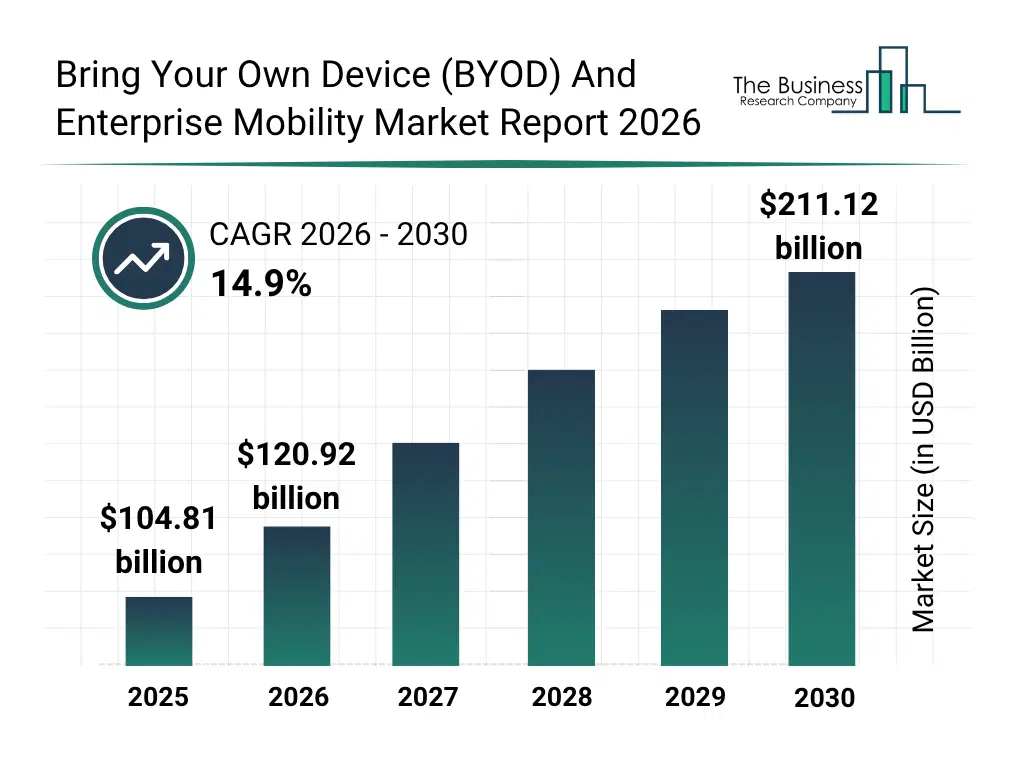
What Is The Bring Your Own Device (BYOD) And Enterprise Mobility Market Size and Share 2026?
The bring your own device (BYOD) and enterprise mobility market size has grown rapidly in recent years. It will grow from $104.81 billion in 2025 to $120.92 billion in 2026 at a compound annual growth rate (CAGR) of 15.4%. The growth in the historic period can be attributed to increasing adoption of remote work practices, rising smartphone and tablet usage in workplaces, growing demand for flexible employee access, increasing enterprise mobility requirements, rising need for remote workforce productivity.What Is The Bring Your Own Device (BYOD) And Enterprise Mobility Market Growth Forecast?
The bring your own device (BYOD) and enterprise mobility market size is expected to see rapid growth in the next few years. It will grow to $211.12 billion in 2030 at a compound annual growth rate (CAGR) of 14.9%. The growth in the forecast period can be attributed to increasing demand for secure mobile workforce enablement, rising adoption of flexible work models, growing need for streamlined device lifecycle management, increasing demand for employee access to enterprise resources, rising emphasis on workforce mobility and operational continuity. Major trends in the forecast period include increasing adoption of zero trust mobile access, rising demand for mobile threat detection and response, growing use of mobile application management solutions, increasing adoption of device lifecycle management, rising demand for employee mobile productivity solutions.
Global Bring Your Own Device (BYOD) And Enterprise Mobility Market Segmentation
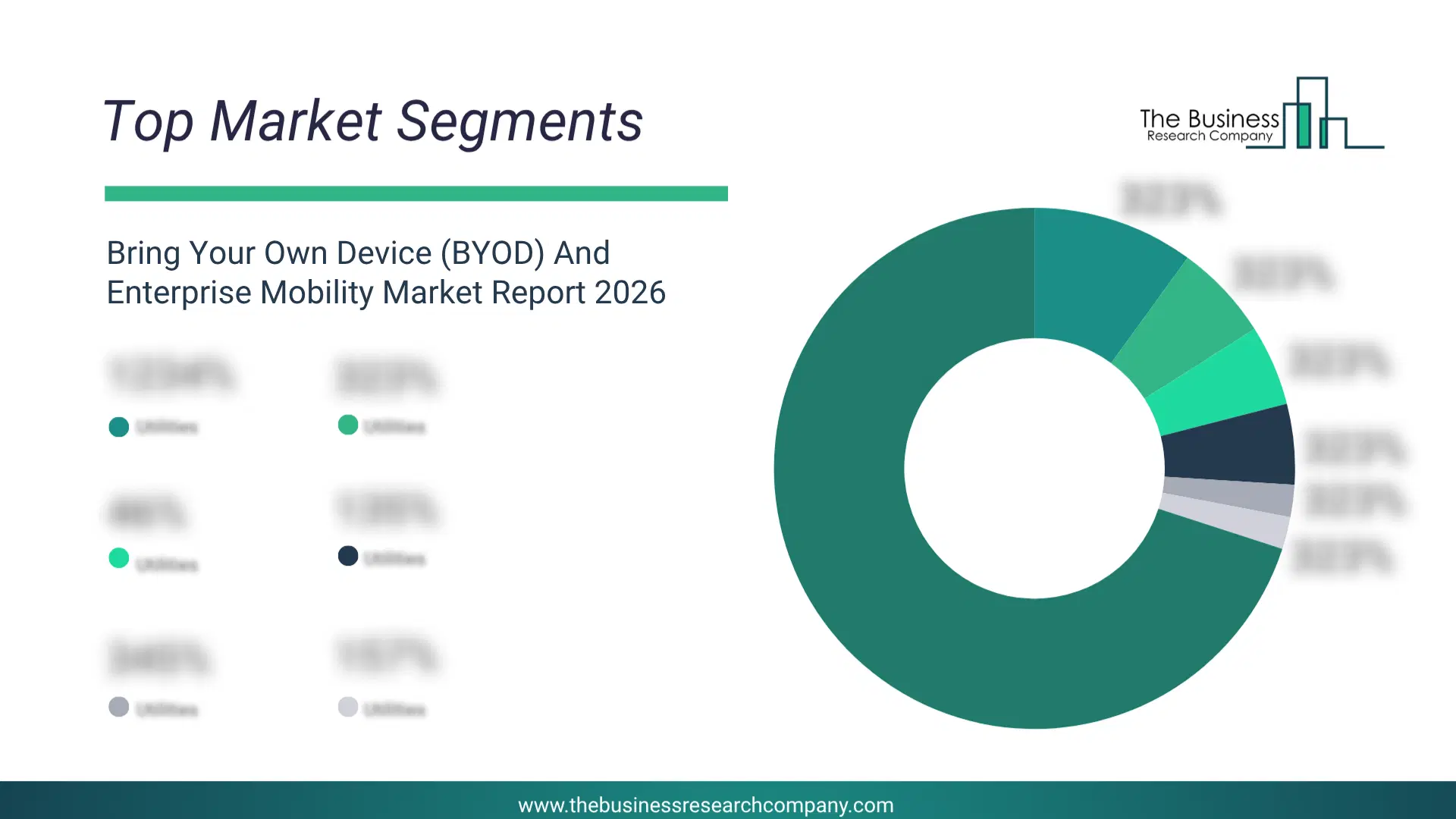
1) By Component: Software, Hardware, Services 2) By Operating System: Android, IPhone Operating System, Windows, Other Operating Systems 3) By Enterprise Size: Small And Medium Enterprises, Large Enterprises 4) By Deployment Mode: Cloud, On-Premises, Hybrid 5) By Industry Vertical: Banking, Financial Services And Insurance, Healthcare, Retail, Information Technology And Telecommunications, Manufacturing, Other Industry Verticals Subsegments: 1) By Software: Mobile Device Management Software, Mobile Application Management Software, Identity And Access Management Software, Unified Endpoint Management Software, Mobile Security Software 2) By Hardware: Smartphones, Tablets, Laptops, Wearable Devices 3) By Services: Managed Mobility Services, Professional Services, Support And Maintenance Services, Device Lifecycle Management Services, Security And Compliance ServicesWhat Is The Driver Of The Bring Your Own Device (BYOD) And Enterprise Mobility Market?
The growth in remote and hybrid work culture is expected to propel the growth of the bring your own device (BYOD) and enterprise mobility market going forward. Remote and hybrid work refers to flexible working arrangements in which employees work either entirely from locations outside the traditional office (remote work) or divide their time between working remotely and working in the office (hybrid work). Remote and hybrid work is growing due to advances in digital communication technology that allow employees to collaborate, attend meetings, share files, and communicate efficiently from any location using tools such as video conferencing, cloud platforms, and instant messaging applications. Bring your own device and enterprise mobility enable remote and hybrid work by providing employees with secure, seamless access to corporate applications, data, and collaboration tools from any location using their preferred devices. For instance, in February 2023, according to the Office for National Statistics, a UK-based government department, employed adults worked entirely from home (16%) between September 2022 and January 2023, while 28% split their time between remote work and commuting, meaning 44% worked from home either fully or in a hybrid arrangement and 56% worked exclusively at their workplace during this period. Therefore, the growth in remote and hybrid work culture is driving the growth of the bring your own device (BYOD) and enterprise mobility industry.Key Players In The Global Bring Your Own Device (BYOD) And Enterprise Mobility Market
Major companies operating in the bring your own device (BYOD) and enterprise mobility market are Apple Inc., Microsoft Corporation, International Business Machines Corporation, Cisco Systems Inc., Palo Alto Networks Inc., Fortinet Inc., CrowdStrike Holdings Inc., Zoho Corporation Private Limited, Trend Micro Incorporated, SentinelOne Inc., Ivanti Inc., ESET spol. s r.o., BlackBerry Limited, SOTI Inc., AO Kaspersky Lab, JumpCloud Inc., Iru Inc., Mitsogo Inc., Esper Inc., Addigy Inc.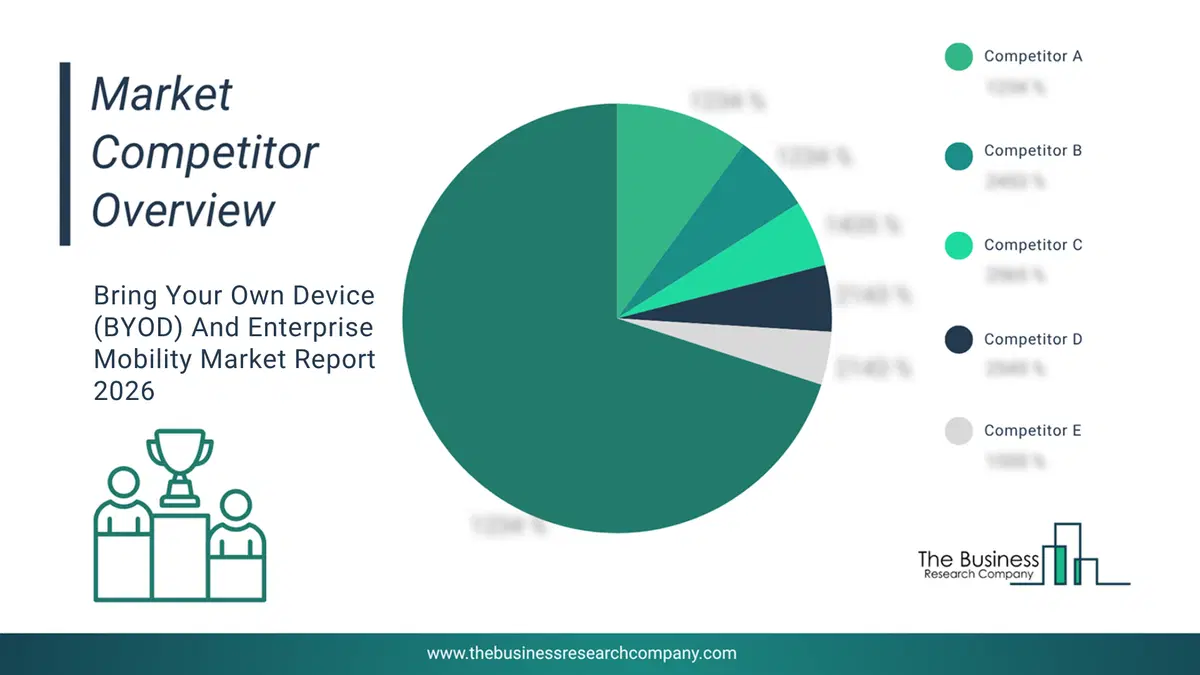
This chart is for illustrative purposes; the full report includes a detailed competitor analysis and comprehensive overview of the top 10 companies in the market.
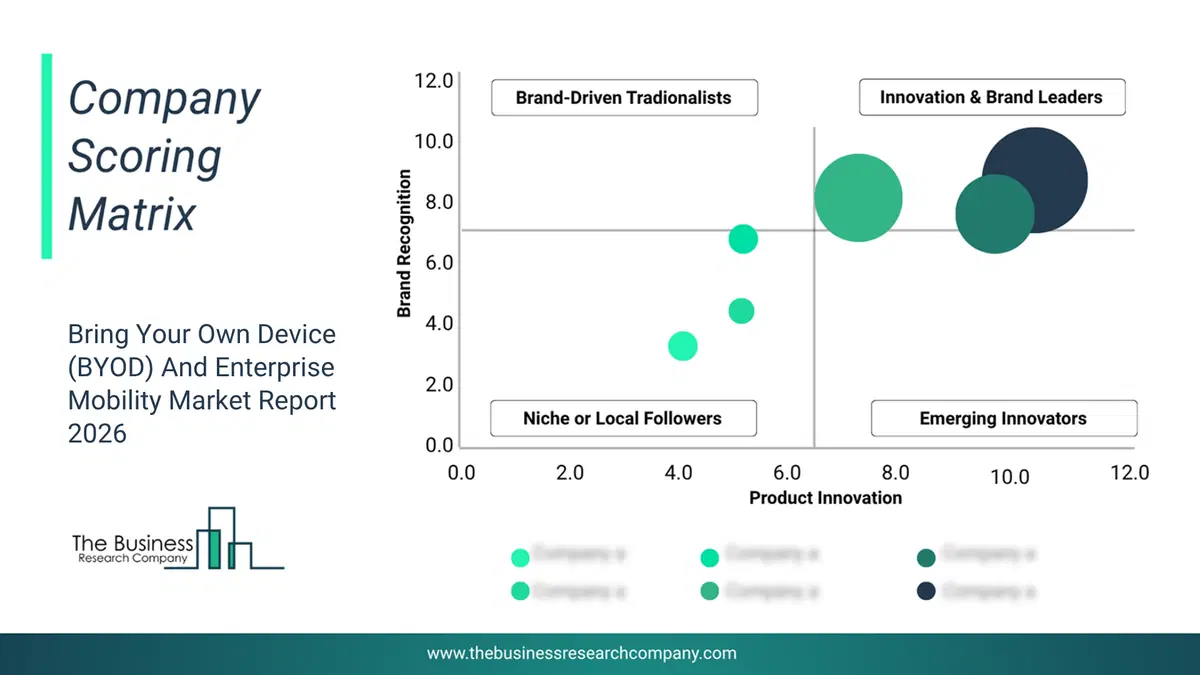
This chart maps companies by product innovation and brand strength, with bubble size indicating relative revenue, helping identify market leaders, challengers, and niche players. This is an illustrative chart; the full report provides a complete and accurate competitive analysis.
Global Bring Your Own Device (BYOD) And Enterprise Mobility Market Trends and Insights
Major companies operating in the bring your own device and enterprise mobility market are focusing on developing innovative platforms such as unified endpoint management platforms to strengthen enterprise mobility security, streamline device administration, and enable seamless access to corporate applications across multiple devices. Unified endpoint management platforms are integrated technologies that allow organizations to manage, secure, and monitor smartphones, tablets, laptops, and IoT devices through a single console, replacing traditional fragmented tools like mobile device management (MDM) and client management tools (CMT). For instance, in March 2023, Microsoft Corporation, a US-based technology company, launched the Microsoft Intune Suite, an advanced enterprise mobility and security solution designed to enhance BYOD management and hybrid workforce productivity. The solution integrates endpoint analytics, advanced endpoint privilege management, and remote help capabilities into a unified platform, enabling IT teams to enforce least-privilege access and reduce cybersecurity risks associated with unmanaged devices. It also supports Zero Trust security principles by continuously verifying device health and user identity before granting access to enterprise resources, making it highly suitable for modern distributed work environments.What Are Latest Mergers And Acquisitions In The Bring Your Own Device (BYOD) And Enterprise Mobility Market?
In November 2023, Broadcom Inc., a US-based technology company, acquired VMware for $61 billion. With this acquisition, Broadcom aims to significantly expand its enterprise software portfolio and strengthen its position in infrastructure and cloud technologies while diversifying its revenue base beyond semiconductors. VMware Inc. is a US-based company that provides bring your own device (BYOD) and enterprise mobility solutions.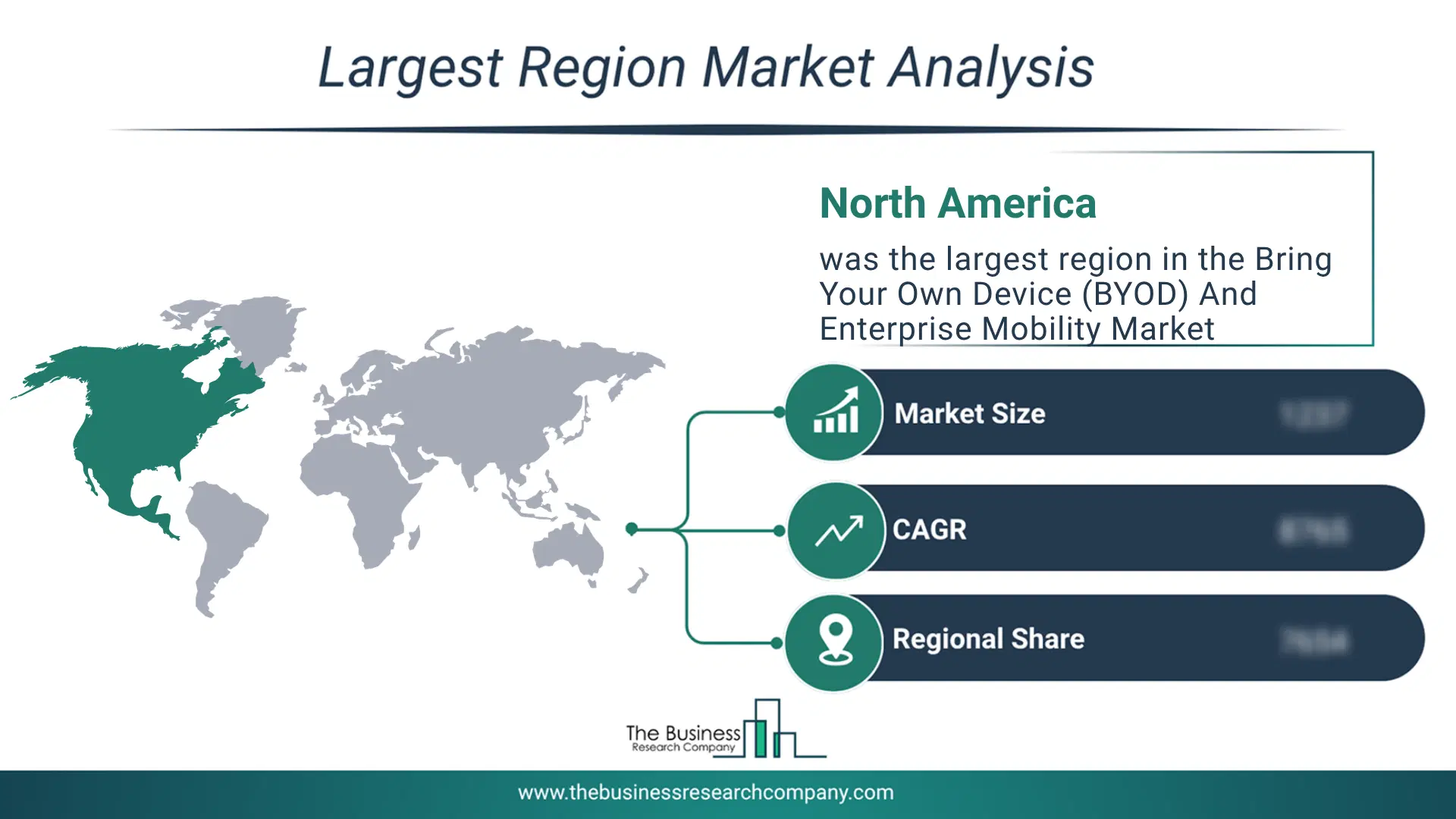
Regional Insights
North America was the largest region in the bring your own device (BYOD) and enterprise mobility market in 2025. Asia-Pacific is expected to be the fastest-growing region in the forecast period. The regions covered in this market report are Asia-Pacific, South East Asia, Western Europe, Eastern Europe, North America, South America, Middle East, Africa. The countries covered in this market report are Australia, Brazil, China, France, Germany, India, Indonesia, Japan, Taiwan, Russia, South Korea, UK, USA, Canada, Italy, Spain.What Defines the Bring Your Own Device (BYOD) And Enterprise Mobility Market?
The bring your own device (BYOD) and enterprise mobility market consists of revenues earned by entities by providing services such as secure mobile device management, enterprise application management, mobile security solutions, remote access and virtual private network (VPN) services, and mobile identity and access management. The market value includes the value of related goods sold by the service provider or included within the service offering. The bring your own device and enterprise mobility market also includes sales of enterprise mobility management (EMM) platforms, secure enterprise smartphones and tablets, virtual private network (VPN) appliances, and mobile security software. Values in this market are ‘factory gate’ values, that is the value of goods sold by the manufacturers or creators of the goods, whether to other entities (including downstream manufacturers, wholesalers, distributors and retailers) or directly to end customers. The value of goods in this market includes related services sold by the creators of the goods.How is Market Value Defined and Measured?
The market value is defined as the revenues that enterprises gain from the sale of goods and/or services within the specified market and geography through sales, grants, or donations in terms of the currency (in USD unless otherwise specified). The revenues for a specified geography are consumption values that are revenues generated by organizations in the specified geography within the market, irrespective of where they are produced. It does not include revenues from resales along the supply chain, either further along the supply chain or as part of other products.
This chart presents market attractiveness based on a quantitative evaluation of growth, competition, strategic alignment, and risk, offering a clear view of opportunity areas for decision-making. This chart is for illustrative purposes; the full report contains the complete analysis.

This chart highlights the Total Addressable Market (TAM) by estimating the maximum revenue opportunity using an assumption-driven approach, supporting strategic planning and opportunity sizing across markets. The chart is illustrative; the full report provides a more comprehensive analysis.
What Key Data and Analysis Are Included in the Bring Your Own Device (BYOD) And Enterprise Mobility Market Report 2026?
The bring your own device (byod) and enterprise mobility market research report is one of a series of new reports from The Business Research Company that provides market statistics, including industry global market size, regional shares, competitors with the market share, detailed market segments, market trends and opportunities, and any further data you may need to thrive in the bring your own device (byod) and enterprise mobility industry. The market research report delivers a complete perspective of everything you need, with an in-depth analysis of the current and future state of the industry.Bring Your Own Device (BYOD) and Enterprise Mobility Market Report Forecast Analysis
| Report Attribute | Details |
|---|---|
| Market Size Value In 2026 | $120.92 billion |
| Revenue Forecast In 2030 | $211.12 billion |
| Growth Rate | CAGR of 14.9% from 2026 to 2030 |
| Base Year For Estimation | 2025 |
| Actual Estimates/Historical Data | 2020-2025 |
| Forecast Period | 2026 - 2030 |
| Market Representation | Revenue in USD Billion and CAGR from 2026 to 2030 |
| Segments Covered | Component, Operating System, Enterprise Size, Deployment Mode, Industry Vertical |
| Regional Scope | Asia-Pacific, Western Europe, Eastern Europe, North America, South America, Middle East, Africa |
| Country Scope | The countries covered in the report are Australia, Brazil, China, France, Germany, India, Indonesia, Japan, Taiwan, Russia, South Korea, UK, USA, Canada, Italy, Spain. |
| Key Companies Profiled | Apple Inc., Microsoft Corporation, International Business Machines Corporation, Cisco Systems Inc., Palo Alto Networks Inc., Fortinet Inc., CrowdStrike Holdings Inc., Zoho Corporation Private Limited, Trend Micro Incorporated, SentinelOne Inc., Ivanti Inc., ESET spol. s r.o., BlackBerry Limited, SOTI Inc., AO Kaspersky Lab, JumpCloud Inc., Iru Inc., Mitsogo Inc., Esper Inc., Addigy Inc. |
| Customization Scope | Request for Customization |
| Pricing And Purchase Options | Explore Purchase Options |