
Brominated Butyl Rubber Market Report 2026
Global Outlook – By Product Type (Standard Brominated Butyl Rubber, Specialty Brominated Butyl Rubber), By Distribution Channel (Direct Sales And Industrial Contracts, Distributors), By Application (Tires And Inner Liners, Inner Tubes, Pharmaceutical Stoppers And Closures, Hoses And Gaskets, Sealants And Adhesives), By End Use Industry (Automotive And Transportation, Pharmaceuticals And Healthcare, Industrial Manufacturing, Building And Construction, Other End Use Industries) – Market Size, Trends, Strategies, and Forecast to 2030
Brominated Butyl Rubber Market Overview
• Brominated Butyl Rubber market size has reached to $2.66 billion in 2025 • Expected to grow to $3.89 billion in 2030 at a compound annual growth rate (CAGR) of 7.8% • Growth Driver: Rising Focus On Fuel-efficient Vehicles Fueling The Growth Of The Market Due To Increasing Demand For Low Rolling Resistance Tires And Enhanced Air Retention Performance • Market Trend: Production Capacity Expansion Strengthens Supply Capabilities And Supports Growing Application Demand • North America was the largest region in 2025 and Asia-Pacific is the fastest growing region.What Is Covered Under Brominated Butyl Rubber Market?
Brominated butyl rubber (BIIR) is a halogenated elastomer produced by brominating butyl rubber, providing enhanced reactivity while retaining excellent air impermeability, heat resistance, and flexibility. It offers superior adhesion to other rubbers, improved curing efficiency, and strong resistance to ageing, chemicals, ozone, and moisture, making it suitable for demanding industrial applications. Its combination of durability, low gas permeability, and reliable mechanical performance makes it a widely used material in products requiring long-term sealing and protective properties. The main product types of brominated butyl rubber include standard brominated butyl rubber and specialty brominated butyl rubber. Standard brominated butyl rubber refers to halogenated butyl rubber designed for general-purpose applications, offering enhanced curing characteristics and adhesion while retaining low gas permeability, flexibility, and resistance to heat, chemicals, ozone, and moisture. It is distributed through direct sales and industrial contracts and distributors. It is primarily used in tires and inner liners, inner tubes, pharmaceutical stoppers and closures, hoses and gaskets, and sealants and adhesives, serving end-use industries including automotive and transportation, pharmaceuticals and healthcare, industrial manufacturing, building and construction, and other end-use industries.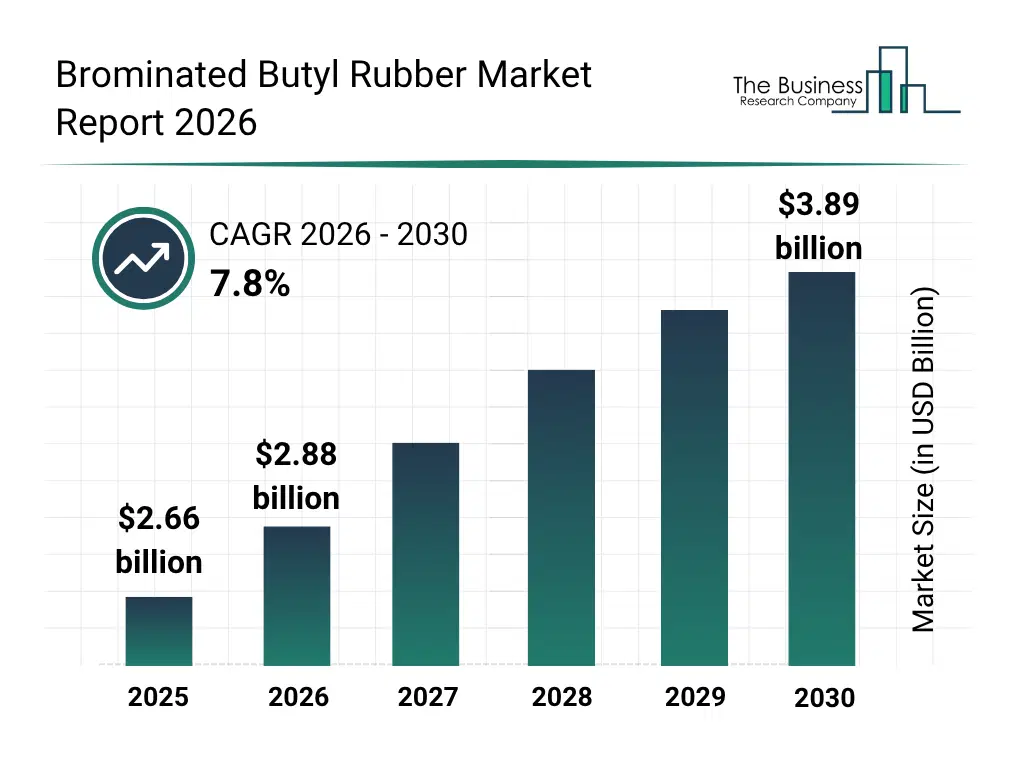
What Is The Brominated Butyl Rubber Market Size and Share 2026?
The brominated butyl rubber market size has grown strongly in recent years. It will grow from $2.66 billion in 2025 to $2.88 billion in 2026 at a compound annual growth rate (CAGR) of 8.3%. The growth in the historic period can be attributed to rising vehicle production and tire manufacturing, growing demand for durable tire inner liners, increasing use of pharmaceutical rubber closures, expanding demand for chemical and ozone-resistant sealing materials, rising utilization of high-performance elastomers in industrial applications.What Is The Brominated Butyl Rubber Market Growth Forecast?
The brominated butyl rubber market size is expected to see strong growth in the next few years. It will grow to $3.89 billion in 2030 at a compound annual growth rate (CAGR) of 7.8%. The growth in the forecast period can be attributed to increasing demand for advanced sealing materials in electric vehicles, growing pharmaceutical and healthcare manufacturing, expanding adoption of high-purity rubber grades, rising demand for long-life automotive components, increasing use of specialty elastomers in demanding industrial applications. Major trends in the forecast period include rising demand for high air-impermeability rubber compounds in tire inner liners, growing adoption of brominated butyl rubber in pharmaceutical closures, increasing use of high-purity grades for medical and healthcare applications, rising demand for heat- and ozone-resistant sealing materials, growing use of brominated butyl rubber in hoses, gaskets, sealants, and adhesives.Tariff Impact On Brominated Butyl Rubber Market
Tariffs are impacting the brominated butyl rubber market by increasing the cost of imported butyl rubber, brominating agents, specialty chemicals, and processing equipment used in production. This is raising manufacturing costs and can slow adoption across tires and inner liners, inner tubes, pharmaceutical stoppers and closures, hoses and gaskets, and sealants and adhesives, particularly in regions dependent on imported rubber and chemical inputs. Specialty and high-purity grades, including pharmaceutical and medical grades, are most affected because of their reliance on specialized raw materials and stringent processing requirements. However, tariffs are also encouraging domestic raw material sourcing, regional supplier diversification, local rubber production, and development of more resilient elastomer supply chains.
Global Brominated Butyl Rubber Market Segmentation
1) By Product Type: Standard Brominated Butyl Rubber, Specialty Brominated Butyl Rubber 2) By Distribution Channel: Direct Sales And Industrial Contracts, Distributors 3) By Application: Tires And Inner Liners, Inner Tubes, Pharmaceutical Stoppers And Closures, Hoses And Gaskets, Sealants And Adhesives 4) By End Use Industry: Automotive And Transportation, Pharmaceuticals And Healthcare, Industrial Manufacturing, Building And Construction, Other End Use Industries Subsegments: 1) By Standard Brominated Butyl Rubber: General Purpose Grade, Standard Processing Grade, Standard Cure Grade 2) By Specialty Brominated Butyl Rubber: High Performance Grade, High Purity Grade, Pharmaceutical And Medical Grade, Low Extractables GradeWhat Are The Drivers Of The Brominated Butyl Rubber Market?
The rising focus on fuel-efficient vehicles is expected to propel the growth of the brominated butyl rubber market going forward. Fuel-efficient vehicles are designed to reduce fuel consumption through lightweight materials, advanced engineering, and energy-efficient powertrains while maintaining vehicle performance. The rising focus on fuel-efficient vehicles is due to increasing consumer demand for lower fuel costs and stricter emission regulations. The rising focus on fuel-efficient vehicles supports brominated butyl rubber by increasing demand for low rolling resistance tires, where its excellent air retention properties improve fuel efficiency and tire performance. For instance, in January 2026, according to the Electric Vehicle Council (EVC), an Australia-based electric vehicle industry association, total electric vehicle sales in Australia increased by 38% in 2025 compared with 2024, exceeding 157,000 units, while electric vehicle market share of new-car sales increased from 9.6% in 2024 to 13.1% in 2025. Therefore, the rising focus on fuel-efficient vehicles is driving the growth of the brominated butyl rubber industry. The growth in automotive tire shipments is expected to propel the growth of the brominated butyl rubber market going forward. Automotive tire shipments refer to the total number of tires delivered by manufacturers to original equipment manufacturers and replacement markets for commercial distribution and end use. Automotive tire shipments are increasing due to rising global vehicle production, that drives higher demand for original equipment and replacement tires across passenger and commercial vehicles. The growth in automotive tire shipments supports brominated butyl rubber by increasing demand for tire inner liners that provide excellent air retention, heat resistance, and durability. For instance, in March 2026, according to the U.S. Tire Manufacturers Association (USTMA), a US-based tire industry association, total U.S. tire shipments are projected to increase from 336.3 million units in 2025 to 338.9 million units in 2026, representing an increase of approximately 0.8%. Therefore, the growth in automotive tire shipments is driving the growth of the brominated butyl rubber industry.Key Players In The Global Brominated Butyl Rubber Market
Major companies operating in the brominated butyl rubber market are Saudi Arabian Oil Company, Exxon Mobil Corporation, SIBUR Holding, China National Petroleum Corporation, ENEOS Holdings Inc, TSRC Corporation, Synthos S.A., Formosa Synthetic Rubber (Ningbo) Co. Ltd, Shandong Chambroad Petrochemicals Co. Ltd, Panjin Vinko Chemical Co. Ltd, Zhejiang Cenway New Synthetic Material Co. Ltd, Sundow Polymers Co. Ltd, Panjin Heyun Industrial Group Co. Ltd, Hengtai Chemical Co. Ltd, Shanghai Ethaichem Co. Ltd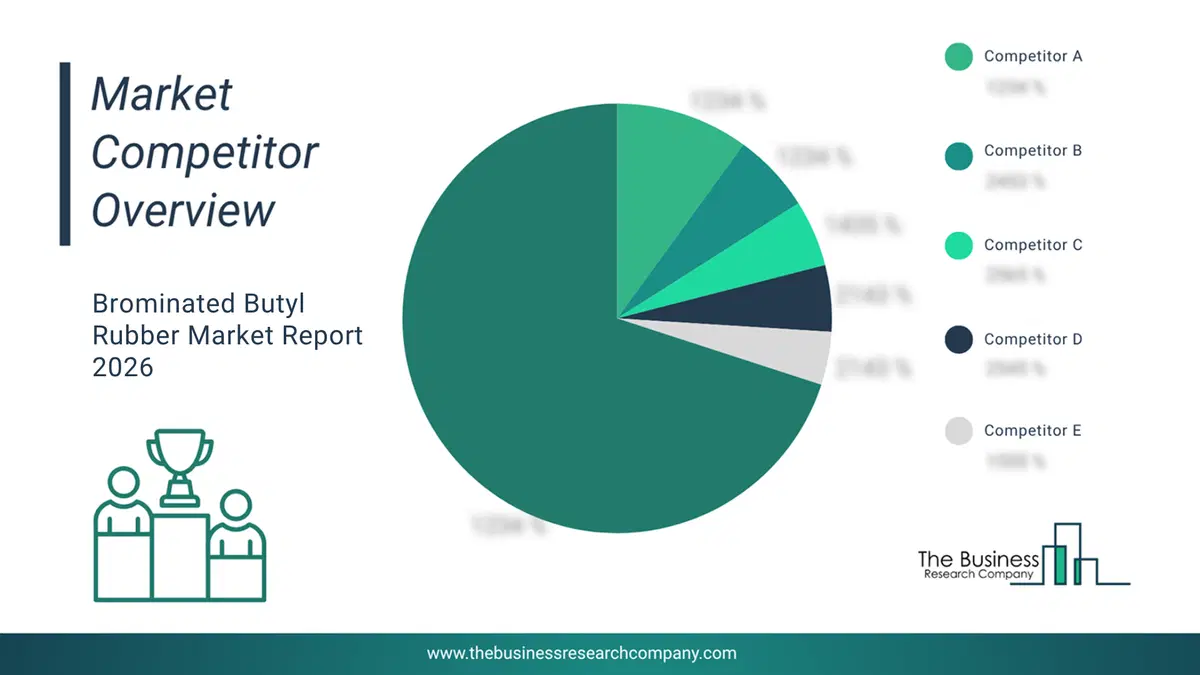
This chart is for illustrative purposes; the full report includes a detailed competitor analysis and comprehensive overview of the top 10 companies in the market.
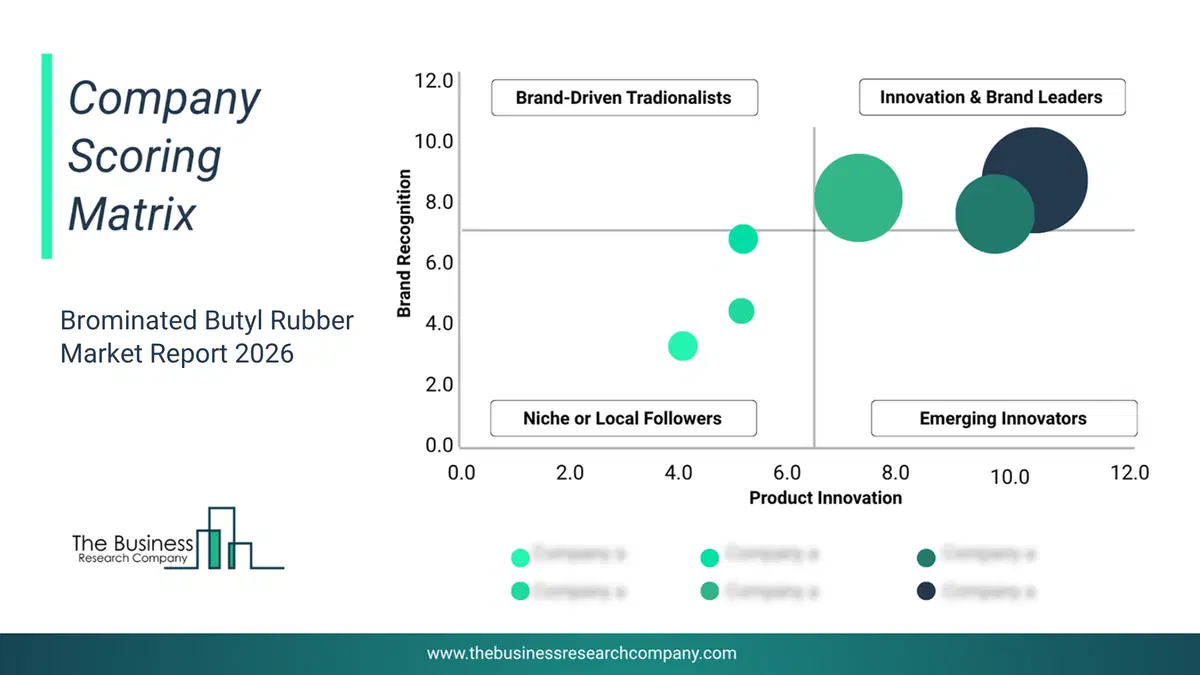
This chart maps companies by product innovation and brand strength, with bubble size indicating relative revenue, helping identify market leaders, challengers, and niche players. This is an illustrative chart; the full report provides a complete and accurate competitive analysis.
Global Brominated Butyl Rubber Market Trends and Insights
Major companies operating in the brominated butyl rubber market are focusing on expanding production capacity to enable companies to meet growing demand, increase supply, and strengthen their market position. Expanding butyl rubber production capacity is beneficial as it enhances supply capabilities, meets rising demand, and enables manufacturers to support the growing needs of tire and industrial applications. For instance, in January 2025, Zhejiang Cenway New Materials Co. Ltd. (Cenway), a China-based manufacturer of butyl rubber, announced plans to expand its butyl rubber production capacity by 70 kilotons per annum (ktpa). The project will be located in the China Chemical New Material (Jiaxing) Park within the Jiaxing Port Area in Zhejiang Province. By optimizing and enhancing process technology at the facility, Cenway plans to add annual production capacity of 5 kt of ordinary butyl rubber and 65 ktpa of halogenated butyl rubber. Upon completion, the plant’s total butyl rubber production capacity is expected to reach 120 kt per year. This will comprise 5 kt of ordinary butyl rubber, 74.6 ktpa of brominated butyl rubber, and 40.4 ktpa of chlorobutyl rubber.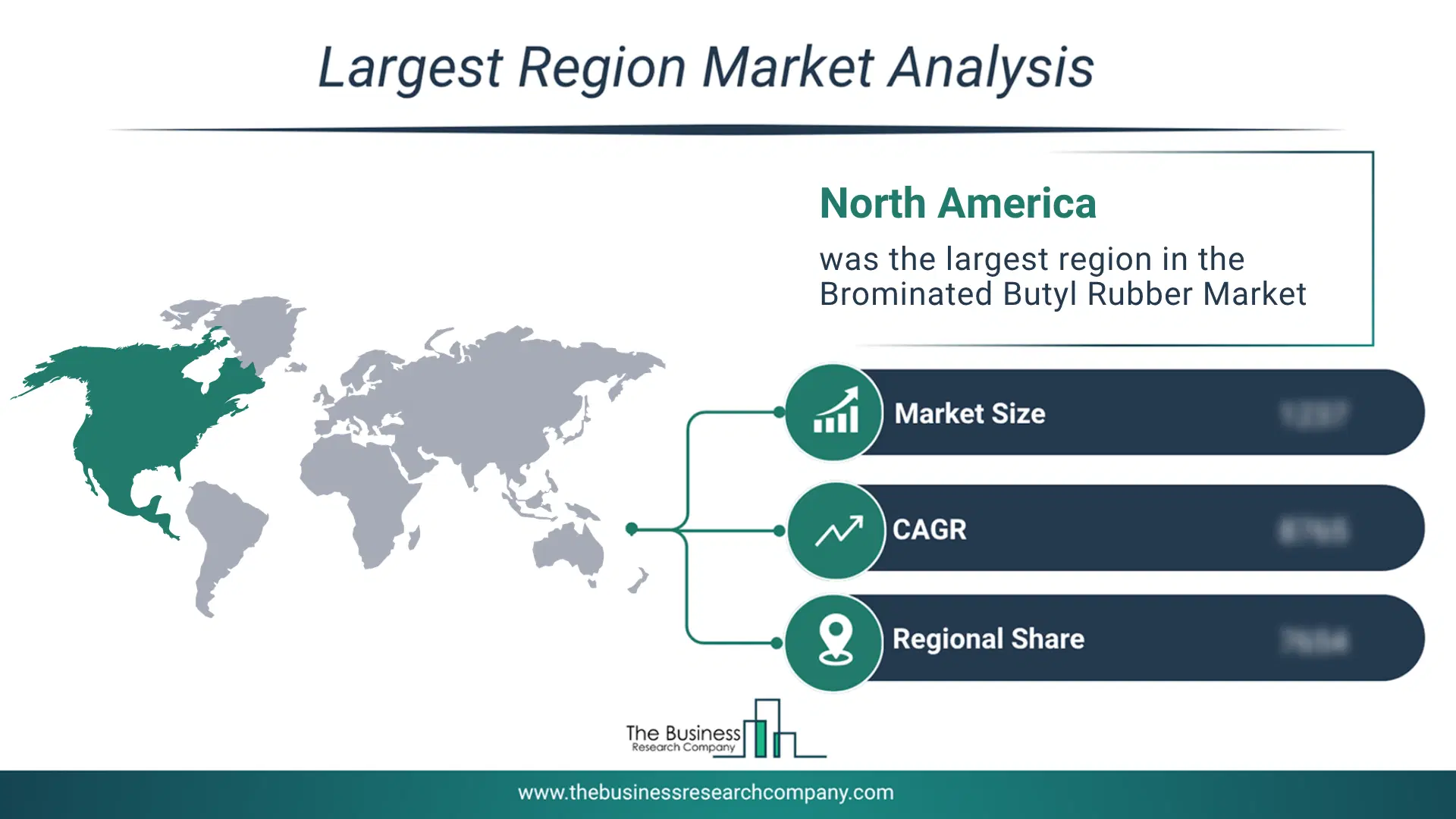
Regional Outlook
North America was the largest region in the brominated butyl rubber market in 2025. Asia-Pacific is expected to be the fastest-growing region in the forecast period. The regions covered in this market report are Asia-Pacific, South East Asia, Western Europe, Eastern Europe, North America, South America, Middle East, Africa. The countries covered in this market report are Australia, Brazil, China, France, Germany, India, Indonesia, Japan, Taiwan, Russia, South Korea, UK, USA, Canada, Italy, Spain.What Defines the Brominated Butyl Rubber Market?
The brominated butyl rubber market consists of sales of tire inner liners, pharmaceutical and medical closures, vial and syringe stoppers, seals and gaskets, hoses, diaphragms, tank and container linings, and other specialty rubber components. Values in this market are ‘factory gate’ values, that is, the value of goods sold by the manufacturers or creators of the goods, whether to other entities (including downstream manufacturers, wholesalers, distributors, and retailers) or directly to end customers. The value of goods in this market includes related services sold by the creators of the goods.How is Market Value Defined and Measured?
The market value is defined as the revenues that enterprises gain from the sale of goods and/or services within the specified market and geography through sales, grants, or donations in terms of the currency (in USD unless otherwise specified). The revenues for a specified geography are consumption values that are revenues generated by organizations in the specified geography within the market, irrespective of where they are produced. It does not include revenues from resales along the supply chain, either further along the supply chain or as part of other products.
This chart presents market attractiveness based on a quantitative evaluation of growth, competition, strategic alignment, and risk, offering a clear view of opportunity areas for decision-making. This chart is for illustrative purposes; the full report contains the complete analysis.

This chart highlights the Total Addressable Market (TAM) by estimating the maximum revenue opportunity using an assumption-driven approach, supporting strategic planning and opportunity sizing across markets. The chart is illustrative; the full report provides a more comprehensive analysis.
What Key Data and Analysis Are Included in the Brominated Butyl Rubber Market Report 2026?
The brominated butyl rubber market research report is one of a series of new reports from The Business Research Company that provides market statistics, including industry global market size, regional shares, competitors with the market share, detailed market segments, market trends and opportunities, and any further data you may need to thrive in the brominated butyl rubber industry. The market research report delivers a complete perspective of everything you need, with an in-depth analysis of the current and future state of the industry.Brominated Butyl Rubber Market Report Forecast Analysis
| Report Attribute | Details |
|---|---|
| Market Size Value In 2026 | $2.88 billion |
| Revenue Forecast In 2030 | $3.89 billion |
| Growth Rate | CAGR of 7.8% from 2026 to 2030 |
| Base Year For Estimation | 2025 |
| Actual Estimates/Historical Data | 2020-2025 |
| Forecast Period | 2026 - 2030 |
| Market Representation | Revenue in USD Billion and CAGR from 2026 to 2030 |
| Segments Covered | Product Type, Distribution Channel, Application, End Use Industry |
| Regional Scope | Asia-Pacific, Western Europe, Eastern Europe, North America, South America, Middle East, Africa |
| Country Scope | The countries covered in the report are Australia, Brazil, China, France, Germany, India, Indonesia, Japan, Taiwan, Russia, South Korea, UK, USA, Canada, Italy, Spain. |
| Key Companies Profiled | Saudi Arabian Oil Company, Exxon Mobil Corporation, SIBUR Holding, China National Petroleum Corporation, ENEOS Holdings Inc, TSRC Corporation, Synthos S.A., Formosa Synthetic Rubber (Ningbo) Co. Ltd, Shandong Chambroad Petrochemicals Co. Ltd, Panjin Vinko Chemical Co. Ltd, Zhejiang Cenway New Synthetic Material Co. Ltd, Sundow Polymers Co. Ltd, Panjin Heyun Industrial Group Co. Ltd, Hengtai Chemical Co. Ltd, Shanghai Ethaichem Co. Ltd |
| Customization Scope | Request for Customization |
| Pricing And Purchase Options | Explore Purchase Options |