
Building Automation And Control System Market Report 2026
Global Outlook – By Offerings (Solution, Services), By Technology (Wired, Wireless), By End User (Residential, Commercial, Industrial) – Market Size, Trends, Strategies, and Forecast to 2030
Building Automation And Control System Market Overview
• Building Automation And Control System market size has reached to $106.95 billion in 2025 • Expected to grow to $180.85 billion in 2030 at a compound annual growth rate (CAGR) of 11.1% • Growth Driver: The Impact Of The Rise In Smart Buildings On The Building Automation And Control System Market • Market Trend: Next-Generation Solutions Transforming Building Automation And Energy Management • Asia-Pacific was the largest region in 2025 and Europe is the fastest growing region.Market Gains By 2030 – Top Opportunities By Segment
Market Gain identifies the most promising market opportunities by highlighting the segments or products expected to generate the highest incremental revenue growth over the next five years.
What Is Covered Under Building Automation And Control System Market?
A building automation and control system (BACS) is a centralized system that integrates and controls various building systems to optimize energy efficiency, enhance occupant comfort, and streamline facility management operations. The system is used to provide intelligent, integrated solutions to manage and optimize building performance, comfort, and efficiency. The main offerings in building automation and control systems are solutions and services. The solutions in building automation and control systems streamline operations, enhance energy efficiency, and improve occupant comfort by integrating and automating various building systems such as HVAC, lighting, and security onto a centralized platform for centralized monitoring and control. The technology types include wired and wireless for end users, such as residential, commercial, and industrial.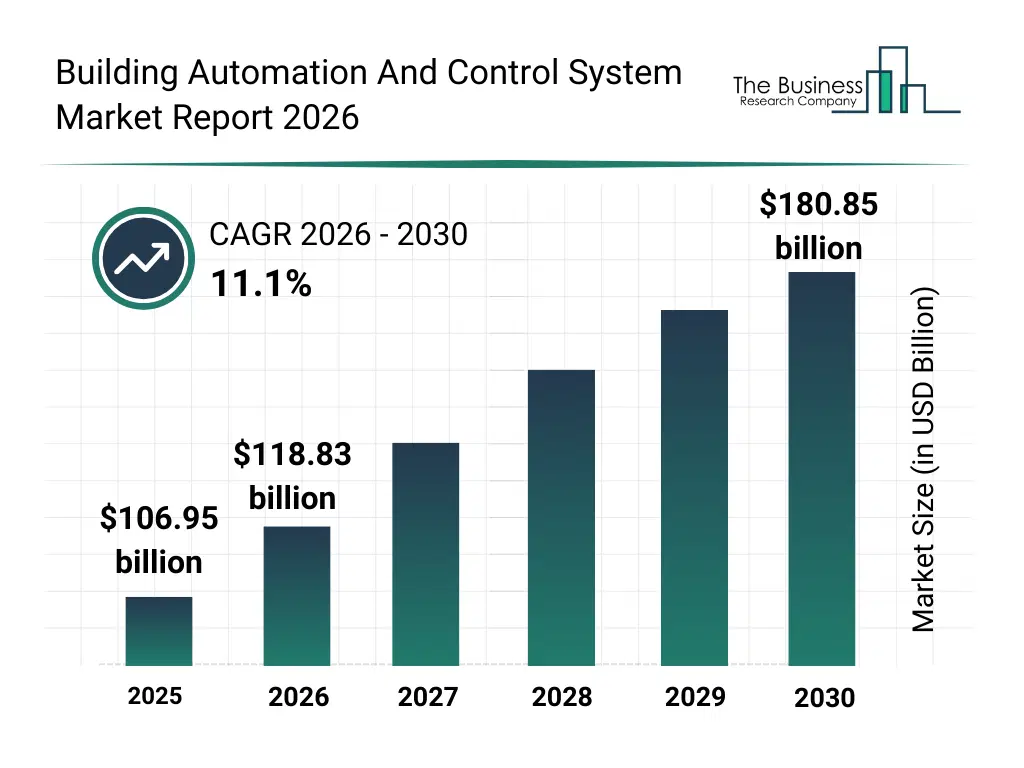
What Is The Building Automation And Control System Market Size and Share 2026?
The building automation and control system market size has grown rapidly in recent years. It will grow from $106.95 billion in 2025 to $118.83 billion in 2026 at a compound annual growth rate (CAGR) of 11.1%. The growth in the historic period can be attributed to expansion of building automation adoption, reliance on imported control system components, growth in commercial and industrial construction, increased demand for integrated hvac and lighting control, early shift toward smart facility management.What Is The Building Automation And Control System Market Growth Forecast?
The building automation and control system market size is expected to see rapid growth in the next few years. It will grow to $180.85 billion in 2030 at a compound annual growth rate (CAGR) of 11.1%. The growth in the forecast period can be attributed to increasing demand for energy-efficient buildings, rising adoption of wireless automation technologies, advancements in AI-driven building optimization, growth in retrofitting and modernization projects, expanding use of cloud-based building management systems. Major trends in the forecast period include integration of intelligent control algorithms, growth in smart building deployments, advancement in remote facility management, rising adoption of energy optimization systems, expansion of predictive maintenance solutions.

Global Building Automation And Control System Market Segmentation
1) By Offerings: Solution, Services 2) By Technology: Wired, Wireless 3) By End User: Residential, Commercial, Industrial Subsegments: 1) By Solution: Hardware, Software 2) By Services: Installation And Integration, Support And Maintenance, Managed Services The top segments in the building automation and control system market will be: • Solution will reach $125410.68 Million by 2030. • Wired will reach $94966.84 Million by 2030. • Commercial will reach $98906.03 Million by 2030. • Wireless will reach $75658.43 Million by 2030. • Services will reach $45214.59 Million by 2030.What Is The Driver Of The Building Automation And Control System Market?
The rise in smart building construction is expected to propel the growth of the building automation and control system market going forward. Smart buildings utilize advanced technology and interconnected systems to optimize energy efficiency, enhance occupant comfort, improve operational efficiency, and increase overall building performance. Smart building construction is increasing due to cost-saving opportunities, regulatory requirements, and the growing demand for connected and intelligent spaces. The building automation and control system provides the necessary connectivity and integration capabilities to ensure interoperability and coordination among various components, enabling centralized control and monitoring of building operations. For instance, in May 2024, according to the United States Environmental Protection Agency, a US-based federal government agency, as of the end of 2023, more than 43,000 buildings in the United States had received the EPA’s ENERGY STAR certification. Collectively, these buildings have saved nearly $6 billion in energy costs and avoided over 23 million metric tons of greenhouse gas emissions, equivalent to the annual emissions of more than 3 million homes. Therefore, the rise in smart buildings is driving the growth of the building automation and control system industry.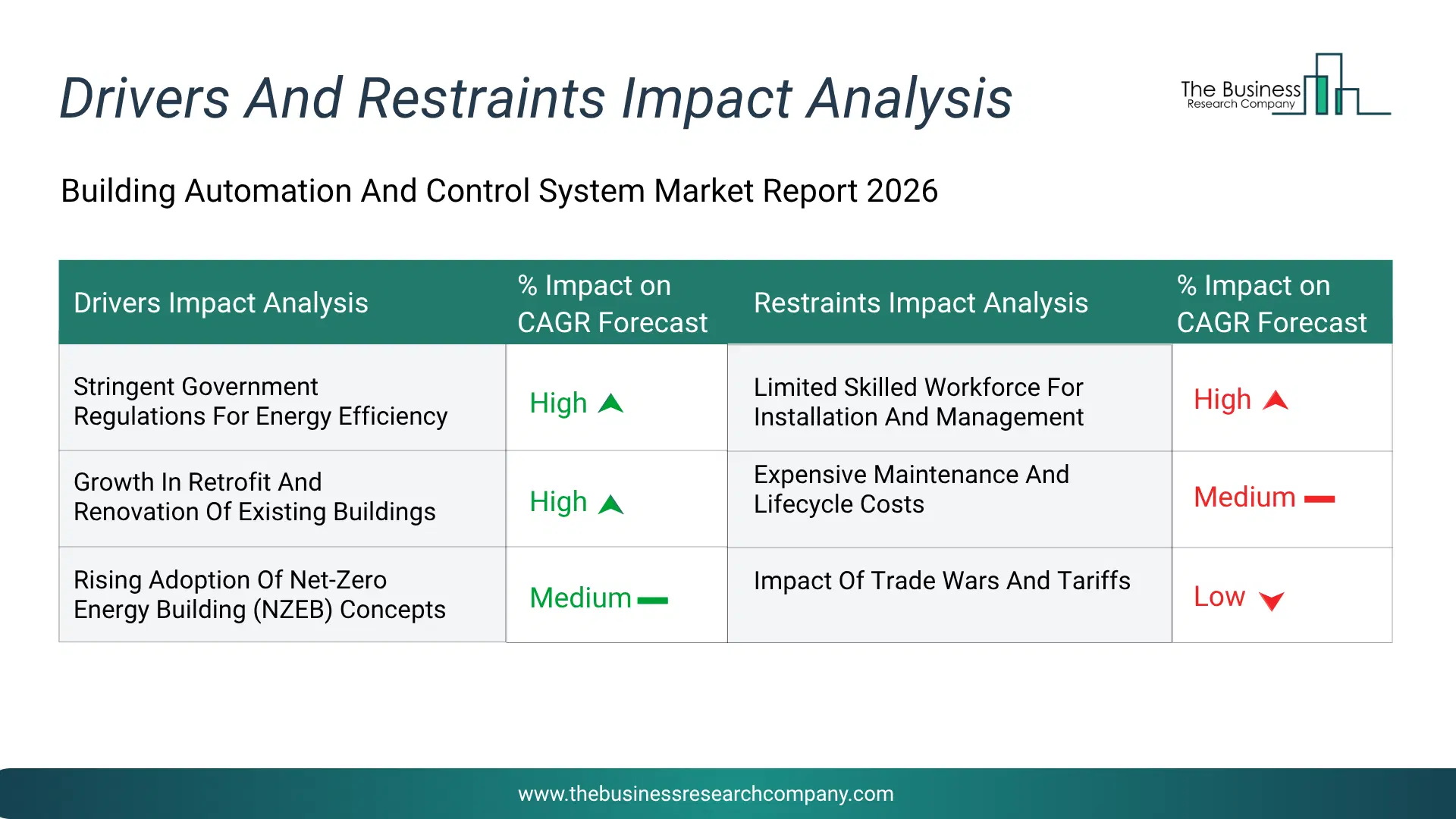
Infographic Chart Showing Key Market Drivers Analysis And Restraints For Building Automation And Control System Market
The chart presents an impact analysis of key drivers and restraints, quantifying their relative influence on the market's growth rate and helping assess the balance between growth enablers and limiting factors. This chart offers a high-level perspective; the full report contains more detailed insights.
How Will The Drivers Impact Growth In The Global Building Automation And Control System Market?
• Stringent Government Regulations For Energy Efficiency (High) – During the forecast period, the stringent government regulations for energy efficiency is expected to driver expansion in the building automation and control system market. Stringent government regulations for energy efficiency are pushing building owners to adopt advanced automation systems that can continuously monitor, optimize and report energy usage to meet compliance requirements and avoid penalties. Policies such as the EU’s Energy Performance of Buildings Directive and similar global standards require energy performance improvements, inspections and certification, which are easier to achieve through automated control of HVAC, lighting and other systems. These regulations often mandate retrofits and minimum efficiency levels for new and existing buildings, encouraging the integration of intelligent control technologies to ensure real-time optimization. The stringent government regulations for energy efficiency growth contribution during the forecast period in 2025 is 2.5%. • Growth In Retrofit And Renovation Of Existing Buildings (High) – During the forecast period, the growth in retrofit and renovation of existing buildings is expected to propel growth in the building automation and control system market. The growth in retrofit and renovation of existing buildings is accelerating demand for automation solutions, as older structures are upgraded to improve energy efficiency and meet modern environmental standards. During retrofits, building owners increasingly install sensors, controllers and centralized management platforms to optimize legacy systems like HVAC and lighting. These upgrades help reduce operational costs, improve occupant comfort and extend building lifecycle while aligning with sustainability targets. Retrofit projects also provide an opportunity to integrate interoperable and scalable control systems that were not present in original designs. The growth in retrofit and renovation of existing buildings growth contribution during the forecast period in 2025 is 2.0%. • Rising Adoption Of Net-Zero Energy Building (NZEB) Concepts (Medium) – During the forecast period, the rising adoption of net-zero energy building (NZEB) concepts are expected to driver growth in the building automation and control system market. The rising adoption of net-zero energy building concepts is driving the need for highly intelligent and integrated control systems capable of minimizing energy consumption while maximizing the use of renewable sources. Achieving net-zero performance requires continuous monitoring, predictive analytics and automated adjustments based on occupancy, weather and energy demand patterns. Automation systems play a critical role in coordinating HVAC, lighting, storage and renewable generation to balance energy supply and demand efficiently. As net-zero targets become more widespread, the reliance on advanced control technologies becomes essential for achieving and maintaining these performance levels. The rising adoption of net-zero energy building (NZEB) concepts growth contribution during the forecast period in 2025 is 1.5%. • Growing Deployment Of Smart Meters And Advanced Metering Infrastructure (AMI) (Medium) – During the forecast period, the growth in growing deployment of smart meters and advanced metering infrastructure (AMI)is expected to be a key driver propelling growth in the building automation and control system market. The growing deployment of smart meters and advanced metering infrastructure enables real-time data collection on energy consumption, which supports more precise control and optimization of building operations. These systems provide granular insights into usage patterns, allowing automation platforms to detect inefficiencies, adjust loads and implement demand response strategies. Integration of metering data with control systems enhances visibility across subsystems such as HVAC, lighting and equipment, enabling data-driven decision-making. As smart metering becomes more widespread, it strengthens the effectiveness of automated building control by providing the continuous feedback needed for optimization and energy management. The growth in growing deployment of smart meters and advanced metering infrastructure (AMI)growth contribution during the forecast period in 2025 is 1.0%.How Will The Restraints Impact Growth In The Global Building Automation And Control System Market?
• Limited Skilled Workforce For Installation And Management (High) – During the forecast period, limited skilled workforce for installation and management are restricting the growth of the building automation and control system market. A shortage of trained professionals slows down deployment because building automation systems require specialized knowledge in configuration, integration and troubleshooting across multiple subsystems. Without adequate expertise, installations take longer, error rates increase and system performance may not meet expected standards. Organizations often face delays in commissioning and higher reliance on external consultants or vendors, which adds operational complexity. The lack of skilled personnel also limits the ability to scale projects efficiently across multiple sites. As a result, adoption becomes uneven, particularly in regions where technical training and certification programs are limited. This gap ultimately reduces confidence among end users in implementing advanced automation solutions. Growth affected by the limited skilled workforce for installation and management during the forecast period in 2025 is -2.0%. • Expensive Maintenance And Lifecycle Costs (High) – During the forecast period, expensive maintenance and lifecycle costs is restricting the growth of the building automation and control system market. High ongoing expenses associated with upkeep and system upgrades can discourage adoption, as these solutions require periodic software updates, sensor calibration, hardware replacements and system monitoring. Over time, integrating new technologies or replacing outdated components adds to total lifecycle spending. Facility operators may also need dedicated personnel or service contracts to ensure optimal performance, further increasing recurring obligations. Unexpected breakdowns or compatibility issues between legacy and modern components can lead to additional repair costs. These financial commitments can outweigh perceived benefits for some organizations, especially those with tight operational budgets. Consequently, decision-makers may postpone or scale down implementation to manage long-term financial exposure. Growth affected by the expensive maintenance and lifecycle costs during the forecast period in 2025 is -1.0%. • Impact Of Trade Wars And Tariffs (Medium) – During the forecast period, the impact of trade wars and tariffs is restricting the growth of the building automation and control system market. External economic and geopolitical factors such as trade restrictions and import duties can disrupt supply chains for critical components like controllers, sensors and networking equipment. Increased tariffs raise the cost of imported hardware, making projects more expensive and less predictable in terms of budgeting. Trade uncertainties can also lead to delays in procurement, as companies face fluctuating prices and limited availability of key technologies. Manufacturers may need to reconfigure sourcing strategies or shift production, which can slow down product delivery cycles. These disruptions create inefficiencies in planning and execution of projects across regions. Growth affected by the impact of trade wars and tariffs during the forecast period in 2025 is -0.3%.Key Players In The Global Building Automation And Control System Market
Major companies operating in the building automation and control system market are Robert Bosch GmbH, Hitachi Ltd, Siemens AG, Cisco Systems Inc, Schneider Electric SE, Honeywell International Inc, ABB Ltd, Johnson Controls International plc, Trane Technologies plc, Emerson Electric Co, Legrand SA, Rockwell Automation Inc, Signify Holding B.V, Hubbell Incorporated, Lennox International Inc, Acuity Brands Inc, Carrier Global Corporation, Crestron Electronics Inc, Leviton Manufacturing Co. Inc, Beckhoff Automation GmbH & Co. KG, Snap One LLC, Lutron Electronics Co. Inc, Current Lighting Solutions LLC, Dialight plc, Uplight Inc.
This chart is for illustrative purposes; the full report includes a detailed competitor analysis and comprehensive overview of the top 10 companies in the market.

This chart maps companies by product innovation and brand strength, with bubble size indicating relative revenue, helping identify market leaders, challengers, and niche players. This is an illustrative chart; the full report provides a complete and accurate competitive analysis.
Global Building Automation And Control System Market Trends and Insights
Major companies operating in the building automation and control system market are focusing on developing innovative solutions such as advanced cybersecurity and smart building analytics to enhance system reliability, protect data, and optimize building performance. Advanced cybersecurity in building automation protects networks and data from cyber threats, while smart building analytics uses AI and IoT data to monitor and optimize energy use, occupancy, and maintenance, enhancing efficiency, comfort, and cost savings. For instance, in January 2024, Honeywell International Inc., a US-based technology and manufacturing company, launched the Advance Control Building Management System, an innovative solution designed for modern commercial and industrial facilities. The system combines predictive energy analytics, adaptive control algorithms, and remote accessibility, enabling facilities to reduce energy consumption while maintaining optimal comfort and safety. Its modular architecture allows seamless integration with existing infrastructure, and a user-friendly interface simplifies monitoring and decision-making for facility managers. Scalability for large enterprises is supported, offering cloud-based insights and automated alerts for maintenance and operational efficiency.What Are Latest Mergers And Acquisitions In The Building Automation And Control System Market?
In March 2023, Building Controls and Solutions., a US-based distributor of energy management, acquired Minvalco Inc. for $455 million. With this acquisition, Building Controls and Solutions aims to expand its services and strengthen its position in the North American building automation market. Minvalco, Inc. is a US-based building automation and control systems provider.
Regional Insights
Asia-Pacific was the largest region in the building automation and control system market in 2025. Europe is expected to be the fastest-growing region in the forecast period. The regions covered in this market report are Asia-Pacific, South East Asia, Western Europe, Eastern Europe, North America, South America, Middle East, Africa. The countries covered in this market report are Australia, Brazil, China, France, Germany, India, Indonesia, Japan, Taiwan, Russia, South Korea, UK, USA, Canada, Italy, Spain.What Defines the Building Automation And Control System Market?
The building automation and control system market consists of revenues earned by entities through services such as installation services, integration services, commissioning services, training services, energy management services, system upgrades and expansion, and other equipment used during the process. The market value includes the value of related goods sold by the service provider or included within the service offering. The market for building automation and control systems also includes sales of controllers, sensors, actuators, human-machine interfaces, networking infrastructure, and software application equipment. Values in this market are ‘factory gate’ values, that is, the value of goods sold by the manufacturers or creators of the goods, whether to other entities (including downstream manufacturers, wholesalers, distributors, and retailers) or directly to end customers. The value of goods in this market includes related services sold by the creators of the goods.How is Market Value Defined and Measured?
The market value is defined as the revenues that enterprises gain from the sale of goods and/or services within the specified market and geography through sales, grants, or donations in terms of the currency (in USD unless otherwise specified). The revenues for a specified geography are consumption values that are revenues generated by organizations in the specified geography within the market, irrespective of where they are produced. It does not include revenues from resales along the supply chain, either further along the supply chain or as part of other products.
This chart presents market attractiveness based on a quantitative evaluation of growth, competition, strategic alignment, and risk, offering a clear view of opportunity areas for decision-making. This chart is for illustrative purposes; the full report contains the complete analysis.

This chart highlights the Total Addressable Market (TAM) by estimating the maximum revenue opportunity using an assumption-driven approach, supporting strategic planning and opportunity sizing across markets. The chart is illustrative; the full report provides a more comprehensive analysis.
What Key Data and Analysis Are Included in theBuilding Automation And Control System Market Report 2026?
The building automation and control system market research report is one of a series of new reports from The Business Research Company that provides market statistics, including industry global market size, regional shares, competitors with the market share, detailed market segments, market trends and opportunities, and any further data you may need to thrive in the building automation and control system industry. The market research report delivers a complete perspective of everything you need, with an in-depth analysis of the current and future state of the industry.Building Automation And Control System Market Report Forecast Analysis
| Report Attribute | Details |
|---|---|
| Market Size Value In 2026 | $118.83 billion |
| Revenue Forecast In 2030 | $180.85 billion |
| Growth Rate | CAGR of 11.1% from 2026 to 2030 |
| Base Year For Estimation | 2025 |
| Actual Estimates/Historical Data | 2020-2025 |
| Forecast Period | 2026 - 2030 - 2035 |
| Market Representation | Revenue in USD Billion and CAGR from 2026 to 2030 |
| Segments Covered | Offerings, Technology, End User |
| Regional Scope | Asia-Pacific, Western Europe, Eastern Europe, North America, South America, Middle East, Africa |
| Country Scope | The countries covered in the report are Australia, Brazil, China, France, Germany, India, Indonesia, Japan, Taiwan, Russia, South Korea, UK, USA, Canada, Italy, Spain. |
| Key Companies Profiled | Robert Bosch GmbH, Hitachi Ltd, Siemens AG, Cisco Systems Inc, Schneider Electric SE, Honeywell International Inc, ABB Ltd, Johnson Controls International plc, Trane Technologies plc, Emerson Electric Co, Legrand SA, Rockwell Automation Inc, Signify Holding B.V, Hubbell Incorporated, Lennox International Inc, Acuity Brands Inc, Carrier Global Corporation, Crestron Electronics Inc, Leviton Manufacturing Co. Inc, Beckhoff Automation GmbH & Co. KG, Snap One LLC, Lutron Electronics Co. Inc, Current Lighting Solutions LLC, Dialight plc, Uplight Inc. |
| Customization Scope | Request for Customization |
| Pricing And Purchase Options | Explore Purchase Options |