
Building Automation And Control System Global Market Opportunities And Strategies To 2035
By Offering (Solution, Services), By Technology (Wired, Wireless), By End User (Residential, Commercial, Industrial), And By Region, Opportunities And Strategies – Global Forecast To 2035
Building Automation And Control System Market Definition
Building automation and control systems (BACS) are integrated networks of hardware and software that monitor, control and optimize building functions such as heating, ventilation, air conditioning (HVAC), lighting, security, fire safety and energy management. These systems use sensors, controllers, actuators and centralized platforms to enable real-time monitoring and automated control of building operations. The primary purpose of BACS is to enhance energy efficiency, occupant comfort, safety and operational performance of buildings. The building automation and control system market covered in this report includes revenues generated by entities (organizations, private companies and partnerships) that develop, manufacture, install and provide services related to automated building control solutions. These solutions are used to monitor, control and optimize key building functions such as heating, ventilation and air conditioning (HVAC), lighting, security and access control, energy management, fire safety and other facility operations.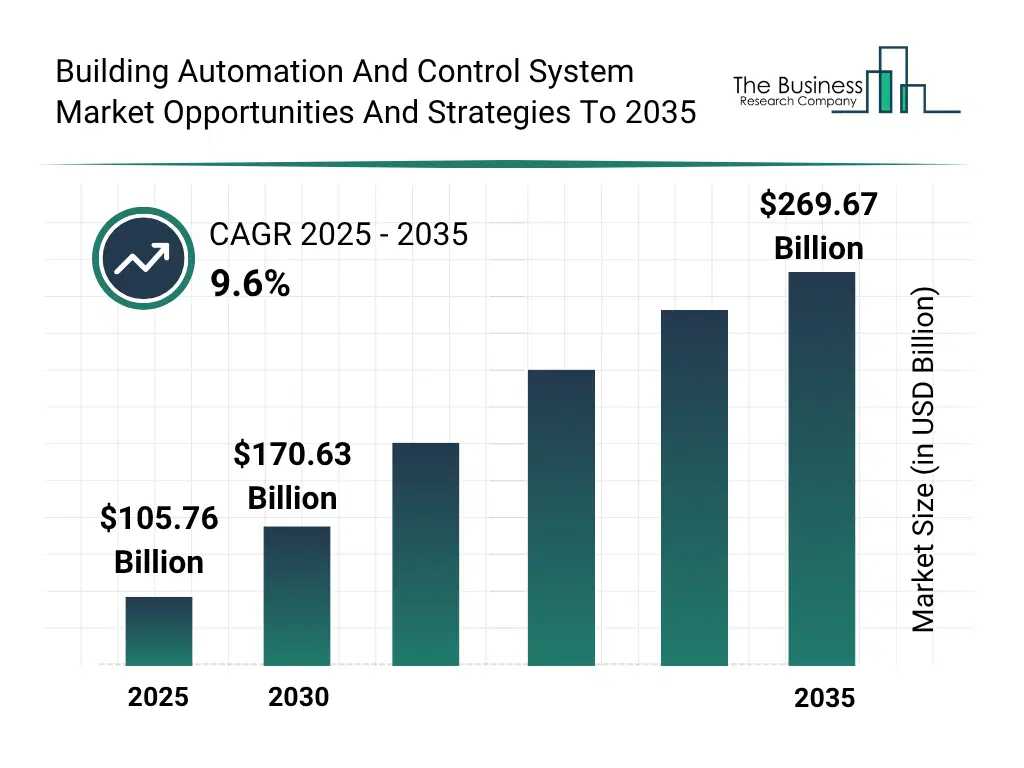
Building Automation And Control System Market Size
The global building automation and control system market reached a value of nearly $105,759.7 million in 2025, having grown at a compound annual growth rate (CAGR) of 9.4% since 2020. The market is expected to grow from $105,759.7 million in 2025 to $170,625.3 million in 2030 at a rate of 10.0%. The market is then expected to grow at a CAGR of 9.6% from 2030 and reach $269,668.1 million in 2035. Growth in the historic period resulted from rising investments in smart city initiatives and smart infrastructure, increasing adoption of green building standards, expansion of commercial and residential infrastructure and increasing focus on sustainability and carbon reduction. Factors that negatively affected growth in the historic period were high initial installation cost and cybersecurity vulnerabilities. Going forward, stringent government regulations for energy efficiency, growth in retrofit and renovation of existing buildings, rising adoption of net-zero energy building (NZEB) concepts and growing deployment of smart meters and advanced metering infrastructure (AMI) will drive the growth. Factors that could hinder the growth of the building automation and control system market in the future include limited skilled workforce for installation and management, expensive maintenance and lifecycle costs and impact of trade wars and tariffs.
Building Automation And Control System Market Segmentation
The building automation and control system market is segmented by offering, by technology and by end user.By Offering–
The building automation and control system market is segmented by offering into:
- a) Solution
- b) Services
By Technology–
The building automation and control system market is segmented by technology into:
- a) Wired
- b) Wireless
By End User–
The building automation and control system market is segmented by end user into:
- a) Residential
- b) Commercial
- c) Industrial
By Geography - The building automation and control system market is segmented by geography into:
- China
- India
- Japan
- Australia
- Indonesia
- South Korea
- USA
- Canada
- Brazil
- France
- Germany
- UK
- Italy
- Spain
- Russia
-
o Asia Pacific
o Africa