
Building Automation System Market Report 2026
Global Outlook – By Component (Hardware, Software), By Offerings (Facility Management Systems, Security And Access Controls, Fire Protection Systems, Building Energy Management Software, Building Automation System Services, Other Offerings), By Technology (Wireless Technology, Wired Technology), By Application (Industrial, Residential, Commercial) – Market Size, Trends, Strategies, and Forecast to 2030
Building Automation System Market Overview
• Building Automation System market size has reached to $110.73 billion in 2025 • Expected to grow to $204.14 billion in 2030 at a compound annual growth rate (CAGR) of 13.1% • Growth Driver: Rising Construction Activities Fuel Growth in the Building Automation System Market • Market Trend: Increasing Focus On Product Innovations To Provide Reliable Services To Their Customers • North America was the largest region in 2025 and Asia-Pacific is the fastest growing region.Market Gains By 2030 – Top Opportunities By Segment
Market Gain identifies the most promising market opportunities by highlighting the segments or products expected to generate the highest incremental revenue growth over the next five years.
What Is Covered Under Building Automation System Market?
A building automation system is an intelligent system comprising hardware and software used to control and monitor various systems that connect heating, ventilation, air conditioning (HVAC), lighting, security, and other systems in a building to interact on a single platform. The main building automation systems offered are facility management systems, security and access controls, fire protection systems, building energy management software, building automation system services, and others. Facility management software aids in automating simple to moderately complicated facility management duties, allowing consumers to serve themselves. It has mainly two components: hardware and software, and it is used in various applications such as industrial, residential, and commercial.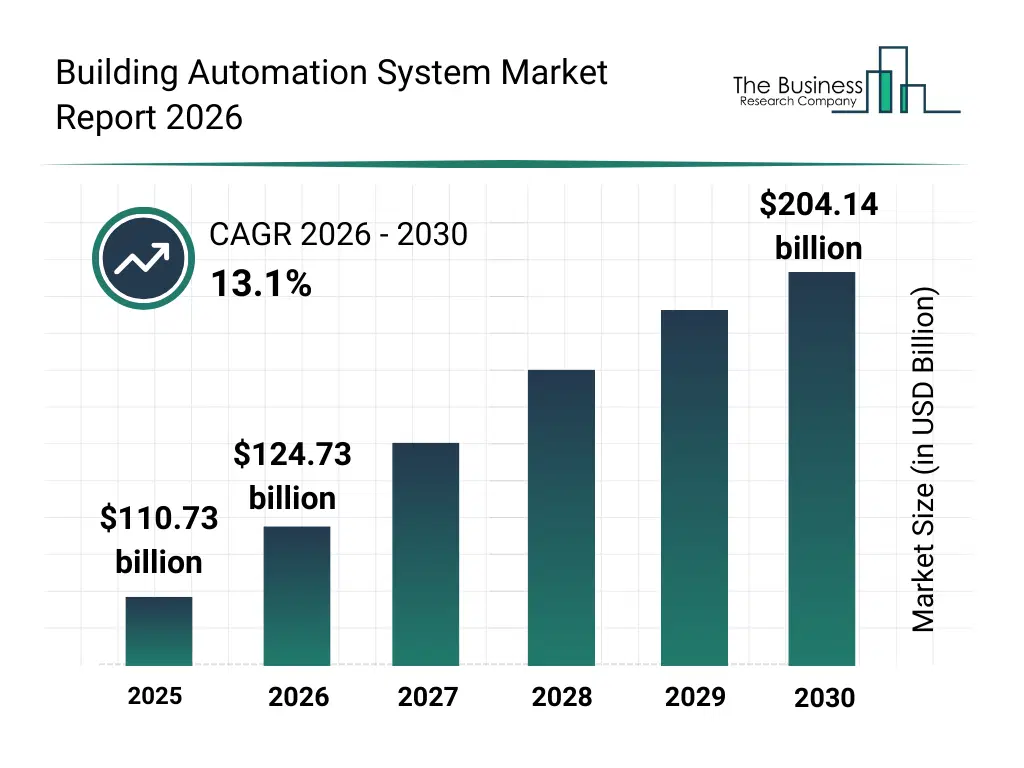
What Is The Building Automation System Market Size and Share 2026?
The building automation system market size has grown rapidly in recent years. It will grow from $110.73 billion in 2025 to $124.73 billion in 2026 at a compound annual growth rate (CAGR) of 12.6%. The growth in the historic period can be attributed to growing adoption of early hvac control systems, increased reliance on wired building automation networks, expansion of standalone energy management platforms, rising deployment of basic access control solutions, development of foundational sensor and controller technologies.What Is The Building Automation System Market Growth Forecast?
The building automation system market size is expected to see rapid growth in the next few years. It will grow to $204.14 billion in 2030 at a compound annual growth rate (CAGR) of 13.1%. The growth in the forecast period can be attributed to increasing adoption of AI-enabled building optimization, growing use of cloud-based automation software, expansion of wireless and interoperable control technologies, rising demand for integrated multi-system building platforms, development of advanced sensors for predictive facility management. Major trends in the forecast period include growing integration of multi-system building controls into unified platforms, increasing adoption of smart hvac and lighting optimization solutions, expansion of retrofit building automation projects in aging infrastructure, rising demand for remote monitoring and predictive maintenance services, wider deployment of advanced security and access control systems in commercial buildings.
Global Building Automation System Market Segmentation
1) By Component: Hardware, Software 2) By Offerings: Facility Management Systems, Security And Access Controls, Fire Protection Systems, Building Energy Management Software, Building Automation System Services, Other Offerings 2) By Technology: Wireless Technology, Wired Technology 4) By Application: Industrial, Residential, Commercial Subsegments: 1) By Hardware: Sensors, Actuators, Controllers, Switches And Relays, HVAC Control Systems, Lighting Control Systems, Security And Access Control Systems 2) By Software: Building Management Software, Energy Management Software, Facility Management Software, Security Management Software, Integrated Building Automation Software, Cloud-Based Building Automation Solutions The top segments in the building automation system market will be: • Hardware will reach $127.21 Billion by 2030. • Software will reach $76.93 Billion by 2030.What Is The Driver Of The Building Automation System Market?
The increasing construction activities is expected to boost the growth of the building automation system market. Construction activity refers to the process of building or assembling physical structures, such as buildings, roads, bridges, and other infrastructure projects. As construction activities increase, there is likely to be a corresponding increase in demand for building automation systems (BAS). Implementing automation solutions can minimize administrative burdens on engineering personnel and assist construction managers in becoming more productive in these critical areas. For instance, in September 2024, according to data published by the Office for National Statistics, a UK-based recognized national statistics institute, construction output in the UK is projected to have risen by 1.2% in the three months leading to July 2024, supported by growth in new work (1.6%) and repair and maintenance (0.8%), with significant increases of 1.7% in May and 0.5% in June 2024. Therefore, increasing construction activities are driving the growth of the building automation system industry.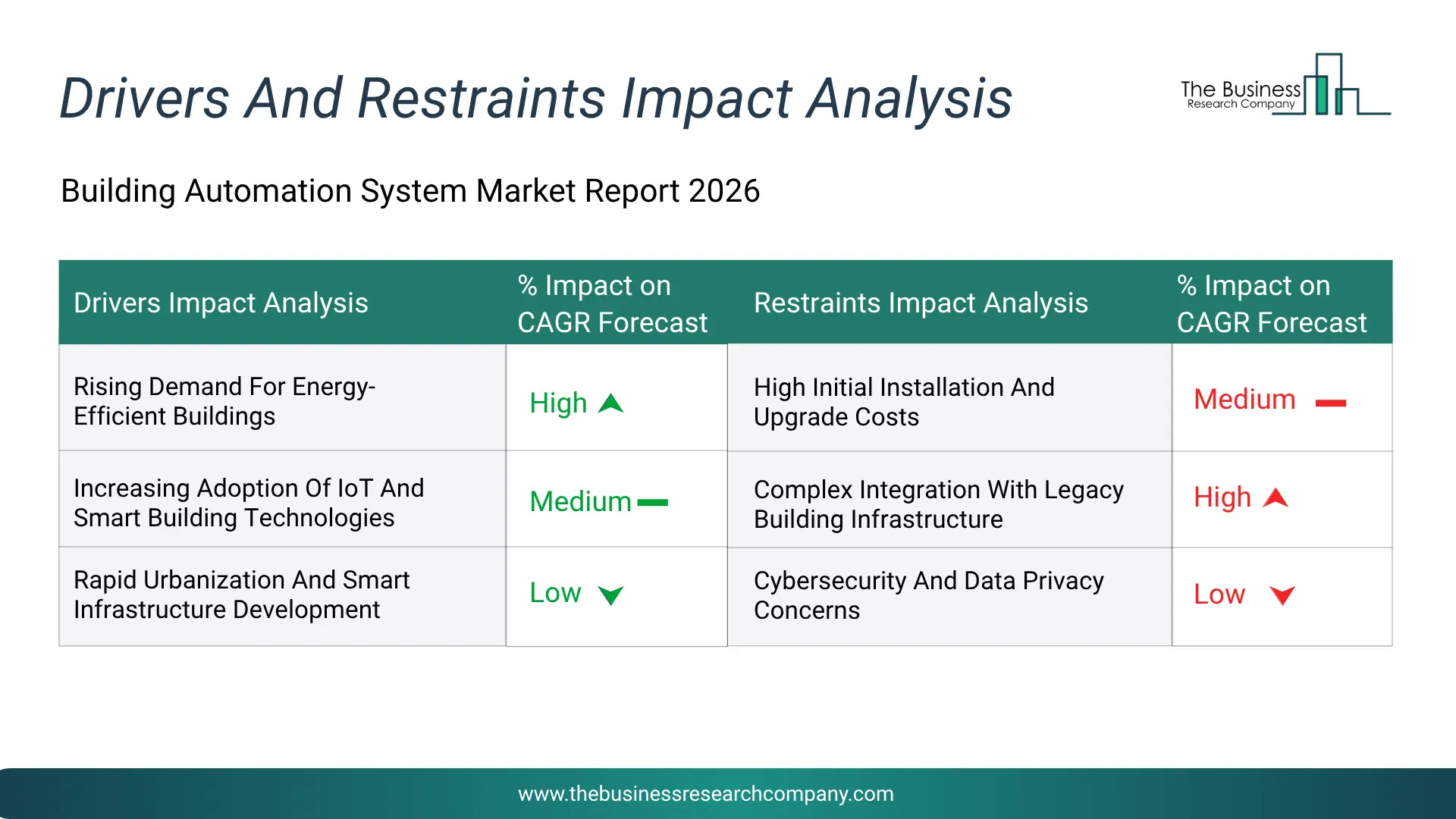
Infographic Chart Showing Key Market Drivers Analysis And Restraints For Building Automation System Market
The chart presents an impact analysis of key drivers and restraints, quantifying their relative influence on the market's growth rate and helping assess the balance between growth enablers and limiting factors. This chart offers a high-level perspective; the full report contains more detailed insights.
How Will The Drivers Impact Growth In The Global Building Automation System Market?
• Rising Demand For Energy-Efficient Buildings (High) – During the forecast period, the rising demand for energy-efficient buildings is expected to become a key growth driver for the building automation system market by 2030. Rising demand for energy-efficient buildings is driving growth in the building automation systems market as property owners and facility managers seek solutions that reduce electricity consumption, optimize HVAC performance, and lower operating costs. Building automation systems enable real-time monitoring and intelligent control of lighting, heating, cooling, and ventilation systems, helping buildings meet sustainability targets, regulatory standards, and green certification requirements. • Increasing Adoption Of IoT And Smart Building Technologies (Medium) – During the forecast period, the increasing adoption of IoT and smart building technologies is expected to emerge as a major factor driving the expansion of the building automation system market by 2030. Increasing adoption of IoT and smart building technologies is driving growth in the building automation systems market as connected sensors, smart devices, and cloud-based platforms enable real-time monitoring, predictive maintenance, and automated control of building functions. Building automation systems enhance operational efficiency, occupant comfort, security, and energy management, making them essential for modern intelligent buildings. • Rapid Urbanization And Smart Infrastructure Development (Low) – During the forecast period, the rapid urbanization and smart infrastructure development are expected to act as a key growth catalyst for the building automation system market by 2030. Rapid urbanization and smart infrastructure development are driving growth in the building automation systems market as expanding cities require efficient management of commercial complexes, residential towers, hospitals, airports, and public facilities. Building automation systems provide centralized control of lighting, HVAC, security, and energy usage, supporting smarter, safer, and more sustainable urban infrastructure.How Will The Restraints Impact Growth In The Global Building Automation System Market?
• High Initial Installation And Upgrade Costs (High) – During the forecast period, the high initial installation and upgrade costs are restraining growth in the building automation systems market as deploying sensors, controllers, software platforms, networking infrastructure, and system integration services requires significant upfront investment. These costs can discourage adoption among small and medium-sized building owners, delay retrofit projects, and extend return on investment timelines. • Complex Integration With Legacy Building Infrastructure (Medium) – During the forecast period, the complex integration with legacy building infrastructure is restraining growth in the building automation systems market as older buildings often use outdated electrical systems, standalone equipment, and incompatible control technologies. Upgrading these facilities to support modern automation requires extensive retrofitting, custom integration, and higher project costs, which can delay adoption and implementation. • Cybersecurity And Data Privacy Concerns (Low) – During the forecast period, the cybersecurity and data privacy concerns are restraining growth in the building automation systems market as connected platforms and IoT-enabled devices can be vulnerable to unauthorized access, cyberattacks, and data breaches. These risks create hesitation among building owners and facility managers, especially in critical infrastructure and commercial facilities, while increasing the need for additional security investments and compliance measures.Key Players In The Global Building Automation System Market
Major companies operating in the building automation system market are Honeywell International Inc., Robert Bosch GmbH, Johnson Controls International plc, Mitsubishi Electric Corporation, ABB Ltd., Schneider Electric SE, Siemens AG, Hubbell Inc., United Technologies Corporation, Ingersoll-Rand plc, General Electric Company, Cisco Systems Inc., Trane Technologies, Lutron Electronics Co. Ltd., Hitachi Ltd., Huawei Technologies Co. Ltd., Emerson Electric Co., Legrand, Control4 Corporation, Automated Logic Corporation, Delta Controls Inc., Distech Controls Inc., Crestron Electronics Inc., Leviton Manufacturing Co. Inc., Lynxspring Inc., Reliable Controls Corporation, Tridium Inc., Carrier Corporation, Computrols Inc., Daikin Industries Ltd.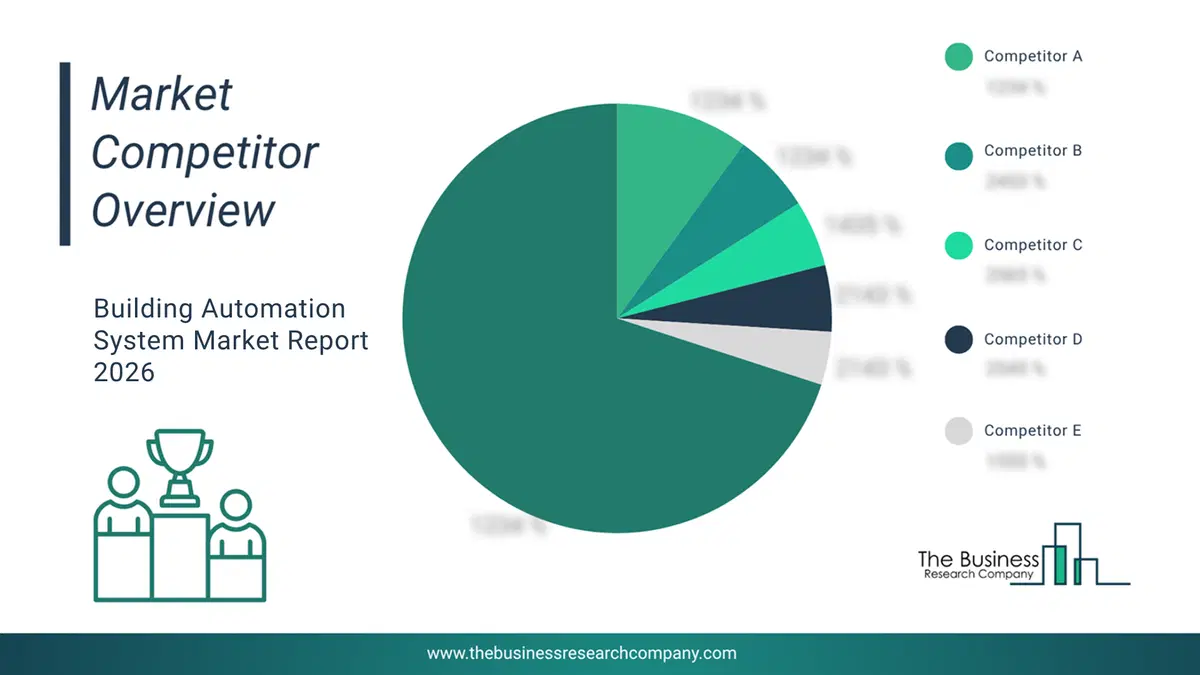
This chart is for illustrative purposes; the full report includes a detailed competitor analysis and comprehensive overview of the top 10 companies in the market.
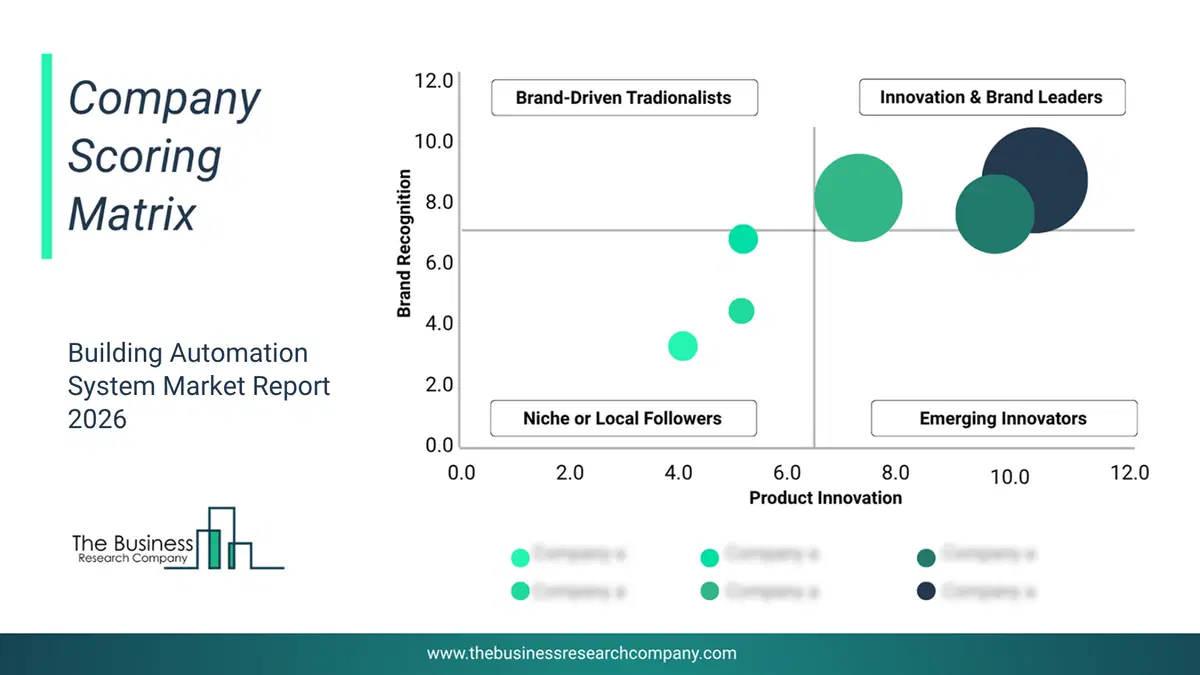
This chart maps companies by product innovation and brand strength, with bubble size indicating relative revenue, helping identify market leaders, challengers, and niche players. This is an illustrative chart; the full report provides a complete and accurate competitive analysis.
Global Building Automation System Market Trends and Insights
Major companies operating in the building automation system market are focusing on innovative products such as connect box to drive revenues in their market. Connect Box is a smart IoT solution that is intended to manage small and medium-sized buildings with the ability to maximize energy efficiency by up to 30% and significantly enhance indoor air quality in small to medium-sized buildings. For instance, in March 2023, Siemens Smart Infrastructure, a Germany-based company that focuses on providing products and services related to building technologies, launched connect box. Siemens Xcelerator is an open digital business platform that makes it simpler, quicker, and more feasible for clients to accelerate their digital transformation. Connect Box's cloud-based interface enables customers to complete routine building management chores all from one location. Notifications of impending problems and charts that illustrate past patterns offer valuable insights into the functioning of the building at any given moment, assisting in the optimization of building processes. Connect Box provides simple online access through a smartphone or desktop. Connect Box provides two models for licensing.What Are Latest Mergers And Acquisitions In The Building Automation System Market?
In April 2024, Building Controls & Solutions LLC, a US-based building automation company, acquired Yorkland Controls Limited for an undisclosed amount. This acquisition strengthens Building Controls & Solutions, LLC's ability to enhance its product offerings and expand its reach in the HVAC and building automation sector. Yorkland Controls Limited is a Canada-based company that offers building automation systems and solutions for connecting a building's systems and devices.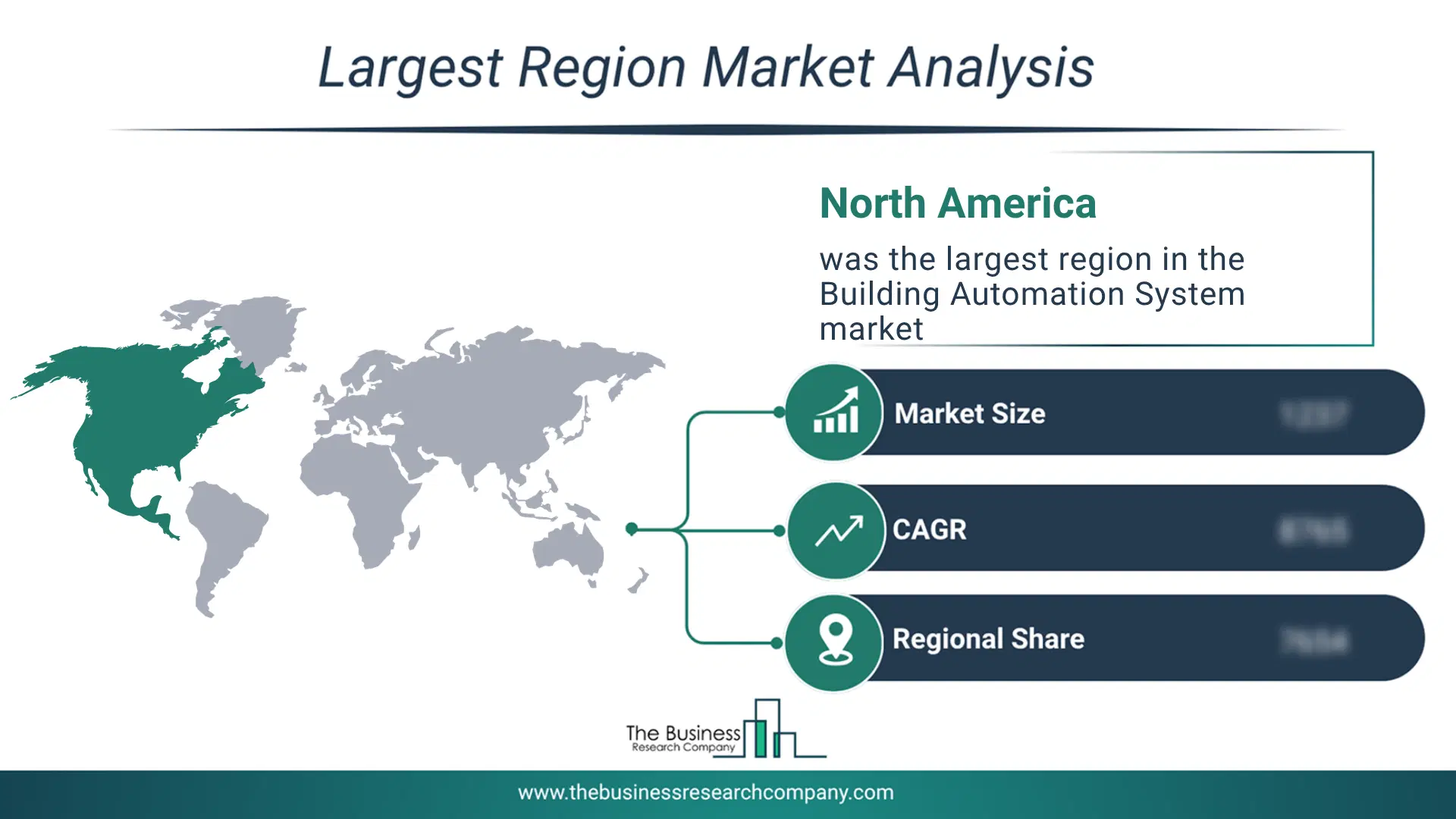
Regional Insights
North America was the largest region in the building automation system market in 2025.Asia-Pacific is expected to be the fastest-growing region in the global building automation system market report during the forecast period. The regions covered in this market report are Asia-Pacific, South East Asia, Western Europe, Eastern Europe, North America, South America, Middle East, Africa. The countries covered in this market report are Australia, Brazil, China, France, Germany, India, Indonesia, Japan, Taiwan, Russia, South Korea, UK, USA, Canada, Italy, Spain.What Defines the Building Automation System Market?
The building automation system market consists of revenues earned by entities by providing services such as design and engineering, installation and commissioning, maintenance and support, monitoring and optimization and consulting and training. The market value includes the value of related goods sold by the service provider or included within the service offering. The building automation system market also includes sales of sensors, output devices, controllers, communication protocols, and a terminal. Values in this market are ‘factory gate’ values, that is the value of goods sold by the manufacturers or creators of the goods, whether to other entities (including downstream manufacturers, wholesalers, distributors and retailers) or directly to end customers. The value of goods in this market includes related services sold by the creators of the goods.How is Market Value Defined and Measured?
The market value is defined as the revenues that enterprises gain from the sale of goods and/or services within the specified market and geography through sales, grants, or donations in terms of the currency (in USD unless otherwise specified). The revenues for a specified geography are consumption values that are revenues generated by organizations in the specified geography within the market, irrespective of where they are produced. It does not include revenues from resales along the supply chain, either further along the supply chain or as part of other products.
This chart presents market attractiveness based on a quantitative evaluation of growth, competition, strategic alignment, and risk, offering a clear view of opportunity areas for decision-making. This chart is for illustrative purposes; the full report contains the complete analysis.

This chart highlights the Total Addressable Market (TAM) by estimating the maximum revenue opportunity using an assumption-driven approach, supporting strategic planning and opportunity sizing across markets. The chart is illustrative; the full report provides a more comprehensive analysis.
What Key Data and Analysis Are Included in theBuilding Automation System Market Report 2026?
The building automation system market research report is one of a series of new reports from The Business Research Company that provides market statistics, including industry global market size, regional shares, competitors with the market share, detailed market segments, market trends and opportunities, and any further data you may need to thrive in the building automation system industry. The market research report delivers a complete perspective of everything you need, with an in-depth analysis of the current and future state of the industry.Building Automation System Market Report Forecast Analysis
| Report Attribute | Details |
|---|---|
| Market Size Value In 2026 | $124.73 billion |
| Revenue Forecast In 2030 | $204.14 billion |
| Growth Rate | CAGR of 12.6% from 2026 to 2030 |
| Base Year For Estimation | 2025 |
| Actual Estimates/Historical Data | 2020-2025 |
| Forecast Period | 2026 - 2030 |
| Market Representation | Revenue in USD Billion and CAGR from 2026 to 2030 |
| Segments Covered | Component, Offerings, Technology, Application |
| Regional Scope | Asia-Pacific, Western Europe, Eastern Europe, North America, South America, Middle East, Africa |
| Country Scope | The countries covered in the report are Australia, Brazil, China, France, Germany, India, Indonesia, Japan, Taiwan, Russia, South Korea, UK, USA, Canada, Italy, Spain. |
| Key Companies Profiled | Honeywell International Inc., Robert Bosch GmbH, Johnson Controls International plc, Mitsubishi Electric Corporation, ABB Ltd., Schneider Electric SE, Siemens AG, Hubbell Inc., United Technologies Corporation, Ingersoll-Rand plc, General Electric Company, Cisco Systems Inc., Trane Technologies, Lutron Electronics Co. Ltd., Hitachi Ltd., Huawei Technologies Co. Ltd., Emerson Electric Co., Legrand, Control4 Corporation, Automated Logic Corporation, Delta Controls Inc., Distech Controls Inc., Crestron Electronics Inc., Leviton Manufacturing Co. Inc., Lynxspring Inc., Reliable Controls Corporation, Tridium Inc., Carrier Corporation, Computrols Inc., Daikin Industries Ltd. |
| Customization Scope | Request for Customization |
| Pricing And Purchase Options | Explore Purchase Options |