

Building Management System Market Report 2026
Global Outlook – By Component (Hardware, Software, Service), By Technology (Wireless Technologies, Wired Technologies), By End-User (Commercial Buildings, Residential Buildings, Industrial Buildings, Government And Public Buildings) – Market Size, Trends, Strategies, and Forecast to 2030
Building Management System Market Overview
• Building Management System market size has reached to $22.95 billion in 2025 • Expected to grow to $60.76 billion in 2030 at a compound annual growth rate (CAGR) of 20.7% • Growth Driver: Driving Growth With Building Management Systems (BMS) In The Construction Industry • Market Trend: Innovating Building Management With Automated Solutions For Enhanced Efficiency • Europe was the largest region in 2025 and Asia-Pacific is the fastest growing region.Market Gains By 2030 – Top Opportunities By Segment
Market Gain identifies the most promising market opportunities by highlighting the segments or products expected to generate the highest incremental revenue growth over the next five years.
What Is Covered Under Building Management System Market?
A building management system (BMS) is a computer-based control system that monitors and manages a building's mechanical and electrical equipment. The primary purpose of a BMS is to automate and optimize the control and monitoring of various building systems and equipment, such as heating, ventilation, air conditioning (HVAC), lighting, security, and access control. It helps to improve energy efficiency, reduce costs, and enhance occupant comfort and safety. The main components of building management system are hardware, software, and services. Hardware in the building management system (BMS) market refers to the physical components used to control and monitor building systems, such as sensors, actuators, controllers, and interfaces. Wireless technologies and wired technologies are used by various end-users such as commercial buildings, residential buildings, industrial buildings, and government and public buildings.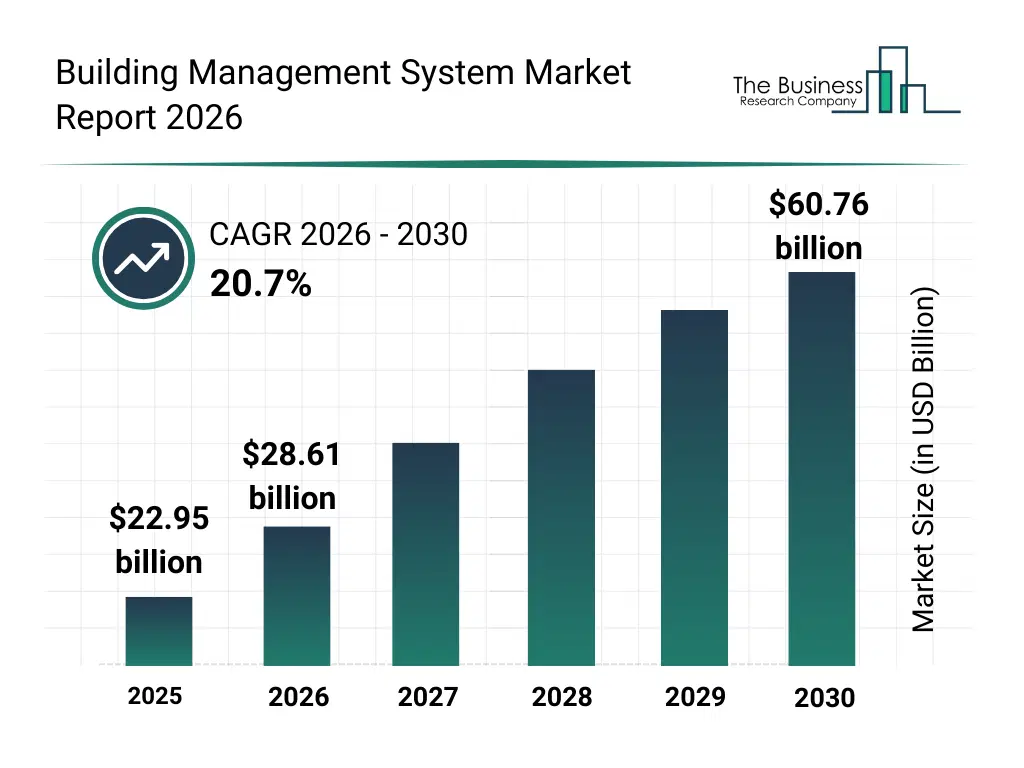
What Is The Building Management System Market Size and Share 2026?
The building management system market size has grown exponentially in recent years. It will grow from $22.95 billion in 2025 to $28.61 billion in 2026 at a compound annual growth rate (CAGR) of 24.7%. The growth in the historic period can be attributed to increasing adoption of centralized building controls, early deployment of energy management systems, growth of commercial building automation, rising demand for integrated security solutions, expansion of digital facility management tools.What Is The Building Management System Market Growth Forecast?
The building management system market size is expected to see exponential growth in the next few years. It will grow to $60.76 billion in 2030 at a compound annual growth rate (CAGR) of 20.7%. The growth in the forecast period can be attributed to increasing use of AI-enabled building optimization, growth in IOT-connected automation devices, rising deployment of cloud-based bms platforms, expansion of energy-efficient retrofitting, development of predictive maintenance ecosystems. Major trends in the forecast period include increasing adoption of smart building automation, expansion of integrated facility monitoring, rising deployment of intelligent hvac optimization, growth in energy-efficient building operations, increased use of centralized access and security controls.
Global Building Management System Market Segmentation
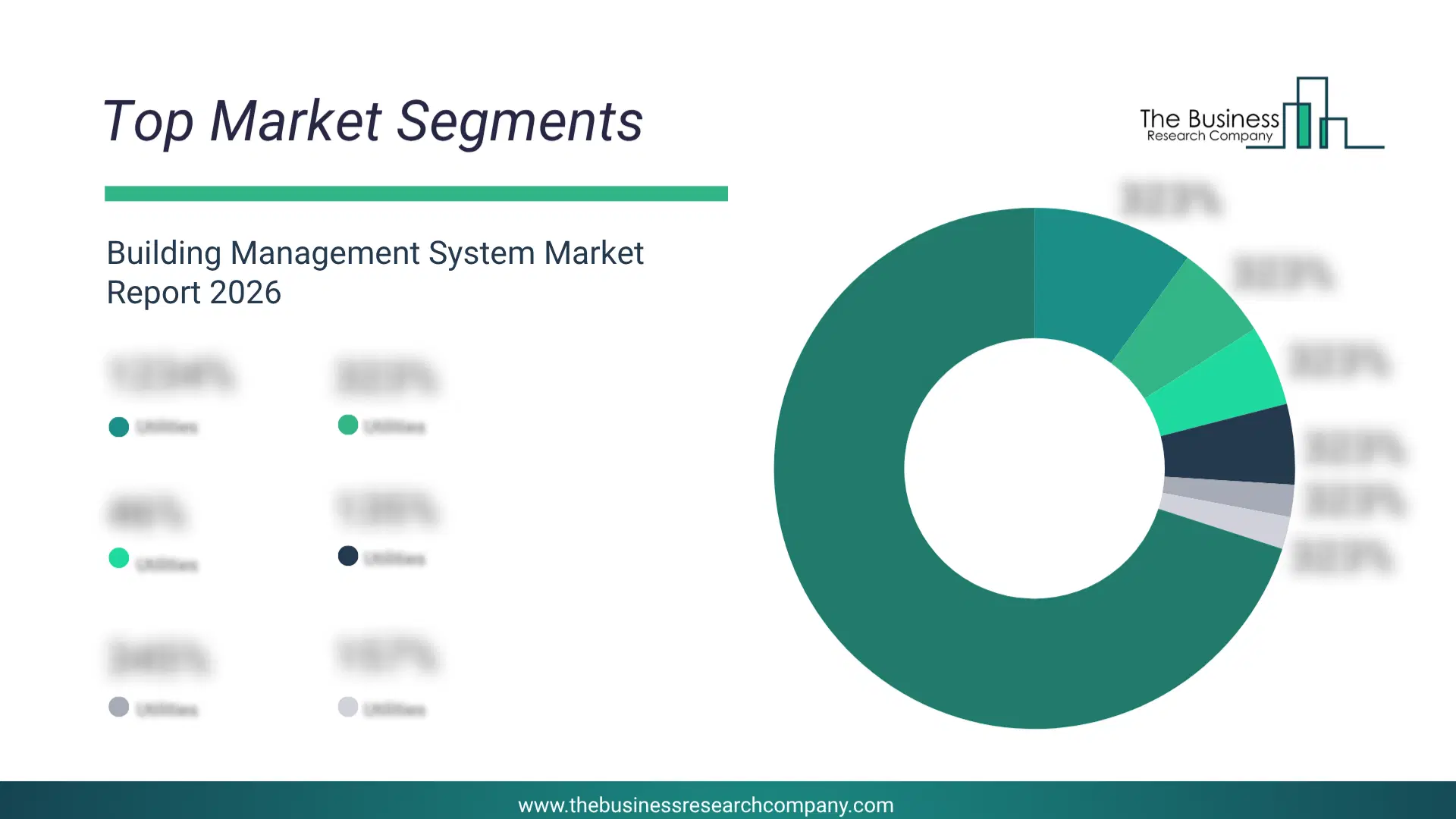
1) By Component: Hardware, Software, Service 2) By Technology: Wireless Technologies, Wired Technologies 3) By End-User: Commercial Buildings, Residential Buildings, Industrial Buildings, Government And Public Buildings Subsegments: 1) By Hardware: Sensors (Temperature, Humidity, Co2, Motion), Controllers (Centralized And Distributed), Actuators And Valves, Power Monitoring Equipment, Hvac Systems And Controls, Lighting Control Systems, Security And Access Control Hardware 2) By Software: Building Energy Management Software (Bems), Facility Management Software, Hvac Control Software, Lighting Control Software, Security And Surveillance Software, Integrated Building Management Software (Ibms) 3) By Service: Installation And Integration Services, Consulting And Design Services, Maintenance And Support Services, Training And Technical Support, Cloud-Based And Remote Monitoring Services The top segments in the building management system market will be: • Software will reach $30.99 Billion by 2030. • Hardware will reach $17.35 Billion by 2030. • Service will reach $7.81 Billion by 2030.What Is The Driver Of The Building Management System Market?
The rapid expansion of building and construction-related activities is expected to propel the growth of the building management system market going forward. Construction activities refer to any proposed or ongoing installation, repair, maintenance, or similar action on the land, including the movement of vehicles and cranes, the transport of building supplies, and the anchoring or shoring of rocks. BMS allows building managers to centrally control and manage multiple building systems from a single interface, including HVAC, lighting, security, and access control. This centralized control enables efficient operation and coordination of building functions, optimizing energy usage and occupant comfort. For instance, in June 2023, according to the United States Census Bureau, a US-based primary agency of the Federal Statistics System, construction spending reached $566.7 billion in the initial four months of 2023, an increase of 6.1 % compared to $533.9 billion in the same period of 2022. Therefore, the rapid expansion of building and construction-related activities drives the building management system industry.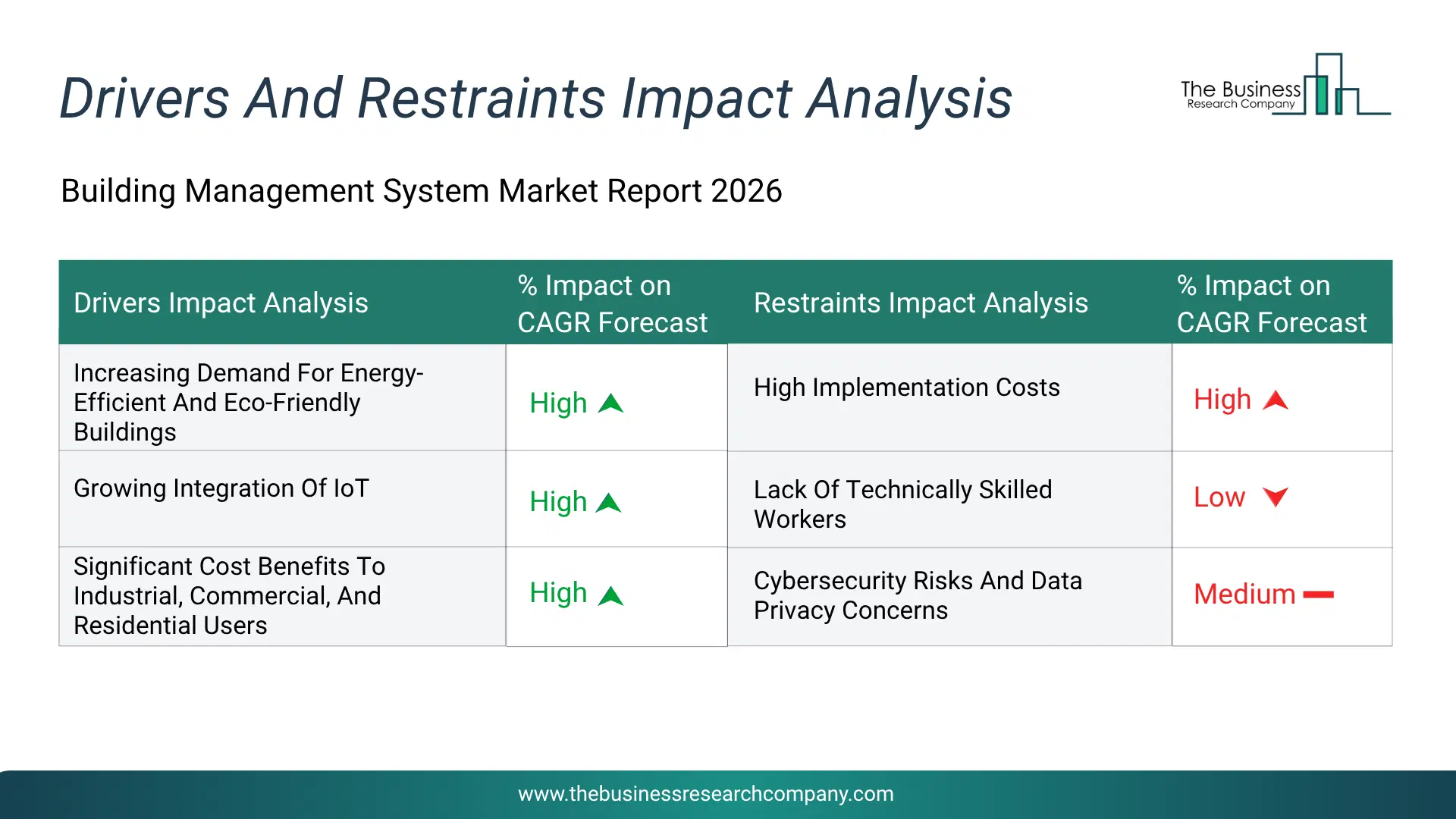
Infographic Chart Showing Key Market Drivers Analysis And Restraints For Building Management System Market
The chart presents an impact analysis of key drivers and restraints, quantifying their relative influence on the market's growth rate and helping assess the balance between growth enablers and limiting factors. This chart offers a high-level perspective; the full report contains more detailed insights.
How Will The Drivers Impact Growth In The Global Building Management System Market?
• Increasing Demand For Energy-Efficient And Eco-Friendly Buildings (High) – During the forecast period, the increasing demand for energy-efficient and eco-friendly buildings is expected to become a key growth driver for the building management system market by 2030. Increasing demand for energy-efficient and eco-friendly buildings is a major driver of the Building Management System (BMS) market because organizations are actively seeking ways to reduce energy consumption and operating expenses. BMS solutions enable real-time monitoring and control of HVAC, lighting, and other building systems, helping optimize energy usage. Governments and regulatory bodies are also promoting sustainable construction practices, encouraging the adoption of advanced management technologies. Building owners use BMS platforms to achieve green building certifications and meet environmental targets. The ability to minimize carbon emissions while maintaining occupant comfort further enhances their appeal. • Growing Integration Of IoT (High) – During the forecast period, the growing integration of IoT is expected to emerge as a major factor driving the expansion of the building management system market by 2030. Growing integration of IoT is accelerating the Building Management System market by enabling smarter and more connected building operations. IoT-enabled sensors and devices continuously collect data related to temperature, occupancy, lighting, and equipment performance. This real-time information allows BMS platforms to automate processes and improve operational efficiency. Facility managers can identify issues quickly, reduce energy wastage, and optimize resource utilization. IoT connectivity also supports remote monitoring and control, making building management more convenient and effective. Enhanced data analytics helps organizations make informed decisions regarding maintenance and energy management. • Significant Cost Benefits To Industrial, Commercial, And Residential Users (High) – During the forecast period, the significant cost benefits to industrial, commercial, and residential users is expected to act as a key growth catalyst for the building management system market by 2030. Significant cost benefits to industrial, commercial, and residential users are fueling the expansion of the Building Management System market. BMS platforms help reduce utility expenses by optimizing energy consumption and minimizing unnecessary equipment operation. Automated controls lower labor requirements and improve overall operational efficiency. Predictive maintenance capabilities help identify potential equipment failures before they become costly problems. Reduced downtime and extended equipment lifespan further contribute to long-term savings. Businesses and property owners increasingly recognize the financial advantages associated with intelligent building management.How Will The Restraints Impact Growth In The Global Building Management System Market?
• High Implementation Costs (High) – During the forecast period, the high implementation costs act as a significant restraint on the Building Management System (BMS) market because the deployment of these solutions often requires substantial upfront investment. Expenses associated with hardware installation, software integration, sensors, controllers, and network infrastructure can be considerable, especially for small and medium-sized organizations. In addition, upgrading existing building systems to support BMS technology may further increase project costs. Many building owners hesitate to invest when the payback period appears lengthy or uncertain. Budget limitations can delay modernization initiatives and reduce adoption rates. The financial burden becomes more pronounced in developing regions where capital expenditure is closely monitored. As a result, high implementation costs continue to limit the widespread penetration of BMS solutions across various end-user segments. • Lack Of Technically Skilled Workers (High) – During the forecast period, the lack of technically skilled workers is another major challenge restraining the growth of the Building Management System market. BMS platforms involve advanced technologies such as automation, IoT connectivity, data analytics, and integrated control systems that require specialized expertise to operate and maintain. Organizations often face difficulties in recruiting professionals with the necessary technical knowledge and experience. Insufficient workforce skills can lead to inefficient system utilization and reduced operational benefits. Training existing staff requires additional time and financial resources, increasing overall implementation complexity. The shortage of qualified personnel can also delay installation, maintenance, and troubleshooting activities. Consequently, the limited availability of skilled workers slows the adoption and effective deployment of Building Management System solutions worldwide. • Cybersecurity Risks And Data Privacy Concerns (High) – During the forecast period, the cybersecurity risks and data privacy concerns restrain the growth of the Building Management System market by increasing the potential for unauthorized access to connected building infrastructure. Modern BMS platforms rely on IoT devices, cloud connectivity, and networked control systems, making them vulnerable to cyberattacks and data breaches. A successful security incident can disrupt critical building operations, compromise occupant safety, and expose sensitive operational data. Building owners must invest in advanced cybersecurity solutions, continuous monitoring, and regulatory compliance to mitigate these risks. These additional investments increase the total cost of ownership and implementation complexity. Concerns regarding system security may also discourage organizations from adopting cloud-based BMS solutions. Consequently, cybersecurity and data privacy challenges limit the broader adoption of Building Management System technologies.Key Players In The Global Building Management System Market
Major companies operating in the building management system market are Siemens AG, United Technologies Corporation (UTC), International Business Machines Corporation (IBM), Cisco Systems Inc., Schneider Electric SE, Mitsubishi Electric Corporation, Honeywell International Inc., ABB Group, Johnson Controls International plc, Carrier Global Corporation, Trane Technologies plc, Emerson Electric Co., Legrand SA, Rockwell Automation Inc., Crestron Electronics Inc., Delta Controls Inc., Automated Logic Corporation, Trend Control Systems Ltd., KMC Controls Inc., Alerton, Reliable Controls Corporation, Distech Controls Inc. (Acuity Brands), Cylon Controls Ltd., Automated Building Controls (ABC) Ltd., Computrols Inc., Innotech Control Systems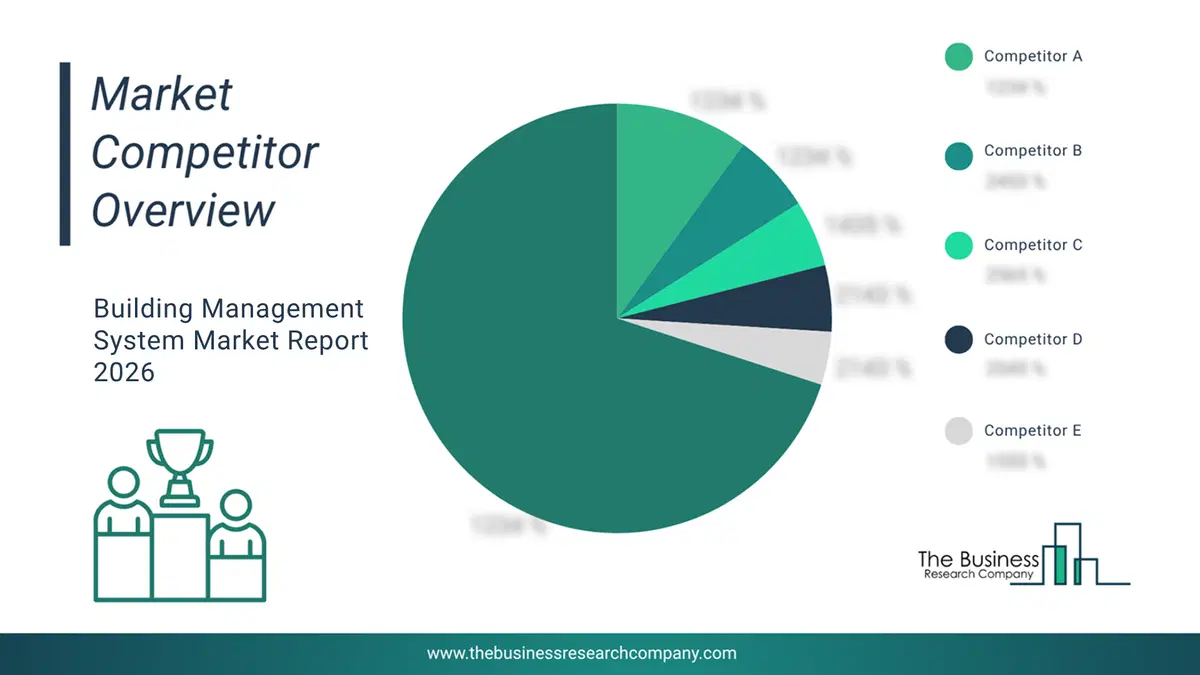
This chart is for illustrative purposes; the full report includes a detailed competitor analysis and comprehensive overview of the top 10 companies in the market.
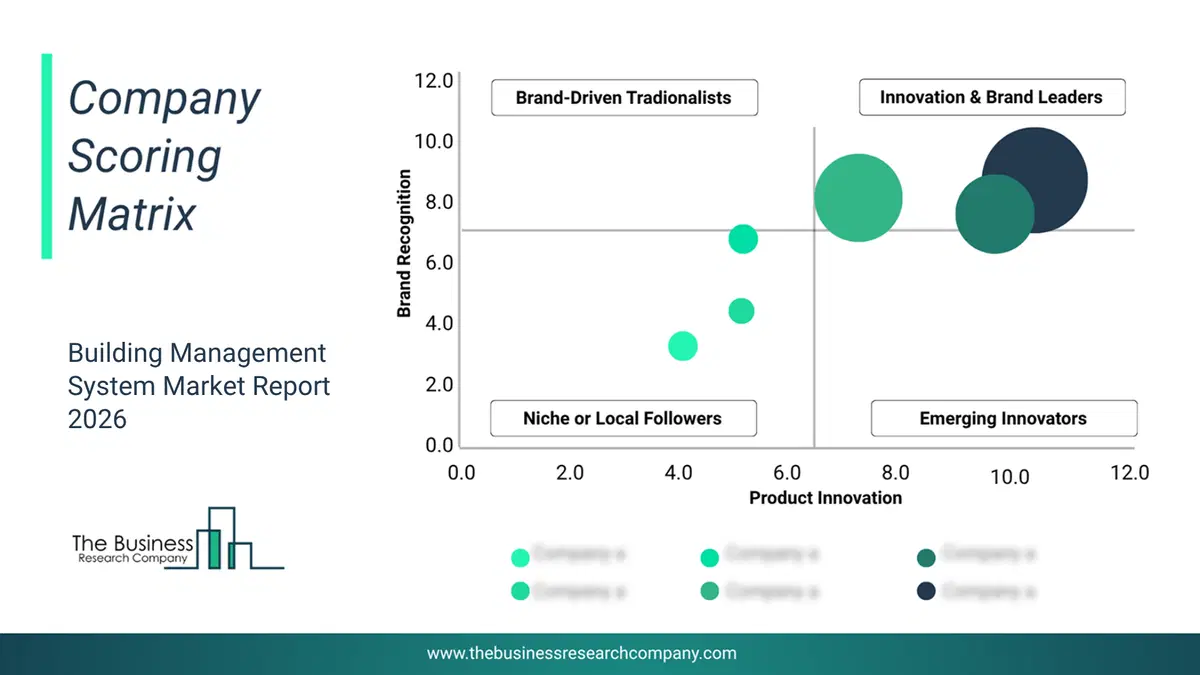
This chart maps companies by product innovation and brand strength, with bubble size indicating relative revenue, helping identify market leaders, challengers, and niche players. This is an illustrative chart; the full report provides a complete and accurate competitive analysis.
Global Building Management System Market Trends and Insights
Major companies operating in the building management system are developing automated building management systems to streamline building operations, improve energy efficiency, and enhance occupant comfort. An automated building management system (BMS) is a centralized system that uses sensors, controllers, and software to automate and control various building systems. For instance, in January 2024, Honeywell International Inc., a manufacturer of building controls, launched advance control for buildings. This distinctive technology combines automation, machine learning, and cybersecurity to optimize building operations, increase energy efficiency, and enhance the overall occupant experience. Honeywell's Advance Control for Buildings represents a significant advancement in building control technology by leveraging existing wiring and strategic partnerships with semiconductor leaders such as NXP Semiconductors and Analog Devices Inc., offering faster network speeds, enhanced security, and increased operational efficiency.What Are Latest Mergers And Acquisitions In The Building Management System Market?
In March 2024, Learnd, a UK-based technology company, acquired BGES Group for an undisclosed amount. The acquisition of BGES Group by Learnd strengthens Learnd's position in the building management system sector by providing expertise, expanding market reach, enhancing resources, and fostering synergies between the two entities to deliver cutting-edge solutions in energy management and sustainability. BGES Group is a UK-based building management firm providing services focused on reducing energy costs and carbon emissions in non-residential buildings.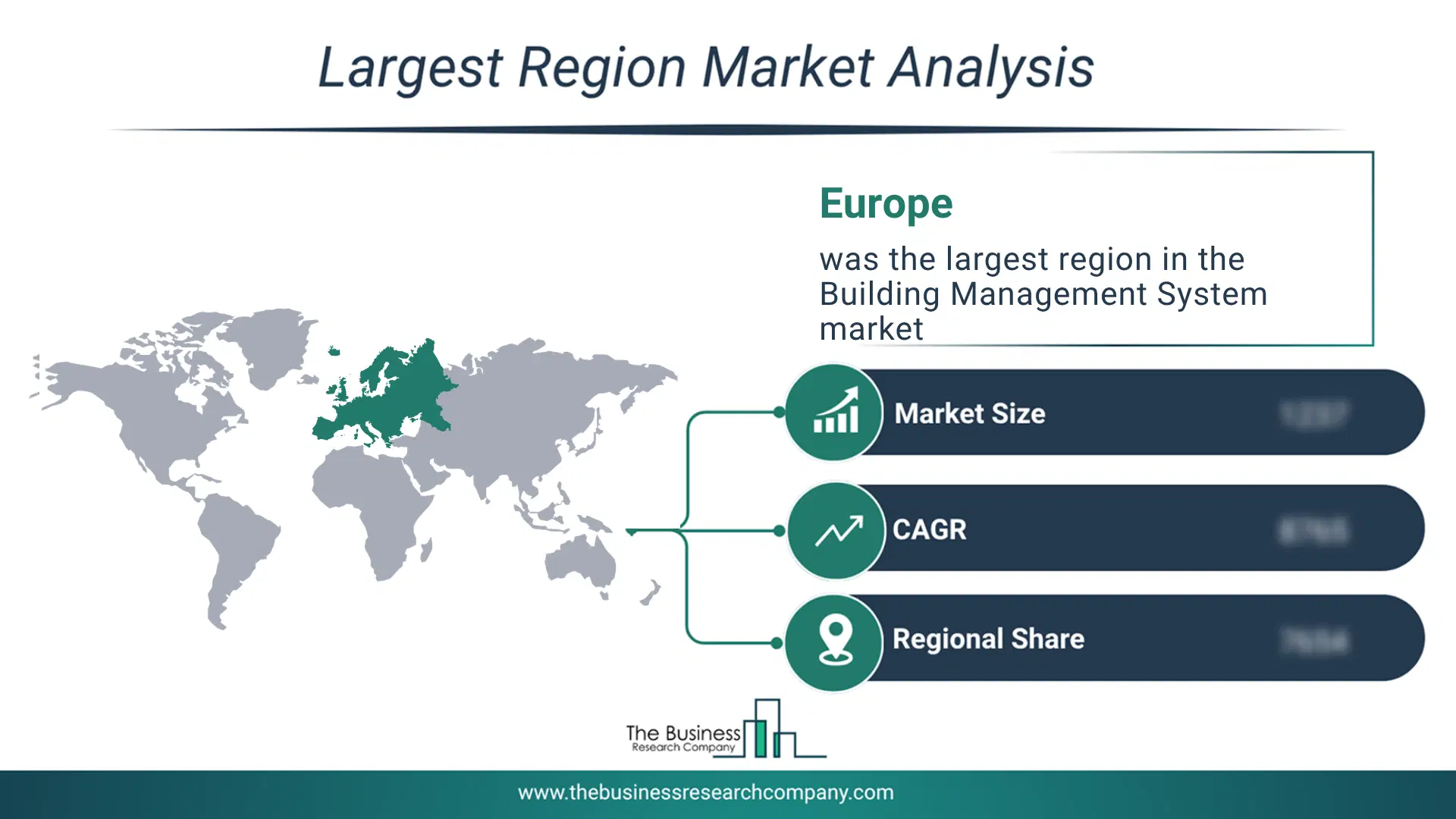
Regional Insights
Europe was the largest region in the building management system market in 2025. Asia-Pacific is expected to be the fastest-growing region in the forecast period. The regions covered in this market report are Asia-Pacific, South East Asia, Western Europe, Eastern Europe, North America, South America, Middle East, Africa. The countries covered in this market report are Australia, Brazil, China, France, Germany, India, Indonesia, Japan, Taiwan, Russia, South Korea, UK, USA, Canada, Italy, Spain.What Defines the Building Management System Market?
The building management system market consists of revenues earned by entities by providing services such as energy management, fire detection and alarm systems, environmental monitoring, occupancy tracking, and lighting control. The market value includes the value of related goods sold by the service provider or included within the service offering. The building management system market also includes sales of security devices, sensors and actuators, user interfaces, and building automation controllers. Values in this market are ‘factory gate’ values, that is the value of goods sold by the manufacturers or creators of the goods, whether to other entities (including downstream manufacturers, wholesalers, distributors and retailers) or directly to end customers. The value of goods in this market includes related services sold by the creators of the goods.How is Market Value Defined and Measured?
The market value is defined as the revenues that enterprises gain from the sale of goods and/or services within the specified market and geography through sales, grants, or donations in terms of the currency (in USD unless otherwise specified). The revenues for a specified geography are consumption values that are revenues generated by organizations in the specified geography within the market, irrespective of where they are produced. It does not include revenues from resales along the supply chain, either further along the supply chain or as part of other products.
This chart presents market attractiveness based on a quantitative evaluation of growth, competition, strategic alignment, and risk, offering a clear view of opportunity areas for decision-making. This chart is for illustrative purposes; the full report contains the complete analysis.

This chart highlights the Total Addressable Market (TAM) by estimating the maximum revenue opportunity using an assumption-driven approach, supporting strategic planning and opportunity sizing across markets. The chart is illustrative; the full report provides a more comprehensive analysis.
What Key Data and Analysis Are Included in theBuilding Management System Market Report 2026?
The building management system market research report is one of a series of new reports from The Business Research Company that provides market statistics, including industry global market size, regional shares, competitors with the market share, detailed market segments, market trends and opportunities, and any further data you may need to thrive in the building management system industry. The market research report delivers a complete perspective of everything you need, with an in-depth analysis of the current and future state of the industry.Building Management System Market Report Forecast Analysis
| Report Attribute | Details |
|---|---|
| Market Size Value In 2026 | $28.61 billion |
| Revenue Forecast In 2030 | $60.76 billion |
| Growth Rate | CAGR of 24.7% from 2026 to 2030 |
| Base Year For Estimation | 2025 |
| Actual Estimates/Historical Data | 2020-2025 |
| Forecast Period | 2026 - 2030 |
| Market Representation | Revenue in USD Billion and CAGR from 2026 to 2030 |
| Segments Covered | Component, Technology, End-User |
| Regional Scope | Asia-Pacific, Western Europe, Eastern Europe, North America, South America, Middle East, Africa |
| Country Scope | The countries covered in the report are Australia, Brazil, China, France, Germany, India, ... |
| Key Companies Profiled | Siemens AG, United Technologies Corporation (UTC), International Business Machines Corporation (IBM), Cisco Systems Inc., Schneider Electric SE, Mitsubishi Electric Corporation, Honeywell International Inc., ABB Group, Johnson Controls International plc, Carrier Global Corporation, Trane Technologies plc, Emerson Electric Co., Legrand SA, Rockwell Automation Inc., Crestron Electronics Inc., Delta Controls Inc., Automated Logic Corporation, Trend Control Systems Ltd., KMC Controls Inc., Alerton, Reliable Controls Corporation, Distech Controls Inc. (Acuity Brands), Cylon Controls Ltd., Automated Building Controls (ABC) Ltd., Computrols Inc., Innotech Control Systems |
| Customization Scope | Request for Customization |
| Pricing And Purchase Options | Explore Purchase Options |