
Building Vibration Isolation Market Report 2026
Global Outlook – By Product (Elastomeric Isolators, Air Isolators, Mechanical Isolators, Compact Pneumatic Isolators, Other Products), By Material (Natural And Recycled Rubber, Cork And Resin Bonded Cork, Virgin Polyurethane, Other Materials), By Form (Mats Or Pads, Blocks, Module), By Application (Transportation, Architecture, Electronics, Aerospace, Defense, Manufacturing, Medical, Other Applications), By End-Use (Residential, Commercial, Industrial) – Market Size, Trends, Strategies, and Forecast to 2030
Building Vibration Isolation Market Overview
• Building Vibration Isolation market size has reached to $2.57 billion in 2025 • Expected to grow to $3.65 billion in 2030 at a compound annual growth rate (CAGR) of 7.2% • Growth Driver: Surge In Construction And Infrastructure Development Fueling The Growth Of The Building Vibration Isolation Market Due To Rising Urbanization Demands • Market Trend: Innovative Solutions Enhance Building Comfort And Acoustic Performance • North America was the largest region in 2025.What Is Covered Under Building Vibration Isolation Market?
Building vibration isolation refers to the techniques and systems designed to reduce or eliminate the transmission of vibrations from external or internal sources into a building's structure. These vibrations can originate from nearby railways, heavy machinery, heating, ventilation, and air conditioning systems, or foot traffic, potentially affecting occupant comfort and sensitive equipment. By incorporating isolators, damping materials, and structural modifications, vibration isolation ensures improved building performance and stability. The main products of building vibration isolation include elastomeric isolators, air isolators, mechanical isolators, compact pneumatic isolators, and others. Elastomeric isolators refer to vibration-damping components made from elastic materials that absorb and reduce vibrations and shocks in structures or equipment. These are made from materials such as natural and recycled rubber, cork and resin-bonded cork, virgin polyurethane, and others. The forms are involved in mats or pads, blocks, and modules. The various applications, such as transportation, architecture, electronics, aerospace, defense, manufacturing, medical, and others, and the key end uses are residential, commercial, and industrial.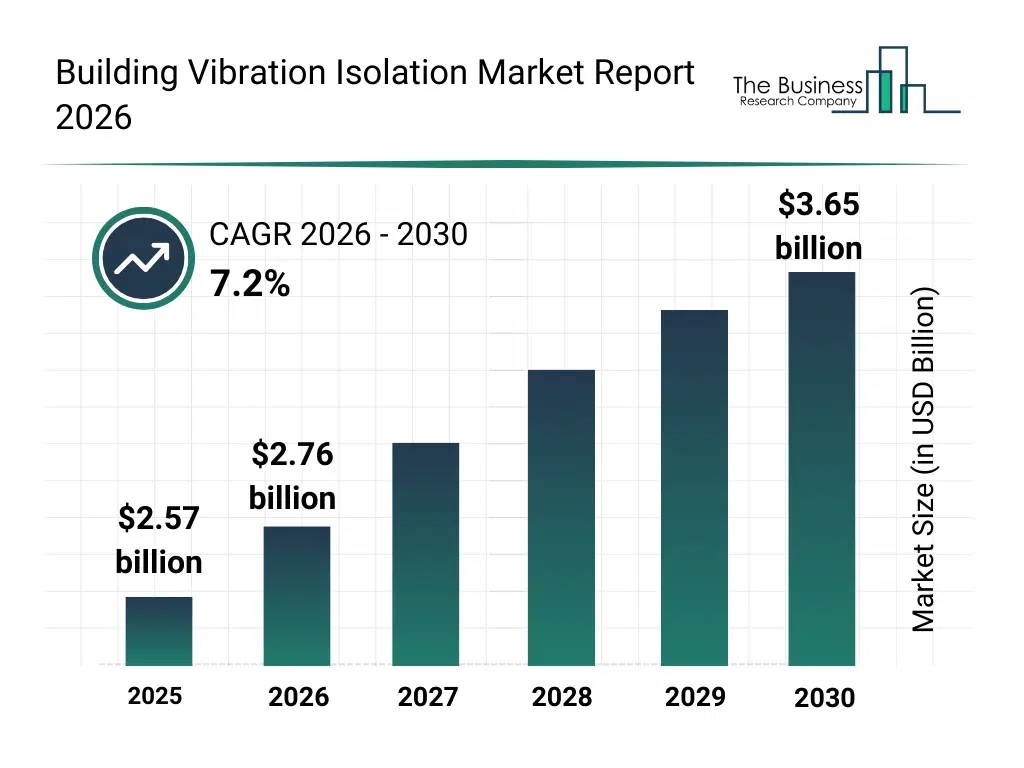
What Is The Building Vibration Isolation Market Size and Share 2026?
The building vibration isolation market size has grown strongly in recent years. It will grow from $2.57 billion in 2025 to $2.76 billion in 2026 at a compound annual growth rate (CAGR) of 7.5%. The growth in the historic period can be attributed to rising need for vibration control in urban construction, increasing use of damping materials in sensitive facilities, reliance on isolation rails and mounts, growth in infrastructure near high-vibration zones, rising installation of vibration reduction systems.What Is The Building Vibration Isolation Market Growth Forecast?
The building vibration isolation market size is expected to see strong growth in the next few years. It will grow to $3.65 billion in 2030 at a compound annual growth rate (CAGR) of 7.2%. The growth in the forecast period can be attributed to growing adoption of smart vibration monitoring devices, expansion of advanced damping material production, rising investment in resilient building design, development of low-carbon isolation materials, increasing integration of digital modeling in vibration mitigation. Major trends in the forecast period include expansion of AI-based vibration monitoring systems, advancement of eco-friendly isolation materials, development of automated isolation manufacturing lines, integration of IOT-enabled building vibration sensors, adoption of digital simulation and performance analytics.
Global Building Vibration Isolation Market Segmentation
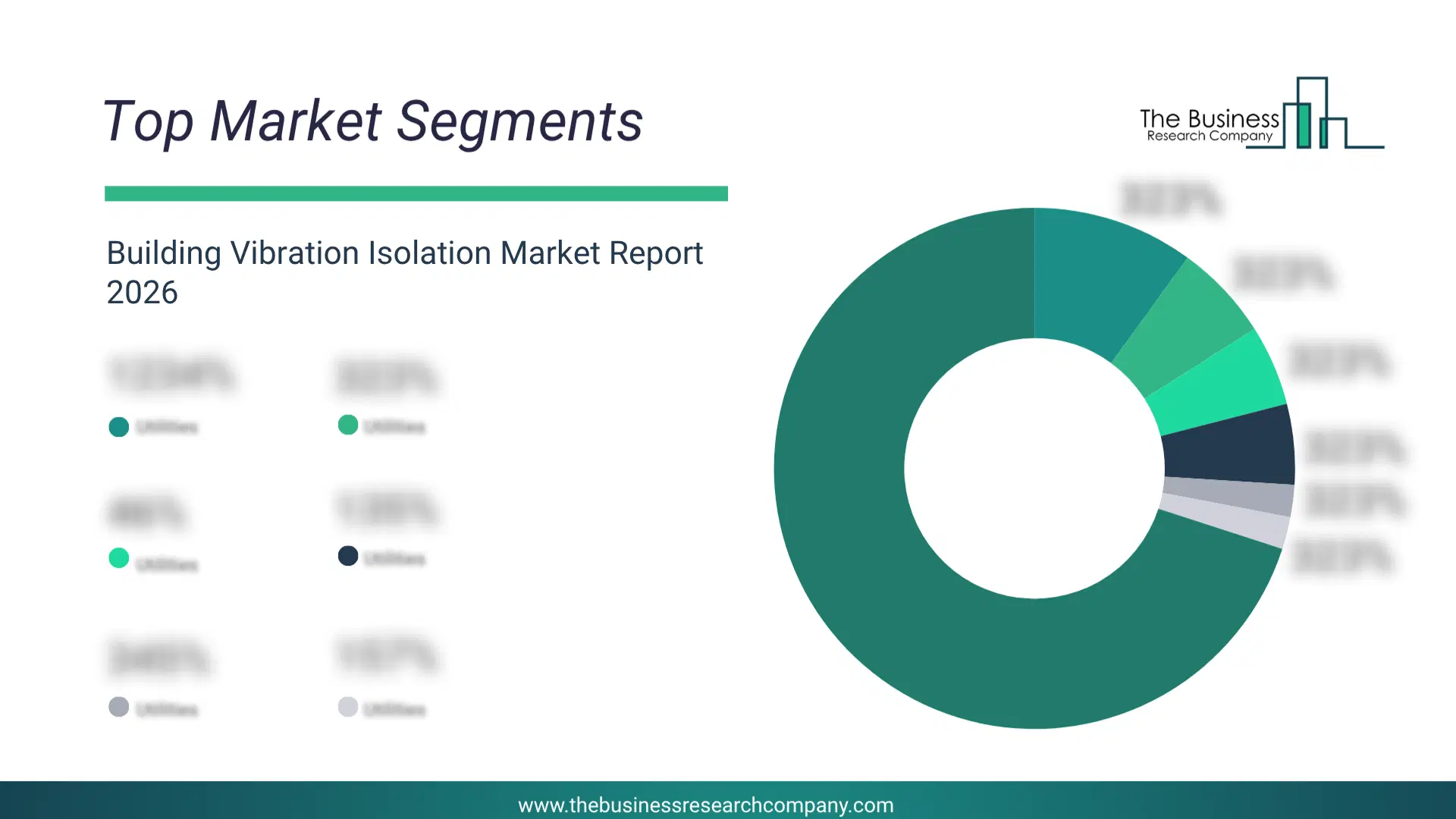
1) By Product: Elastomeric Isolators, Air Isolators, Mechanical Isolators, Compact Pneumatic Isolators, Other Products 2) By Material: Natural And Recycled Rubber, Cork And Resin Bonded Cork, Virgin Polyurethane, Other Materials 3) By Form: Mats Or Pads, Blocks, Module 4) By Application: Transportation, Architecture, Electronics, Aerospace, Defense, Manufacturing, Medical, Other Applications 5) By End-Use: Residential, Commercial, Industrial Subsegments: 1) By Elastomeric Isolators: Neoprene Isolators, Natural Rubber Isolators, Silicone Isolators, Polyurethane Isolators, Other Elastomeric Materials 2) By Air Isolators: Passive Air Isolators, Active Air Isolators, Pneumatic Air Isolators 3) By Mechanical Isolators: Spring Isolators, Wire Rope Isolators, Friction Isolators, Viscous Dampers 4) By Compact Pneumatic Isolators: Single-Stage Pneumatic Isolators, Multi-Stage Pneumatic Isolators 5) By Other Products: Tuned Mass Dampers, Base Isolators, Vibration Pads, Floor Isolation SystemsWhat Is The Driver Of The Building Vibration Isolation Market?
The increasing construction and infrastructure development are expected to propel the growth of the building vibration isolation market going forward. Construction and infrastructure development refer to the planning, building, and upgrading of physical structures and systems such as buildings, roads, bridges, and utilities that support economic and social activities. The rise in construction and infrastructure development is due to urbanization, as growing populations in cities demand improved housing, transportation, and utility networks. Building vibration isolation supports construction and infrastructure development by enhancing structural integrity and occupant comfort, minimizing the impact of ground-borne vibrations from sources such as traffic, railways, or industrial machinery. For instance, in February 2024, according to the Infrastructure and Projects Authority, a UK-based government agency, £164 ($214.18) billion planned investment in major infrastructure and construction projects for 2024/25 exceeds that of 2023/24. Over the next decade, total projected investments are estimated to reach between £700 ($914.16) billion and £775 ($1012.11) billion. Therefore, the increasing construction and infrastructure development is driving the building vibration isolation industry.Key Players In The Global Building Vibration Isolation Market
Major companies operating in the building vibration isolation market are Trelleborg AB, Getzner Werkstoffe GmbH, Hutchinson Group, Mason Industries Inc, ACE Controls Inc., VMC Group, Resistoflex Inc., SEBERT Schwingungstechnik GmbH, Enidine Inc., Socitec Group, Vibro-Acoustics by Swegon AB, Maurer SE, VibraSystems Inc., AMC Mecanocaucho S.A., Farrat Engineering Ltd, Vibra-Sonic Control Inc., Vibration Eliminator Company, Kellett Enterprises Inc., Bilz Vibration Technology AG, ISOTECH Industries Inc.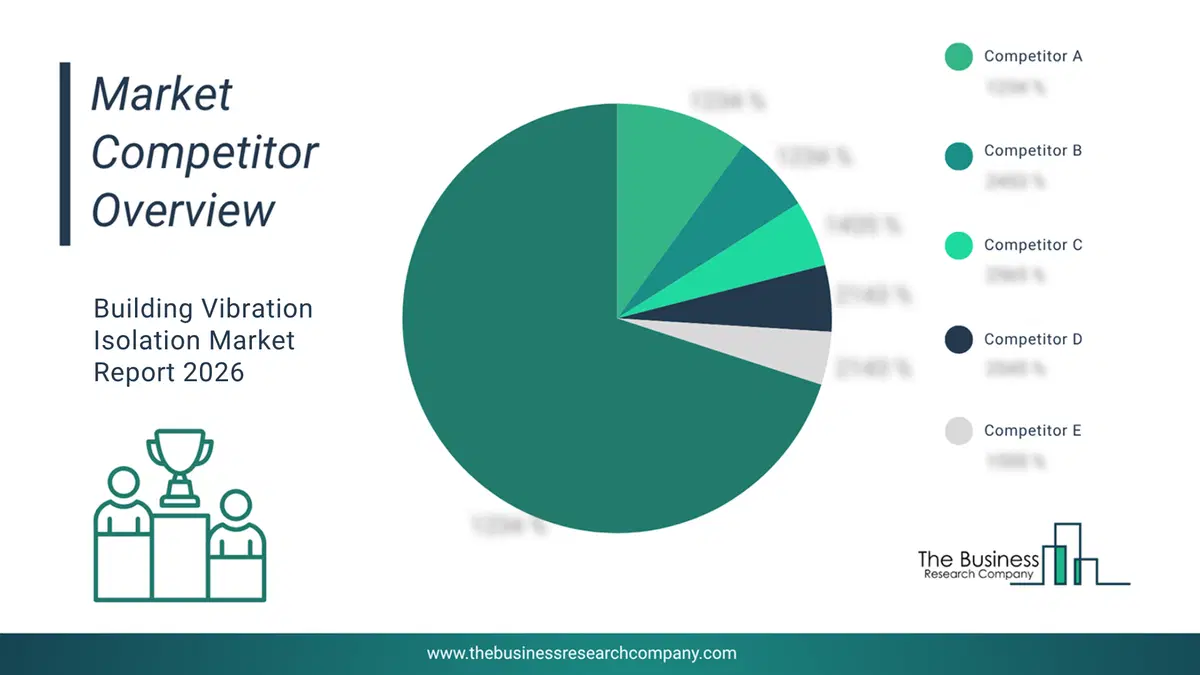
This chart is for illustrative purposes; the full report includes a detailed competitor analysis and comprehensive overview of the top 10 companies in the market.
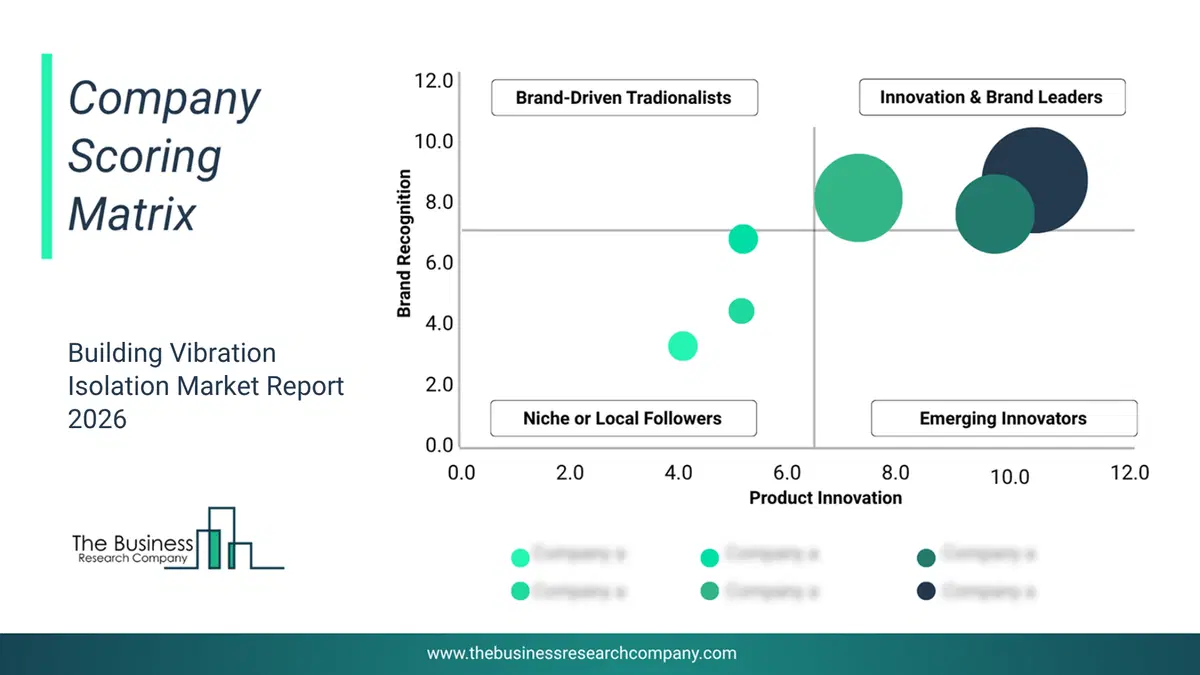
This chart maps companies by product innovation and brand strength, with bubble size indicating relative revenue, helping identify market leaders, challengers, and niche players. This is an illustrative chart; the full report provides a complete and accurate competitive analysis.
Global Building Vibration Isolation Market Trends and Insights
Major companies operating in the building vibration isolation market focusing on developing innovative products such as sound reduction and vibration isolation products to enhance building comfort, structural stability, and acoustic performance. Sound reduction and vibration isolation products refer to materials and systems designed to minimize the transmission of noise and vibrations through building structures, improving acoustic comfort and structural integrity. For instance, in June 2025, The Pate Company, a US-based manufacturing company, launched a pate sound shield (PSS) to reduce structural noise and enhance building acoustic performance. It is designed to reduce rooftop equipment noise by up to 75 decibels while providing vibration isolation and improved thermal insulation with an R-value of 8.0. Its flexible acoustic barrier absorbs sound waves effectively, enhancing occupant comfort and protecting building structures from vibration damage. The product is easy to install with a watertight seal and helps buildings comply with noise ordinances and building codes, making it a cost-effective sound and vibration control solution.What Are Latest Mergers And Acquisitions In The Building Vibration Isolation Market?
In April 2024, Amplex Group, a Sweden-based investment company, acquired Vibrostop Srl for an undisclosed amount. Through this acquisition, Vibrostop’s advanced vibration control and noise reduction technologies are integrated into Amplex’s portfolio. It strengthens Amplex’s position in building and industrial vibration isolation by enhancing its delivery of reliable, high-performance solutions. Vibrostop Srl is an Italy-based manufacturer of products for vibration damping, and they offer products that are relevant to building vibration isolation.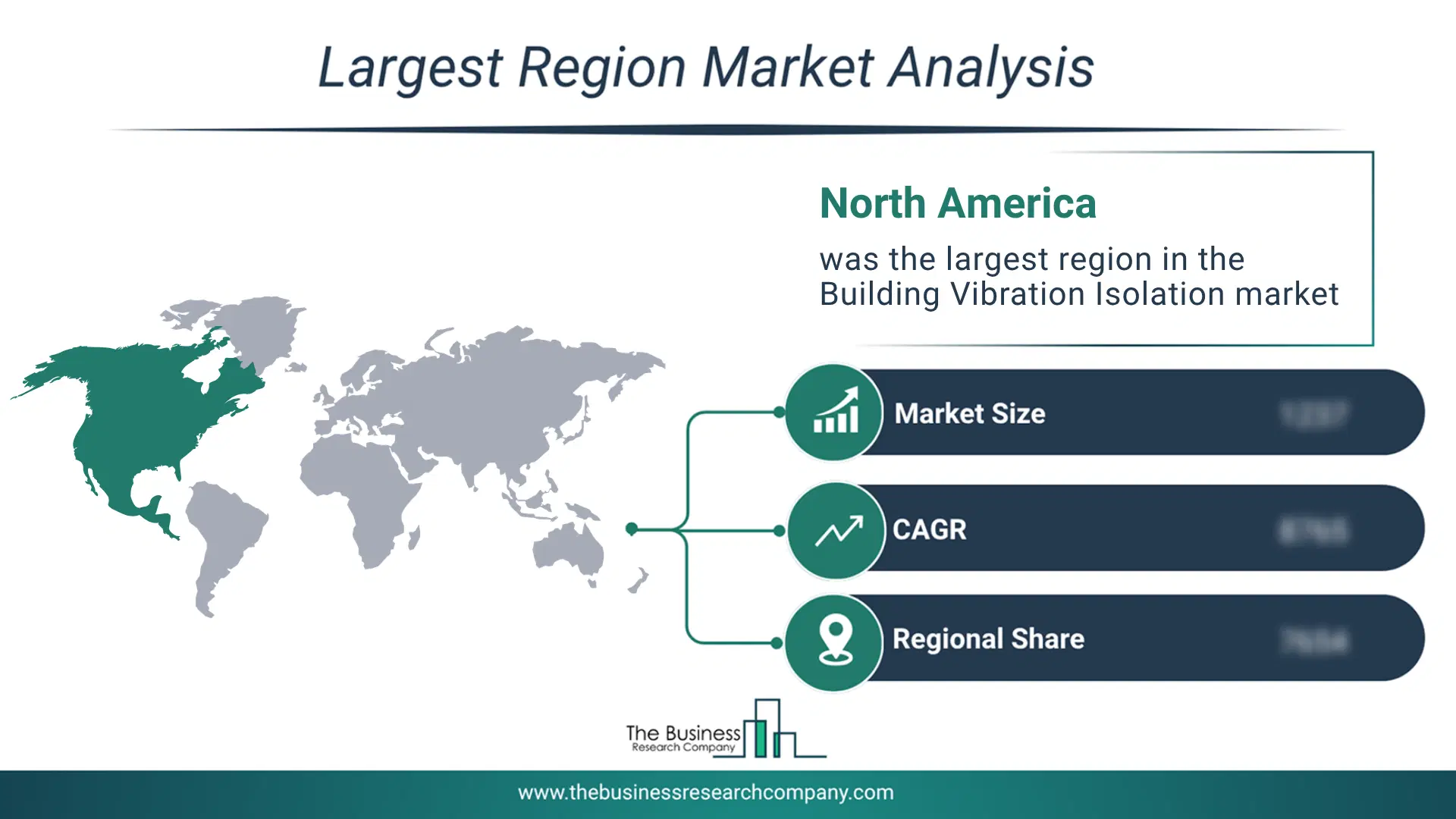
Regional Insights
North America was the largest region in the building vibration isolation market in 2025. The regions covered in this market report are Asia-Pacific, South East Asia, Western Europe, Eastern Europe, North America, South America, Middle East, Africa. The countries covered in this market report are Australia, Brazil, China, France, Germany, India, Indonesia, Japan, Taiwan, Russia, South Korea, UK, USA, Canada, Italy, Spain.What Defines the Building Vibration Isolation Market?
The building vibration isolation market consists of revenues earned by entities by providing services such as structural damping enhancement, design consultation for vibration-sensitive projects, and architectural acoustic consulting. The market value includes the value of related goods sold by the service provider or included within the service offering. The building vibration isolation market also includes sales of resilient mounts and pads, base isolators, and isolation rails and tracks. Values in this market are ‘factory gate’ values, that is, the value of goods sold by the manufacturers or creators of the goods, whether to other entities (including downstream manufacturers, wholesalers, distributors, and retailers) or directly to end customers. The value of goods in this market includes related services sold by the creators of the goods.How is Market Value Defined and Measured?
The market value is defined as the revenues that enterprises gain from the sale of goods and/or services within the specified market and geography through sales, grants, or donations in terms of the currency (in USD unless otherwise specified). The revenues for a specified geography are consumption values that are revenues generated by organizations in the specified geography within the market, irrespective of where they are produced. It does not include revenues from resales along the supply chain, either further along the supply chain or as part of other products.
This chart presents market attractiveness based on a quantitative evaluation of growth, competition, strategic alignment, and risk, offering a clear view of opportunity areas for decision-making. This chart is for illustrative purposes; the full report contains the complete analysis.

This chart highlights the Total Addressable Market (TAM) by estimating the maximum revenue opportunity using an assumption-driven approach, supporting strategic planning and opportunity sizing across markets. The chart is illustrative; the full report provides a more comprehensive analysis.
What Key Data and Analysis Are Included in theBuilding Vibration Isolation Market Report 2026?
The building vibration isolation market research report is one of a series of new reports from The Business Research Company that provides market statistics, including industry global market size, regional shares, competitors with the market share, detailed market segments, market trends and opportunities, and any further data you may need to thrive in the building vibration isolation industry. The market research report delivers a complete perspective of everything you need, with an in-depth analysis of the current and future state of the industry.Building Vibration Isolation Market Report Forecast Analysis
| Report Attribute | Details |
|---|---|
| Market Size Value In 2026 | $2.76 billion |
| Revenue Forecast In 2030 | $3.65 billion |
| Growth Rate | CAGR of 7.5% from 2026 to 2030 |
| Base Year For Estimation | 2025 |
| Actual Estimates/Historical Data | 2020-2025 |
| Forecast Period | 2026 - 2030 |
| Market Representation | Revenue in USD Billion and CAGR from 2026 to 2030 |
| Segments Covered | Product, Material, Form, Application, End-Use |
| Regional Scope | Asia-Pacific, Western Europe, Eastern Europe, North America, South America, Middle East, Africa |
| Country Scope | The countries covered in this market report are Australia, Brazil, China, France, Germany, India, Indonesia, Japan, Taiwan, Russia, South Korea, UK, USA, Canada, Italy, Spain |
| Key Companies Profiled | Trelleborg AB, Getzner Werkstoffe GmbH, Hutchinson Group, Mason Industries Inc, ACE Controls Inc., VMC Group, Resistoflex Inc., SEBERT Schwingungstechnik GmbH, Enidine Inc., Socitec Group, Vibro-Acoustics by Swegon AB, Maurer SE, VibraSystems Inc., AMC Mecanocaucho S.A., Farrat Engineering Ltd, Vibra-Sonic Control Inc., Vibration Eliminator Company, Kellett Enterprises Inc., Bilz Vibration Technology AG, ISOTECH Industries Inc. |
| Customization Scope | Request for Customization |
| Pricing And Purchase Options | Explore Purchase Options |