
Bulk Petroleum And Chemical Storage Market Report 2026
Global Outlook – By Material Type (Metal; Carbon Fiber; Glass Fiber), By Storage Type (Open Top Tanks; Fixed Roof Tanks; Floating Roof Tanks), By Application (Fuel Storage Tank; Chemical Storage Tank) – Market Size, Trends, Strategies, and Forecast to 2030
Bulk Petroleum And Chemical Storage Market Overview
• Bulk Petroleum And Chemical Storage market size has reached to $36.88 billion in 2025 • Expected to grow to $51.92 billion in 2030 at a compound annual growth rate (CAGR) of 7.2% • Growth Driver: Escalating Energy Demand Propels Expansion In The Bulk Petroleum And Chemical Storage Market • Market Trend: Autonomous Robots Redefine Innovation In The Bulk Petroleum And Chemical Storage Market • Asia-Pacific was the largest region and fastest growing region.Market Gains By 2030 – Top Opportunities By Segment
Market Gain identifies the most promising market opportunities by highlighting the segments or products expected to generate the highest incremental revenue growth over the next five years.
What Is Covered Under Bulk Petroleum And Chemical Storage Market?
Bulk petroleum and chemical storage refers to the gathering, storage, and processing of petroleum products and chemicals before they are transported to end users. The structure and materials of these storage tanks depend on their intended use and the environmental, safety, and other legal requirements of the storage location. The main types of materials used in bulk petroleum and chemical storage are metal, carbon fiber, and glass fiber. Metal is a sort of solid material that is typically hard and shiny and can conduct heat and electricity. It includes various types of storage, which involved open-top tanks, fixed-roof tanks, and floating-roof tanks, which are used in several applications including fuel storage tanks and chemical storage tanks.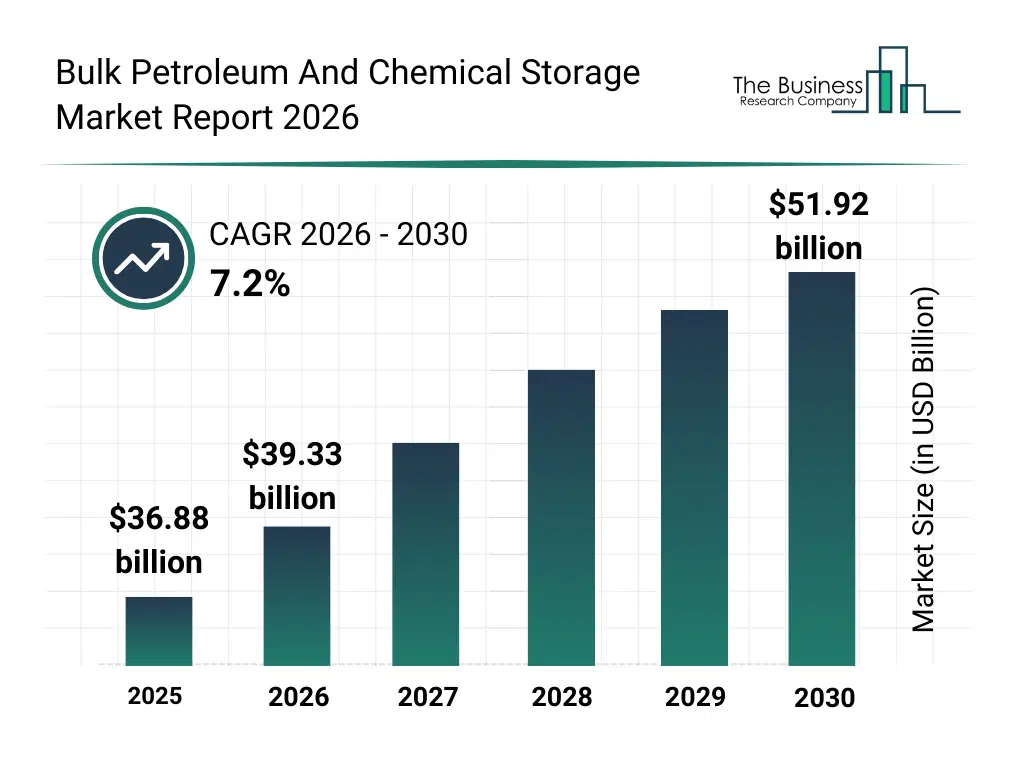
What Is The Bulk Petroleum And Chemical Storage Market Size and Share 2026?
The bulk petroleum and chemical storage market size has grown strongly in recent years. It will grow from $36.88 billion in 2025 to $39.33 billion in 2026 at a compound annual growth rate (CAGR) of 6.7%. The growth in the historic period can be attributed to expansion of global petroleum refining capacity, growth in chemical manufacturing activities, increasing demand for bulk fuel storage infrastructure, development of industrial storage terminals, implementation of safety-driven storage standards.What Is The Bulk Petroleum And Chemical Storage Market Growth Forecast?
The bulk petroleum and chemical storage market size is expected to see strong growth in the next few years. It will grow to $51.92 billion in 2030 at a compound annual growth rate (CAGR) of 7.2%. The growth in the forecast period can be attributed to expansion of strategic petroleum reserves, rising investments in chemical logistics infrastructure, growing adoption of smart storage facilities, increasing focus on emission control compliance, expansion of bulk storage capacity in emerging markets. Major trends in the forecast period include increasing adoption of advanced tank monitoring systems, rising use of corrosion-resistant storage materials, growing focus on environmental and safety compliance, expansion of floating roof tank installations, enhanced integration of automated leak detection.
Global Bulk Petroleum And Chemical Storage Market Segmentation
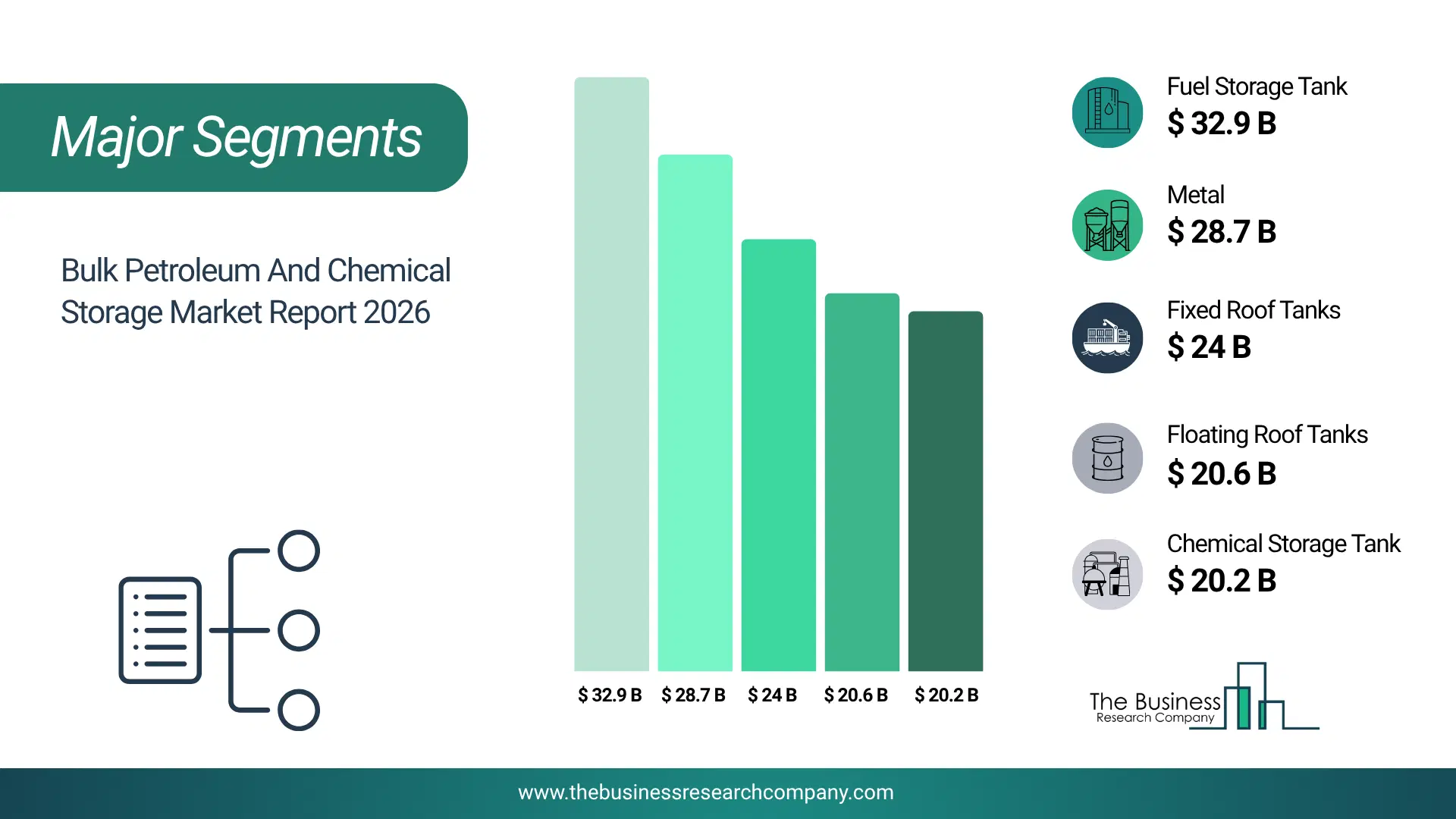
1) By Material Type: Metal, Carbon Fiber, Glass Fiber 2) By Storage Type: Open Top Tanks, Fixed Roof Tanks, Floating Roof Tanks 3) By Application: Fuel Storage Tank, Chemical Storage Tank Subsegments: 1) By Metal: Carbon Steel, Stainless Steel, Aluminum 2) By Carbon Fiber: Reinforced Carbon Fiber, Composite Structures 3) By Glass Fiber: Glass Reinforced Plastic (GRP), Fiber Reinforced Polymer (FRP) The top segments in the bulk petroleum and chemical storage market will be: • Fuel Storage Tank will reach $32928.02 Million by 2030. • Metal will reach $28733.79 Million by 2030. • Fixed Roof Tanks will reach $24002.28 Million by 2030. • Floating Roof Tanks will reach $20667.26 Million by 2030. • Chemical Storage Tank will reach $20241.56 Million by 2030.What Is The Driver Of The Bulk Petroleum And Chemical Storage Market?
The increasing demand for energy is expected to propel the growth of the bulk petroleum and chemical storage market going forward. Energy refers to the power sources that are utilized to run any machinery, equipment, or tools needed for repairs. There is a surge in the need for efficient storage solutions for petroleum and chemical products, as industries expand, economies grow and demand for energy increases. Bulk storage facilities play a pivotal role in meeting this escalating demand by providing a secure and organized means to store large quantities of these critical commodities. For instance, in April 2023, according to the Energy Information Administration, a US-based government agency, energy usage in the US industrial sector was projected to rise by 5% to 32% between 2022 and 2050. Therefore, the increasing demand for energy is driving the growth of the bulk petroleum and chemical storage industry.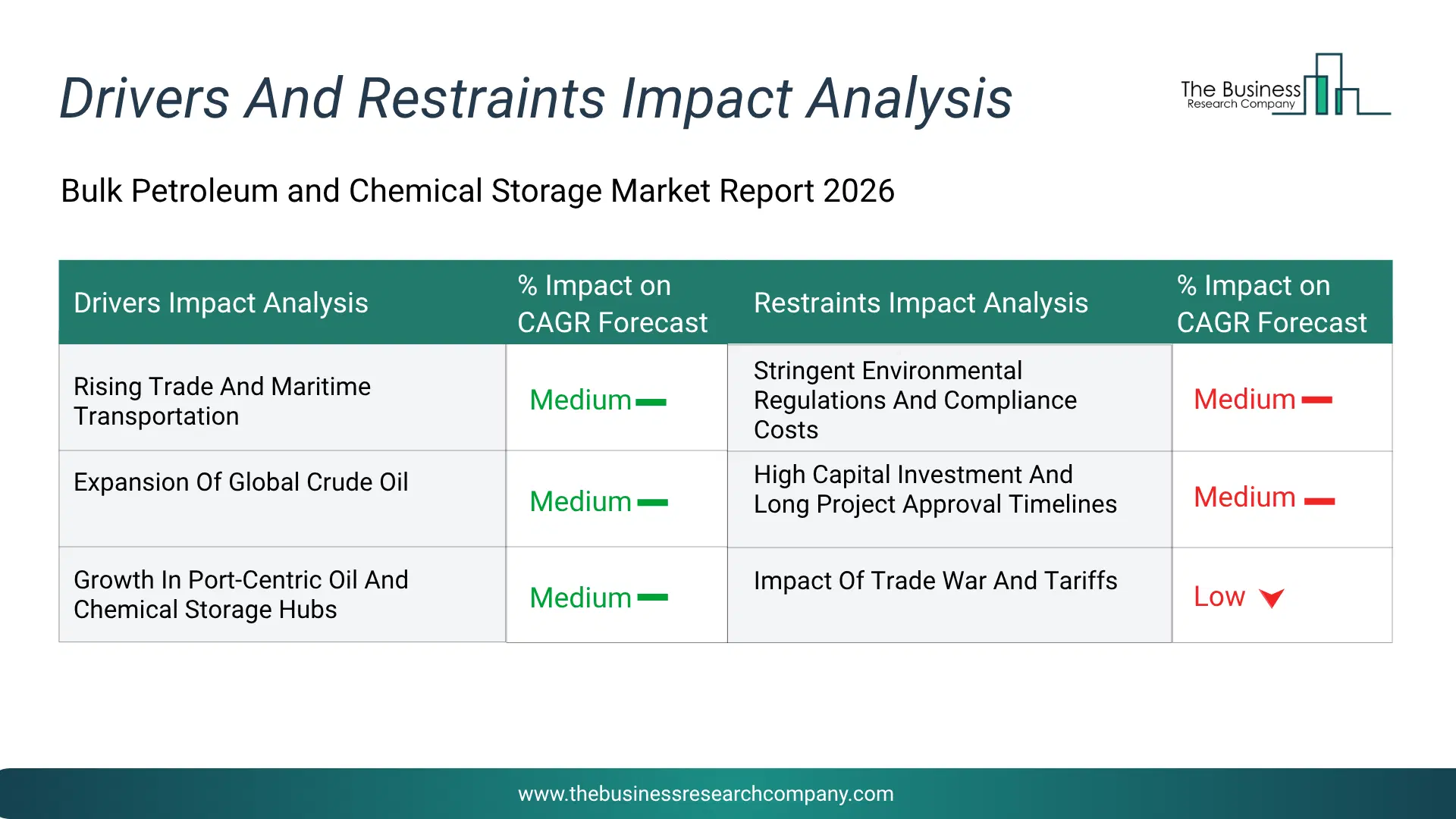
Infographic Chart Showing Key Market Drivers Analysis And Restraints For Bulk Petroleum And Chemical Storage Market
The chart presents an impact analysis of key drivers and restraints, quantifying their relative influence on the market's growth rate and helping assess the balance between growth enablers and limiting factors. This chart offers a high-level perspective; the full report contains more detailed insights.
How Will The Drivers Impact Growth In The Global Bulk Petroleum and Chemical Storage Market?
• Rising Trade And Maritime Transportation (Medium) – During the forecast period, rising trade activity and expanding maritime transportation are expected to propel the growth of the bulk petroleum and chemical storage market. As global and regional trade volumes continue to increase and seaborne transport remains the primary mode for moving petroleum products, chemicals and liquid bulk cargoes, demand for intermediate storage infrastructure at ports and coastal hubs is intensifying. Higher vessel traffic, increased cargo handling at major ports and growing reliance on maritime logistics for energy and industrial supply chains are creating sustained requirements for bulk liquid storage facilities that enable efficient import, export and redistribution of petroleum and chemical products. These trade-driven flows require adequate tank capacity to manage inventory balancing, cargo segregation and scheduling flexibility between shipping and downstream consumption. As a result, terminal operators and logistics providers are increasingly expanding storage capacity and upgrading port-based infrastructure to support rising maritime trade volumes. The rising trade activity and expanding maritime transportation growth contribution during the forecast period in 2025 is 1.5%. • Expansion Of Global Crude Oil (Medium) – During the forecast period, the expansion of global crude oil production is expected to propel the growth of the bulk petroleum and chemical storage market. As crude oil supply continues to increase across major producing regions, higher volumes of crude are transported through international trade routes and maritime logistics networks, increasing the need for intermediate storage between production, transportation, refining and downstream distribution. Growing crude oil output leads to higher inventory levels, greater trading activity and more frequent cargo movements, all of which require adequate bulk storage capacity to manage supply fluctuations and ensure operational continuity. These conditions drive demand for large-scale tank terminals that can support inventory buffering, cargo segregation and scheduling flexibility across global oil supply chains. As a result, storage operators are increasingly expanding crude oil storage capacity to accommodate rising throughput volumes and support stable energy supply flows. The expansion of global crude oil production growth contribution during the forecast period in 2025 is 1.3%. • Growth In Port-Centric Oil And Chemical Storage Hubs (Medium) – During the forecast period, the growth of port-centric oil and chemical storage hubs is expected to propel the growth of the bulk petroleum and chemical storage market. As ports increasingly function as integrated logistics and energy hubs, greater volumes of crude oil, refined petroleum products and chemicals are being routed through port-based infrastructure, increasing the need for nearby storage capacity. Port-centric storage facilities play a critical role in balancing cargo flows between maritime transportation and downstream distribution by enabling inventory management, cargo segregation and operational flexibility. These hubs support efficient import, export and transshipment activities, particularly as global trade volumes and vessel traffic continue to rise. As a result, storage operators are expanding and developing port-based tank terminals to accommodate higher throughput and support complex supply chain requirements. Consequently, the continued growth of port-centric oil and chemical storage hubs is anticipated to remain a key driver of growth in the bulk petroleum and chemical storage market throughout the forecast period. The growth of port-centric oil and chemical storage hubs growth contribution during the forecast period in 2025 is 1.0%. • Expansion Of Third-Party And Independent Bulk Storage Terminal Outsourcing (Low) – During the forecast period, the expansion of third-party and independent bulk storage terminal outsourcing is expected to propel the growth of the bulk petroleum and chemical storage market. As oil, gas and chemical companies increasingly focus on core production, trading and marketing activities, greater reliance is being placed on external terminal operators to manage storage, handling and logistics functions. Outsourcing storage requirements to independent terminal providers allows market participants to reduce capital expenditure, improve operational flexibility and access strategically located port-based infrastructure without owning dedicated assets. These arrangements support efficient inventory management, cargo segregation and scheduling flexibility across complex supply chains involving multiple products and trading flows. As a result, demand for third-party bulk storage services continues to rise across major ports and industrial hubs. Consequently, the growing preference for outsourcing storage operations to independent terminal operators is anticipated to remain a key driver of growth in the bulk petroleum and chemical storage market throughout the forecast period. The expansion of third-party and independent bulk storage terminal outsourcing growth contribution during the forecast period in 2025 is 0.5%.How Will The Restraints Impact Growth In The Global Bulk Petroleum and Chemical Storage Market?
• Stringent Environmental Regulations And Compliance Costs (Medium) – During the forecast period, stringent environmental regulations and rising compliance costs are restricting the growth of the bulk petroleum and chemical storage market. Bulk petroleum and chemical storage operations are increasingly subject to stricter environmental requirements related to emissions control, monitoring, reporting and environmental risk management across storage terminals, port facilities and associated maritime logistics. From an operational and investment perspective, terminal operators must navigate complex regulatory frameworks, higher compliance expenditures and evolving sustainability mandates, which increase operating costs and create uncertainty around long-term infrastructure planning and capacity expansion. As a result, storage operators may face reduced financial flexibility, slower decision-making on new terminal developments and greater caution in committing capital to large-scale storage projects, particularly in highly regulated regions. Consequently, the growing burden of environmental regulations and associated compliance costs is expected to continue restricting investment momentum and limiting expansion in the bulk petroleum and chemical storage market throughout the forecast period. Growth affected by the stringent environmental regulations and rising compliance costs during the forecast period in 2025 is -1.5%. • High Capital Investment And Long Project Approval Timelines (Medium) – During the forecast period, high capital investment requirements and long project approval timelines are restricting the growth of the bulk petroleum and chemical storage market. Development of bulk petroleum and chemical storage facilities involves substantial upfront expenditure on land acquisition, tank construction, safety systems and environmental protection infrastructure, while projects are also subject to lengthy regulatory and environmental approval processes. From a project development perspective, operators must navigate complex permitting procedures, public consultations and compliance reviews, which can significantly extend the time required to move from planning to execution. These extended timelines and capital-intensive requirements increase financial risk, reduce flexibility in investment planning and can discourage new entrants or delay expansion decisions by existing operators. As a result, storage developers may face slower project execution, deferred capacity additions and cautious capital allocation strategies. Growth affected by the high capital investment requirements and long project approval timelines during the forecast period in 2025 is -1.0%. • Impact Of Trade War And Tariffs (Medium) – During the forecast period, the impact of trade wars and tariffs is restricting the growth of the bulk petroleum and chemical storage market. Bulk petroleum and chemical storage activities are closely linked to global trade flows, cross-border supply chains and international movement of crude oil, refined products and chemicals, making the market highly sensitive to changes in trade policies and tariff regimes. From an operational and investment perspective, tariff increases and trade-related tensions create uncertainty around cargo volumes, disrupt established trade routes and raise costs for imported materials and equipment used in storage terminal construction and expansion. These uncertainties can lead to hesitation among terminal operators and investors when planning long-term storage capacity additions or committing capital to new infrastructure projects. As a result, market participants may experience delayed investment decisions, uneven utilization of storage assets and cautious expansion strategies. Consequently, ongoing trade conflicts and tariff-related uncertainties are expected to continue restricting growth in the bulk petroleum and chemical storage market throughout the forecast period. Growth affected by the impact of trade wars and tariffs during the forecast period in 2025 is -0.3%.Key Players In The Global Bulk Petroleum And Chemical Storage Market
Major companies operating in the bulk petroleum and chemical storage market are Vitol Tank Terminals International BV, Royal Vopak N.V., Buckeye Partners, Containment Solutions Inc., CST Industries Inc., Superior Tank Inc., Delta Oil B.V, L.F. Manufacturing Inc., Ziemann Holvrieka GmbH, ZCL Composites Inc., Snyder Industries Inc., Kinder Morgan Inc., Oiltanking GmbH, Magellan Midstream Partners L.P., NuStar Energy L.P., Inter Pipeline Ltd., Plains All American Pipeline L.P., Enterprise Products Partners L.P., Sunoco Logistics Partners L.P., Sinochem Group Co. Ltd., Royal Dutch Shell plc, TotalEnergies SE, Occidental Petroleum Corporation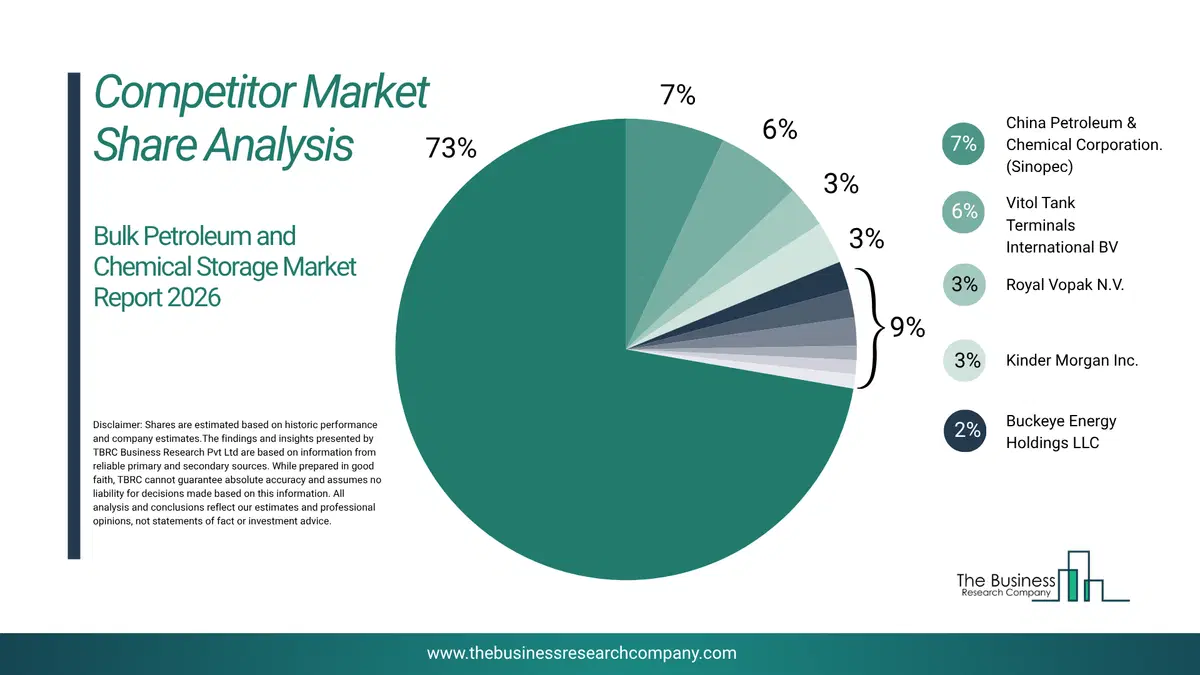
This chart is for illustrative purposes; the full report includes a detailed competitor analysis and comprehensive overview of the top 10 companies in the market.
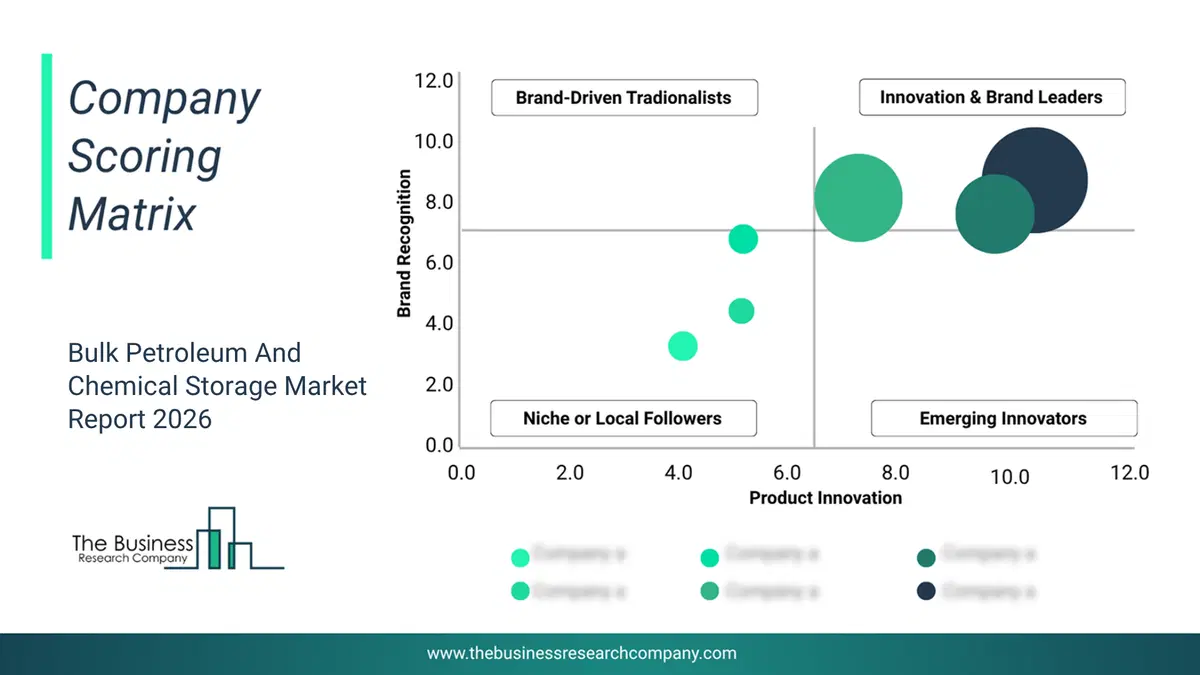
This chart maps companies by product innovation and brand strength, with bubble size indicating relative revenue, helping identify market leaders, challengers, and niche players. This is an illustrative chart; the full report provides a complete and accurate competitive analysis.
Global Bulk Petroleum And Chemical Storage Market Trends and Insights
Major companies operating in the bulk petroleum and chemical storage market are focusing on innovating products, such as autonomous robot, to provide a competitive edge in the market. Autonomous robot is an in-service above-ground storage tank inspection robot designed for robotic tank inspections. For instance, in September 2023, Square Robot, Inc., a US-based innovator in robotic tank inspections, launched Autonomous robot. Using autonomous robots for tank inspections prevented the production of nearly six tons of carbon dioxide (CO2), which is normally needed when a fuel oil tank needs to be taken out of operation for inspection. Robotic technology has improved the efficiency and reliability of tank inspections in the petroleum and chemical storage industry.What Are Latest Mergers And Acquisitions In The Bulk Petroleum And Chemical Storage Market?
In July 2025, Mitsui O.S.K. Lines Ltd. (MOL), a Japan-based provider of marine transportation and logistics services, acquired LBC Tank Terminals Group for approximately US $1.7 billion. With this acquisition, MOL aims to strengthen its bulk liquid storage business, expand its chemical and petroleum tank terminal operations, and integrate onshore storage capabilities into its marine and logistics portfolio to support diverse customer needs and next-generation energy supply chains. LBC Tank Terminals Group is a Netherlands-based operator of tank terminals specializing in bulk storage of chemicals, petroleum products, and other liquids, with an extensive network of storage facilities and services across Europe.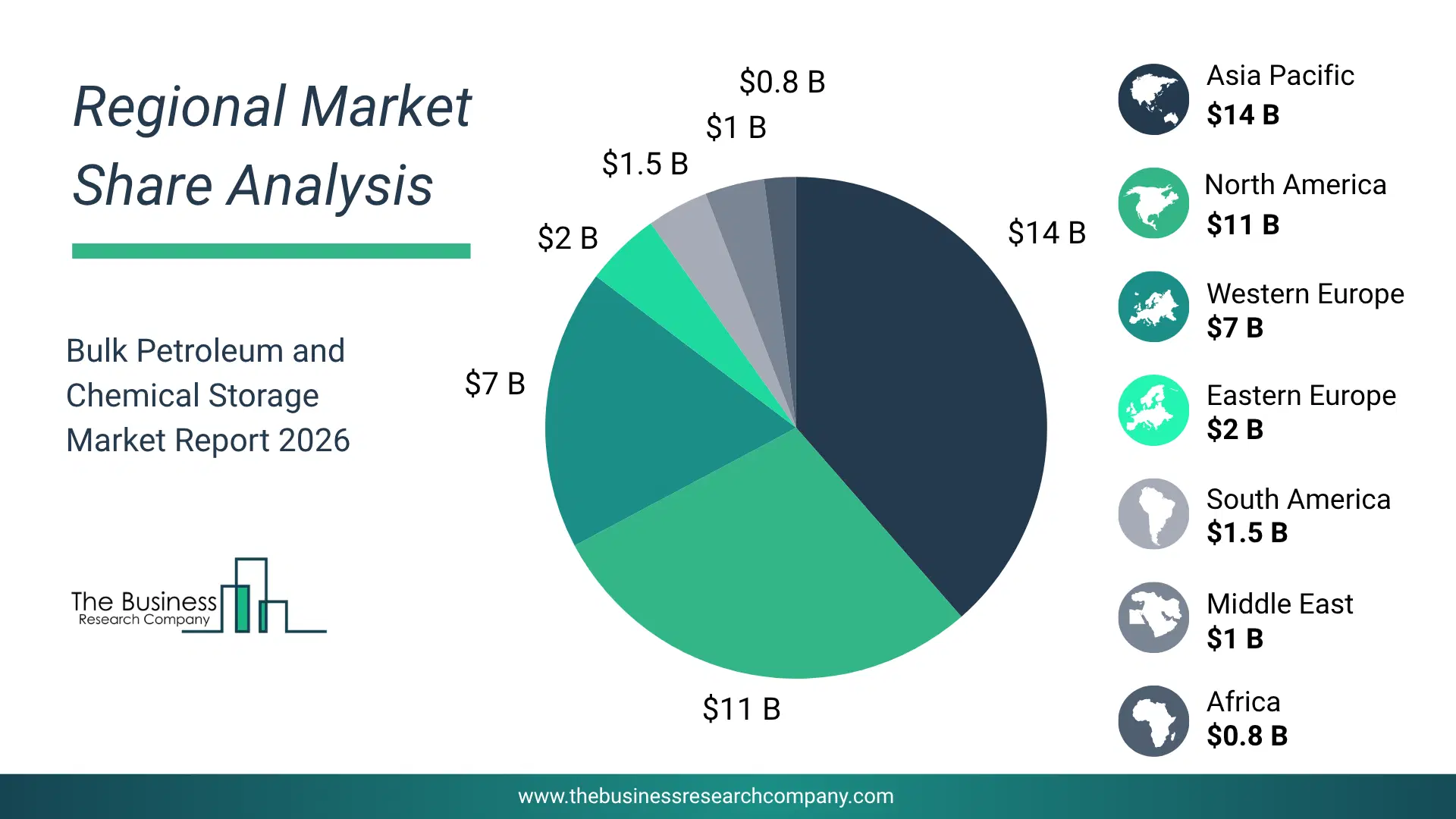
Regional Outlook
Asia-Pacific was the largest region in the bulk petroleum and chemical storage market in 2025 and is expected to be the fastest-growing region in the bulk petroleum and chemical storage market report during the forecast period. The regions covered in this market report are Asia-Pacific, South East Asia, Western Europe, Eastern Europe, North America, South America, Middle East, Africa. The countries covered in this market report are Australia; Brazil; China; France; Germany; India; Indonesia; Japan; Taiwan; Russia; South Korea; UK; USA; Canada; Italy; Spain.What Defines the Bulk Petroleum And Chemical Storage Market?
The bulk petroleum and chemical storage market includes of revenues earned by entities by providing supply chain services, warehousing, distribution, transportation, and inventory management services. The market value includes the value of related goods sold by the service provider or included within the service offering. Only goods and services traded between entities or sold to end consumers are included.How is Market Value Defined and Measured?
The market value is defined as the revenues that enterprises gain from the sale of goods and/or services within the specified market and geography through sales, grants, or donations in terms of the currency (in USD unless otherwise specified). The revenues for a specified geography are consumption values that are revenues generated by organizations in the specified geography within the market, irrespective of where they are produced. It does not include revenues from resales along the supply chain, either further along the supply chain or as part of other products.
This chart presents market attractiveness based on a quantitative evaluation of growth, competition, strategic alignment, and risk, offering a clear view of opportunity areas for decision-making. This chart is for illustrative purposes; the full report contains the complete analysis.

This chart highlights the Total Addressable Market (TAM) by estimating the maximum revenue opportunity using an assumption-driven approach, supporting strategic planning and opportunity sizing across markets. The chart is illustrative; the full report provides a more comprehensive analysis.
What Key Data and Analysis Are Included in the Bulk Petroleum And Chemical Storage Market Report 2026?
The bulk petroleum and chemical storage market research report is one of a series of new reports from The Business Research Company that provides market statistics, including Market Report 2026?global market size, regional shares, competitors with the market share, detailed market segments, market trends and opportunities, and any further data you may need to thrive in the bulk petroleum and chemical storage Market Report 2026? The market research report delivers a complete perspective of everything you need, with an in-depth analysis of the current and future state of the Market Report 2026?Bulk Petroleum And Chemical Storage Market Report Forecast Analysis
| Report Attribute | Details |
|---|---|
| Market Size Value In 2026 | $39.33 billion |
| Revenue Forecast In 2030 | $51.92 billion |
| Growth Rate | CAGR of 6.7% from 2026 to 2030 |
| Base Year For Estimation | 2025 |
| Actual Estimates/Historical Data | 2020-2025 |
| Forecast Period | 2026 - 2030 - 2035 |
| Market Representation | Revenue in USD Billion and CAGR from 2026 to 2030 |
| Segments Covered | Material Type, Storage Type, Application |
| Regional Scope | Asia-Pacific, Western Europe, Eastern Europe, North America, South America, Middle East, Africa |
| Country Scope | The countries covered in the report are Australia, Brazil, China, France, Germany, India, Indonesia, Japan, Taiwan, Russia, South Korea, UK, USA, Canada, Italy, Spain. |
| Key Companies Profiled | Vitol Tank Terminals International BV, Royal Vopak N.V., Buckeye Partners, Containment Solutions Inc., CST Industries Inc., Superior Tank Inc., Delta Oil B.V, L.F. Manufacturing Inc., Ziemann Holvrieka GmbH, ZCL Composites Inc., Snyder Industries Inc., Kinder Morgan Inc., Oiltanking GmbH, Magellan Midstream Partners L.P., NuStar Energy L.P., Inter Pipeline Ltd., Plains All American Pipeline L.P., Enterprise Products Partners L.P., Sunoco Logistics Partners L.P., Sinochem Group Co. Ltd., Royal Dutch Shell plc, TotalEnergies SE, Occidental Petroleum Corporation |
| Customization Scope | Request for Customization |
| Pricing And Purchase Options | Explore Purchase Options |