

Camera Modules Market Report 2026
Global Outlook – By Product Type ( CMOS Camera Module, CCD Camera Module ), By Component ( Image Sensors, Lens Modules, Voice Coil Motors), By Focus Type ( Interface, Pixel, Process ), By Applications ( Medical, Smartphone And Tablet PC, Automotive, Defense And Space, Industrial And Security, Consumer Electronics) – Market Size, Trends, Strategies, and Forecast to 2030
Camera Modules Market Overview
• Camera Modules market size has reached to $56.24 billion in 2025 • Expected to grow to $90.21 billion in 2030 at a compound annual growth rate (CAGR) of 10% • Growth Driver: The Surge In Automated And Semi-Automated Cars Propels Growth In The Camera Module Market • Market Trend: Innovations In Vision-Based Camera Technologies Enhance Imaging Performance And AI-Driven Application Capabilities • Asia-Pacific was the largest region and fastest growing region.What Is Covered Under Camera Modules Market?
The camera module is used to capture photographic or videographic images and consist of an image sensor, lens, IR filters, image processors, and other additional components. The camera module is an integral part of the digital camera system and is built into the camera itself. The size and power consumption of the camera depend on the camera module. The main types of camera modules are the CMOS camera module and the CCD camera module. CMOS camera modules are used to create images in digital cameras, digital Video Cameras, and digital CCTV cameras. These types of camera modules consist of components such as image sensors, lens modules, and voice coil motors and are focused on interface, pixel, and process. Medical, smartphone and tablet PC, automotive, defense and space, industrial and security, and consumer electronics all make use of these camera modules.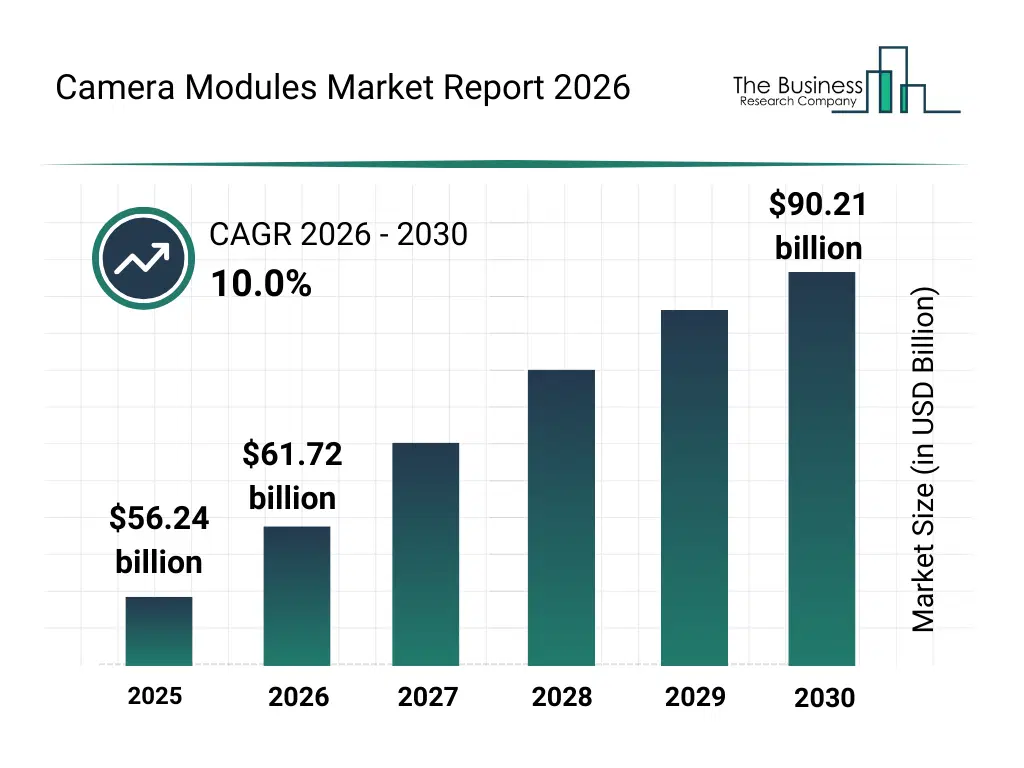
What Is The Camera Modules Market Size 2026 And Growth Rate?
The camera modules market size has grown strongly in recent years. It will grow from $56.24 billion in 2025 to $61.72 billion in 2026 at a compound annual growth rate (CAGR) of 9.7%. The growth in the historic period can be attributed to increased use of basic cmos and ccd sensors, early adoption in mobile devices, expansion in automotive imaging, rising deployment in consumer electronics, dependence on traditional lens and vcm technologies.What Is The Camera Modules Market Growth Forecast?
The camera modules market size is expected to see strong growth in the next few years. It will grow to $90.21 billion in 2030 at a compound annual growth rate (CAGR) of 10.0%. The growth in the forecast period can be attributed to rising demand for high-resolution multi-sensor modules, expansion of automotive adas cameras, growth of medical and industrial imaging systems, increasing adoption of low-light and high-speed sensors, rapid development of compact camera modules for smart devices. Major trends in the forecast period include development of AI-driven computational photography, expansion of cloud-integrated camera processing systems, growth of IoT-enabled smart camera modules, advancement of automated precision camera manufacturing, integration of robotic imaging and sensor alignment.
Global Camera Modules Market Segmentation
1) By Product Type: CMOS Camera Module, CCD Camera Module 2) By Component: Image Sensors, Lens Modules, Voice Coil Motors 3) By Focus Type: Interface, Pixel, Process 4) By Applications: Medical, Smartphone And Tablet PC, Automotive, Defense And Space, Industrial And Security, Consumer Electronics Subsegments: 1) By CMOS Camera Module: Standard CMOS Camera Modules, High-Speed CMOS Camera Modules, Low-Light CMOS Camera Modules, Multi-Sensor CMOS Camera Modules 2) By CCD Camera Module: Standard CCD Camera Modules, High-Resolution CCD Camera Modules, Scientific-Grade CCD Camera Modules, Color And Monochrome CCD Camera ModulesWhat Is The Driver Of The Camera Modules Market?
The rising popularity of automated and semi-automated cars is significantly contributing to the growth of the camera module market. Automated and semi-automated cars are the most advanced cars, having an autonomous driving system (ADS) which uses artificial intelligence, integrated cameras, and other software to perform all driving tasks on behalf of drivers or provide certain driving assistance like active steering, breaking, and acceleration based on roads and other environmental conditions. Camera modules are highly used in automotive camera systems, which are an integrated part of the Autonomous Driving System (ADS) to provide high-definition imaging to process data for driving cars autonomously. For instance, in June 2023, according to the Zipdo, a Germany-based meeting management and productivity software, around 8 million units of semi-autonomous or fully autonomous vehicles are expected to be sold globally by 2026. Therefore, the rise in popularity of automated and semi-automated cars is expected to propel the growth of the camera module industry over the coming years.Key Players In The Global Camera Modules Market
Major companies operating in the camera modules market are Hon HAI Precision Industry Co. Ltd., Pixelplus Co. Ltd., BYD Electronic (International) Company Limited, Panasonic Corporation, Toshiba Electronic Devices & Storage Corporation, Fujifilm Corporation, Sharp Corporation, STMicroelectronics N.V., LG Innotek Co. Ltd., Hikvision Digital Technology Co. Ltd., On Semiconductor Corporation, Sony Corporation, Samsung Electro-Mechanics Co. Ltd., LITE-ON Technology Corporation, Sunny Optical Technology (Group) Company Limited, Chicony Electronics Co. Ltd., FICOSA International S.A., Primax Electronics Ltd., OFILM Group Co. Ltd., OmniVision Technologies Inc., Himax Technologies Inc., Cowell Electronics Holdings Inc., Partron Co. Ltd., MCNEX Co. Ltd., Aptina Imaging Corporation, Largan Precision Co. Ltd.
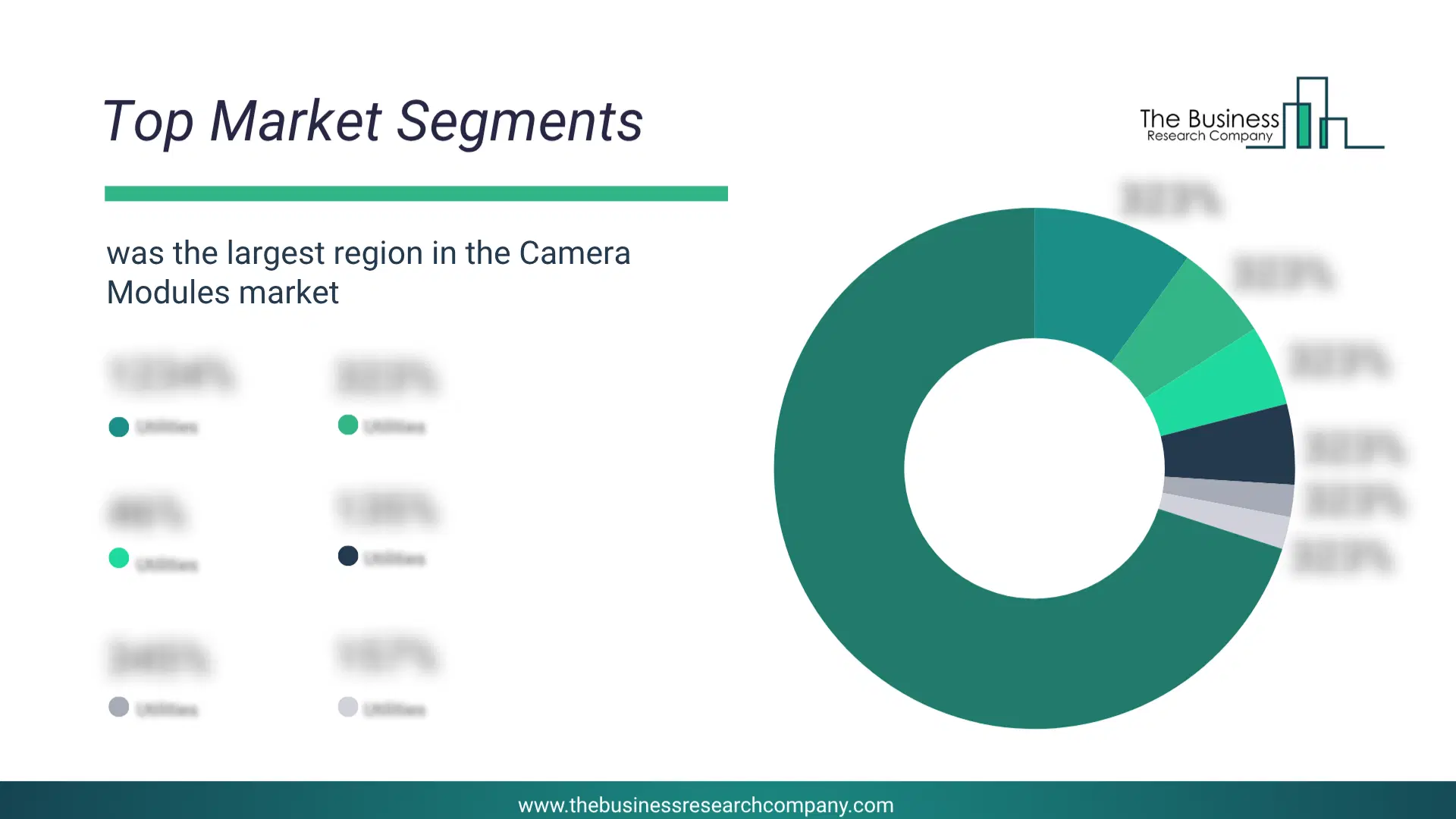
This chart is for illustrative purposes; the full report includes a detailed competitor analysis and comprehensive overview of the top 10 companies in the market.
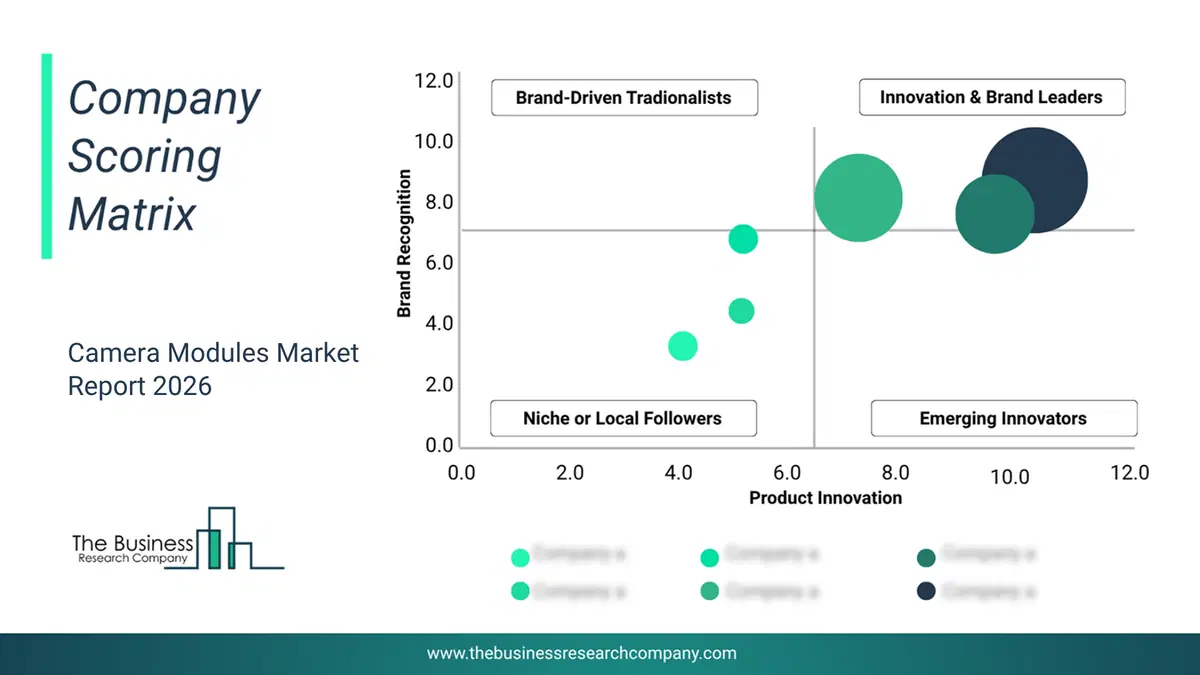
This chart maps companies by product innovation and brand strength, with bubble size indicating relative revenue, helping identify market leaders, challengers, and niche players. This is an illustrative chart; the full report provides a complete and accurate competitive analysis.
Global Camera Modules Market Trends and Insights
Major companies operating in the camera modules market are focusing on developing advanced solutions, such as AI-optimized camera modules, to improve imaging performance, enhance processing efficiency, and enable more accurate real-time vision analytics. AI-optimized camera modules refer to imaging components designed to support artificial intelligence workloads by enabling high-resolution capture, improved low-light performance, and enhanced on-device processing for vision-based tasks. For instance, in September 2024, Raspberry Pi, a UK-based computing platform provider, launched a new camera module designed for vision-based AI applications, offering improved image quality, faster data handling, and enhanced compatibility with machine-learning frameworks. Designed to support developers and embedded-system engineers, the module enables more efficient AI vision solutions across robotics, automation, and IoT devices.What Are Latest Mergers And Acquisitions In The Camera Modules Market?
In May 2024, Dixon Technologies (India) Limited, an India-based manufacturer of electronic services, acquired a 51% stake in Q Tech for an undisclosed amount. Through this acquisition, Dixon Technologies aimed to strengthen its camera module manufacturing capabilities and expand its footprint in the domestic and global electronics supply chain. Q Tech is an India-based manufacturer of high-precision camera modules known for advanced optical components used in smartphones and smart devices.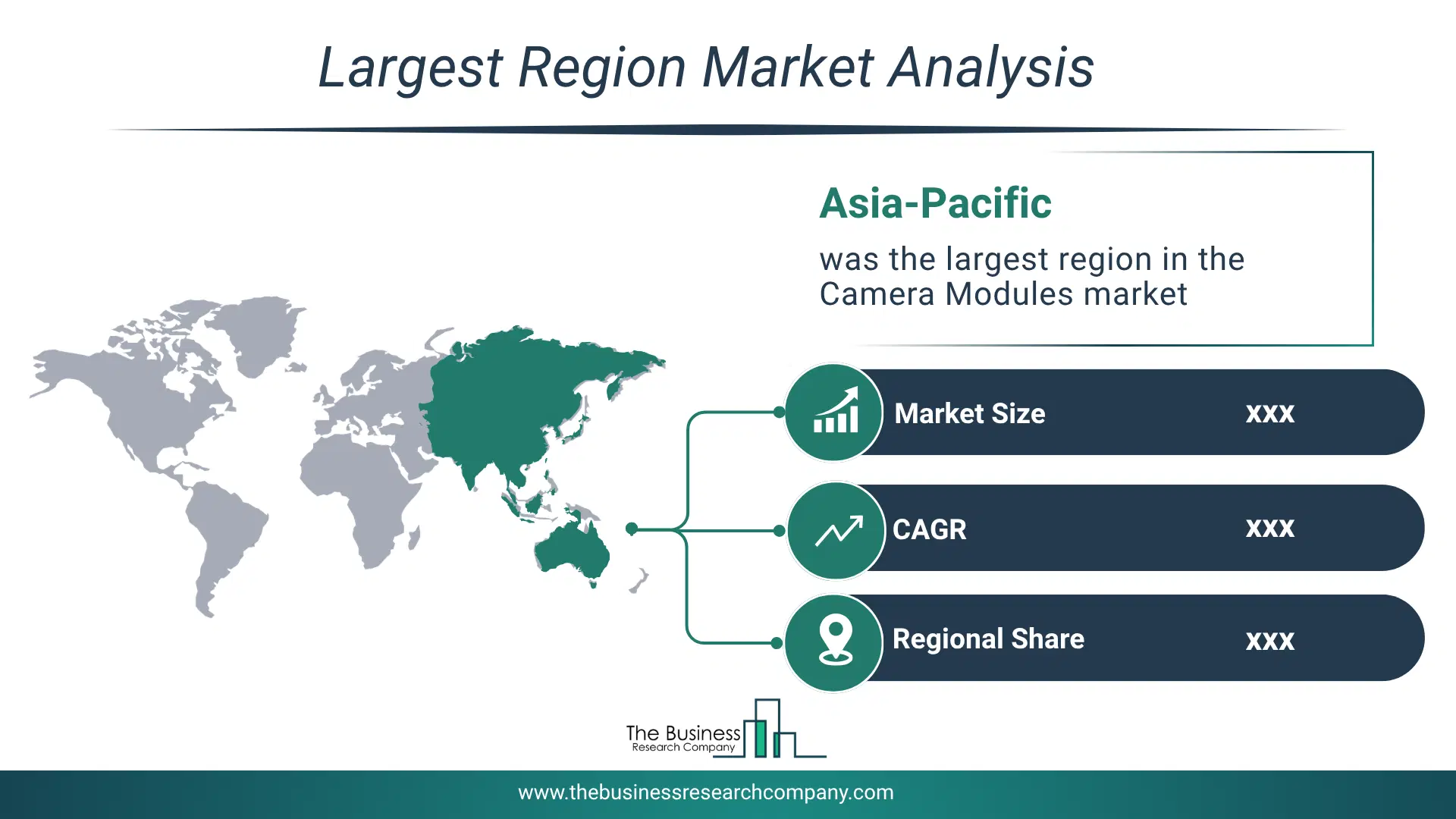
Regional Outlook
Asia-Pacific was the largest region in the camera module market in 2025 and is also expected to be the fastest-growing region in the forecast period. The regions covered in this market report are Asia-Pacific, South East Asia, Western Europe, Eastern Europe, North America, South America, Middle East, Africa. The countries covered in this market report are Australia, Brazil, China, France, Germany, India, Indonesia, Japan, Taiwan, Russia, South Korea, UK, USA, Canada, Italy, Spain.What Defines the Camera Modules Market?
The camera module market consists of sales of actuators, lens, PCB, and module PKG. Values in this market are ‘factory gate’ values, that is the value of goods sold by the manufacturers or creators of the goods, whether to other entities (including downstream manufacturers, wholesalers, distributors and retailers) or directly to end customers. The value of goods in this market includes related services sold by the creators of the goods.How is Market Value Defined and Measured?
The market value is defined as the revenues that enterprises gain from the sale of goods and/or services within the specified market and geography through sales, grants, or donations in terms of the currency (in USD unless otherwise specified). The revenues for a specified geography are consumption values that are revenues generated by organizations in the specified geography within the market, irrespective of where they are produced. It does not include revenues from resales along the supply chain, either further along the supply chain or as part of other products.
This chart presents market attractiveness based on a quantitative evaluation of growth, competition, strategic alignment, and risk, offering a clear view of opportunity areas for decision-making. This chart is for illustrative purposes; the full report contains the complete analysis.

This chart highlights the Total Addressable Market (TAM) by estimating the maximum revenue opportunity using an assumption-driven approach, supporting strategic planning and opportunity sizing across markets. The chart is illustrative; the full report provides a more comprehensive analysis.
What Key Data and Analysis Are Included in the Camera Modules Market Report 2026?
The camera modules market research report is one of a series of new reports from The Business Research Company that provides market statistics, including industry global market size, regional shares, competitors with the market share, detailed market segments, market trends and opportunities, and any further data you may need to thrive in the camera modules industry. The market research report delivers a complete perspective of everything you need, with an in-depth analysis of the current and future state of the industry.Camera Modules Market Report Forecast Analysis
| Report Attribute | Details |
|---|---|
| Market Size Value In 2026 | $61.72 billion |
| Revenue Forecast In 2030 | $90.21 billion |
| Growth Rate | CAGR of 10% from 2026 to 2030 |
| Base Year For Estimation | 2025 |
| Actual Estimates/Historical Data | 2020-2025 |
| Forecast Period | 2026 - 2030 |
| Market Representation | Revenue in USD Billion and CAGR from 2026 to 2030 |
| Segments Covered | Product Type, Component, Focus Type, Applications |
| Regional Scope | Asia-Pacific, Western Europe, Eastern Europe, North America, South America, Middle East, Africa |
| Country Scope | The countries covered in the report are Australia, Brazil, China, France, Germany, India, Indonesia, Japan, Taiwan, Russia, South Korea, UK, USA, Canada, Italy, Spain. |
| Key Companies Profiled | Hon HAI Precision Industry Co. Ltd., Pixelplus Co. Ltd., BYD Electronic (International) Company Limited, Panasonic Corporation, Toshiba Electronic Devices & Storage Corporation, Fujifilm Corporation, Sharp Corporation, STMicroelectronics N.V., LG Innotek Co. Ltd., Hikvision Digital Technology Co. Ltd., On Semiconductor Corporation, Sony Corporation, Samsung Electro-Mechanics Co. Ltd., LITE-ON Technology Corporation, Sunny Optical Technology (Group) Company Limited, Chicony Electronics Co. Ltd., FICOSA International S.A., Primax Electronics Ltd., OFILM Group Co. Ltd., OmniVision Technologies Inc., Himax Technologies Inc., Cowell Electronics Holdings Inc., Partron Co. Ltd., MCNEX Co. Ltd., Aptina Imaging Corporation, Largan Precision Co. Ltd. |
| Customization Scope | Request for Customization |
| Pricing And Purchase Options | Explore Purchase Options |