
Canned Vegetable Market Report 2026
Global Outlook – By Type (Sliced, Peeled, Other Types), By Distribution Channel (Store-Based, Non-Store-Based), By Application (Culinary, Salads And Soups, Toppings And Dressings, Other Applications) – Market Size, Trends, Strategies, and Forecast to 2030
Canned Vegetable Market Overview
• Canned Vegetable market size has reached to $24.21 billion in 2025 • Expected to grow to $30.03 billion in 2030 at a compound annual growth rate (CAGR) of 4.3% • Growth Driver: Rise In Packaged Food Consumption Fuels Growth Of Canned Vegetable Market • Market Trend: Emerging Trends In Ready-to-Use And Health-Focused Canned Vegetables • North America was the largest region in 2025 and Asia-Pacific is the fastest growing region.What Is Covered Under Canned Vegetable Market?
Canned vegetables refer to vegetables that have been processed, cooked, and sealed in airtight containers for preservation. This method involves heating the vegetables to a high temperature to kill bacteria and enzymes, thereby extending their shelf life. The canning helps to retain nutrients and flavor, making these vegetables convenient and accessible for consumption at any time. The main types of the canned vegetable market are sliced, peeled, and other types. Canned vegetables that are cut into thin, flat pieces, usually uniform in shape and size, ready to be used directly without further chopping. The various distribution channels include store-based and non-store-based used for various applications such as culinary, salads and soups, toppings and dressings, and others.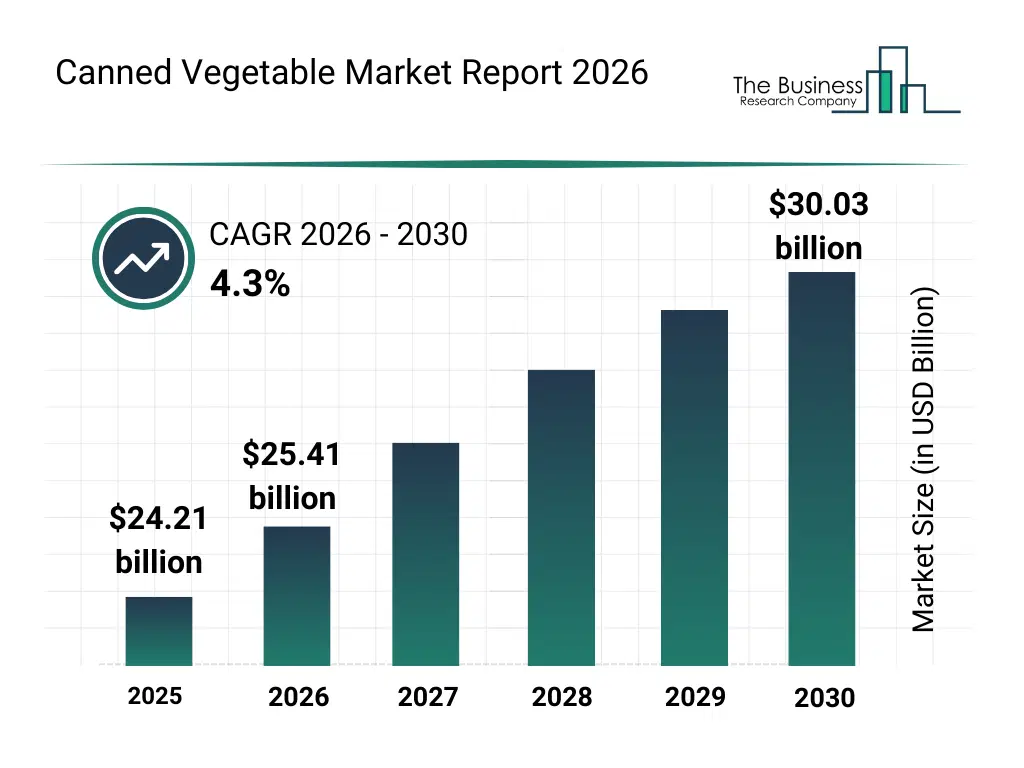
What Is The Canned Vegetable Market Size and Share 2026?
The canned vegetable market size has grown steadily in recent years. It will grow from $24.21 billion in 2025 to $25.41 billion in 2026 at a compound annual growth rate (CAGR) of 5.0%. The growth in the historic period can be attributed to growth in urban population consumption patterns, expansion of organized retail food distribution, increased reliance on preserved food products, advancements in food canning technology, rising demand for convenience foods.What Is The Canned Vegetable Market Growth Forecast?
The canned vegetable market size is expected to see steady growth in the next few years. It will grow to $30.03 billion in 2030 at a compound annual growth rate (CAGR) of 4.3%. The growth in the forecast period can be attributed to increasing demand for clean-label canned foods, rising investments in advanced food processing equipment, growing preference for ready-to-eat vegetables, expansion of e-commerce grocery channels, increasing focus on recyclable packaging solutions. Major trends in the forecast period include increasing adoption of sustainable packaging materials, rising demand for long-shelf-life vegetable products, growing focus on nutrient retention technologies, expansion of automated canning and processing lines, enhanced emphasis on food safety and traceability.
Global Canned Vegetable Market Segmentation
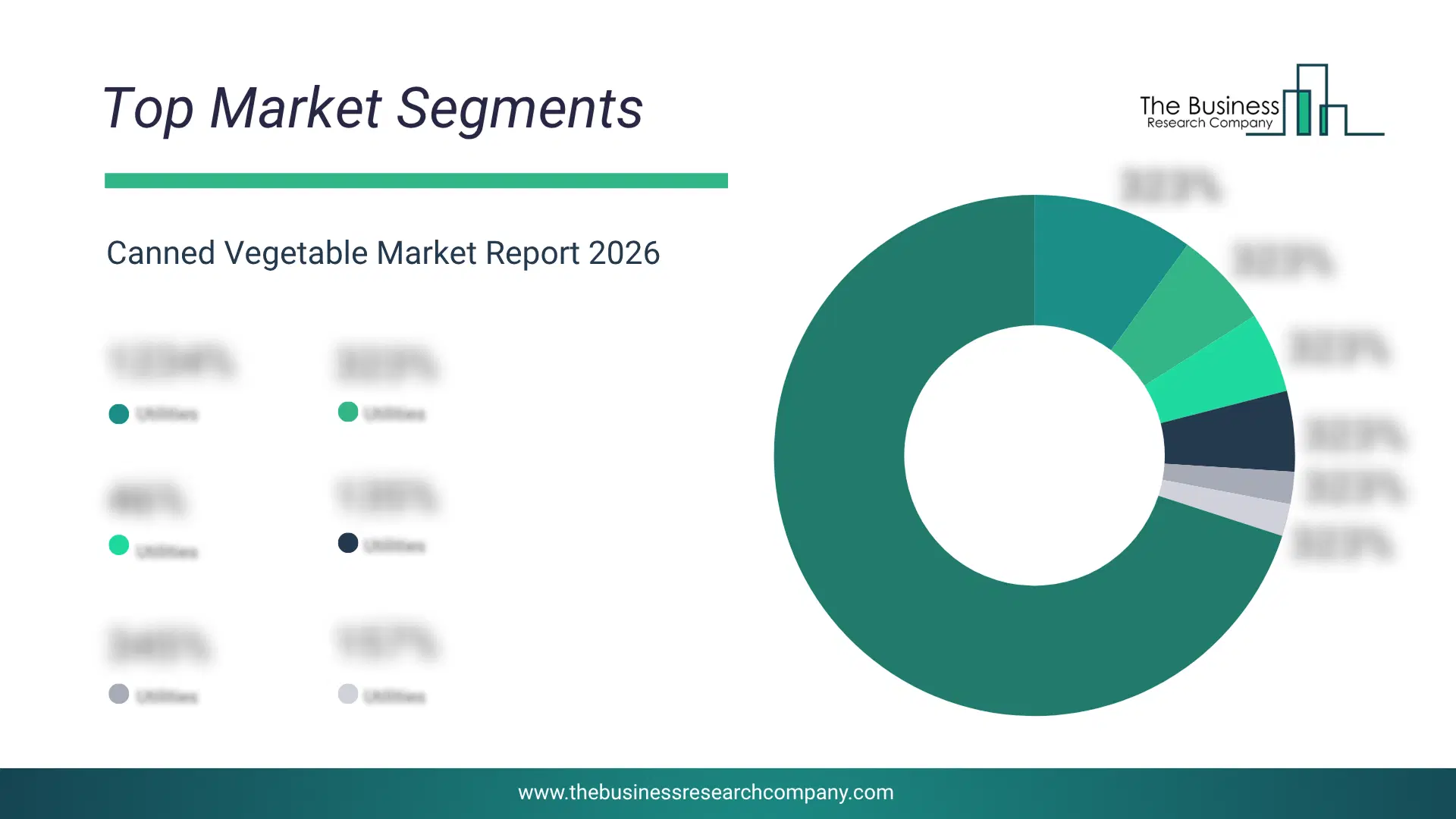
1) By Type: Sliced, Peeled, Other Types 2) By Distribution Channel: Store-Based, Non-Store-Based 3) By Application: Culinary, Salads And Soups, Toppings And Dressings, Other Applications Subsegments: 1) By Sliced: Sliced Carrots, Sliced Mushrooms, Sliced Potatoes, Sliced Beets, Sliced Tomatoes 2) By Peeled: Peeled Tomatoes, Peeled Potatoes, Peeled Carrots, Peeled Green Beans 3) By Other Types: Whole Vegetables, Diced Vegetables, Chopped Vegetables, Mixed Vegetables, Pureed VegetablesWhat Is The Driver Of The Canned Vegetable Market?
The rise in consumption of various packaged food products is expected to propel the growth of the canned vegetable market going forward. Packaged food refers to items processed, preserved, and sealed in packaging for convenience, preservation, and distribution, often including various pre-cooked or ready-to-eat meals, snacks, and ingredients. Consumption of packaged food products is on the rise due to changing lifestyles, convenience demands, and the globalization of food markets, offering diverse options to consumers seeking quick and easy meal solutions. Canned vegetables simplify meal preparation and enhance flavor profiles. For instance, in June 2023, according to a report published by Euromonitor International, a UK-based research and analysis organization, the projected retail sales of packaged foods in Japan are expected to hit $235.9 billion by 2026, marking a 9.1% increase or $19.6 billion surge compared to 2022. Therefore, the rise in consumption of various packaged food products is driving the growth of the canned vegetable industry.Key Players In The Global Canned Vegetable Market
Major companies operating in the canned vegetable market are Nestlé S.A., The Kraft Heinz Company, Dole plc, Del Monte Foods Inc., TreeHouse Foods Inc., Bonduelle SA, Whole Foods Market Inc., B&G Foods Inc., Goya Foods Inc., Seneca Foods Corporation, Hanover Foods Corp., Century Pacific Food Inc., Landec Corporation, CHB Group, Ban Mai company, Planet Green Holdings Corp., Cento Fine Foods Inc., Ayam Brand, Edinborough Products (Pvt) Limited, Libby's, Farmer’s Market Foods, Mediterranea Belfiore SRL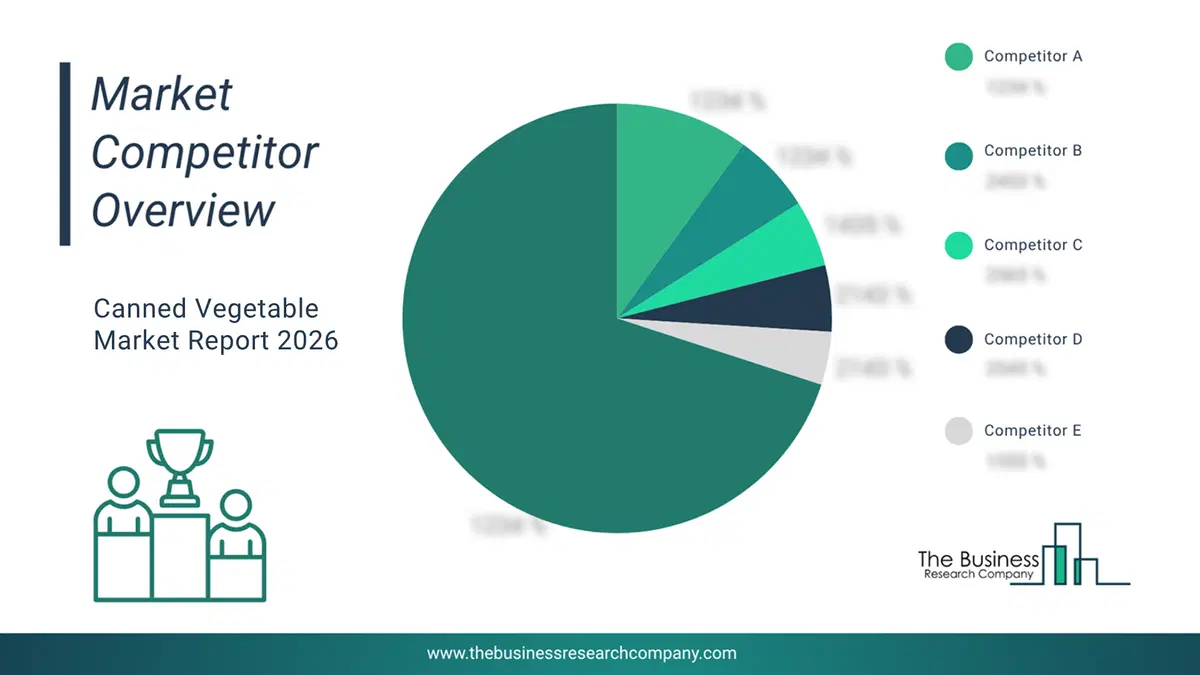
This chart is for illustrative purposes; the full report includes a detailed competitor analysis and comprehensive overview of the top 10 companies in the market.
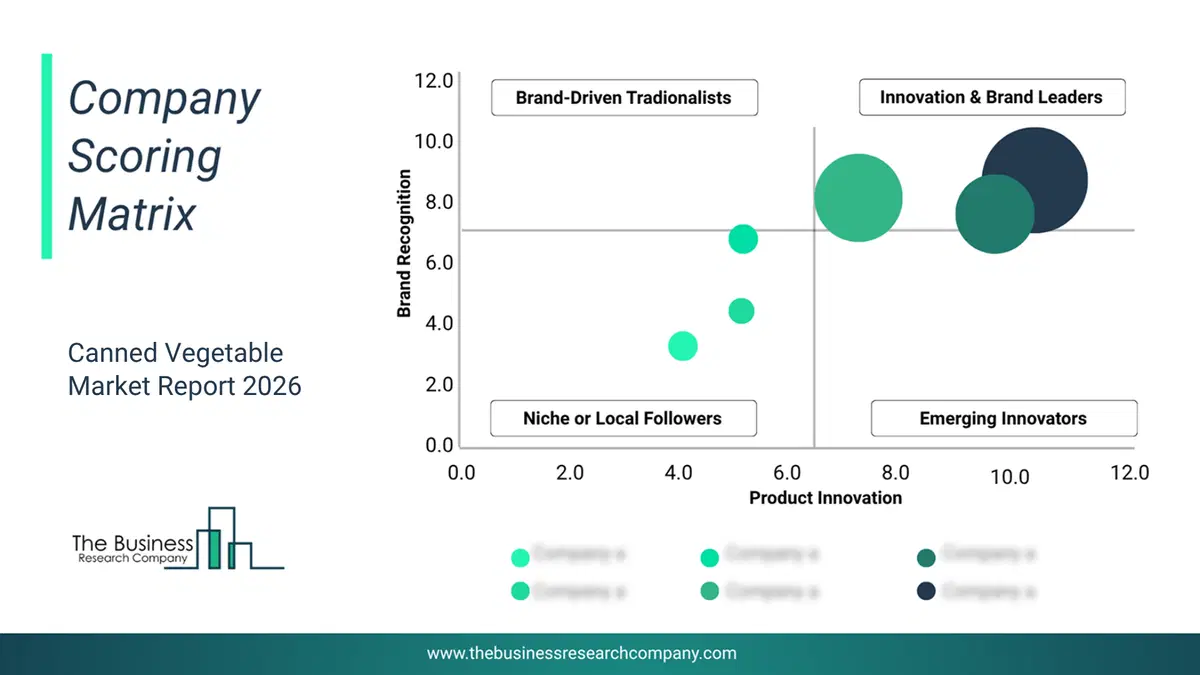
This chart maps companies by product innovation and brand strength, with bubble size indicating relative revenue, helping identify market leaders, challengers, and niche players. This is an illustrative chart; the full report provides a complete and accurate competitive analysis.
Global Canned Vegetable Market Trends and Insights
Major companies operating in the Canned Vegetable Market are increasingly focusing on developing diversified, convenience‑oriented, and health‑forward canned vegetable and vegetable‑blend products to meet the rising demand for ready‑to-use, shelf‑stable produce among busy urban consumers, emerging markets with limited fresh supply, and foodservice kitchens seeking consistent quality and supply stability. These modern canned vegetable offerings often feature mixed‑vegetable purées, blended vegetable mixes (sometimes with added ingredients like chia or nuts for enhanced nutrition), and ready‑to‑eat soup or purée formats replacing traditional plain canned vegetables (single‑vegetable cans) that required washing, chopping or additional preparation and had limited versatility. For instance, in June 2025, Countree Food, a China‑based canned‑food manufacturer, officially showcased new products including a “Veggies Mix Purée with Chia,” “Truffle Cream of Mushroom Soup,” and a ready‑to‑go “Nut‑Mix with Chia,” at the 2025 global trade‑show circuit (including Europe’s PLMA Amsterdam and Southeast Asia’s THAIFEX–Anuga Asia). The Veggies Mix Purée and soup‑format products are designed for convenience providing pre‑processed, ready‑to‑heat or ready‑to‑use vegetables and blends that save preparation time, simplify meal-making, and ensure consistent nutrition and taste, especially for households, working professionals, or markets with limited fresh‑vegetable supply. Countree’s expansion of product formats and its global trade‑show push underscore a broader market shift: consumers and foodservice buyers increasingly value convenience, long shelf life, and variety over traditional bulk‑vegetable cans.What Are Latest Mergers And Acquisitions In The Canned Vegetable Market?
In September 2023, Seneca Foods Corporation, a US-based food distributor and processor company, acquired Green Giant U.S. shelf-stable business from B&G Foods. for an undisclosed amount. With this acquisition, Seneca aims to access a wide range of popular products synonymous with frozen and canned vegetables, aligning with its goal of offering nutritious, high-quality food options. B&G Foods Inc. is a US-based food holding company.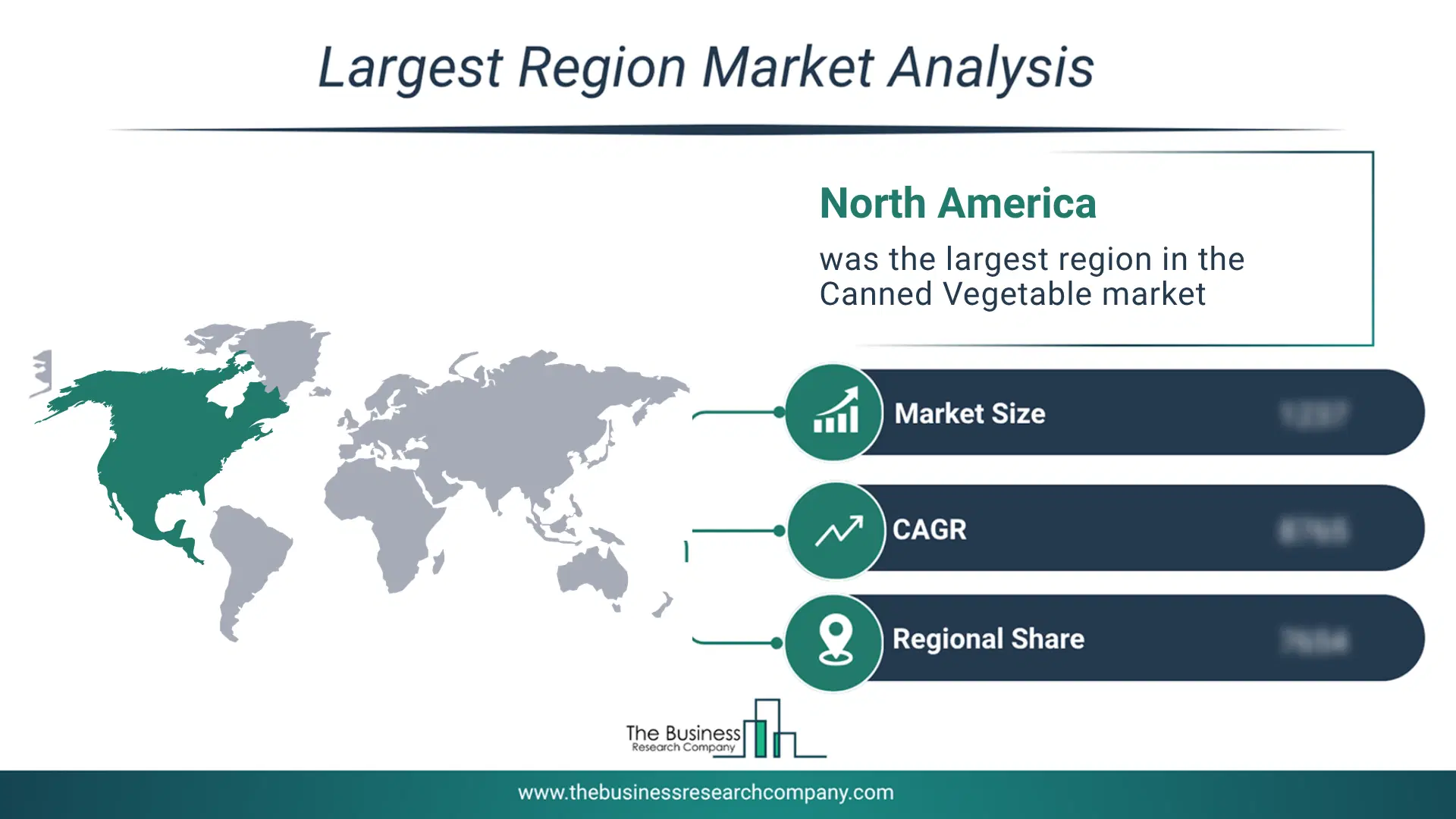
Regional Outlook
North America was the largest region in the canned vegetable market in 2025. Asia-Pacific is expected to be the fastest-growing region in the forecast period. The regions covered in this market report are Asia-Pacific, South East Asia, Western Europe, Eastern Europe, North America, South America, Middle East and Africa. The countries covered in this market report are Australia, Brazil, China, France, Germany, India, Indonesia, Japan, Taiwan, Russia, South Korea, UK, USA, Italy, Spain, CanadaWhat Defines the Canned Vegetable Market?
The canned vegetable market consists of sales of canned pumpkin, canned asparagus, canned beets, and canned mixed vegetables. Values in this market are ‘factory gate’ values, that is, the value of goods sold by the manufacturers or creators of the goods, whether to other entities (including downstream manufacturers, wholesalers, distributors, and retailers) or directly to end customers. The value of goods in this market includes related services sold by the creators of the goods.How is Market Value Defined and Measured?
The market value is defined as the revenues that enterprises gain from the sale of goods and/or services within the specified market and geography through sales, grants, or donations in terms of the currency (in USD unless otherwise specified). The revenues for a specified geography are consumption values that are revenues generated by organizations in the specified geography within the market, irrespective of where they are produced. It does not include revenues from resales along the supply chain, either further along the supply chain or as part of other products.
This chart presents market attractiveness based on a quantitative evaluation of growth, competition, strategic alignment, and risk, offering a clear view of opportunity areas for decision-making. This chart is for illustrative purposes; the full report contains the complete analysis.

This chart highlights the Total Addressable Market (TAM) by estimating the maximum revenue opportunity using an assumption-driven approach, supporting strategic planning and opportunity sizing across markets. The chart is illustrative; the full report provides a more comprehensive analysis.
What Key Data and Analysis Are Included in the Canned Vegetable Market Report 2026?
The canned vegetable market research report is one of a series of new reports from The Business Research Company that provides market statistics, including industry global market size, regional shares, competitors with the market share, detailed market segments, market trends and opportunities, and any further data you may need to thrive in the canned vegetable industry. The market research report delivers a complete perspective of everything you need, with an in-depth analysis of the current and future state of the industry.Canned Vegetable Market Report Forecast Analysis
| Report Attribute | Details |
|---|---|
| Market Size Value In 2026 | $25.41 billion |
| Revenue Forecast In 2030 | $30.03 billion |
| Growth Rate | CAGR of 5.0% from 2026 to 2030 |
| Base Year For Estimation | 2025 |
| Actual Estimates/Historical Data | 2020-2025 |
| Forecast Period | 2026 - 2030 |
| Market Representation | Revenue in USD Billion and CAGR from 2026 to 2030 |
| Segments Covered | Type, Distribution Channel, Application |
| Regional Scope | Asia-Pacific, Western Europe, Eastern Europe, North America, South America, Middle East, Africa |
| Country Scope | The countries covered in the report are Australia, Brazil, China, France, Germany, India, Indonesia, Japan, Taiwan, Russia, South Korea, UK, USA, Canada, Italy, Spain. |
| Key Companies Profiled | Nestlé S.A., The Kraft Heinz Company, Dole plc, Del Monte Foods Inc., TreeHouse Foods Inc., Bonduelle SA, Whole Foods Market Inc., B&G Foods Inc., Goya Foods Inc., Seneca Foods Corporation, Hanover Foods Corp., Century Pacific Food Inc., Landec Corporation, CHB Group, Ban Mai company, Planet Green Holdings Corp., Cento Fine Foods Inc., Ayam Brand, Edinborough Products (Pvt) Limited, Libby's, Farmer’s Market Foods, Mediterranea Belfiore SRL |
| Customization Scope | Request for Customization |
| Pricing And Purchase Options | Explore Purchase Options |