
Capesize Bulk Carrier Market Report 2026
Global Outlook – By Type (Newbuild, Second Hand, Refurbished), By Vessel Size (Deadweight Less Than One Hundred Seventy Thousand Tons, Deadweight Higher Than One Hundred Seventy Thousand Tons, Deadweight Less Than Two Hundred Thousand Tons, Deadweight Higher Than Two Hundred Thousand Tons), By Cargo Type (Coal, Iron Ore, Grain, Other Cargo Types), By End User Industry (Steel Production, Power Generation, Mining, Construction) – Market Size, Trends, Strategies, and Forecast to 2030
Capesize Bulk Carrier Market Overview
• Capesize Bulk Carrier market size has reached to $12.29 billion in 2025 • Expected to grow to $16.32 billion in 2030 at a compound annual growth rate (CAGR) of 5.8% • Growth Driver: The Rising Global Iron Ore Trade Volumes Fueling The Growth Of The Market Due To Sustaining Steel Demand In Emerging Economies • Market Trend: LNG-Fueled Capesize Bulk Carriers Are Driving Market Growth Due To Enhanced Sustainability And Emissions Reduction • Asia-Pacific was the largest region and fastest growing region.What Is Covered Under Capesize Bulk Carrier Market?
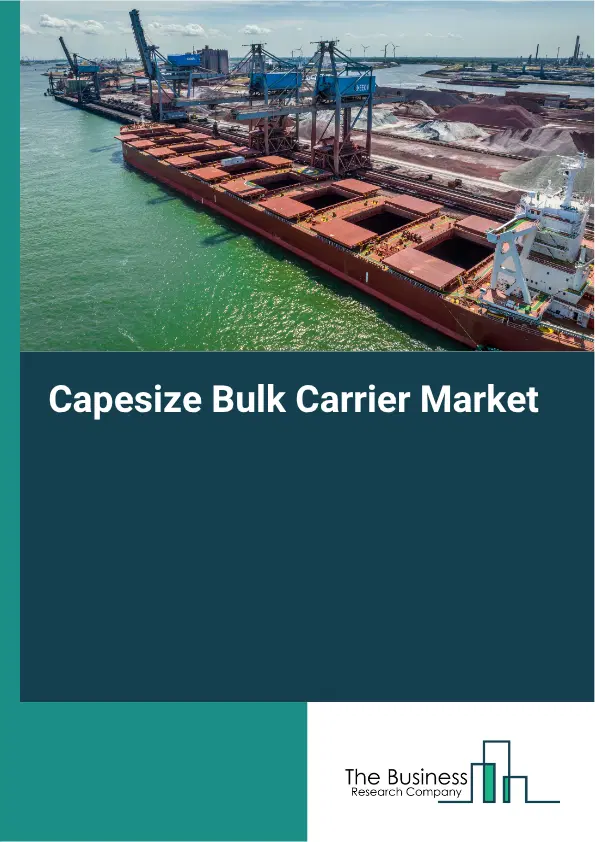
A capesize bulk carrier is a large dry bulk vessel, typically exceeding 150,000 DWT, built to transport substantial quantities of commodities such as iron ore, coal, and other raw materials. Its primary purpose is to enable efficient and cost-effective long-distance movement of bulk cargo between major resource-producing regions and industrial markets worldwide. The main types of capesize bulk carrier include newbuild, second hand, and refurbished. Newbuild refers to a newly constructed capesize bulk carrier designed and manufactured to transport large volumes of dry bulk cargo across international shipping routes. These vessels are available in vessel sizes including deadweight less than one hundred seventy thousand tons, deadweight higher than one hundred seventy thousand tons, deadweight less than two hundred thousand tons, and deadweight higher than two hundred thousand tons. They are used to transport cargo types such as coal, iron ore, grain, and other cargo types and are utilized by end-user industries including steel production, power generation, mining, and construction.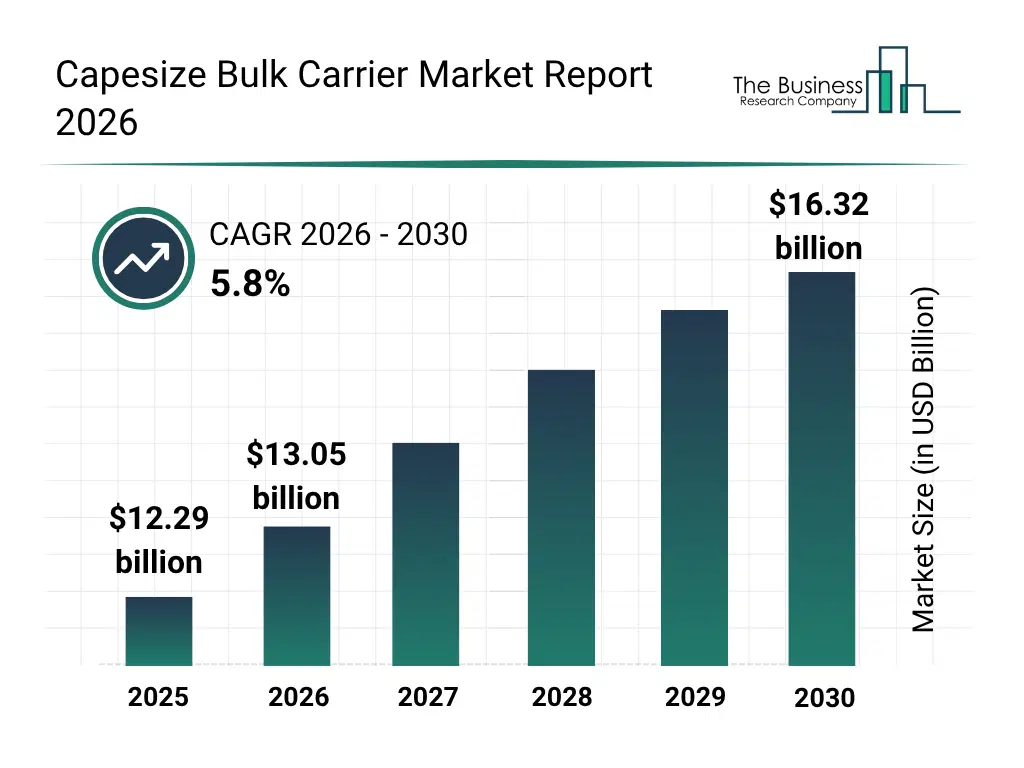
What Is The Capesize Bulk Carrier Market Size and Share 2026?
The capesize bulk carrier market size has grown strongly in recent years. It will grow from $12.29 billion in 2025 to $13.05 billion in 2026 at a compound annual growth rate (CAGR) of 6.2%. The growth in the historic period can be attributed to increasing global trade of iron ore and coal, rising demand for raw material transportation, expansion of steel production activities, growth of international maritime shipping networks, increasing investments in large-scale bulk carrier fleets.What Is The Capesize Bulk Carrier Market Growth Forecast?
The capesize bulk carrier market size is expected to see strong growth in the next few years. It will grow to $16.32 billion in 2030 at a compound annual growth rate (CAGR) of 5.8%. The growth in the forecast period can be attributed to growing adoption of energy-efficient capesize vessels, increasing demand for sustainable maritime transportation, rising replacement of aging bulk carrier fleets, expanding global infrastructure development activities, increasing demand for high-capacity cargo transportation solutions. Major trends in the forecast period include increasing adoption of fuel-efficient capesize bulk carriers, growing demand for eco-friendly vessel designs and emission reduction solutions, rising modernization of aging capesize fleets through refurbishment activities, increasing expansion of global dry bulk transportation capacity, growing demand for advanced vessel maintenance and operational optimization practices.
Global Capesize Bulk Carrier Market Segmentation
2) By Vessel Size: Deadweight Less Than One Hundred Seventy Thousand Tons, Deadweight Higher Than One Hundred Seventy Thousand Tons, Deadweight Less Than Two Hundred Thousand Tons, Deadweight Higher Than Two Hundred Thousand Tons 3) By Cargo Type: Coal, Iron Ore, Grain, Other Cargo Types 4) By End User Industry: Steel Production, Power Generation, Mining, Construction Subsegments: 1) By Newbuild: Standard Capesize Bulk Carriers, Fuel Efficient Capesize Bulk Carriers, Eco Design Capesize Bulk Carriers, Dual Fuel Capesize Bulk Carriers 2) By Second Hand: Modern Second Hand Capesize Bulk Carriers, Mid Age Second Hand Capesize Bulk Carriers, Vintage Second Hand Capesize Bulk Carriers, Resale Ready Capesize Bulk Carriers 3) By Refurbished: Engine Upgraded Refurbished Capesize Bulk Carriers, Hull Renovated Refurbished Capesize Bulk Carriers, Energy Efficient Refurbished Capesize Bulk Carriers, Class Certified Refurbished Capesize Bulk CarriersWhat Is The Driver Of The Capesize Bulk Carrier Market?
The rising global iron ore trade volumes are expected to propel the growth of the capesize bulk carrier market going forward. Iron ore trade refers to the cross-border shipment of iron ore from mining regions to industrial markets for steel production. Global iron ore trade volumes are rising as expanding steel production capacity increases demand for iron ore, the primary raw material used in steel manufacturing, thereby boosting international trade flows. Capesize bulk carriers help increase iron ore trade volumes by enabling the cost-efficient transportation of large iron ore cargoes over long distances, reducing per-ton shipping costs and supporting high-volume international trade. For instance, in May 2025, according to the Government of Western Australia’s Department of Jobs, Tourism, Science, and Innovation, an Australia-based government department, China imported 1,173 million tonnes of iron ore, representing 72% of global iron ore imports. Therefore, the rising global iron ore trade volumes are driving the growth of the capesize bulk carrier industry.Key Players In The Global Capesize Bulk Carrier Market
Major companies operating in the capesize bulk carrier market are Berge Bulk Pte. Ltd., Golden Ocean Group Ltd., Oldendorff Carriers GmbH & Co. KG, Star Bulk Carriers Corp., COSCO Shipping Bulk Co. Ltd., Nippon Yusen Kabushiki Kaisha, Mitsui O.S.K. Lines Ltd., Navios Maritime Partners L.P., Pan Ocean Co. Ltd., Genco Shipping and Trading Limited, Kawasaki Kisen Kaisha Ltd., Eastern Pacific Shipping Pte. Ltd., CMB Group, Asyad Shipping Company SAOG, Safe Bulkers Inc., Diana Shipping Inc., Jinhui Shipping and Transportation Limited, Seanergy Maritime Holdings Corp., Winning International Group, C Transport Maritime S.A.M., Ultrabulk A/S, SwissMarine Pte. Ltd.
This chart is for illustrative purposes; the full report includes a detailed competitor analysis and comprehensive overview of the top 10 companies in the market.
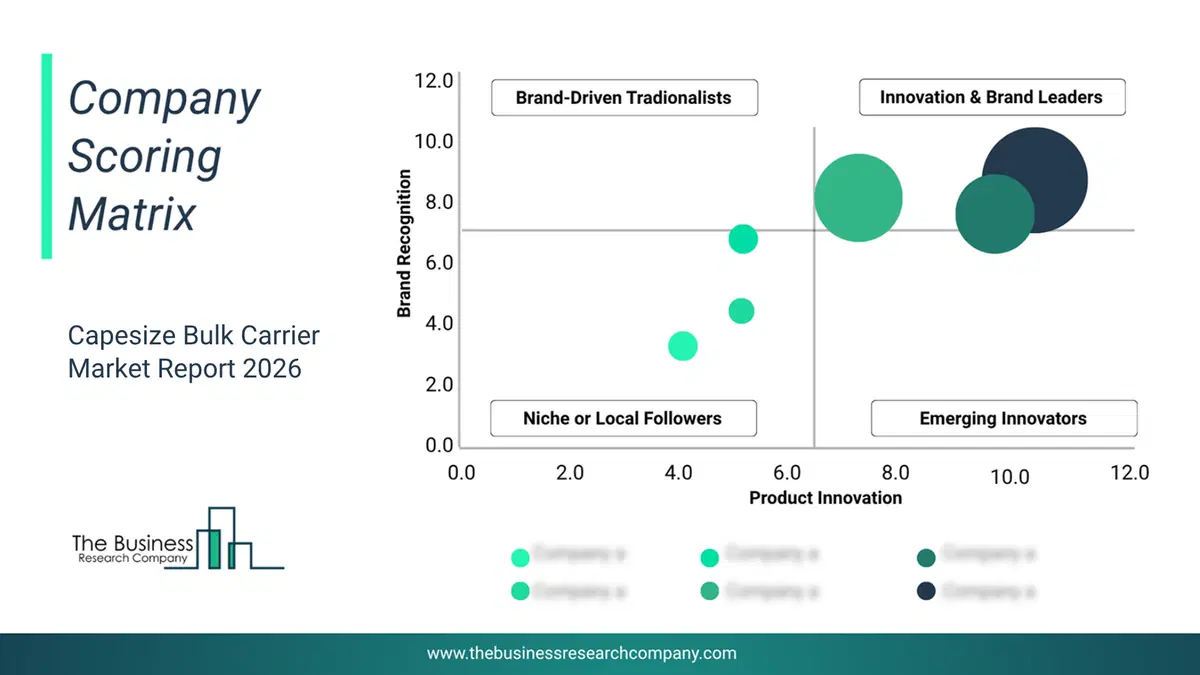
This chart maps companies by product innovation and brand strength, with bubble size indicating relative revenue, helping identify market leaders, challengers, and niche players. This is an illustrative chart; the full report provides a complete and accurate competitive analysis.
Global Capesize Bulk Carrier Market Trends and Insights
Major companies operating in the capesize bulk carrier market are focusing on the development of LNG-fueled capesize vessels to reduce greenhouse gas emissions, comply with evolving environmental regulations, and improve operational efficiency. LNG-fueled capesize bulk carriers are large dry bulk vessels powered by liquefied natural gas, enabling lower emissions of carbon dioxide (CO₂), nitrogen oxides (NOx), and sulfur oxides (SOx) compared to conventionally fueled ships. For instance, in February 2024, Nippon Yusen Kabushiki Kaisha (NYK Line), a Japan-based shipping company, took delivery of SG Ocean, Japan’s first LNG-fueled capesize bulk carrier. The vessel was introduced to support the decarbonization of bulk commodity transportation and is designed to transport iron ore and coal between Australia and Japan. This utilizes LNG as a marine fuel and significantly reduces CO₂, NOx, and SOx emissions, reinforcing sustainable shipping practices and advancing environmental performance in the capesize bulk carrier.What Are Latest Mergers And Acquisitions In The Capesize Bulk Carrier Market?
In April 2024, Star Bulk Carriers Corp., a Greece-based dry bulk shipping company that offers capesize bulk carriers, merged with Eagle Bulk Shipping Inc. to create a larger and more diversified dry bulk shipping fleet with improved operational efficiency. With this merger, Star Bulk expanded its global dry bulk carrier presence by combining fleets, increasing vessel capacity, enhancing economies of scale, and strengthening service capabilities across major bulk cargo routes, including those served by Capesize vessels. Eagle Bulk Shipping Inc. is a US-based company that engages in the ocean transportation of dry bulk cargoes worldwide.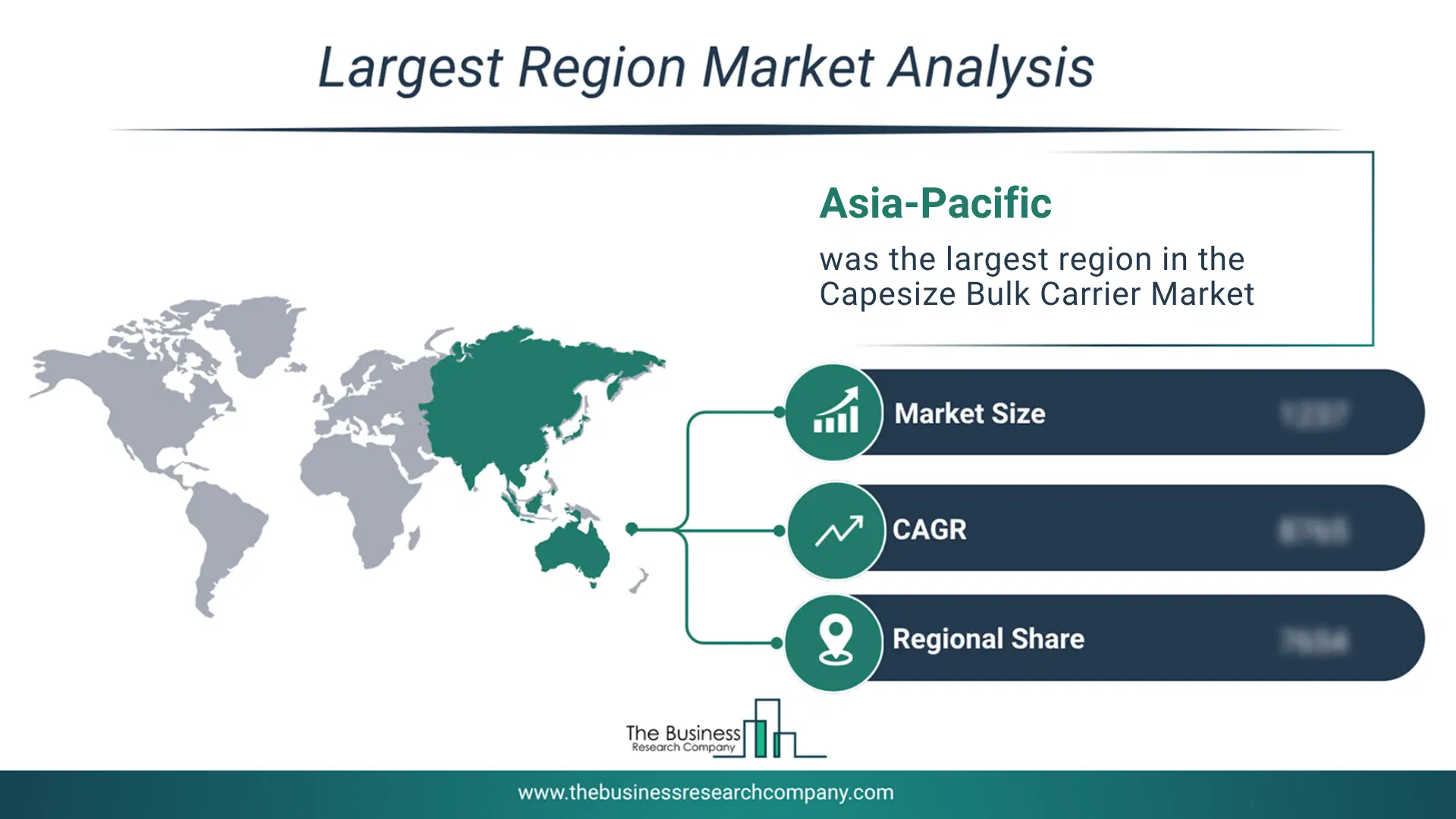
Regional Outlook/Insights
Asia-Pacific was the largest region in the capesize bulk carrier market in 2025. Asia-Pacific is expected to be the fastest-growing region in the forecast period. The regions covered in this market report are Asia-Pacific, South East Asia, Western Europe, Eastern Europe, North America, South America, Middle East, Africa. The countries covered in this market report are Australia, Brazil, China, France, Germany, India, Indonesia, Japan, Taiwan, Russia, South Korea, UK, USA, Canada, Italy, Spain.What Defines the Capesize Bulk Carrier Market?
The capesize bulk carrier market consists of sales of iron ore carrier, coal carrier, bauxite carrier, and grain carrier. Values in this market are ‘factory gate’ values, that is the value of goods sold by the manufacturers or creators of the goods, whether to other entities (including downstream manufacturers, wholesalers, distributors and retailers) or directly to end customers. The value of goods in this market includes related services sold by the creators of the goods.How is Market Value Defined and Measured?
The market value is defined as the revenues that enterprises gain from the sale of goods and/or services within the specified market and geography through sales, grants, or donations in terms of the currency (in USD unless otherwise specified). The revenues for a specified geography are consumption values that are revenues generated by organizations in the specified geography within the market, irrespective of where they are produced. It does not include revenues from resales along the supply chain, either further along the supply chain or as part of other products.
This chart presents market attractiveness based on a quantitative evaluation of growth, competition, strategic alignment, and risk, offering a clear view of opportunity areas for decision-making. This chart is for illustrative purposes; the full report contains the complete analysis.

This chart highlights the Total Addressable Market (TAM) by estimating the maximum revenue opportunity using an assumption-driven approach, supporting strategic planning and opportunity sizing across markets. The chart is illustrative; the full report provides a more comprehensive analysis.
What Key Data and Analysis Are Included in the Capesize Bulk Carrier Market Report 2026?
The capesize bulk carrier market research report is one of a series of new reports from The Business Research Company that provides capesize bulk carrier market statistics, including capesize bulk carrier industry global market size, regional shares, competitors with a capesize bulk carrier market share, detailed capesize bulk carrier market segments, market trends and opportunities, and any further data you may need to thrive in the capesize bulk carrier industry. This capesize bulk carrier market research report delivers a complete perspective of everything you need, with an in-depth analysis of the current and future scenario of the industry.Capesize Bulk Carrier Market Report Forecast Analysis
| Report Attribute | Details |
|---|---|
| Market Size Value In 2026 | $13.05 billion |
| Revenue Forecast In 2030 | $16.32 billion |
| Growth Rate | CAGR of 5.8% from 2026 to 2030 |
| Base Year For Estimation | 2025 |
| Actual Estimates/Historical Data | 2020-2025 |
| Forecast Period | 2026 - 2030 |
| Market Representation | Revenue in USD Billion and CAGR from 2026 to 2030 |
| Segments Covered | Type, Vessel Size, Cargo Type, End User Industry |
| Regional Scope | Asia-Pacific, Western Europe, Eastern Europe, North America, South America, Middle East, Africa |
| Country Scope | The countries covered in the report are Australia, Brazil, China, France, Germany, India, Indonesia, Japan, Taiwan, Russia, South Korea, UK, USA, Canada, Italy, Spain. |
| Key Companies Profiled | Berge Bulk Pte. Ltd., Golden Ocean Group Ltd., Oldendorff Carriers GmbH & Co. KG, Star Bulk Carriers Corp., COSCO Shipping Bulk Co. Ltd., Nippon Yusen Kabushiki Kaisha, Mitsui O.S.K. Lines Ltd., Navios Maritime Partners L.P., Pan Ocean Co. Ltd., Genco Shipping and Trading Limited, Kawasaki Kisen Kaisha Ltd., Eastern Pacific Shipping Pte. Ltd., CMB Group, Asyad Shipping Company SAOG, Safe Bulkers Inc., Diana Shipping Inc., Jinhui Shipping and Transportation Limited, Seanergy Maritime Holdings Corp., Winning International Group, C Transport Maritime S.A.M., Ultrabulk A/S, SwissMarine Pte. Ltd. |
| Customization Scope | Request for Customization |
| Pricing And Purchase Options | Explore Purchase Options |