

Car Engine Parts Market Report 2026
Global Outlook – By Component (Pistons, Crankshaft, Camshaft, Engine Valves, Connecting Rods), By Vehicle Type (Passenger Cars, Commercial Vehicles, Other Vehicle Types), By Fuel Type (Petrol, Diesel, Electric, Hybrid), By Material (Cast Iron, Aluminum Alloys, Steel, Titanium Alloys, Composite Materials, Other Materials), By Distribution Channel (Original Equipment Manufacturer, Aftermarket) – Market Size, Trends, Strategies, and Forecast to 2030
Car Engine Parts Market Overview
• Car Engine Parts market size has reached to $98.83 billion in 2025 • Expected to grow to $124.67 billion in 2030 at a compound annual growth rate (CAGR) of 4.7% • Growth Driver: Increasing Vehicle Production Driving The Growth Of The Market Due To Rising Consumer Demand For Personal Mobility • Market Trend: Innovative Surface Coating Solutions Improve Valvetrain Performance And Wear Resistance • Asia-Pacific was the largest region and fastest growing region.What Is Covered Under Car Engine Parts Market?
Car engine parts refer to the various mechanical, electrical, and supporting components that function together within an automobile engine to convert fuel energy into mechanical power and enable vehicle movement. These components are responsible for combustion processes, energy transfer, heat control, lubrication, and maintaining overall engine efficiency and performance. The main components of car engine parts include pistons, crankshafts, camshafts, engine valves, and connecting rods. Pistons refer to cylindrical engine components that move within the engine cylinders to convert combustion pressure into mechanical motion and transfer force to the crankshaft. These parts are used in passenger cars, commercial vehicles, and other vehicle types, and are compatible with petrol, diesel, electric, and hybrid powertrains. They are manufactured using cast iron, aluminum alloys, steel, titanium alloys, composite materials, and others, and are distributed through original equipment manufacturers and aftermarket channels.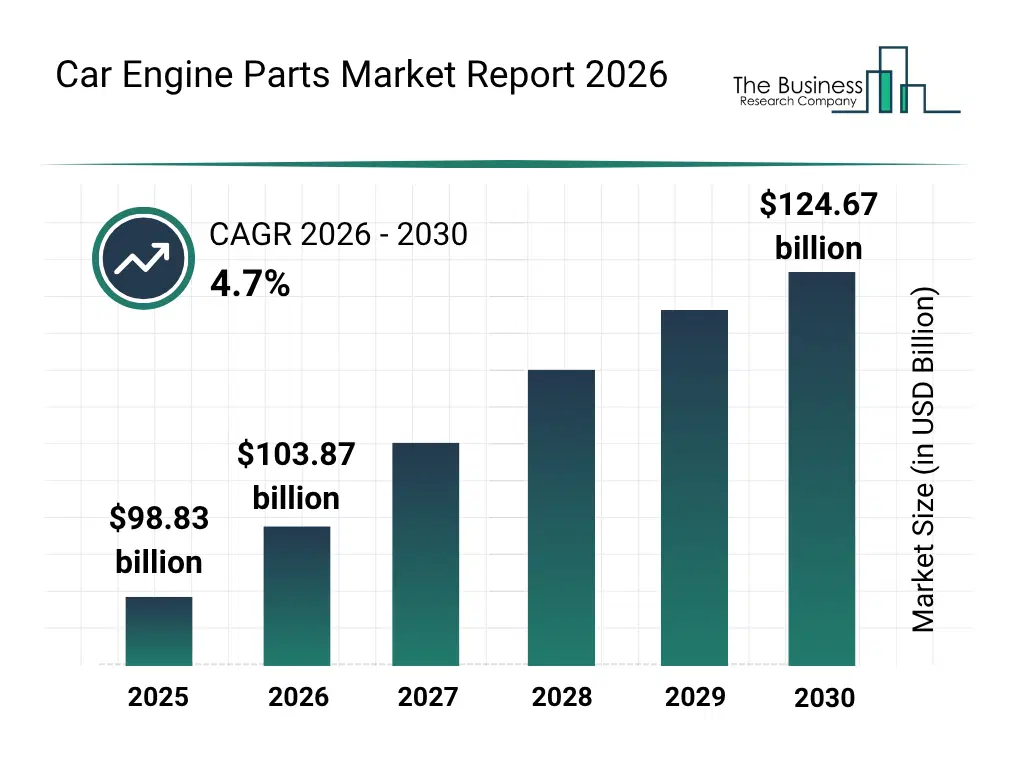
What Is The Car Engine Parts Market Size and Share 2026?
The car engine parts market size has grown strongly in recent years. It will grow from $98.83 billion in 2025 to $103.87 billion in 2026 at a compound annual growth rate (CAGR) of 5.1%. The growth in the historic period can be attributed to growing vehicle production and sales, rising demand for replacement engine components, increasing vehicle ownership, growing automotive manufacturing activities, rising demand for engine maintenance and repair.What Is The Car Engine Parts Market Growth Forecast?
The car engine parts market size is expected to see steady growth in the next few years. It will grow to $124.67 billion in 2030 at a compound annual growth rate (CAGR) of 4.7%. The growth in the forecast period can be attributed to increasing demand for lightweight automotive components, rising adoption of hybrid vehicle powertrains, growing demand for high-performance engine components, increasing vehicle fleet age and replacement requirements, rising demand for fuel-efficient combustion engine technologies. Major trends in the forecast period include rising demand for lightweight engine components, increasing adoption of high-strength engine materials, growing demand for fuel-efficient engine parts, rising use of advanced engine cooling and lubrication components, increasing demand for durable and high-performance replacement parts.Tariff Impact On Car Engine Parts Market
Tariffs are impacting the car engine parts market by increasing the cost of imported metals, precision components, engine parts, manufacturing equipment, and other inputs used across automotive supply chains. This is raising production and replacement-part costs and creating supply-chain pressure for pistons, crankshafts, camshafts, engine valves, and connecting rods, particularly in regions dependent on imported automotive components such as Asia-Pacific, Europe, and North America. Original equipment manufacturers and aftermarket suppliers are most affected because of their reliance on globally sourced components and materials. However, tariffs are also encouraging domestic component manufacturing, regional supplier diversification, localized sourcing, and increased investment in resilient automotive supply chains.
Global Car Engine Parts Market Segmentation
1) By Component: Pistons, Crankshaft, Camshaft, Engine Valves, Connecting Rods 2) By Vehicle Type: Passenger Cars, Commercial Vehicles, Other Vehicle Types 3) By Fuel Type: Petrol, Diesel, Electric, Hybrid 4) By Material: Cast Iron, Aluminum Alloys, Steel, Titanium Alloys, Composite Materials, Other Materials 5) By Distribution Channel: Original Equipment Manufacturer, Aftermarket Subsegments: 1) By Pistons: Cast Aluminum Pistons, Forged Aluminum Pistons, Steel Pistons, Coated Pistons, High-Compression Pistons 2) By Crankshaft: Forged Steel Crankshafts, Cast Iron Crankshafts, Billet Crankshafts, Flat-Plane Crankshafts, Cross-Plane Crankshafts 3) By Camshaft: Hydraulic Camshafts, Mechanical Camshafts, Roller Camshafts, Flat Tappet Camshafts, Single Overhead Camshafts 4) By Engine Valves: Intake Valves, Exhaust Valves, Hollow Stem Valves, Sodium-Filled Valves, Titanium Valves 5) By Connecting Rods: Forged Steel Connecting Rods, Powder Metal Connecting Rods, Aluminum Connecting Rods, Titanium Connecting Rods, H-Beam Connecting RodsWhat Is The Driver Of The Car Engine Parts Market?
The increasing vehicle production is expected to propel the growth of the car engine parts market going forward. Vehicle production refers to the manufacturing of passenger cars, commercial vehicles, buses, and trucks to meet transportation and mobility demand across global markets. Vehicle production is increasing due to rising consumer demand for personal mobility, as growing urbanization, improving living standards, and higher disposable incomes are encouraging consumers to purchase personal vehicles for convenient and flexible transportation. Increasing vehicle production drives demand for car engine parts by increasing the need for essential engine components across newly manufactured vehicles, thereby supporting higher component sales and manufacturing growth. For instance, in April 2026, according to the International Organization of Motor Vehicle Manufacturers, a France-based trade association, global vehicle production increased from 92.7 million units in 2024 to 96.4 million units in 2025, while global vehicle sales grew from 95.3 million to 99.8 million units, reflecting 3.9% and 4.7% growth, respectively. Therefore, the increasing vehicle production is driving the growth of the car engine parts industry.Key Players In The Global Car Engine Parts Market
Major companies operating in the car engine parts market are Robert Bosch GmbH, Continental AG, Denso Corporation, Hitachi Astemo Ltd., Mitsubishi Heavy Industries Ltd., Aisin Corporation, Cummins Inc., Schaeffler AG, BorgWarner Inc., Valeo SE, Rheinmetall AG, Linamar Corporation, Dana Incorporated, MAHLE GmbH, SKF Group, JTEKT Corporation, IHI Corporation, NSK Ltd., Tenneco Inc., Garrett Motion Inc., PHINIA Inc., Niterra Co. Ltd., Musashi Seimitsu Industry Co. Ltd., ElringKlinger AG, TPR Co. Ltd.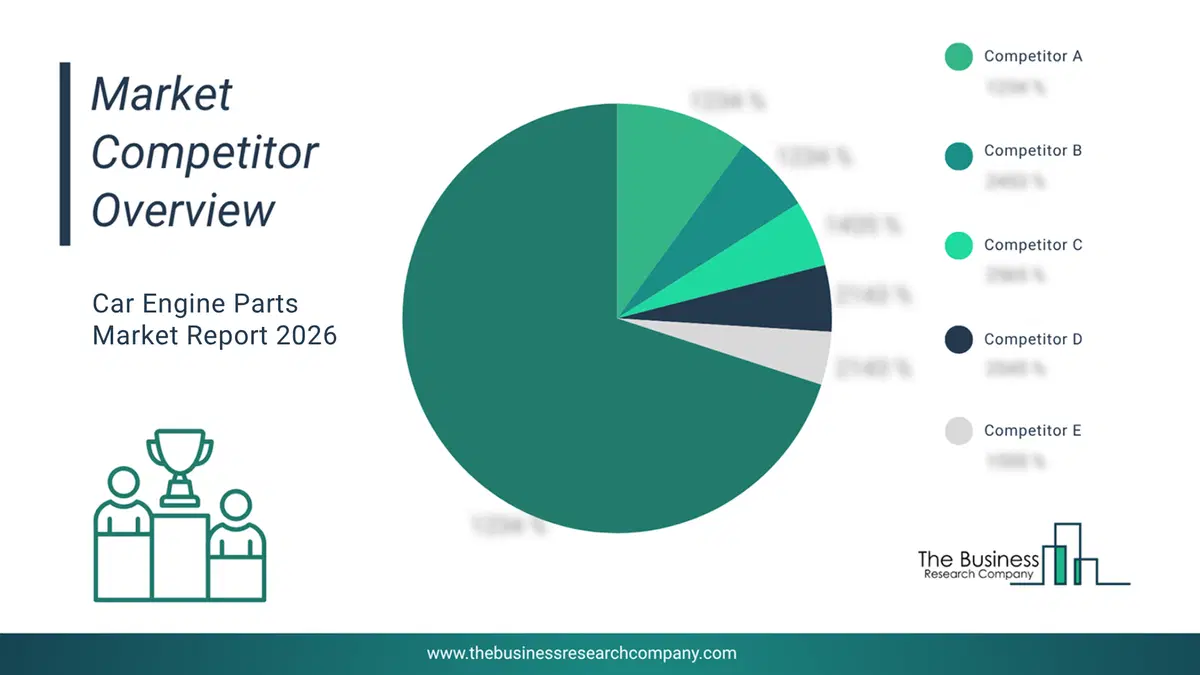
This chart is for illustrative purposes; the full report includes a detailed competitor analysis and comprehensive overview of the top 10 companies in the market.
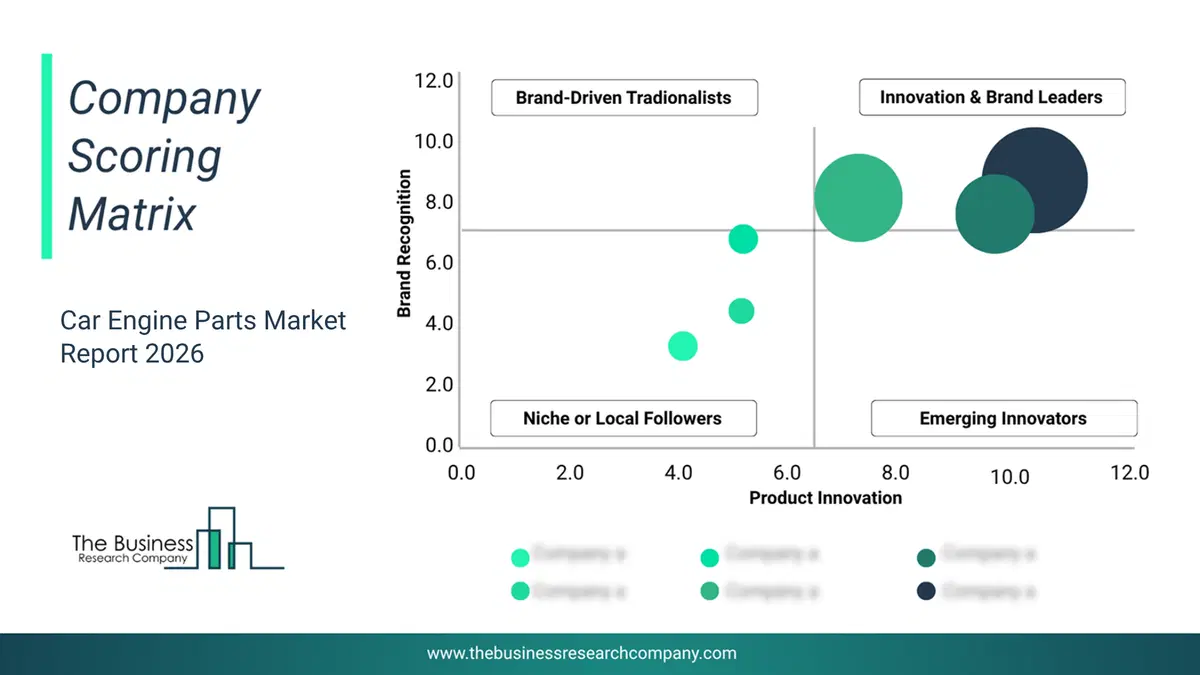
This chart maps companies by product innovation and brand strength, with bubble size indicating relative revenue, helping identify market leaders, challengers, and niche players. This is an illustrative chart; the full report provides a complete and accurate competitive analysis.
Global Car Engine Parts Market Trends and Insights
Major companies operating in the car engine parts market are focusing on developing innovative solutions, such as diamond-like carbon-coated hydraulic flat-tappet lifters, to enhance engine durability, component performance, friction reduction, wear resistance, and overall operating efficiency. Diamond-like carbon (DLC)-coated hydraulic flat-tappet lifters are engine valvetrain components with a hard, low-friction carbon-based coating that improves wear resistance, reduces friction, and extends component life compared with conventional lifters. For instance, in June 2025, Elgin Industries Inc., a US-based manufacturer of engine and chassis components, launched Elgin PRO-STOCK Hydraulic Flat-Tappet Lifters featuring next-generation diamond-like carbon (DLC) coating technology. The hydraulic lifters use an advanced DLC coating that enhances surface hardness, minimizes friction between the lifter and camshaft contact surfaces, and improves resistance to wear. This technology helps extend the service life of valvetrain components by enabling better performance under high-load and high-stress engine conditions. The lifters are developed as upgraded alternatives to conventional flat-tappet lifters with standard surface treatments that offer comparatively lower durability. Designed for automotive engine applications, including performance vehicles, aftermarket engine rebuilding, and classic vehicle powertrain systems, the DLC-coated lifters enhance engine reliability, reduce component wear, and support improved operating efficiency.What Are Latest Mergers And Acquisitions In The Car Engine Parts Market?
In December 2025, Morgan Motor Company Limited, a UK-based automotive company, partnered with Bayerische Motoren Werke AG (BMW AG) to continue their technical partnership and supply of BMW engines for Morgan sports cars. Through this partnership, Morgan Motor Company Limited and Bayerische Motoren Werke AG aim to provide advanced powertrain technology, enhance vehicle performance and efficiency, support the development of next-generation coachbuilt sports cars, strengthen engineering collaboration, and deliver reliable and driver-focused driving experiences. Bayerische Motoren Werke AG is a Germany-based automotive company that specializes in providing automotive engines and engine components.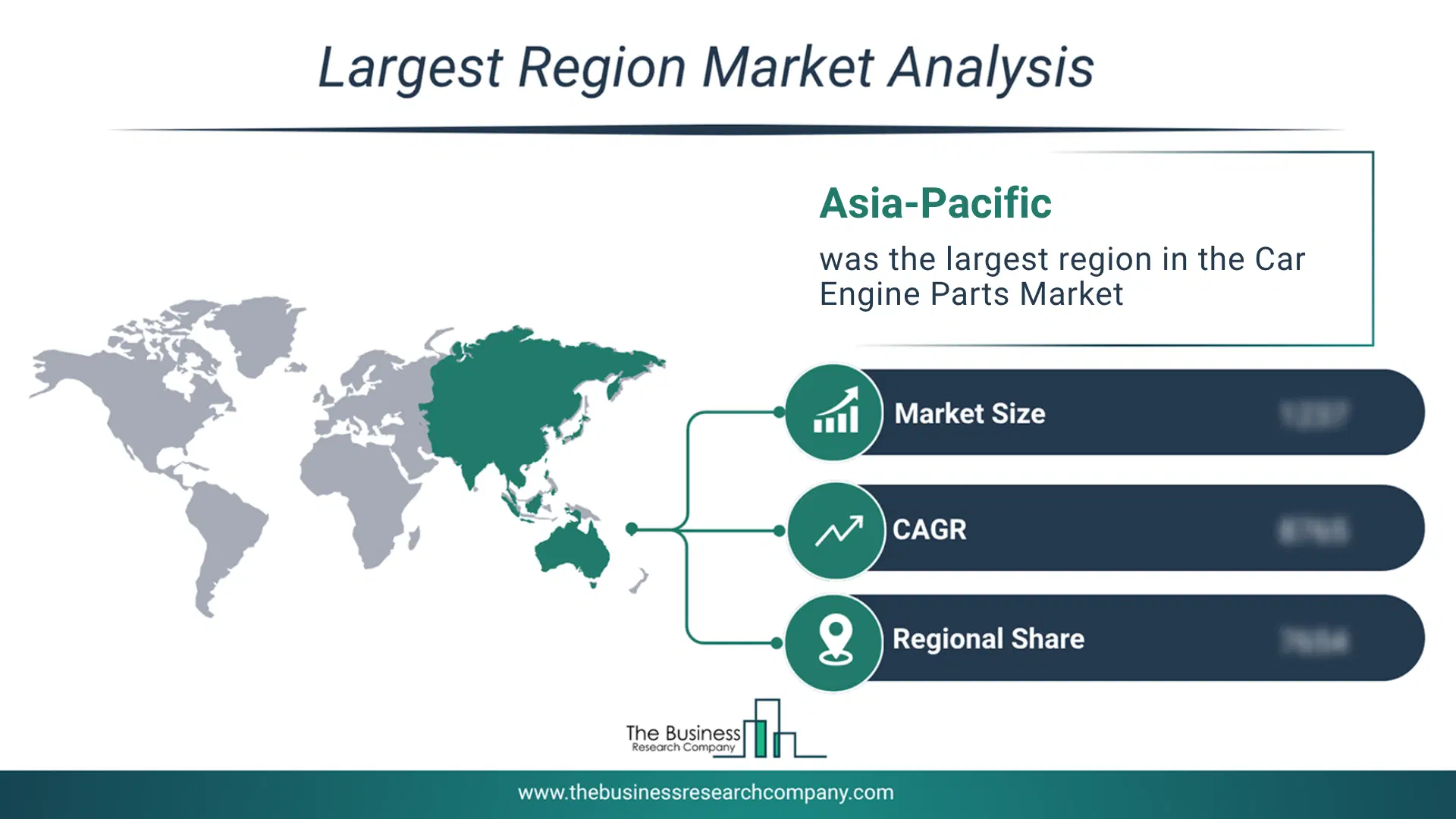
Regional Outlook
Asia-Pacific was the largest region in the car engine parts market in 2025. Asia-Pacific is expected to be the fastest-growing region in the forecast period. The regions covered in this market report are Asia-Pacific, South East Asia, Western Europe, Eastern Europe, North America, South America, Middle East, Africa. The countries covered in this market report are Australia, Brazil, China, France, Germany, India, Indonesia, Japan, Taiwan, Russia, South Korea, UK, USA, Canada, Italy, Spain.What Defines the Car Engine Parts Market?
The car engine parts market consists of sales of engine components, fuel system components, air intake system components, cooling system components, and exhaust system components. Values in this market are ‘factory gate’ values, that is, the value of goods sold by the manufacturers or creators of the goods, whether to other entities (including downstream manufacturers, wholesalers, distributors, and retailers) or directly to end customers. The value of goods in this market includes related services sold by the creators of the goods.How is Market Value Defined and Measured?
The market value is defined as the revenues that enterprises gain from the sale of goods and/or services within the specified market and geography through sales, grants, or donations in terms of the currency (in USD unless otherwise specified). The revenues for a specified geography are consumption values that are revenues generated by organizations in the specified geography within the market, irrespective of where they are produced. It does not include revenues from resales along the supply chain, either further along the supply chain or as part of other products.
This chart presents market attractiveness based on a quantitative evaluation of growth, competition, strategic alignment, and risk, offering a clear view of opportunity areas for decision-making. This chart is for illustrative purposes; the full report contains the complete analysis.

This chart highlights the Total Addressable Market (TAM) by estimating the maximum revenue opportunity using an assumption-driven approach, supporting strategic planning and opportunity sizing across markets. The chart is illustrative; the full report provides a more comprehensive analysis.
What Key Data and Analysis Are Included in the Car Engine Parts Market Report 2026?
The car engine parts market research report is one of a series of new reports from The Business Research Company that provides market statistics, including industry global market size, regional shares, competitors with the market share, detailed market segments, market trends and opportunities, and any further data you may need to thrive in the car engine parts industry. The market research report delivers a complete perspective of everything you need, with an in-depth analysis of the current and future state of the industry.Car Engine Parts Market Report Forecast Analysis
| Report Attribute | Details |
|---|---|
| Market Size Value In 2026 | $103.87 billion |
| Revenue Forecast In 2030 | $124.67 billion |
| Growth Rate | CAGR of 4.7% from 2026 to 2030 |
| Base Year For Estimation | 2025 |
| Actual Estimates/Historical Data | 2020-2025 |
| Forecast Period | 2026 - 2030 |
| Market Representation | Revenue in USD Billion and CAGR from 2026 to 2030 |
| Segments Covered | Component, Vehicle Type, Fuel Type, Material, Distribution Channel |
| Regional Scope | Asia-Pacific, Western Europe, Eastern Europe, North America, South America, Middle East, Africa |
| Country Scope | The countries covered in the report are Australia, Brazil, China, France, Germany, India, Indonesia, Japan, Taiwan, Russia, South Korea, UK, USA, Canada, Italy, Spain. |
| Key Companies Profiled | Robert Bosch GmbH, Continental AG, Denso Corporation, Hitachi Astemo Ltd., Mitsubishi Heavy Industries Ltd., Aisin Corporation, Cummins Inc., Schaeffler AG, BorgWarner Inc., Valeo SE, Rheinmetall AG, Linamar Corporation, Dana Incorporated, MAHLE GmbH, SKF Group, JTEKT Corporation, IHI Corporation, NSK Ltd., Tenneco Inc., Garrett Motion Inc., PHINIA Inc., Niterra Co. Ltd., Musashi Seimitsu Industry Co. Ltd., ElringKlinger AG, TPR Co. Ltd. |
| Customization Scope | Request for Customization |
| Pricing And Purchase Options | Explore Purchase Options |