

Car Powertrain Market Report 2026
Global Outlook – By Component (Engine, Transmission, Drive Shaft, Differential, Power Electronics, Battery, Electric Motor), By Vehicle Type (Passenger Cars, Light Commercial Vehicles, Heavy Commercial Vehicles), By Drive Type (Front Wheel Drive, Rear Wheel Drive, All Wheel Drive), By Sales Channel (Original Equipment Manufacturer, Aftermarket) – Market Size, Trends, Strategies, and Forecast to 2030
Car Powertrain Market Overview
• Car Powertrain market size has reached to $707.61 billion in 2025 • Expected to grow to $947.58 billion in 2030 at a compound annual growth rate (CAGR) of 5.9% • Growth Driver: Increasing Demand For Fuel-Efficient Vehicles Driving The Growth Of The Market Due To Rising Fuel Prices • Market Trend: Next-Generation Electrified Powertrain Innovations Accelerate Sustainable Mobility Adoption • Asia-Pacific was the largest region and fastest growing region.What Is Covered Under Car Powertrain Market?
A car powertrain is the integrated system that generates and delivers power to propel a vehicle. It converts energy into mechanical motion and transmits power efficiently to enable vehicle movement under various driving conditions. The powertrain determines the vehicle's performance, energy efficiency, driving characteristics, and overall operating capability. The main components of car powertrains include engines, transmissions, drive shafts, differentials, power electronics, batteries, and electric motors. Engines refer to powertrain components that convert fuel or other energy sources into mechanical power to propel the vehicle. These powertrains are used in passenger cars, light commercial vehicles, and heavy commercial vehicles. They incorporate front-wheel drive, rear-wheel drive, and all-wheel drive configurations, and are sold through original equipment manufacturers and aftermarket channels.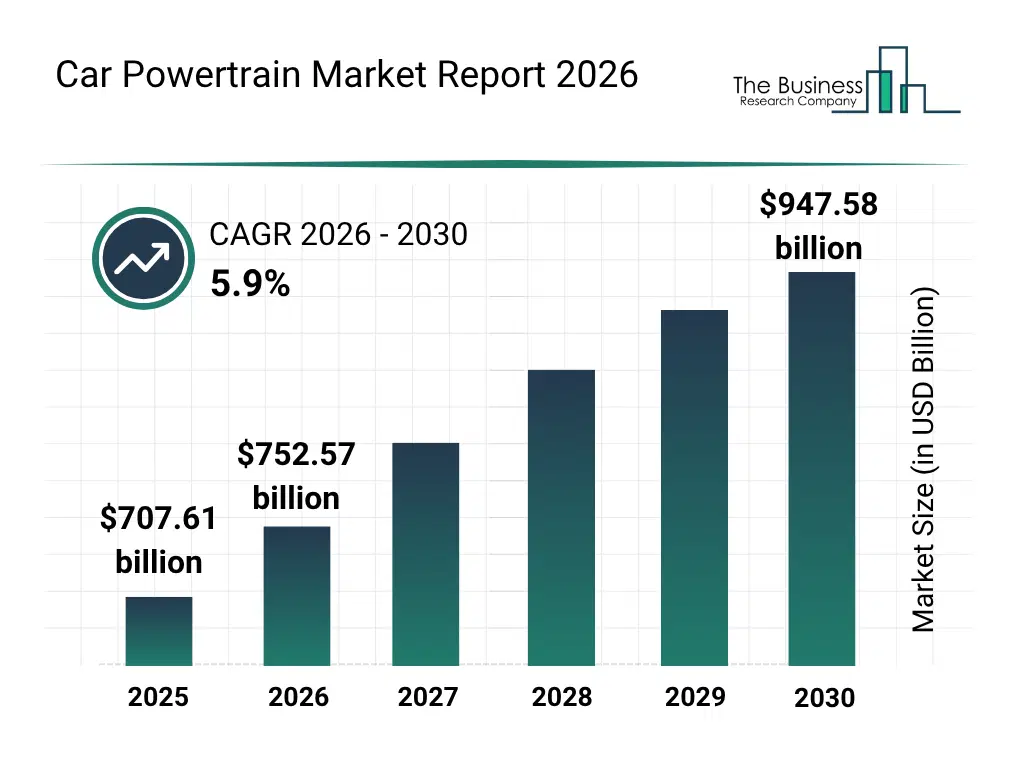
What Is The Car Powertrain Market Size and Share 2026?
The car powertrain market size has grown strongly in recent years. It will grow from $707.61 billion in 2025 to $752.57 billion in 2026 at a compound annual growth rate (CAGR) of 6.4%. The growth in the historic period can be attributed to growing vehicle production and sales, rising demand for fuel-efficient powertrains, increasing adoption of automatic transmission systems, growing demand for replacement powertrain components, rising automotive manufacturing activities.What Is The Car Powertrain Market Growth Forecast?
The car powertrain market size is expected to see strong growth in the next few years. It will grow to $947.58 billion in 2030 at a compound annual growth rate (CAGR) of 5.9%. The growth in the forecast period can be attributed to increasing demand for electric and hybrid powertrains, rising adoption of high-efficiency electric motors, growing demand for advanced power electronics, increasing deployment of lightweight powertrain components, rising demand for integrated vehicle propulsion systems. Major trends in the forecast period include rising demand for high-efficiency powertrain components, increasing adoption of integrated powertrain architectures, growing demand for lightweight powertrain components, rising use of advanced transmission systems, increasing demand for improved powertrain thermal management.Tariff Impact On Car Powertrain Market
Tariffs are impacting the car powertrain market by increasing the cost of imported engines, transmissions, batteries, electric motors, power electronics, and other components required for vehicle propulsion systems. This is raising manufacturing costs and creating supply-chain pressure across passenger cars, light commercial vehicles, and heavy commercial vehicles, particularly in regions dependent on imported automotive components such as Asia-Pacific, Europe, and North America. Original equipment manufacturers are most affected due to their reliance on globally sourced powertrain components and materials, while aftermarket suppliers also face higher replacement-part costs. However, tariffs are encouraging localized powertrain manufacturing, regional supplier diversification, domestic component sourcing, and increased investment in resilient automotive supply chains.
Global Car Powertrain Market Segmentation
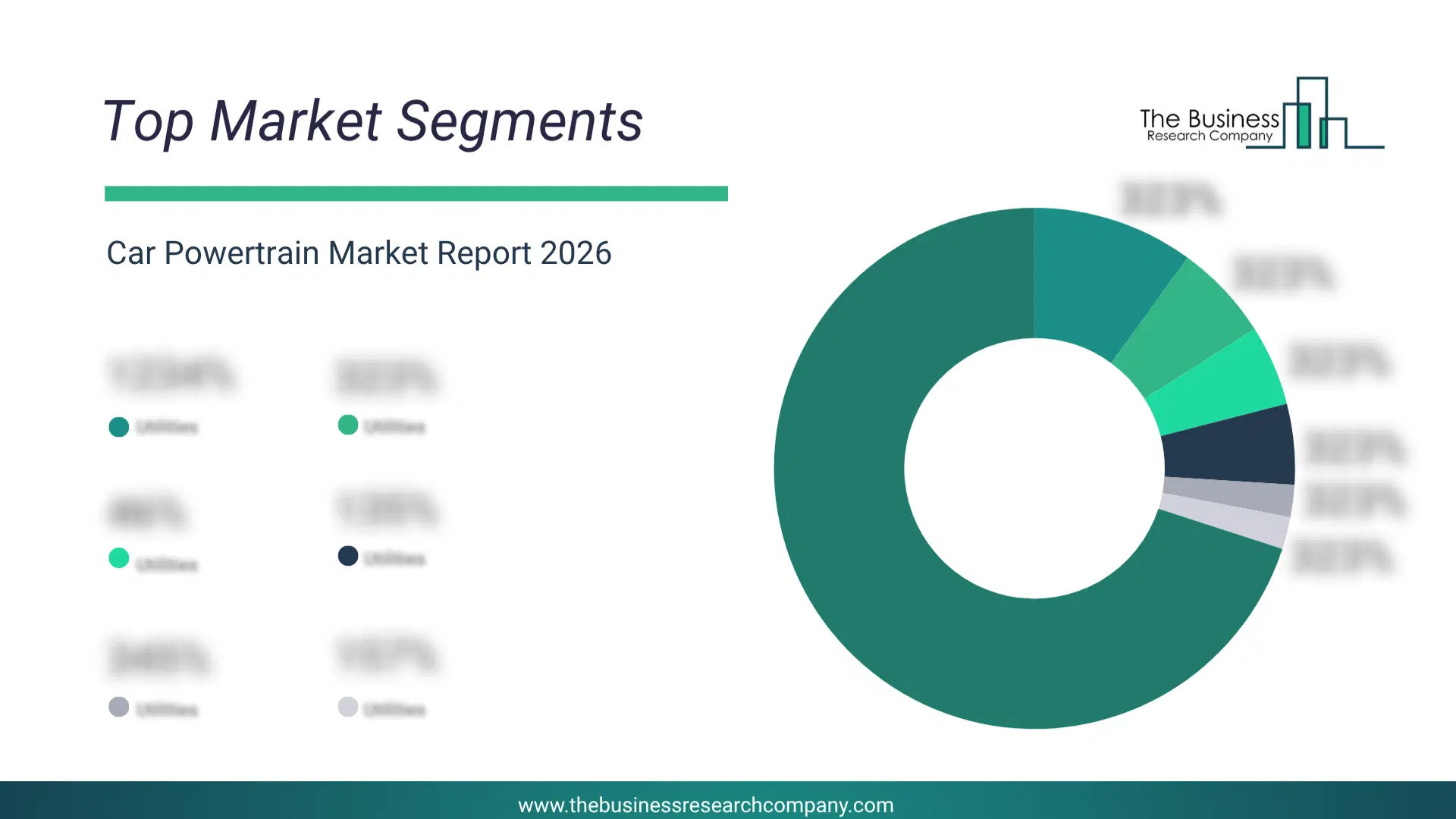
1) By Component: Engine, Transmission, Drive Shaft, Differential, Power Electronics, Battery, Electric Motor 2) By Vehicle Type: Passenger Cars, Light Commercial Vehicles, Heavy Commercial Vehicles 3) By Drive Type: Front Wheel Drive, Rear Wheel Drive, All Wheel Drive 4) By Sales Channel: Original Equipment Manufacturer, Aftermarket Subsegments: 1) By Engine: Gasoline Engine, Diesel Engine, Hybrid Engine 2) By Transmission: Manual Transmission, Automatic Transmission, Continuously Variable Transmission, Dual Clutch Transmission, Automated Manual Transmission 3) By Drive Shaft: Front Drive Shaft, Rear Drive Shaft, Propeller Shaft, Half Shaft, Constant Velocity Shaft 4) By Differential: Open Differential, Limited-Slip Differential, Electronic Differential, Locking Differential, Torque Vectoring Differential 5) By Power Electronics: Inverter, Direct Current To Direct Current Converter, Onboard Charger, Power Control Unit, Electronic Control Unit 6) By Battery: Lithium-Ion Battery, Nickel-Metal Hydride Battery, Solid-State Battery, Lead-Acid Battery 7) By Electric Motor: Permanent Magnet Synchronous Motor, Induction Motor, Brushless Direct Current Motor, Switched Reluctance Motor, Axial Flux MotorWhat Is The Driver Of The Car Powertrain Market?
The increasing demand for fuel-efficient vehicles is expected to propel the growth of the car powertrain market going forward. Fuel-efficient vehicles refer to automobiles designed to travel longer distances using less fuel through advanced engine technologies, lightweight materials, improved aerodynamics, and efficient powertrain systems. The demand for fuel-efficient vehicles is increasing due to rising fuel prices, as higher gasoline and diesel costs encourage consumers and fleet operators to adopt vehicles with improved mileage, lower fuel consumption, and reduced operating expenses. Increasing demand for fuel-efficient vehicles is driving the adoption of advanced car powertrain systems by encouraging manufacturers to develop lightweight, high-efficiency engines, hybrid systems, and electric powertrain technologies that improve fuel economy and reduce emissions. For instance, in July 2026, according to the U.S. Energy Information Administration, a US-based government agency, combined sales of hybrid, plug-in hybrid, and battery electric vehicles (BEVs) reached 24% of total new light-duty vehicle sales in the second quarter of 2026 (2Q26), up from 22% in the second quarter of 2025 (2Q25). Therefore, the increasing demand for fuel-efficient vehicles is driving the growth of the car powertrain industry.Key Players In The Global Car Powertrain Market
Major companies operating in the car powertrain market are Toyota Motor Corporation, Volkswagen AG, Stellantis N.V., General Motors Company, Ford Motor Company, Robert Bosch GmbH, BYD Company Limited, Mercedes-Benz Group AG, Bayerische Motoren Werke Aktiengesellschaft, Nissan Motor Co. Ltd., Continental AG, ZF Friedrichshafen AG, AISIN Corporation, Magna International Inc., Renault SA, Zhejiang Geely Holding Group Co. Ltd., BorgWarner Inc., Schaeffler AG, Chery Automobile Co. Ltd.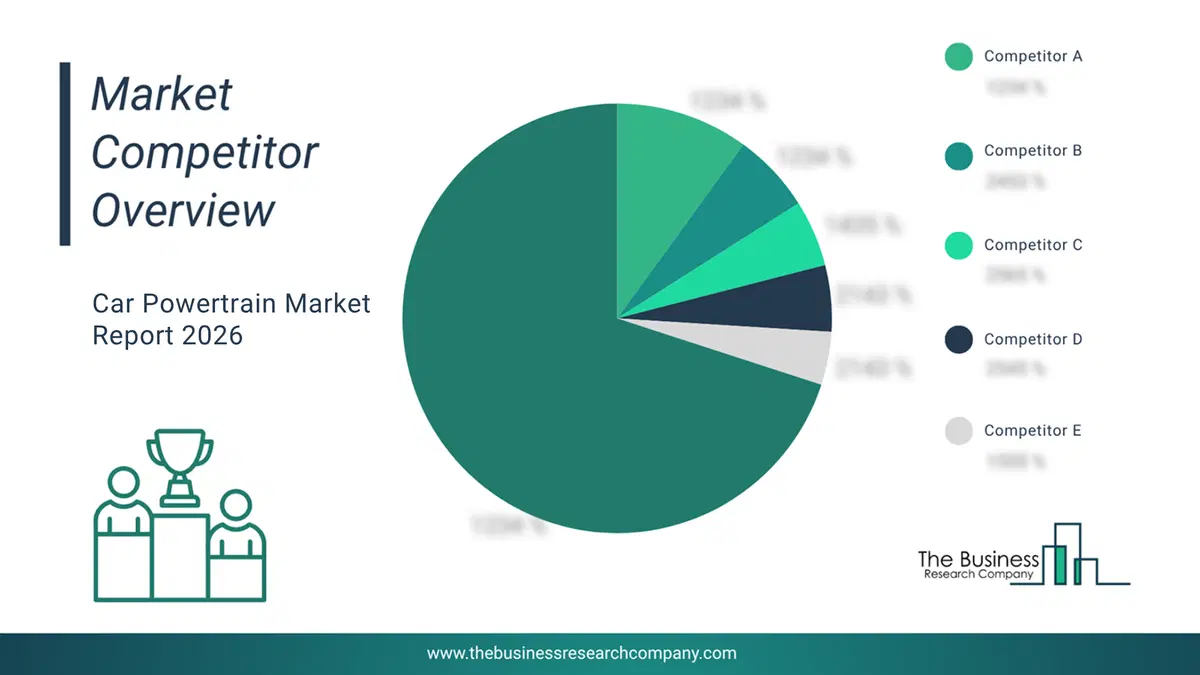
This chart is for illustrative purposes; the full report includes a detailed competitor analysis and comprehensive overview of the top 10 companies in the market.
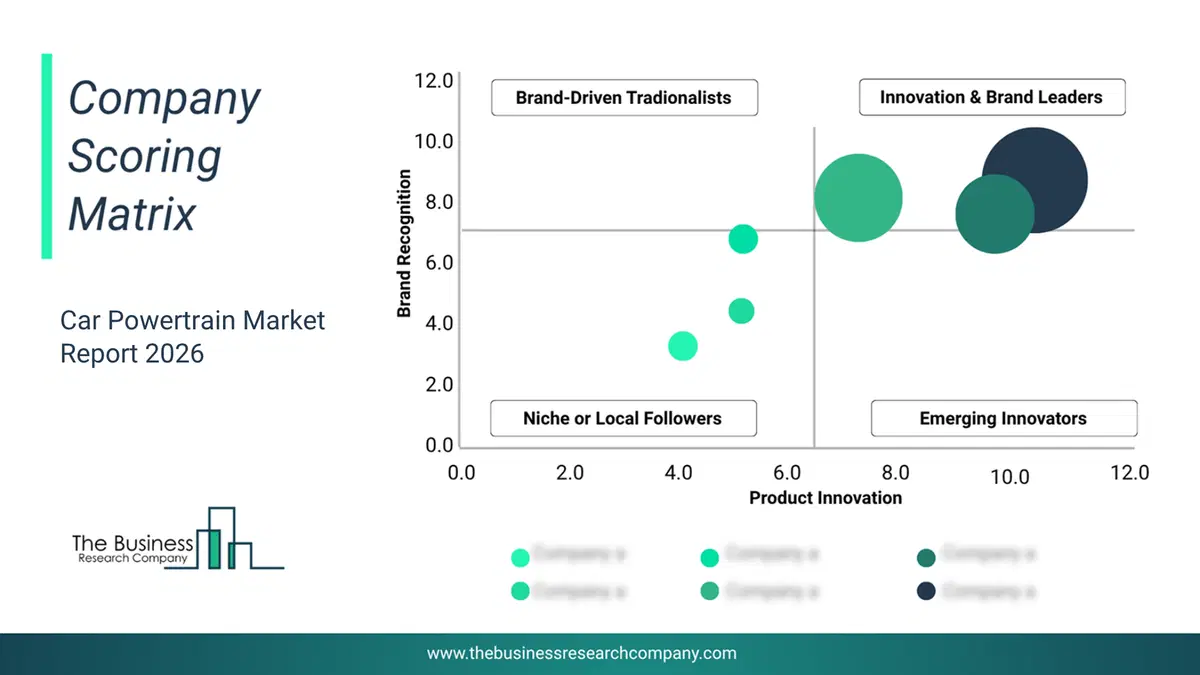
This chart maps companies by product innovation and brand strength, with bubble size indicating relative revenue, helping identify market leaders, challengers, and niche players. This is an illustrative chart; the full report provides a complete and accurate competitive analysis.
Global Car Powertrain Market Trends and Insights
Major companies operating in the car powertrain market are focusing on developing innovative solutions, such as advanced electrified powertrain technologies, to improve vehicle efficiency, optimize power delivery, and support the transition toward sustainable mobility solutions. Advanced electrified powertrain technologies are vehicle propulsion systems that integrate electric motors, batteries, power electronics, and intelligent control systems to improve energy efficiency, enhance performance, and reduce emissions compared with conventional internal combustion powertrains. For instance, in April 2025, Hyundai Motor Group, a South Korea-based automotive manufacturer, launched its next-generation hybrid system, an innovative hybrid powertrain technology designed to improve performance and efficiency in future vehicle models. The system features a newly developed transmission equipped with two integrated motors, including a P1 motor for engine starting, battery energy generation, and energy transfer optimization, and a P2 motor for vehicle propulsion and regenerative braking. The technology can be paired with multiple internal combustion engines across compact, large, and luxury vehicle segments, enabling flexible application across various vehicle classes. It incorporates advanced motor and battery control technologies, smart regenerative braking, vehicle-to-load (V2L) functionality, and EV-inspired features to enhance driving comfort and efficiency. The system delivers up to 45% improved fuel efficiency and 19% higher power output compared with similar-class ICE powertrains, supporting the transition toward electrified mobility while maintaining strong performance.What Are Latest Mergers And Acquisitions In The Car Powertrain Market?
In March 2026, EXEDY Corporation, a Japan-based manufacturing company, acquired Protean Electric Limited from BD Auto And Energy Ltd. for $34 million (¥5.1 billion). With this acquisition, EXEDY Corporation aims to strengthen its electrification capabilities and expand its electric vehicle powertrain portfolio by integrating Protean Electric’s advanced in-wheel motor technology with its existing drivetrain expertise to support the transition toward next-generation mobility solutions. Protean Electric Limited is a UK-based manufacturer of electric car powertrain systems for passenger cars and light commercial vehicles.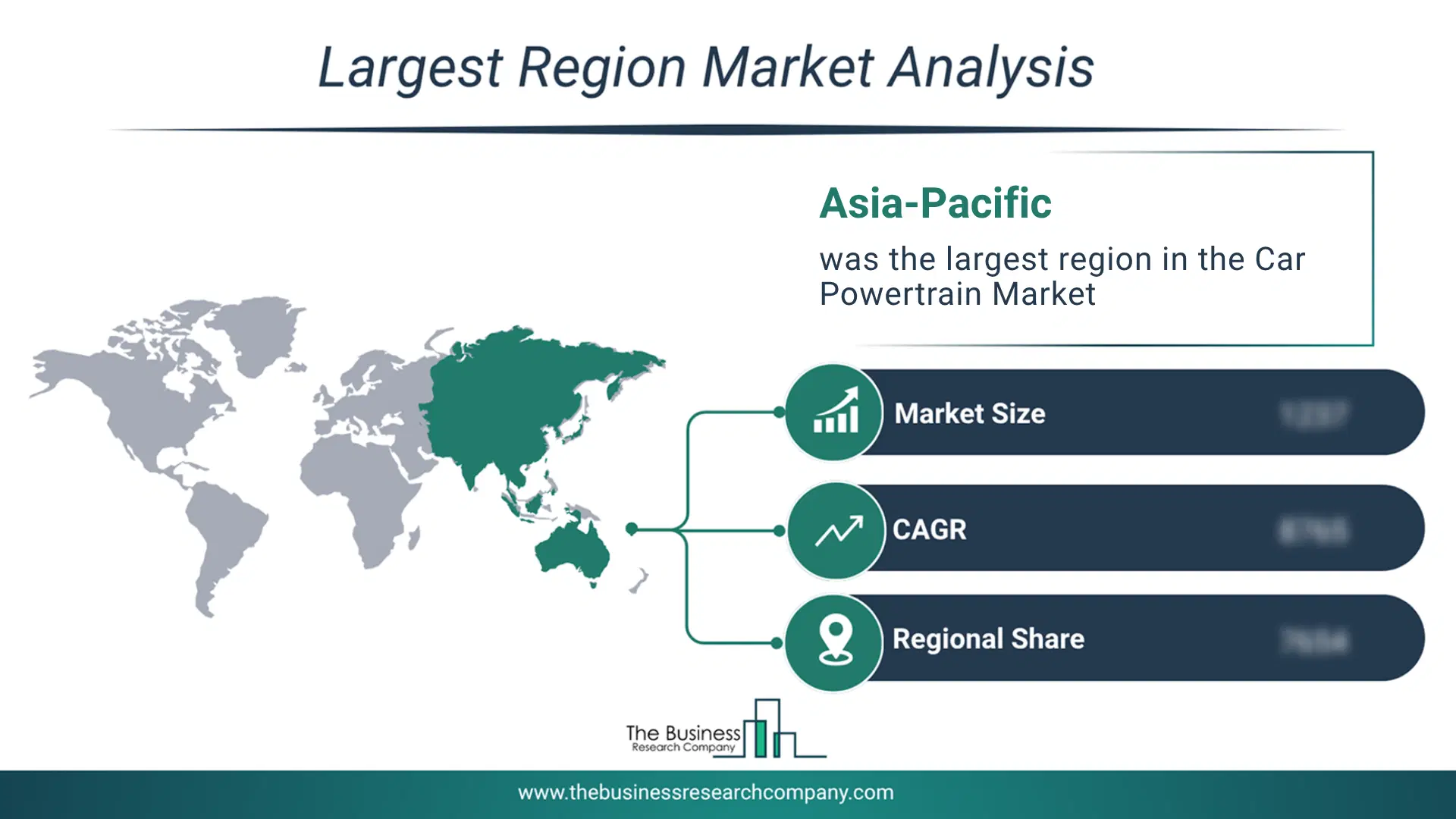
Regional Outlook
Asia-Pacific was the largest region in the car powertrain market in 2025. Asia-Pacific is expected to be the fastest-growing region in the forecast period. The regions covered in this market report are Asia-Pacific, South East Asia, Western Europe, Eastern Europe, North America, South America, Middle East, Africa. The countries covered in this market report are Australia, Brazil, China, France, Germany, India, Indonesia, Japan, Taiwan, Russia, South Korea, UK, USA, Canada, Italy, Spain.What Defines the Car Powertrain Market?
The car powertrain market consists of sales of powertrain modules, hybrid powertrain systems, front-wheel drive systems, and rear-wheel drive systems. Values in this market are ‘factory gate’ values, that is, the value of goods sold by the manufacturers or creators of the goods, whether to other entities (including downstream manufacturers, wholesalers, distributors, and retailers) or directly to end customers. The value of goods in this market includes related services sold by the creators of the goods.How is Market Value Defined and Measured?
The market value is defined as the revenues that enterprises gain from the sale of goods and/or services within the specified market and geography through sales, grants, or donations in terms of the currency (in USD unless otherwise specified). The revenues for a specified geography are consumption values that are revenues generated by organizations in the specified geography within the market, irrespective of where they are produced. It does not include revenues from resales along the supply chain, either further along the supply chain or as part of other products.
This chart presents market attractiveness based on a quantitative evaluation of growth, competition, strategic alignment, and risk, offering a clear view of opportunity areas for decision-making. This chart is for illustrative purposes; the full report contains the complete analysis.

This chart highlights the Total Addressable Market (TAM) by estimating the maximum revenue opportunity using an assumption-driven approach, supporting strategic planning and opportunity sizing across markets. The chart is illustrative; the full report provides a more comprehensive analysis.
What Key Data and Analysis Are Included in the Car Powertrain Market Report 2026?
The car powertrain market research report is one of a series of new reports from The Business Research Company that provides market statistics, including industry global market size, regional shares, competitors with the market share, detailed market segments, market trends and opportunities, and any further data you may need to thrive in the car powertrain industry. The market research report delivers a complete perspective of everything you need, with an in-depth analysis of the current and future state of the industry.Car Powertrain Market Report Forecast Analysis
| Report Attribute | Details |
|---|---|
| Market Size Value In 2026 | $752.57 billion |
| Revenue Forecast In 2030 | $947.58 billion |
| Growth Rate | CAGR of 5.9% from 2026 to 2030 |
| Base Year For Estimation | 2025 |
| Actual Estimates/Historical Data | 2020-2025 |
| Forecast Period | 2026 - 2030 |
| Market Representation | Revenue in USD Billion and CAGR from 2026 to 2030 |
| Segments Covered | Component, Vehicle Type, Drive Type, Sales Channel |
| Regional Scope | Asia-Pacific, Western Europe, Eastern Europe, North America, South America, Middle East, Africa |
| Country Scope | The countries covered in the report are Australia, Brazil, China, France, Germany, India, Indonesia, Japan, Taiwan, Russia, South Korea, UK, USA, Canada, Italy, Spain. |
| Key Companies Profiled | Toyota Motor Corporation, Volkswagen AG, Stellantis N.V., General Motors Company, Ford Motor Company, Robert Bosch GmbH, BYD Company Limited, Mercedes-Benz Group AG, Bayerische Motoren Werke Aktiengesellschaft, Nissan Motor Co. Ltd., Continental AG, ZF Friedrichshafen AG, AISIN Corporation, Magna International Inc., Renault SA, Zhejiang Geely Holding Group Co. Ltd., BorgWarner Inc., Schaeffler AG, Chery Automobile Co. Ltd. |
| Customization Scope | Request for Customization |
| Pricing And Purchase Options | Explore Purchase Options |