

Carbon Black Feedstock Market Report 2026
Global Outlook – By Type (Petroleum Based, Coal Based, Bio Based), By Distribution Channel (Direct Sales, Distributors And Traders), By Application (Tire Carbon Black, Non Tire Rubber Products, Plastics, Batteries, Other Applications), By End Use Industry (Automotive, Industrial Manufacturing, Plastics And Polymers, Printing And Packaging, Energy Storage, Construction, Other End Use Industries) – Market Size, Trends, Strategies, and Forecast to 2035
Carbon Black Feedstock Market Overview
• Carbon Black Feedstock market size has reached to $8 billion in 2025 • Expected to grow to $10.9 billion in 2030 at a compound annual growth rate (CAGR) of 6.3% • Growth Driver: Increasing Production Of Automobiles And Commercial Vehicles Fueling The Growth Of The Market Due To Rising Demand For Tires And Rubber Components • Market Trend: Waste-Derived Feedstock Expands Alternative Carbon Black Feedstock Supply • Asia-Pacific was the largest region and fastest growing region.What Is Covered Under Carbon Black Feedstock Market?
Carbon black feedstock comprises carbon-rich hydrocarbon oils used as raw materials for producing carbon black, particularly through furnace black processes. Common feedstocks include heavy aromatic oils and refinery-derived streams such as FCC decant oil. During production, the hydrocarbon feedstock undergoes controlled thermal decomposition to form carbon black with specific particle size, structure, and surface characteristics. The main types of carbon black feedstock include petroleum based, coal based, and bio based feedstock. Petroleum based refers to carbon-rich raw materials derived from petroleum processing that are used in the production of carbon black. These feedstocks are distributed through direct sales and distributors and traders. They find application in tire carbon black, non tire rubber products, plastics, batteries, and others, serving end use industries including automotive, industrial manufacturing, plastics and polymers, printing and packaging, energy storage, construction, and others.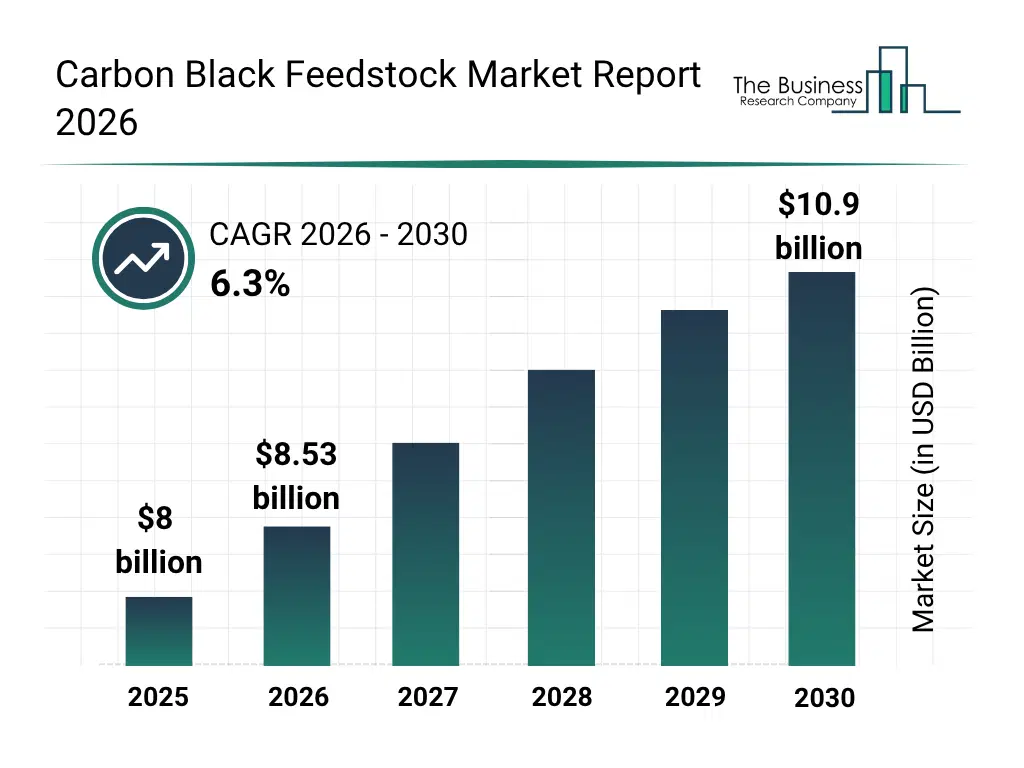
What Is The Carbon Black Feedstock Market Size and Share 2026?
The carbon black feedstock market size has grown strongly in recent years. It will grow from $8 billion in 2025 to $8.53 billion in 2026 at a compound annual growth rate (CAGR) of 6.7%. The growth in the historic period can be attributed to increasing demand for carbon black from tire manufacturing, rising consumption of heavy aromatic oils in furnace black production, growing automotive tire production, expanding use of carbon black in non-tire rubber products, increasing demand for consistent carbon black feedstock quality.What Is The Carbon Black Feedstock Market Growth Forecast?
The carbon black feedstock market size is expected to see strong growth in the next few years. It will grow to $10.9 billion in 2030 at a compound annual growth rate (CAGR) of 6.3%. The growth in the forecast period can be attributed to increasing demand for renewable carbon black feedstocks, rising need to reduce petroleum-based feedstock dependence, growing demand for low-emission carbon black production, expanding carbon black applications in energy storage, increasing demand for diversified feedstock sourcing. Major trends in the forecast period include increasing adoption of bio-based carbon black feedstocks, rising demand for low-emission carbon black production feedstocks, growing preference for high-aromatic feedstocks with consistent quality, increasing demand for feedstock optimization to improve carbon black yield, rising use of alternative feedstock sources to reduce petroleum dependence.Tariff Impact On Carbon Black Feedstock Market
Tariffs are impacting the carbon black feedstock market by increasing the cost of imported petroleum-based oils, coal-based oils, bio-based feedstocks, and related chemical inputs required for carbon black production. This is raising production costs and affecting the availability of feedstocks for tire carbon black, non-tire rubber products, plastics, and batteries, particularly in regions dependent on imported raw materials such as Asia-Pacific, Europe, and North America. Petroleum-based feedstocks and heavy aromatic oil types are most affected due to their reliance on international oil and chemical supply chains. However, tariffs are also encouraging domestic feedstock production, regional supplier diversification, and increased use of alternative and bio-based feedstocks, creating greater long-term supply chain resilience in the market.
Global Carbon Black Feedstock Market Segmentation
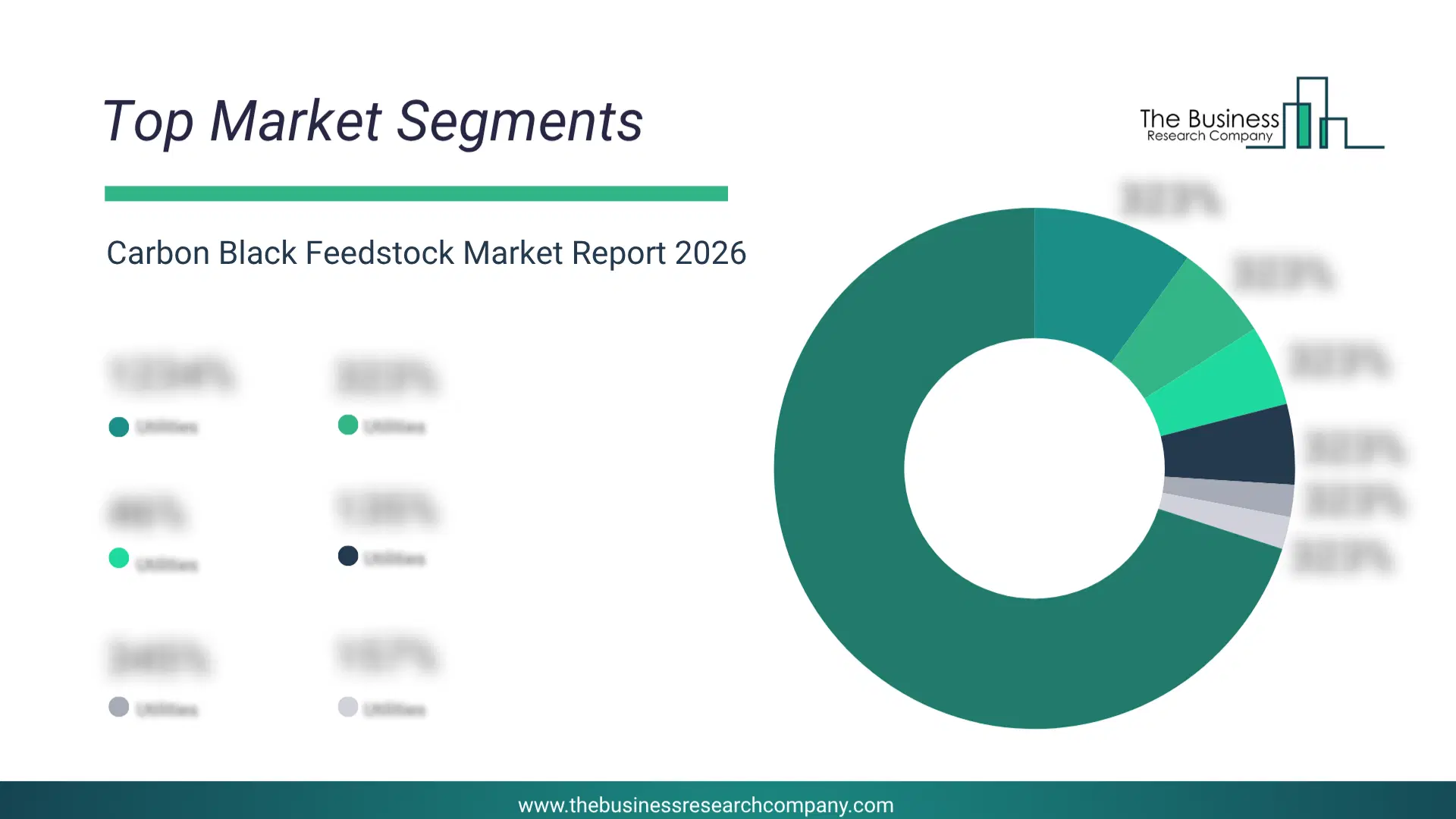
2) By Distribution Channel: Direct Sales, Distributors And Traders 3) By Application: Tire Carbon Black, Non Tire Rubber Products, Plastics, Batteries, Other Applications 4) By End Use Industry: Automotive, Industrial Manufacturing, Plastics And Polymers, Printing And Packaging, Energy Storage, Construction, Other End Use Industries Subsegments: 1) By Petroleum Based: Clarified Slurry Oil Type, Ethylene Cracker Residue Type, Fluid Catalytic Cracking Decant Oil Type, Heavy Aromatic Oil Type 2) By Coal Based: Coal Tar Oil Type, Coal Tar Distillate Type, Coal Tar Pitch Oil Type 3) By Bio Based: Bio Aromatic Oil Type, Biomass Pyrolysis Oil Type, Renewable Feedstock Oil TypeWhat Is The Driver Of The Carbon Black Feedstock Market?
The increasing production of automobiles and commercial vehicles is expected to propel the growth of the carbon black feedstock market going forward. Automobile and commercial vehicle production refers to the manufacturing of passenger cars, vans, trucks, buses, and other road vehicles that require tires and rubber components during assembly. Production of automobiles and commercial vehicles is rising due to increasing transportation demand, as expanding passenger mobility and freight movement are driving manufacturers to increase vehicle production. The increasing production of automobiles and commercial vehicles supports the carbon black feedstock by driving higher demand for tires, rubber components, and automotive plastics, where carbon black feedstock is a key raw material. For instance, in March 2026, according to the Italian Association of the Automotive Industry (ANFIA), an Italy-based automotive industry association, domestic passenger-car production in Italy reached approximately 17,500 units in January 2026, representing a 34.5% year-on-year increase compared with January 2025. Therefore, the increasing production of automobiles and commercial vehicles is driving the growth of the carbon black feedstock industry.Key Players In The Global Carbon Black Feedstock Market
Major companies operating in the carbon black feedstock market are China Petroleum & Chemical Corporation, Exxon Mobil Corporation, TotalEnergies SE, Phillips 66, Valero Energy Corporation, Marathon Petroleum Corporation, Reliance Industries Limited, Indian Oil Corporation Limited, Bharat Petroleum Corporation Limited, HPCL Mittal Energy Limited, JFE Chemical Corporation, Nippon Steel Chemical & Material Co. Ltd., Rain Carbon Inc., Koppers Inc., Chevron Phillips Chemical Company LLC, Tauber Oil Company, Himadri Speciality Chemical Limited, Epsilon Carbon Private Limited, Jalan Carbons & Chemicals Private Limited, Techno Transplus Private Limited, Arham Petrochem Private Limited, KSGR Group, Amar Hydrocarbon Private Limited, Ruhani Industries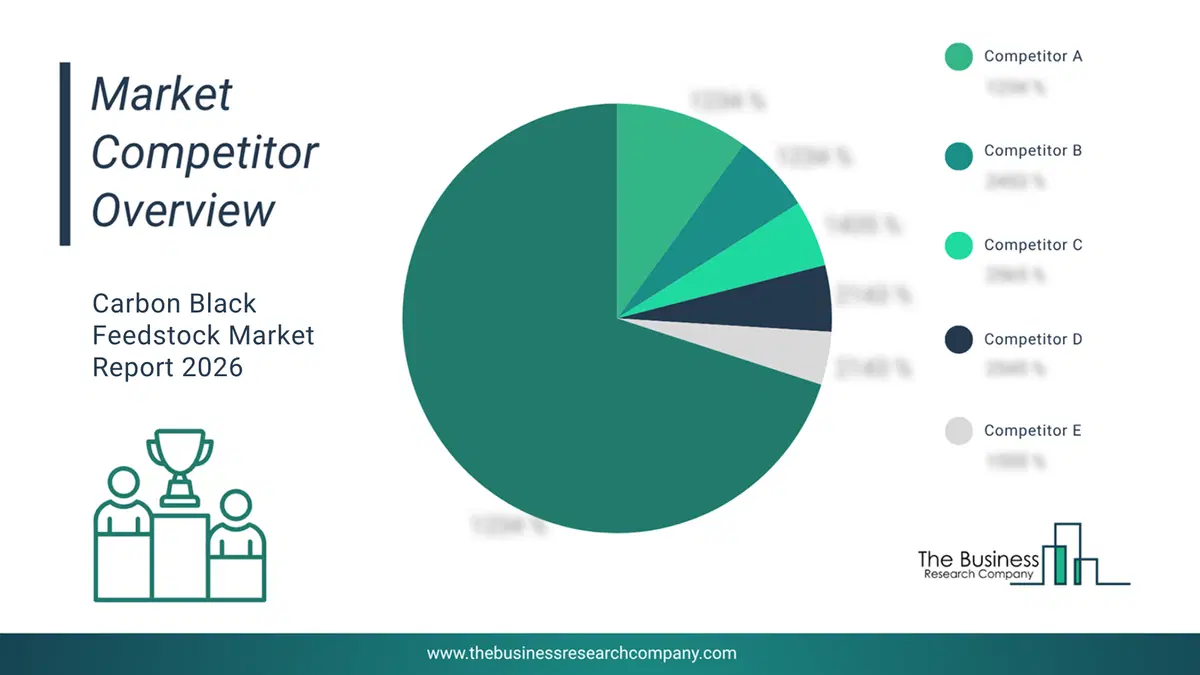
This chart is for illustrative purposes; the full report includes a detailed competitor analysis and comprehensive overview of the top 10 companies in the market.
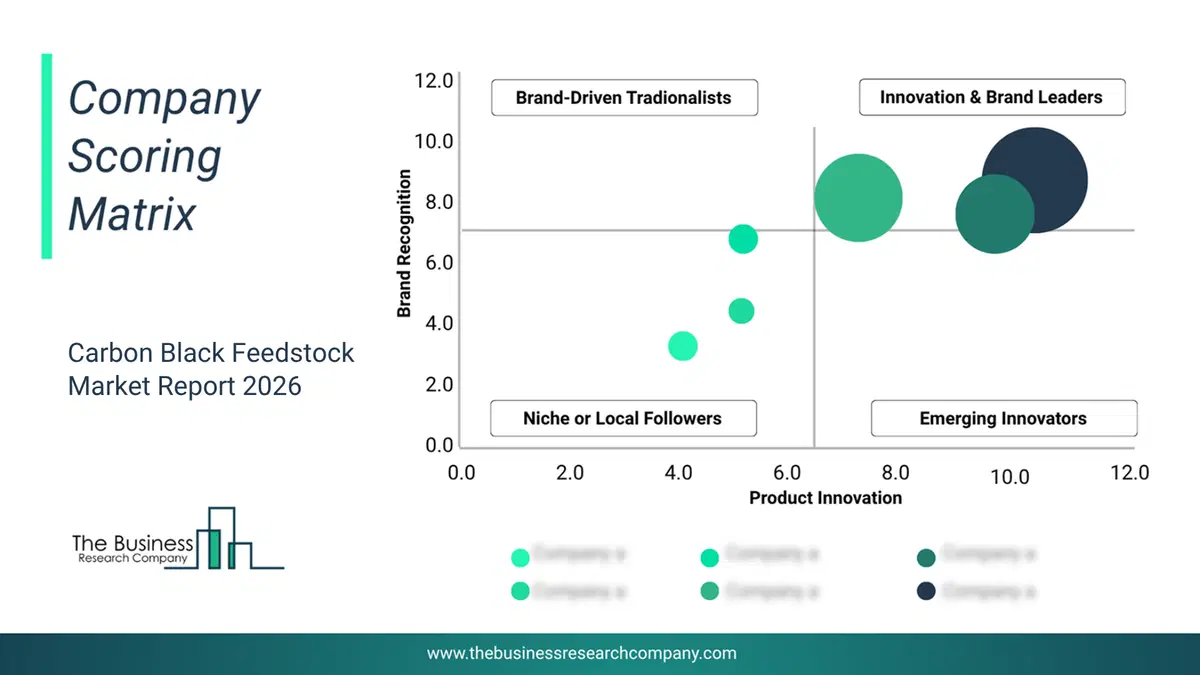
This chart maps companies by product innovation and brand strength, with bubble size indicating relative revenue, helping identify market leaders, challengers, and niche players. This is an illustrative chart; the full report provides a complete and accurate competitive analysis.
Global Carbon Black Feedstock Market Trends and Insights
Major companies operating in the carbon black feedstock market are focusing on expanding alternative feedstock sources, such as waste-derived petroleum oil, to improve feedstock availability, support circular production, and reduce reliance on conventional hydrocarbon sources. Waste-derived petroleum oil refers to oil recovered through the conversion of end-of-life tires and other waste materials into hydrocarbon products that can be used in tire and carbon black manufacturing. For instance, in October 2025, Waste Energy Corp., a US-based waste conversion company, began commissioning its first US-based waste conversion facility in Midland County, Texas, using discarded tires as feedstock. The process produces a petroleum oil used to manufacture tires, along with carbon black and syngas, while the company initially planned to sell the tire-derived oil and carbon black to tire manufacturers. The facility can initially process 15 tons of waste per day and is expected to scale to 60 tons per day, expanding the availability of waste-derived hydrocarbon feedstock and carbonaceous materials for the tire manufacturing industry.What Are Latest Mergers And Acquisitions In The Carbon Black Feedstock Market?
In February 2025, Orion S.A., a US-based specialty chemicals company and carbon black manufacturer, partnered with Contec S.A. to secure tire pyrolysis oil for producing circular carbon black. Through this partnership, Orion and Contec aim to support circular carbon black production by using tire pyrolysis oil derived from end-of-life tires as a sustainable feedstock, reducing reliance on conventional feedstocks and supporting the circular economy. Contec S.A. is a Poland-based tire recycling company providing tire pyrolysis oil relevant to carbon black production.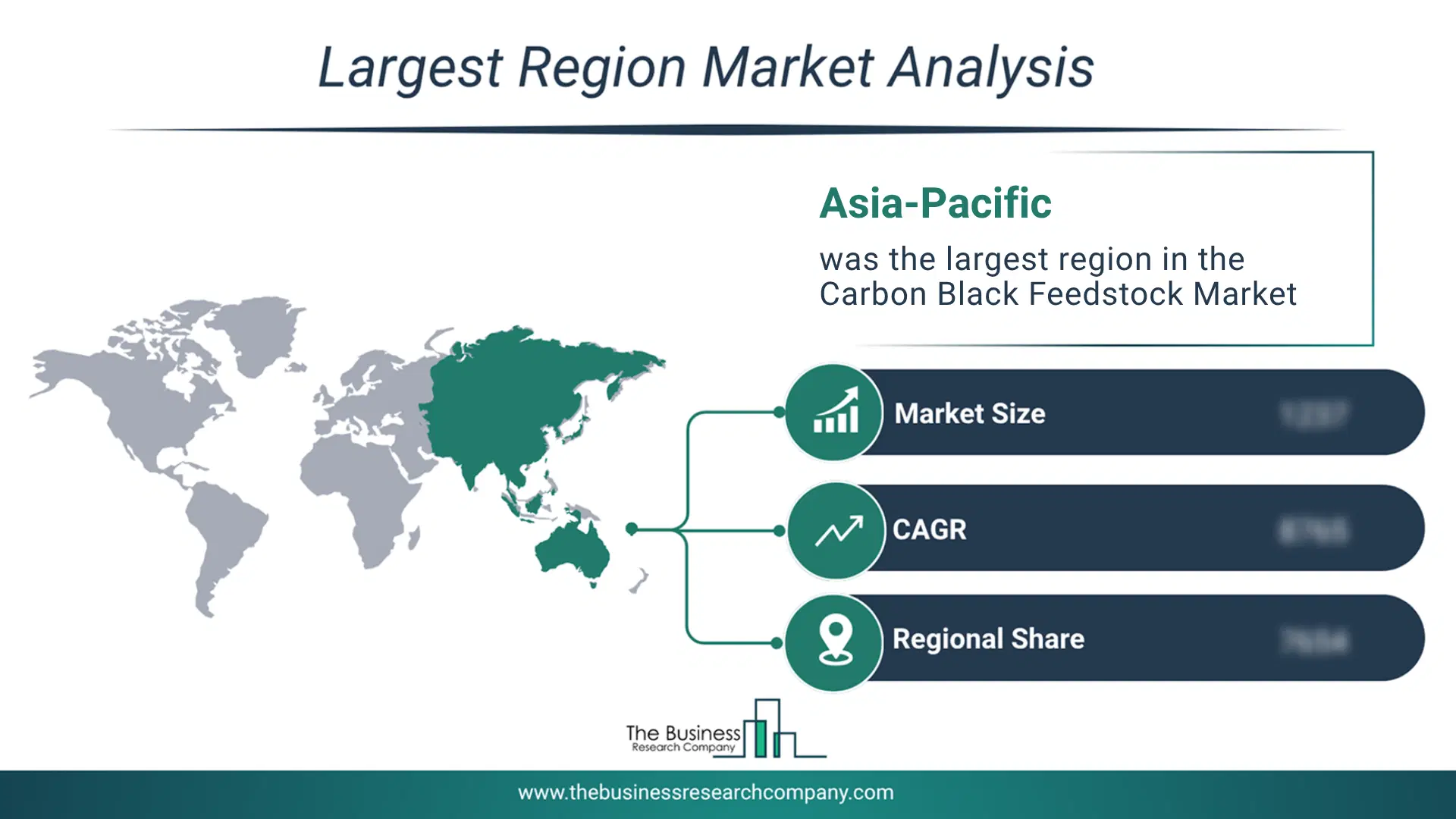
Regional Outlook/Insights
Asia-Pacific was the largest region in the carbon black feedstock market in 2025. Asia-Pacific is expected to be the fastest-growing region in the forecast period. The regions covered in this market report are Asia-Pacific, South East Asia, Western Europe, Eastern Europe, North America, South America, Middle East, Africa. The countries covered in this market report are Australia, Brazil, China, France, Germany, India, Indonesia, Japan, Taiwan, Russia, South Korea, UK, USA, Canada, Italy, Spain.What Defines the Carbon Black Feedstock Market?
The carbon black feedstock market consists of sales of carbon black feedstock oils, decant oil (slurry oil), coal tar distillates, cnd atalytic cracking residual oils. Values in this market are ‘factory gate’ values, that is, the value of goods sold by the manufacturers or creators of the goods, whether to other entities (including downstream manufacturers, wholesalers, distributors, and retailers) or directly to end customers. The value of goods in this market includes related services sold by the creators of the goods.How is Market Value Defined and Measured?
The market value is defined as the revenues that enterprises gain from the sale of goods and/or services within the specified market and geography through sales, grants, or donations in terms of the currency (in USD unless otherwise specified). The revenues for a specified geography are consumption values that are revenues generated by organizations in the specified geography within the market, irrespective of where they are produced. It does not include revenues from resales along the supply chain, either further along the supply chain or as part of other products.
This chart presents market attractiveness based on a quantitative evaluation of growth, competition, strategic alignment, and risk, offering a clear view of opportunity areas for decision-making. This chart is for illustrative purposes; the full report contains the complete analysis.

This chart highlights the Total Addressable Market (TAM) by estimating the maximum revenue opportunity using an assumption-driven approach, supporting strategic planning and opportunity sizing across markets. The chart is illustrative; the full report provides a more comprehensive analysis.
What Key Data and Analysis Are Included in the Carbon Black Feedstock Market Report 2026?
The carbon black feedstock market research report is one of a series of new reports from The Business Research Company that provides market statistics, including industry global market size, regional shares, competitors with the market share, detailed market segments, market trends and opportunities, and any further data you may need to thrive in the carbon black feedstock industry. The market research report delivers a complete perspective of everything you need, with an in-depth analysis of the current and future state of the industry.Carbon Black Feedstock Market Report Forecast Analysis
| Report Attribute | Details |
|---|---|
| Market Size Value In 2026 | $8.53 billion |
| Revenue Forecast In 2030 | $10.9 billion |
| Growth Rate | CAGR of 6.3% from 2026 to 2035 |
| Base Year For Estimation | 2025 |
| Actual Estimates/Historical Data | 2020-2025 |
| Forecast Period | 2026 - 2030 |
| Market Representation | Revenue in USD Billion and CAGR from 2026 to 2030 |
| Segments Covered | Type, Distribution Channel, Application, End Use Industry |
| Regional Scope | Asia-Pacific, Western Europe, Eastern Europe, North America, South America, Middle East, Africa |
| Country Scope | The countries covered in the report are Australia, Brazil, China, France, Germany, India, Indonesia, Japan, Taiwan, Russia, South Korea, UK, USA, Canada, Italy, Spain. |
| Customization Scope | Request for Customization |
| Pricing And Purchase Options | Explore Purchase Options |