

Carbon Black Global Market Opportunities And Strategies To 2035
By Type (Furnace Black, Channel Black, Thermal Black, Acetylene Black, Lamp Black), By Grade (Standard Grade, Specialty Grade), By Application (Tire, Non-Tire Rubber, Inks And Coating, Plastic, Other Applications), And By Region, Opportunities And Strategies – Global Forecast To 2035
Carbon Black Market Definition
Carbon black is a fine black powder produced by the incomplete combustion or thermal decomposition of heavy petroleum products such as coal tar, ethylene cracking tar, or residual oils. It consists primarily of elemental carbon in the form of extremely small particles with a high surface-area-to-volume ratio. The main purpose of carbon black is to act as a reinforcing and performance-enhancing additive in various products, especially rubber and plastics. The carbon black market consists of sales by entities (organizations, sole traders and partnerships) of carbon black that is used by manufacturers across industries including automotive, rubber processing, plastics, coatings, printing inks, electronics and construction. The material is commonly incorporated into products that require reinforcement, ultraviolet protection, electrical conductivity or black pigmentation.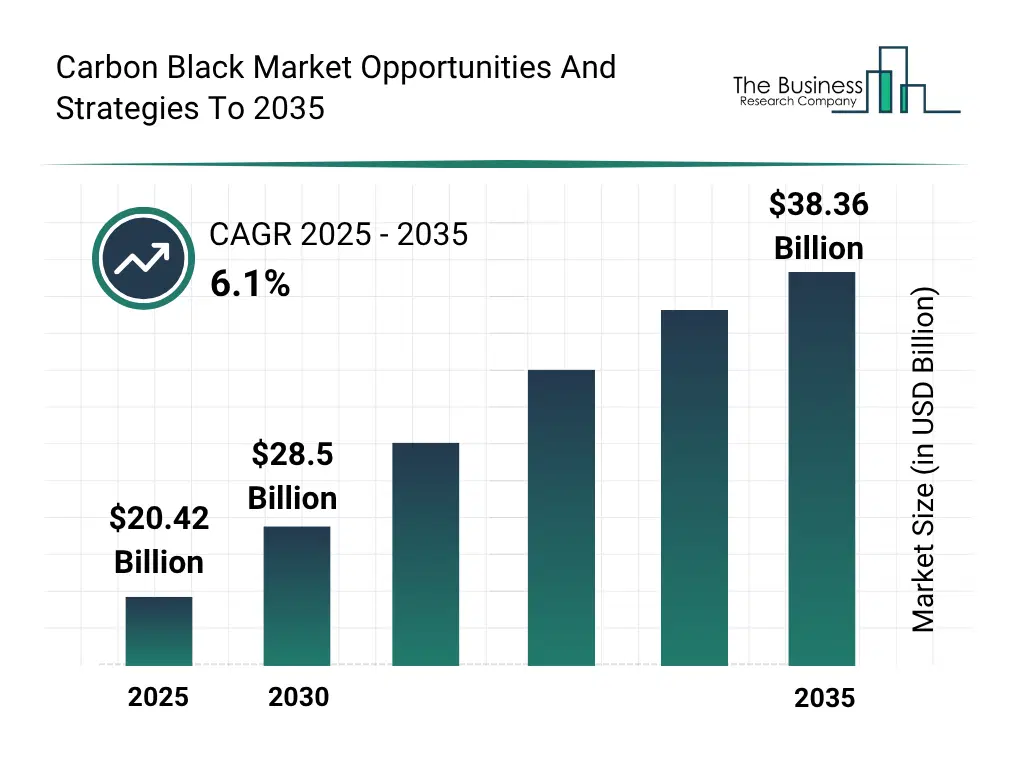
Carbon Black Market Size
The global carbon black market reached a value of nearly $20,420.0 million in 2025, having grown at a compound annual growth rate (CAGR) of 8.0% since 2020. The market is expected to grow from $20,420.0 million in 2025 to $28,499.0 million in 2030 at a rate of 6.9%. The market is then expected to grow at a CAGR of 6.1% from 2030 and reach $38,358.7 million in 2035. Growth in the historic period resulted from expansion of construction sector and infrastructure projects, rising demand for coatings and paints, increase in the adoption of electric vehicles (EVs) and rising demand for high-performance rubber products. Factors that negatively affected growth in the historic period were fluctuating crude oil prices and shift toward sustainable and low-carbon materials. Going forward, increasing plastics consumption, growing focus for sustainable and recovered carbon black, expansion of the printing ink and printing industries and growth in wire and cable manufacturing will drive the growth. Factors that could hinder the growth of the carbon black market in the strict environmental regulations on emissions, stringent waste disposal requirements and impact of trade war and tariff.
Carbon Black Market Segmentation
The carbon black market is segmented by type, by grade and by application.By Type –
The carbon black market is segmented by type into:
- a) Furnace Black
- b) Channel Black
- c) Thermal Black
- d) Acetylene Black
- e) Lamp Black
By Grade –
The carbon black market is segmented by grade into:
- a) Standard Grade
- b) Specialty Grade
By Application –
The carbon black market is segmented by application into:
- a) Tire
- b) Non-Tire Rubber
- c) Inks And Coating
- d) Plastic
- e) Other Applications
By Geography - The carbon black market is segmented by geography into:
- China
- India
- Japan
- Australia
- Indonesia
- South Korea
- USA
- Canada
- Brazil
- France
- Germany
- UK
- Italy
- Spain
- Russia
-
o Asia Pacific
o Africa