
Carbon Capture And Storage Market Report 2026
Global Outlook – By Product (Pre-Combustion, Industrial Process, Post Combustion, Oxy-Combustion), By Service (Capture, Transportation, Utilization, Storage), By End-Use Industry (Oil And Gas, Coal And Biomass Power Plant, Iron And Steel, Chemicals, Other End-Use Industries) – Market Size, Trends, Strategies, and Forecast to 2030
Carbon Capture And Storage Market Overview
• Carbon Capture And Storage market size has reached to $7.1 billion in 2025 • Expected to grow to $14.4 billion in 2030 at a compound annual growth rate (CAGR) of 15.3% • Growth Driver: Surge In Global Carbon Dioxide Emissions • Market Trend: Innovative Methodologies Transforming Carbon Capture And Storage • North America was the largest region in 2025 and Asia-Pacific is the fastest growing region.What Is Covered Under Carbon Capture And Storage Market?
Carbon capture and storage (CCS) refers to the process of capturing, transferring, and preserving emissions of greenhouse gases from power plants using fossil fuels, energy-intensive businesses, and gas reserves by injecting the collected greenhouse gases back into the earth. It is a method of lowering carbon emissions that might be crucial in combating global warming. The main types of carbon capture and storage products are pre-combustion, industrial processes, post-combustion, and oxy-combustion, which are used to provide various types of services, such as capture, transportation, utilization, and storage. Pre-combustion carbon capture is the elimination of carbon dioxide from a gas mixture before combustion, and it is commonly used within integrated gasification combined cycle (IGCC) power plants. These are used by several end-use industries, including oil and gas, coal and biomass power plants, iron and steel, chemicals, and others.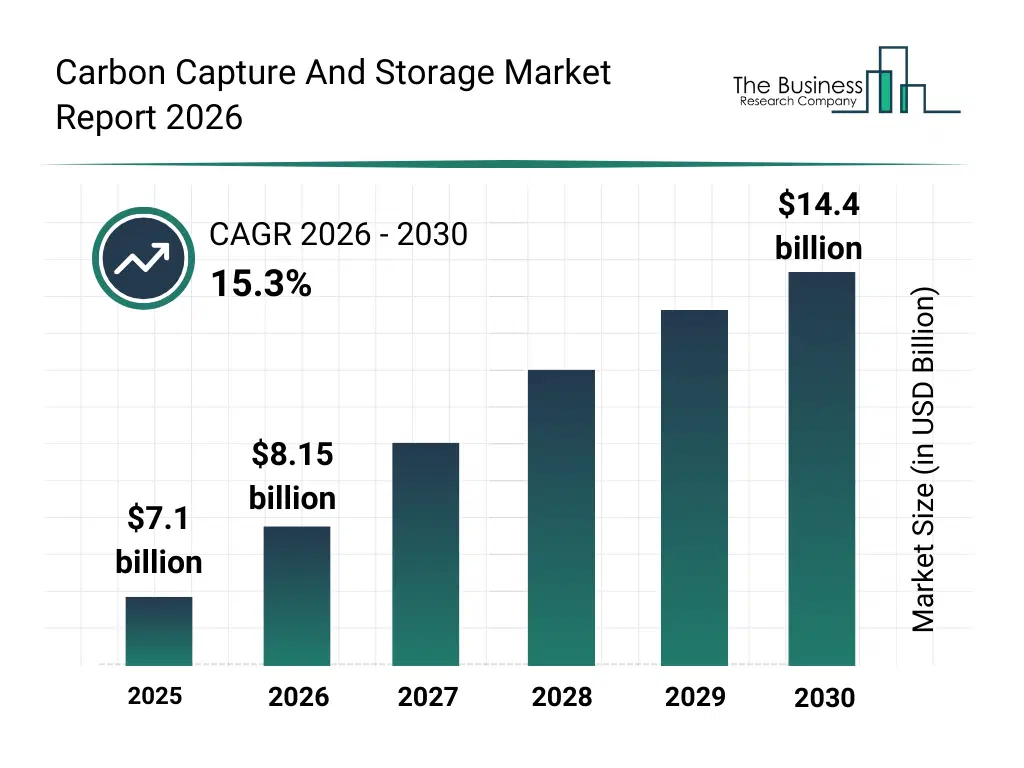
What Is The Carbon Capture And Storage Market Size and Share 2026?
The carbon capture and storage market size has grown rapidly in recent years. It will grow from $7.1 billion in 2025 to $8.15 billion in 2026 at a compound annual growth rate (CAGR) of 14.8%. The growth in the historic period can be attributed to regulatory pressure to reduce co2 emissions, adoption of flue gas treatment systems, growth in coal and biomass power plants, technological advancements in absorption and adsorption techniques, early investment in industrial process capture systems.What Is The Carbon Capture And Storage Market Growth Forecast?
The carbon capture and storage market size is expected to see rapid growth in the next few years. It will grow to $14.4 billion in 2030 at a compound annual growth rate (CAGR) of 15.3%. The growth in the forecast period can be attributed to increasing industrial decarbonization initiatives, expansion of hydrogen economy with carbon capture, rising government incentives for ccs projects, growth in post-combustion and oxy-combustion technologies, rising demand from cement, steel, and chemical industries. Major trends in the forecast period include increasing deployment of post-combustion capture technologies, expansion of oxy-combustion systems in industrial applications, rising adoption of carbon capture in iron and steel manufacturing, growth in utilization of captured carbon for industrial processes, advancements in hydrogen production with carbon capture.
Global Carbon Capture And Storage Market Segmentation
1) By Product: Pre-Combustion, Industrial Process, Post Combustion, Oxy-Combustion 2) By Service: Capture, Transportation, Utilization, Storage 3) By End-Use Industry: Oil And Gas, Coal And Biomass Power Plant, Iron And Steel, Chemicals, Other End-Use Industries Subsegments: 1) By Pre-Combustion: Gasification Systems, Chemical Looping, Hydrogen Production With Carbon Capture 2) By Industrial Process: Cement Production, Steel Manufacturing, Chemical Production 3) By Post Combustion: Flue Gas Treatment Systems, Absorption Techniques, Adsorption Techniques 4) By Oxy-Combustion: Oxygen-Fired Power Generation, Oxy-Fuel Combustion Systems, Oxy-Combustion For Industrial ApplicationsWhat Is The Driver Of The Carbon Capture And Storage Market?
The growing global carbon dioxide emissions are expected to propel the growth of the carbon capture and storage market going forward. Carbon dioxide emissions, often known as CO2 emissions, are those caused by the combustion of fossil fuels and the production of cement. They also include gas flaring and carbon dioxide created during the use of fuels that are solid, liquid, or gaseous. Increasing carbon dioxide emissions increases the market for carbon capture and storage, which is used as a method to lower carbon emissions by separating, treating, and transporting a stream of carbon dioxide (CO2) from industrial sources to a site for long-term storage. For instance, in April 2024, according to the NOAA Research, a US-based scientific organization, in 2023, the global average concentration of CO2 at the surface reached 419.3 parts per million (ppm), marking an increase of 2.8 ppm over the year. Therefore, growing global carbon dioxide emissions are driving the carbon capture and storage industry.Key Players In The Global Carbon Capture And Storage Market
Major companies operating in the carbon capture and storage market are Aker Solutions ASA, Dakota Gasification Company, Equinor ASA, Fluor Corporation, Linde PLC, Mitsubishi Heavy Industries Ltd., Shell PLC, Siemens AG, Sulzer Ltd., NRG Energy Inc., General Electric Company, Maersk, Japan CCS Co. Ltd., Halliburton Company, ExxonMobil Corporation, Schlumberger Limited, Honeywell International Inc., Occidental Petroleum Corporation, Air Liquide S.A., Baker Hughes Company, LanzaTech, Calix Limited, Carbon America, Carbon Clean, CarbonFree, Carbon8 Systems, Chart Industries, Capsol Technologies AS, Global Thermostat
This chart is for illustrative purposes; the full report includes a detailed competitor analysis and comprehensive overview of the top 10 companies in the market.
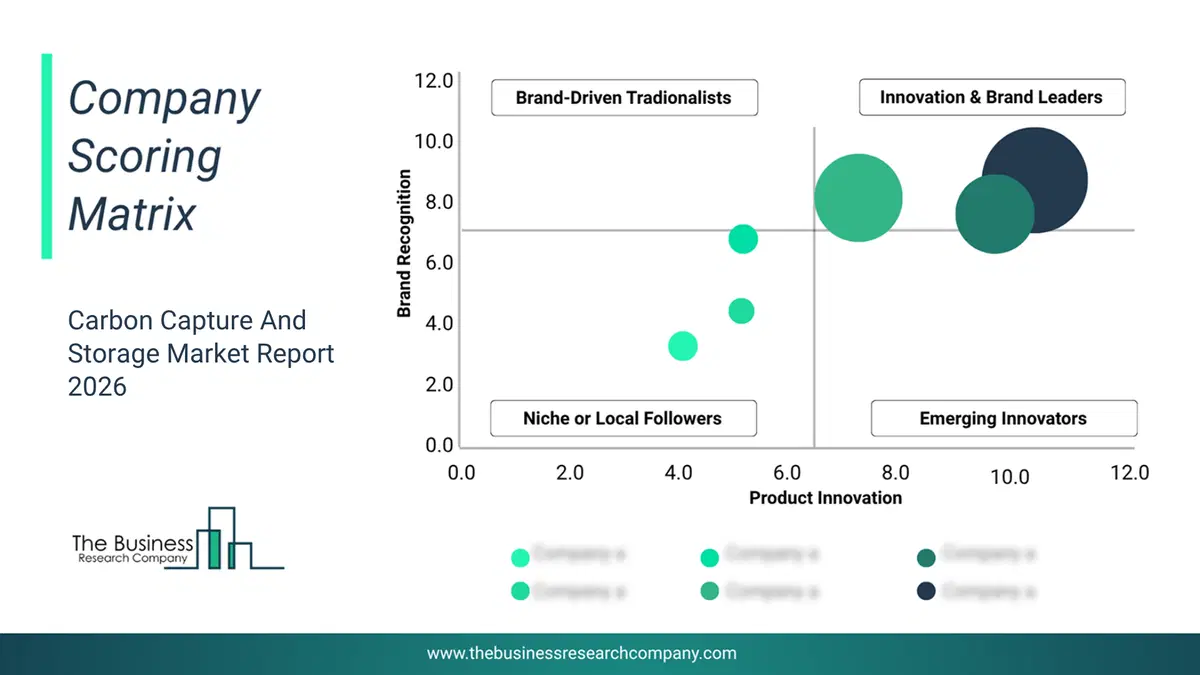
This chart maps companies by product innovation and brand strength, with bubble size indicating relative revenue, helping identify market leaders, challengers, and niche players. This is an illustrative chart; the full report provides a complete and accurate competitive analysis.
Global Carbon Capture And Storage Market Trends and Insights
Major companies operating in the carbon capture and storage market are focusing on developing advanced solutions, such as verified carbon standard (vcs) methodologies, to ensure credible carbon credit generation, improve emissions accounting transparency, and support regulatory compliance. Verified Carbon Standard (VCS) methodologies are standardized frameworks developed by Verra to quantify, monitor, and verify greenhouse gas emission reductions or removals, ensuring they are real, measurable, and independently certified. For instance, in June 2024, Verra, a US-based non-profit organization, released VM0049, a Verified Carbon Standard (VCS) methodology specifically for carbon capture and storage activities. This globally applicable framework provides guidelines for technology-driven initiatives that capture emissions from sources such as direct air capture and high-emission industrial processes, enabling the quantification of carbon dioxide removals and emission reductions critical for climate action.What Are Latest Mergers And Acquisitions In The Carbon Capture And Storage Market?
In March 2024, TotalEnergies SE, a France-based energy company, acquired Talos Low Carbon Solutions (TLCS) from Talos Energy for approximately $148 million. Through this acquisition, TotalEnergies aims to strengthen its carbon capture and storage (CCS) capabilities by integrating TLCS’s CO₂ capture technology and expanding its portfolio of CO₂ storage projects. Talos Energy Inc is a US-based company that operates carbon capture and sequestration projects, including Bayou Bend, Harvest Bend, and Coastal Bend along the U.S. Gulf Coast.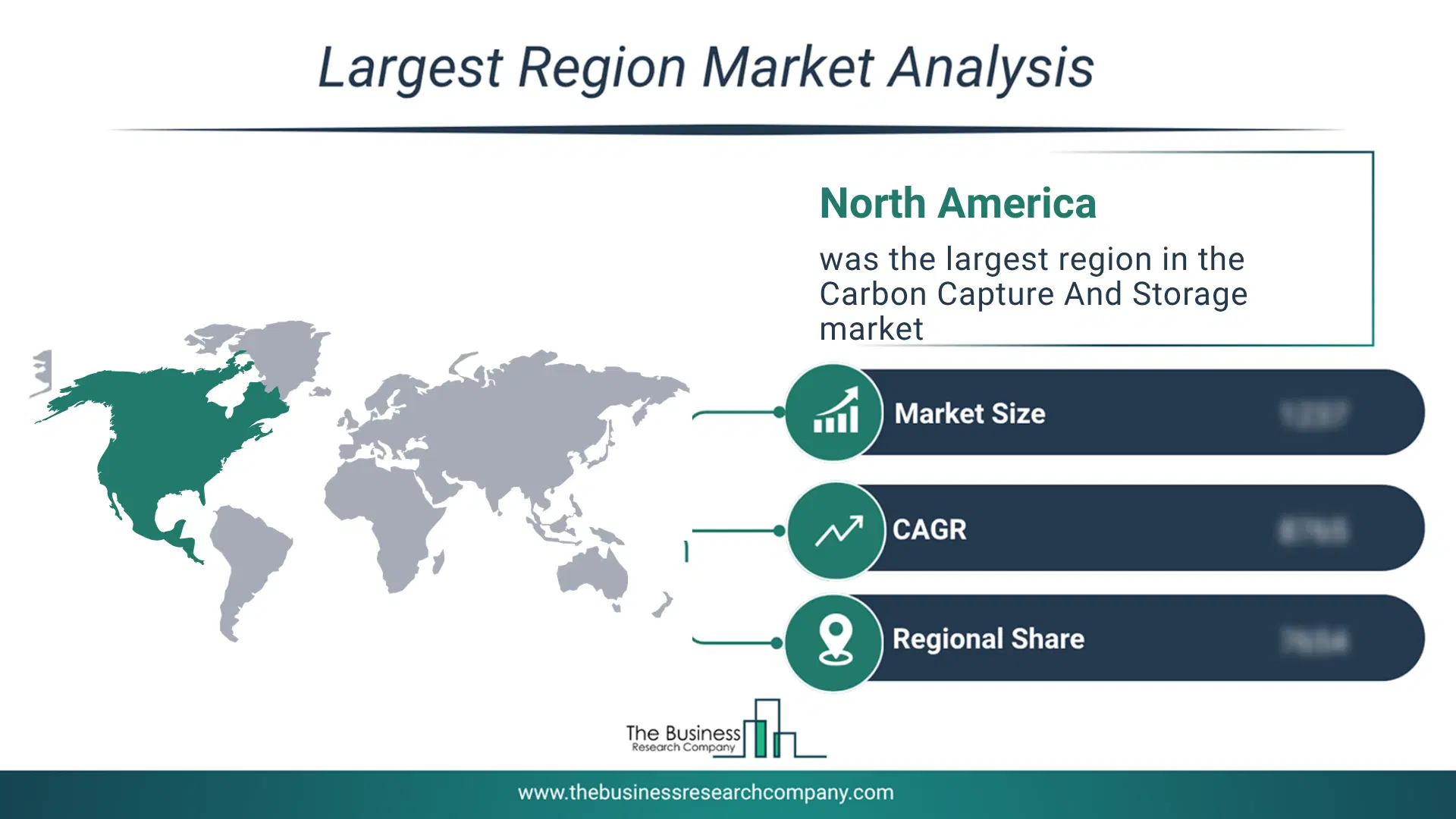
Regional Outlook
North America was the largest region in the carbon capture and storage market in 2025.Asia-Pacific is expected to be the fastest-growing region in the global carbon capture and storage market report during the forecast period. The regions covered in this market report are Asia-Pacific, South East Asia, Western Europe, Eastern Europe, North America, South America, Middle East, Africa. The countries covered in this market report are Australia, Brazil, China, France, Germany, India, Indonesia, Japan, Taiwan, Russia, South Korea, UK, USA, Canada, Italy, SpainWhat Defines the Carbon Capture And Storage Market?
The carbon capture and storage market include revenues earned by entities by offering comprehensive single-point carbon capture, carbon transit, and carbon management. The market value includes the value of related goods sold by the service provider or included within the service offering. Only goods and services traded between entities or sold to end consumers are included.How is Market Value Defined and Measured?
The market value is defined as the revenues that enterprises gain from the sale of goods and/or services within the specified market and geography through sales, grants, or donations in terms of the currency (in USD unless otherwise specified). The revenues for a specified geography are consumption values that are revenues generated by organizations in the specified geography within the market, irrespective of where they are produced. It does not include revenues from resales along the supply chain, either further along the supply chain or as part of other products.
This chart presents market attractiveness based on a quantitative evaluation of growth, competition, strategic alignment, and risk, offering a clear view of opportunity areas for decision-making. This chart is for illustrative purposes; the full report contains the complete analysis.

This chart highlights the Total Addressable Market (TAM) by estimating the maximum revenue opportunity using an assumption-driven approach, supporting strategic planning and opportunity sizing across markets. The chart is illustrative; the full report provides a more comprehensive analysis.
What Key Data and Analysis Are Included in the Carbon Capture And Storage Market Report 2026?
The carbon capture and storage market research report is one of a series of new reports from The Business Research Company that provides market statistics, including Market Report 2026?global market size, regional shares, competitors with the market share, detailed market segments, market trends and opportunities, and any further data you may need to thrive in the carbon capture and storage Market Report 2026? The market research report delivers a complete perspective of everything you need, with an in-depth analysis of the current and future state of the Market Report 2026?Carbon Capture And Storage Market Report Forecast Analysis
| Report Attribute | Details |
|---|---|
| Market Size Value In 2026 | $8.15 billion |
| Revenue Forecast In 2030 | $14.4 billion |
| Growth Rate | CAGR of 14.8% from 2026 to 2030 |
| Base Year For Estimation | 2025 |
| Actual Estimates/Historical Data | 2020-2025 |
| Forecast Period | 2026 - 2030 - 2030 |
| Market Representation | Revenue in USD Billion and CAGR from 2026 to 2030 |
| Segments Covered | Product, Service, End-Use Industry |
| Regional Scope | Asia-Pacific, Western Europe, Eastern Europe, North America, South America, Middle East, Africa |
| Country Scope | The countries covered in the report are Australia, Brazil, China, France, Germany, India, Indonesia, Japan, Taiwan, Russia, South Korea, UK, USA, Canada, Italy, Spain. |
| Key Companies Profiled | Aker Solutions ASA, Dakota Gasification Company, Equinor ASA, Fluor Corporation, Linde PLC, Mitsubishi Heavy Industries Ltd., Shell PLC, Siemens AG, Sulzer Ltd., NRG Energy Inc., General Electric Company, Maersk, Japan CCS Co. Ltd., Halliburton Company, ExxonMobil Corporation, Schlumberger Limited, Honeywell International Inc., Occidental Petroleum Corporation, Air Liquide S.A., Baker Hughes Company, LanzaTech, Calix Limited, Carbon America, Carbon Clean, CarbonFree, Carbon8 Systems, Chart Industries, Capsol Technologies AS, Global Thermostat |
| Customization Scope | Request for Customization |
| Pricing And Purchase Options | Explore Purchase Options |