

Carbon Conductive Ink Market Report 2026
Global Outlook – By Product Type (Carbon Black Conductive Inks, Graphite Conductive Inks, Graphene Conductive Inks, Carbon Nanotube Conductive Inks, Hybrid Carbon Conductive Inks, Other Product Types), By Formulation (Solvent Based Carbon Conductive Inks, Water Based Carbon Conductive Inks, Ultraviolet Light Curable Carbon Conductive Inks), By Printing Technology (Screen Printing, Inkjet Printing, Flexographic Printing, Gravure Printing, Other Printing Technologies), By Application (Printed Circuit Boards, Flexible Electronics, Membrane Switches, Sensors, Radio Frequency Identification Antennas And Tags, Other Applications), By End Use Industry (Electronics And Semiconductors, Automotive, Healthcare And Medical Devices, Consumer Electronics) – Market Size, Trends, Strategies, and Forecast to 2035
Carbon Conductive Ink Market Overview
• Carbon Conductive Ink market size has reached to $2.2 billion in 2025 • Expected to grow to $3.52 billion in 2030 at a compound annual growth rate (CAGR) of 9.8% • Growth Driver: Growing Demand For Printed Electronics Fueling The Growth Of The Market Due To Increasing Use In Flexible Conductive Circuits, Sensors, And Electrodes • Market Trend: Development Of Graphene-Based Conductive Inks For Large-Scale Printing • North America was the largest region in 2025 and Asia-Pacific is the fastest growing region.What Is Covered Under Carbon Conductive Ink Market?
Carbon conductive ink is a specialized printing formulation containing electrically conductive carbon materials, such as carbon black, graphite, or other carbon-based particles, dispersed in a binder and liquid medium. It is used to create electrically conductive patterns on substrates through printing processes. Applications include printed electronics, sensors, flexible circuits, touch interfaces, RFID components, heating elements, and electromagnetic shielding. The main product types of carbon conductive ink include carbon black conductive inks, graphite conductive inks, graphene conductive inks, carbon nanotube conductive inks, hybrid carbon conductive inks, and other product types. Carbon black conductive inks refer to formulations containing conductive carbon black particles that provide electrical conductivity when printed onto suitable substrates. These inks are available as solvent based carbon conductive inks, water based carbon conductive inks, and ultraviolet light curable carbon conductive inks, and are applied using screen printing, inkjet printing, flexographic printing, gravure printing, and other printing technologies. The key applications include printed circuit boards, flexible electronics, membrane switches, sensors, radio frequency identification antennas and tags, and others, while the end-use industries include electronics and semiconductors, automotive, healthcare and medical devices, and consumer electronics.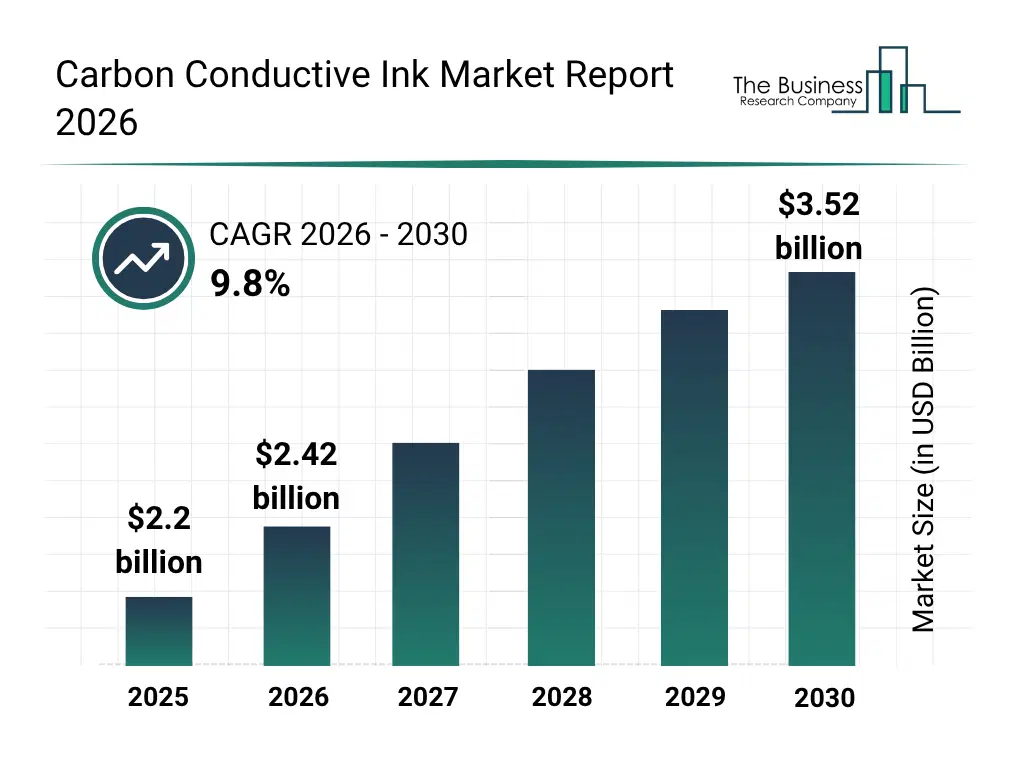
What Is The Carbon Conductive Ink Market Size and Share 2026?
The carbon conductive ink market size has grown rapidly in recent years. It will grow from $2.2 billion in 2025 to $2.42 billion in 2026 at a compound annual growth rate (CAGR) of 10.2%. The growth in the historic period can be attributed to increasing adoption of printed electronics, rising demand for cost-effective conductive materials, growing production of flexible electronic devices, expanding use of printed sensors, increasing demand for conductive inks in membrane switches.What Is The Carbon Conductive Ink Market Growth Forecast?
The carbon conductive ink market size is expected to see strong growth in the next few years. It will grow to $3.52 billion in 2030 at a compound annual growth rate (CAGR) of 9.8%. The growth in the forecast period can be attributed to growing demand for wearable electronic devices, increasing adoption of printed RFID antennas and tags, rising demand for flexible and lightweight electronics, expanding use of conductive inks in automotive electronics, growing demand for high-performance printed circuitry. Major trends in the forecast period include increasing demand for high-conductivity carbon-based inks, rising adoption of flexible and stretchable printed electronics, growing use of carbon conductive inks for advanced sensor applications, expanding demand for low-cost printed electronic circuits, increasing development of high-resolution conductive printing.Tariff Impact On Carbon Conductive Ink Market
Tariffs are impacting the carbon conductive ink market by increasing the cost of imported carbon materials, specialty additives, binders, printing equipment, and electronic components used in conductive ink production. This is increasing manufacturing costs and creating supply chain pressures, particularly in Asia-Pacific and North America, where electronics and printed electronics manufacturing are highly concentrated. Product segments such as carbon black conductive inks, graphene conductive inks, and carbon nanotube conductive inks are most affected because they depend on specialized imported materials and advanced processing inputs. However, tariffs are also encouraging regional sourcing, domestic production of conductive materials, and diversification of suppliers, strengthening local printed electronics and conductive ink manufacturing ecosystems.

Global Carbon Conductive Ink Market Segmentation
2) By Formulation: Solvent Based Carbon Conductive Inks, Water Based Carbon Conductive Inks, Ultraviolet Light Curable Carbon Conductive Inks 3) By Printing Technology: Screen Printing, Inkjet Printing, Flexographic Printing, Gravure Printing, Other Printing Technologies 4) By Application: Printed Circuit Boards, Flexible Electronics, Membrane Switches, Sensors, Radio Frequency Identification Antennas And Tags, Other Applications 5) By End Use Industry: Electronics And Semiconductors, Automotive, Healthcare And Medical Devices, Consumer Electronics Subsegments: 1) By Carbon Black Conductive Inks: Furnace Carbon Black Ink, Acetylene Carbon Black Ink, Channel Carbon Black Ink, Specialty Carbon Black Ink 2) By Graphite Conductive Inks: Natural Graphite Ink, Synthetic Graphite Ink, Expanded Graphite Ink, Flake Graphite Ink 3) By Graphene Conductive Inks: Graphene Oxide Ink, Reduced Graphene Oxide Ink, Pristine Graphene Ink, Graphene Nanoplatelet Ink 4) By Carbon Nanotube Conductive Inks: Single Walled Carbon Nanotube Ink, Multi Walled Carbon Nanotube Ink, Functionalized Carbon Nanotube Ink, Hybrid Carbon Nanotube Ink 5) By Hybrid Carbon Conductive Inks: Carbon Black Graphene Hybrid Ink, Carbon Black Carbon Nanotube Hybrid Ink, Graphene Carbon Nanotube Hybrid Ink, Multi Carbon Composite Ink 6) By Other Product Types: Carbon Fiber Conductive Ink, Activated Carbon Conductive Ink, Carbon Composite Conductive Ink, Custom Carbon Conductive InkWhat Is The Driver Of The Carbon Conductive Ink Market?
The growing demand for printed electronics is expected to propel the growth of the carbon conductive ink market going forward. Printed electronics is the manufacturing of electronic circuits and components using conductive and functional inks on flexible or rigid substrates through printing technologies such as screen, inkjet, and gravure printing. The demand for printed electronics is growing due to the increasing adoption of lightweight, flexible, low-cost, and energy-efficient electronic devices across consumer electronics, automotive, healthcare, packaging, and industrial applications. Rising demand for printed electronics drives the demand for carbon conductive inks by increasing their use in cost-effective, flexible, and lightweight conductive circuits, sensors, electrodes, and other printed electronic components. For instance, in October 2025, according to the Organic and Printed Electronics Association (OE-A), a Germany-based international industry association, OE-A members forecast 14% sales growth in 2026. Therefore, the growing demand for printed electronics is driving the growth of the carbon conductive ink industry.Key Players In The Global Carbon Conductive Ink Market
Major companies operating in the carbon conductive ink market are DuPont de Nemours Inc., Henkel AG & Co. KGaA, DIC Corporation, Heraeus Holding GmbH, Merck KGaA, PPG Industries Inc., Toyobo Co. Ltd., NAGASE & CO. LTD., NovaCentrix Corp., Methode Electronics Inc., CHASM Advanced Materials Inc., Haydale Graphene Industries plc, PV Nano Cell Ltd., Creative Materials Inc., Dycotec Materials Ltd., Cheap Tubes Inc., IOLITEC Ionic Liquids Technologies GmbH, Techinstro, Reinste Nano Ventures Private Limited, AdNano Technologies Private Limited, Dongguan City Betterly New Materials Co. Ltd., Aritech Chemazone Private Limited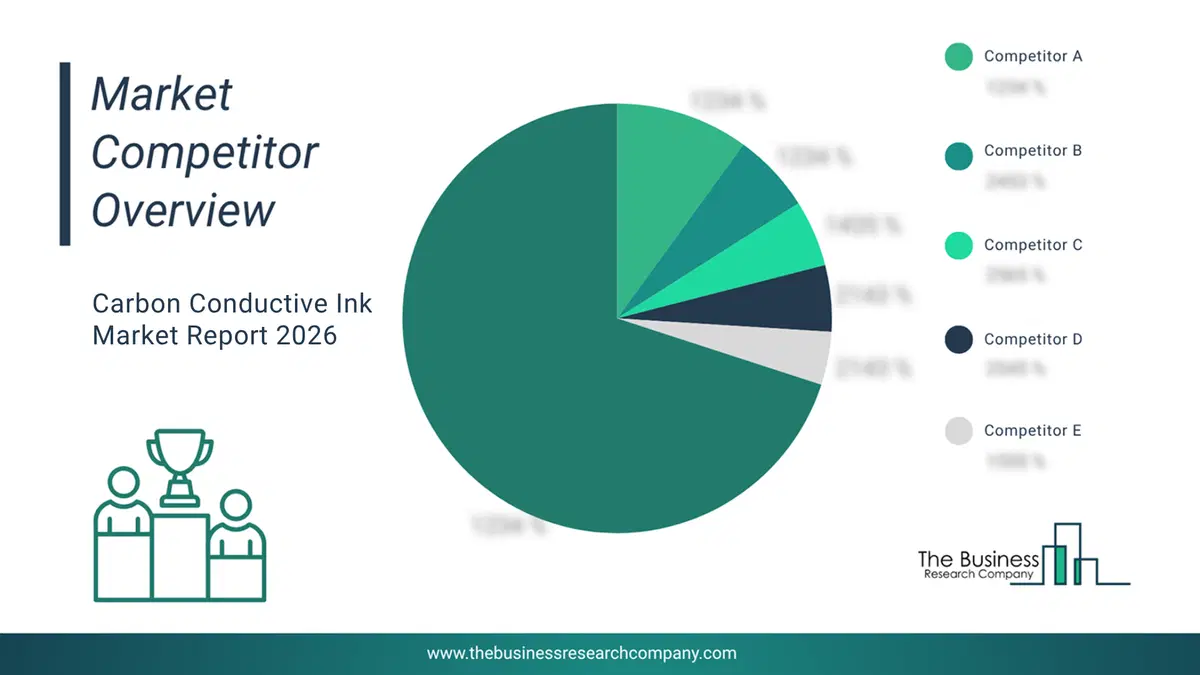
This chart is for illustrative purposes; the full report includes a detailed competitor analysis and comprehensive overview of the top 10 companies in the market.
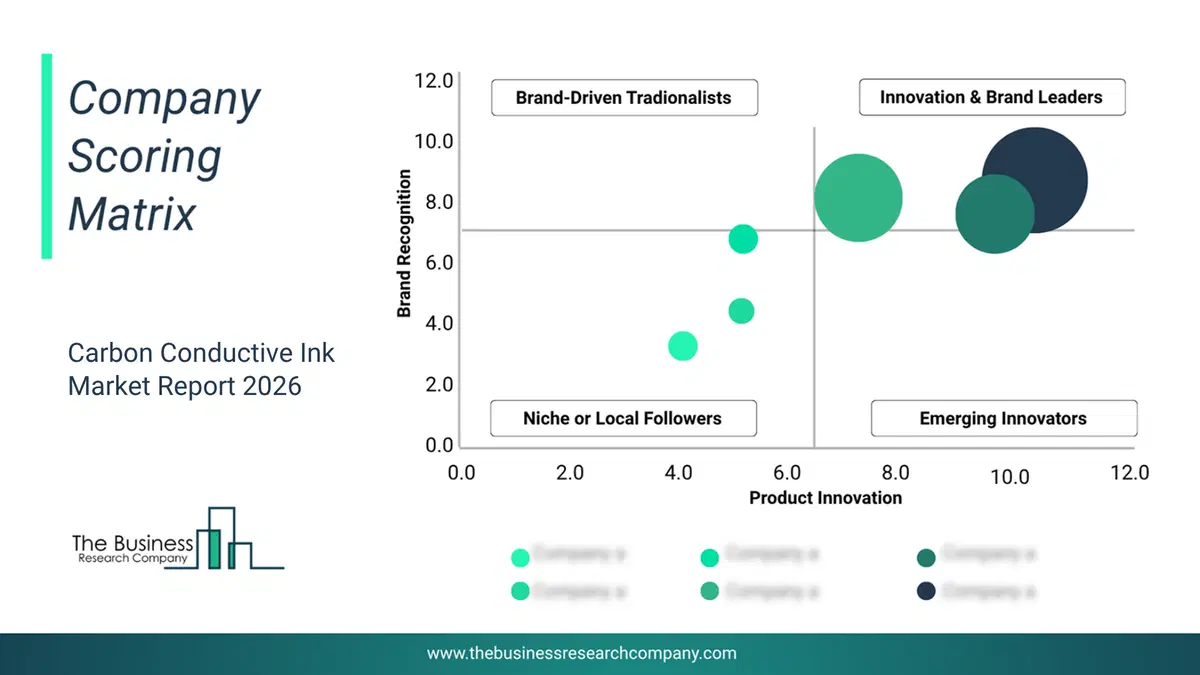
This chart maps companies by product innovation and brand strength, with bubble size indicating relative revenue, helping identify market leaders, challengers, and niche players. This is an illustrative chart; the full report provides a complete and accurate competitive analysis.
Global Carbon Conductive Ink Market Trends and Insights
Major companies operating in the carbon conductive ink market are focusing on developing advanced solutions, such as graphene-based conductive inks, to enhance electrical conductivity, enable high-performance large-scale printing, and expand the use of conductive materials across industrial applications. Graphene-based conductive inks are carbon-based formulations containing graphene as the conductive material, designed to create electrically conductive patterns, coatings, and functional surfaces through printing techniques such as screen printing. For instance, in March 2025, BLACKLEAF, a France-based graphene-based materials company, launched a new range of graphene-based conductive inks specifically designed for screen printing. The new range complements the company’s existing sprayable graphene ink solutions and enables it to provide conductive materials tailored to industrial-scale printing requirements. The launch also supports BLACKLEAF’s strategy to establish graphene-based screen-printing inks as an industrial solution for manufacturers seeking scalable, high-performance carbon-based conductive materials.What Are Latest Mergers And Acquisitions In The Carbon Conductive Ink Market?
In February 2026, Element Solutions Inc., a US-based specialty chemicals company, acquired Micromax from Celanese Corporation for approximately $500 million. With this acquisition, Element Solutions aimed to expand its electronics materials portfolio by integrating Micromax into its MacDermid Alpha Electronics Solutions business, strengthening its capabilities in advanced electronic materials and conductive ink solutions. Micromax is a US-based electronic materials business specializing in thick-film pastes and functional inks, including carbon conductive inks used in printed electronics, circuitry, heating, and other electronic applications.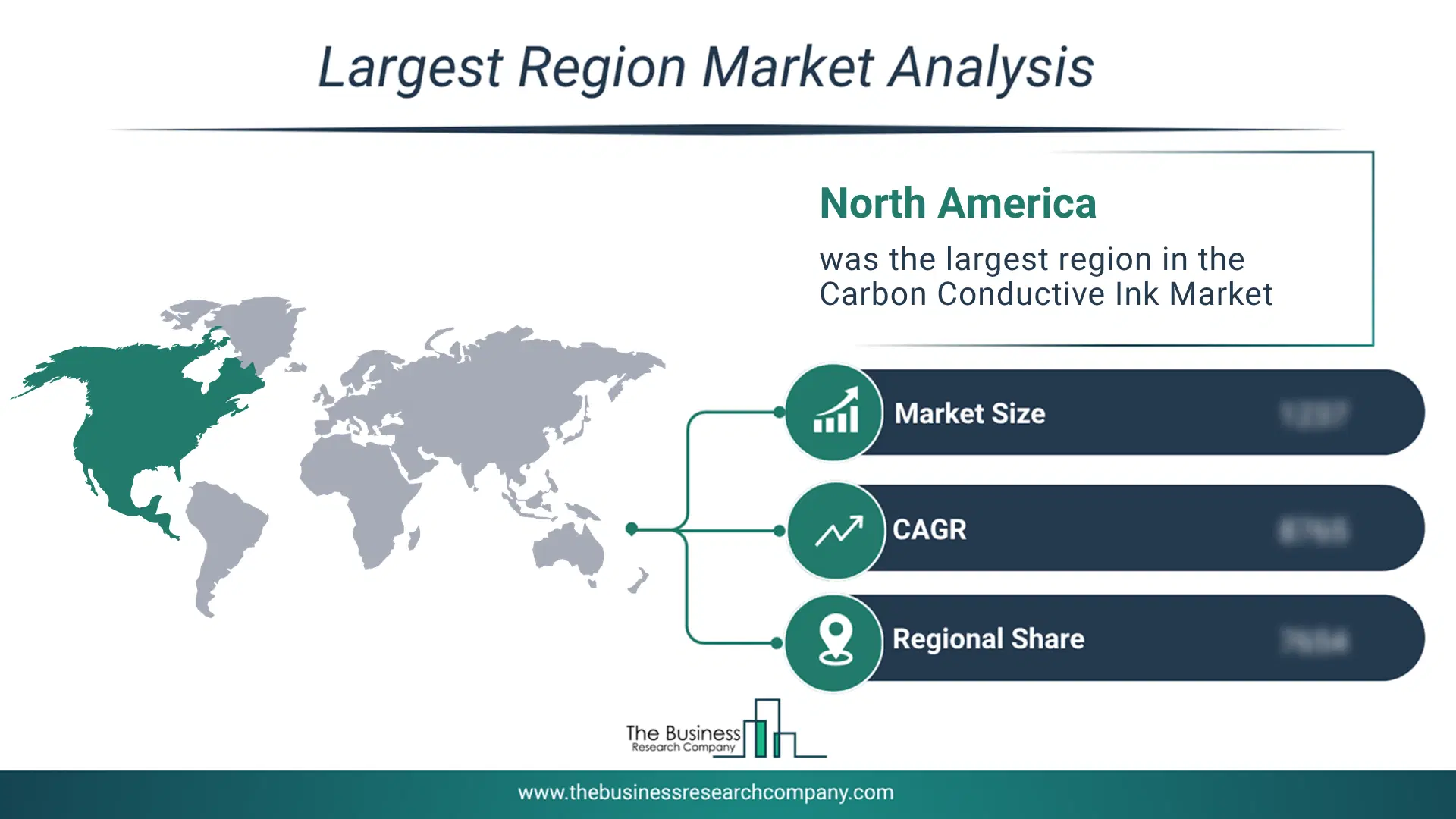
Regional Outlook/Insights
North America was the largest region in the carbon conductive ink market in 2025. Asia-Pacific is expected to be the fastest-growing region in the forecast period. The regions covered in this market report are Asia-Pacific, South East Asia, Western Europe, Eastern Europe, North America, South America, Middle East, Africa. The countries covered in this market report are Australia, Brazil, China, France, Germany, India, Indonesia, Japan, Taiwan, Russia, South Korea, UK, USA, Canada, Italy, Spain.What Defines the Carbon Conductive Ink Market?
The carbon conductive ink market consists of sales of conductive carbon pastes, screen-printable conductive formulations, flexible electronics inks, resistive inks, electrode inks, antistatic inks, electromagnetic interference (EMI) shielding inks, and printed circuit inks. Values in this market are ‘factory gate’ values, that is the value of goods sold by the manufacturers or creators of the goods, whether to other entities (including downstream manufacturers, wholesalers, distributors and retailers) or directly to end customers. The value of goods in this market includes related services sold by the creators of the goods.How is Market Value Defined and Measured?
The market value is defined as the revenues that enterprises gain from the sale of goods and/or services within the specified market and geography through sales, grants, or donations in terms of the currency (in USD unless otherwise specified). The revenues for a specified geography are consumption values that are revenues generated by organizations in the specified geography within the market, irrespective of where they are produced. It does not include revenues from resales along the supply chain, either further along the supply chain or as part of other products.
This chart presents market attractiveness based on a quantitative evaluation of growth, competition, strategic alignment, and risk, offering a clear view of opportunity areas for decision-making. This chart is for illustrative purposes; the full report contains the complete analysis.

This chart highlights the Total Addressable Market (TAM) by estimating the maximum revenue opportunity using an assumption-driven approach, supporting strategic planning and opportunity sizing across markets. The chart is illustrative; the full report provides a more comprehensive analysis.
What Key Data and Analysis Are Included in the Carbon Conductive Ink Market Report 2026?
The carbon conductive ink market research report is one of a series of new reports from The Business Research Company that provides market statistics, including industry global market size, regional shares, competitors with the market share, detailed market segments, market trends and opportunities, and any further data you may need to thrive in the carbon conductive ink industry. The market research report delivers a complete perspective of everything you need, with an in-depth analysis of the current and future state of the industry.Carbon Conductive Ink Market Report Forecast Analysis
| Report Attribute | Details |
|---|---|
| Market Size Value In 2026 | $2.42 billion |
| Revenue Forecast In 2030 | $3.52 billion |
| Growth Rate | CAGR of 9.8% from 2026 to 2035 |
| Base Year For Estimation | 2025 |
| Actual Estimates/Historical Data | 2020-2025 |
| Forecast Period | 2026 - 2030 |
| Market Representation | Revenue in USD Billion and CAGR from 2026 to 2030 |
| Segments Covered | Product Type, Formulation, Printing Technology, Application, End Use Industry |
| Regional Scope | Asia-Pacific, Western Europe, Eastern Europe, North America, South America, Middle East, Africa |
| Country Scope | The countries covered in the report are Australia, Brazil, China, France, Germany, India, Indonesia, Japan, Taiwan, Russia, South Korea, UK, USA, Canada, Italy, Spain. |
| Customization Scope | Request for Customization |
| Pricing And Purchase Options | Explore Purchase Options |