
Carbon Credit For Agriculture, Forestry, And Land Use Market Report 2026
Global Outlook – By Type (Voluntary, Compliance), By Project Type (Forestry And Land Use, Agriculture), By Application (Avoidance Projects, Removal Projects, Combination Projects) – Market Size, Trends, Strategies, and Forecast to 2030
Carbon Credit For Agriculture, Forestry, And Land Use Market Overview
• Carbon Credit For Agriculture, Forestry, And Land Use market size has reached to $7.5 billion in 2025 • Expected to grow to $26.53 billion in 2030 at a compound annual growth rate (CAGR) of 28.7% • Growth Driver: Impact of Carbon Credits on Agriculture, Forestry, and Land Use Market • Market Trend: Advancing The Carbon Credit Market Through Multi-Activity SaaS Platforms • Asia-Pacific was the largest region in 2025 and is the fastest growing region.What Is Covered Under Carbon Credit For Agriculture, Forestry, And Land Use Market?
Carbon credits in agriculture, forestry, and land use are units representing the reduction or removal of greenhouse gases from the atmosphere through activities such as reforestation, sustainable farming, or wetland restoration. It incentivize carbon emissions reduction and are traded to offset emissions elsewhere, contributing to global climate change mitigation efforts and promoting sustainable land management practices. The main types in the carbon credit for agriculture, forestry, and land use market are voluntary and compliance. Voluntary carbon credits refer to units of greenhouse gas emissions reductions or removals that are generated outside of mandatory regulatory frameworks. The various types of projects include forestry and land use, and agriculture, and several applications including avoidance projects, removal projects, and combination projects.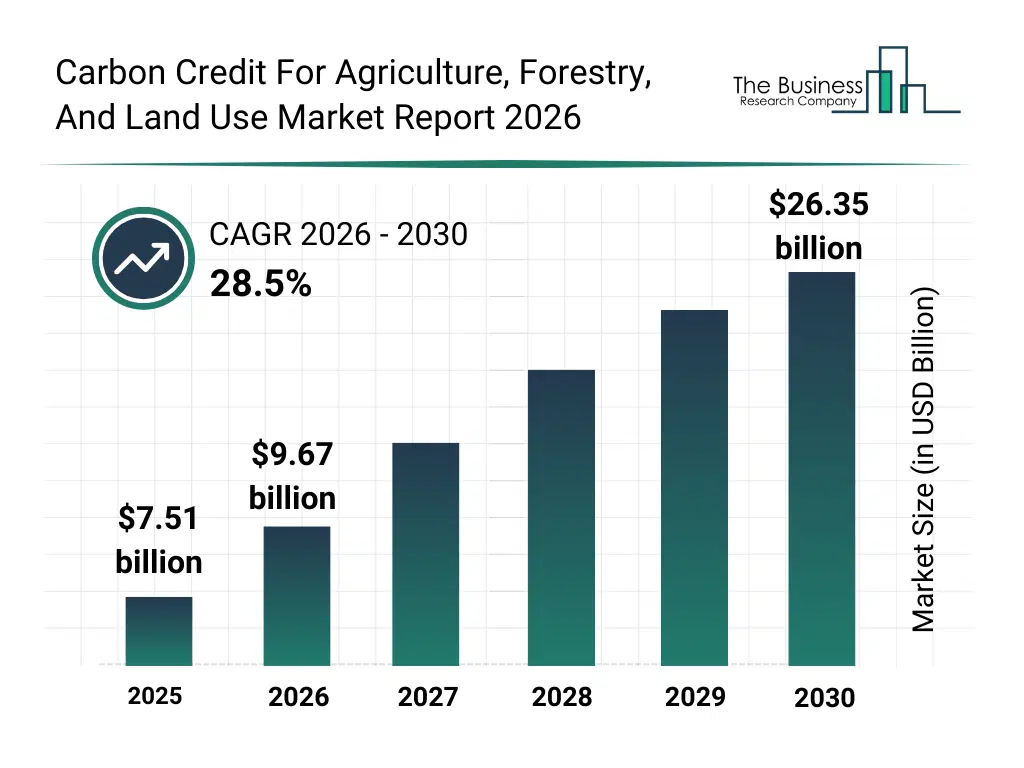
What Is The Carbon Credit For Agriculture, Forestry, And Land Use Market Size and Share 2026?
The carbon credit for agriculture, forestry, and land use market size has grown exponentially in recent years. It will grow from $7.5 billion in 2025 to $9.67 billion in 2026 at a compound annual growth rate (CAGR) of 28.9%. The growth in the historic period can be attributed to early promotion of reforestation initiatives, rising awareness of climate change impacts, initial adoption of voluntary carbon markets, government-led afforestation and conservation programs, growth of sustainable agriculture practices.What Is The Carbon Credit For Agriculture, Forestry, And Land Use Market Growth Forecast?
The carbon credit for agriculture, forestry, and land use market size is expected to see exponential growth in the next few years. It will grow to $26.53 billion in 2030 at a compound annual growth rate (CAGR) of 28.7%. The growth in the forecast period can be attributed to increasing corporate net-zero commitments, rising demand for high-quality removal credits, expansion of digital mrv (measurement, reporting, verification) tools, growing investments in regenerative farming, global policy support for carbon market transparency. Major trends in the forecast period include growing adoption of nature-based carbon removal projects, expansion of regenerative agriculture for soil carbon sequestration, rising participation of farmers and landowners in carbon credit programs, increasing development of standardized measurement and verification protocols, growing integration of carbon credits into corporate sustainability strategies.
Global Carbon Credit For Agriculture, Forestry, And Land Use Market Segmentation
2) By Project Type: Forestry And Land Use, Agriculture 3) By Application: Avoidance Projects, Removal Projects, Combination Projects Subsegments: 1) By Voluntary: Carbon Offset Projects, Carbon Credit Trading 2) By Compliance: Cap-And-Trade Systems, Emission Reduction ProgramsWhat Is The Driver Of The Carbon Credit For Agriculture, Forestry, And Land Use Market?
The growing demand for reducing carbon emissions is expected to propel the growth of the carbon credit for agriculture, forestry, and land use market going forward. Carbon emissions refer to releasing carbon dioxide (CO2) and other greenhouse gases into the atmosphere. The demand for reducing carbon emissions is spurring innovation and research in areas such as renewable energy, battery storage, carbon capture and storage (CCS), and sustainable agriculture to achieve sustainable and long-lasting impacts. Carbon credits reduce emissions by incentivizing activities that remove carbon dioxide or prevent emissions, balancing the carbon footprint in agriculture, forestry, and land use. For instance, in November 2023, according to the United Nations Environment Programme, a Kenya-based environmental authority, as of 25 September 2023, 97 Parties, covering about 81% of global GHG emissions, had made net-zero commitments: 27 in law, 54 in policy documents, and 16 announced by officials. This is up from 88 parties last year. Targets for 2050 or earlier cover 37% of emissions, while pledges beyond 2050 cover 44%. Therefore, the growing demand for reducing carbon emissions is driving the growth of the carbon credit for agriculture, forestry, and land use.Key Players In The Global Carbon Credit For Agriculture, Forestry, And Land Use Market
Major companies operating in the carbon credit for agriculture, forestry, and land use market are Cargill Incorporated, Bayer AG, WGL Holdings Inc., Conservation International, Indigo AG Inc., Green Mountain Energy, The Carbon Trust, 3Degrees Group Inc., Terra Global Capital LLC, EcoAct, Verra, American Carbon Registry, Carbon Credit Capital LLC, Land Life Company, Allcot Group, Enking International, natureOffice GmbH, South Pole, Ecosystem Services Market Consortium, Sterling Planet Inc., Finite Carbon Corporation, GreenTrees LLC, Gold Standard, Nori Inc.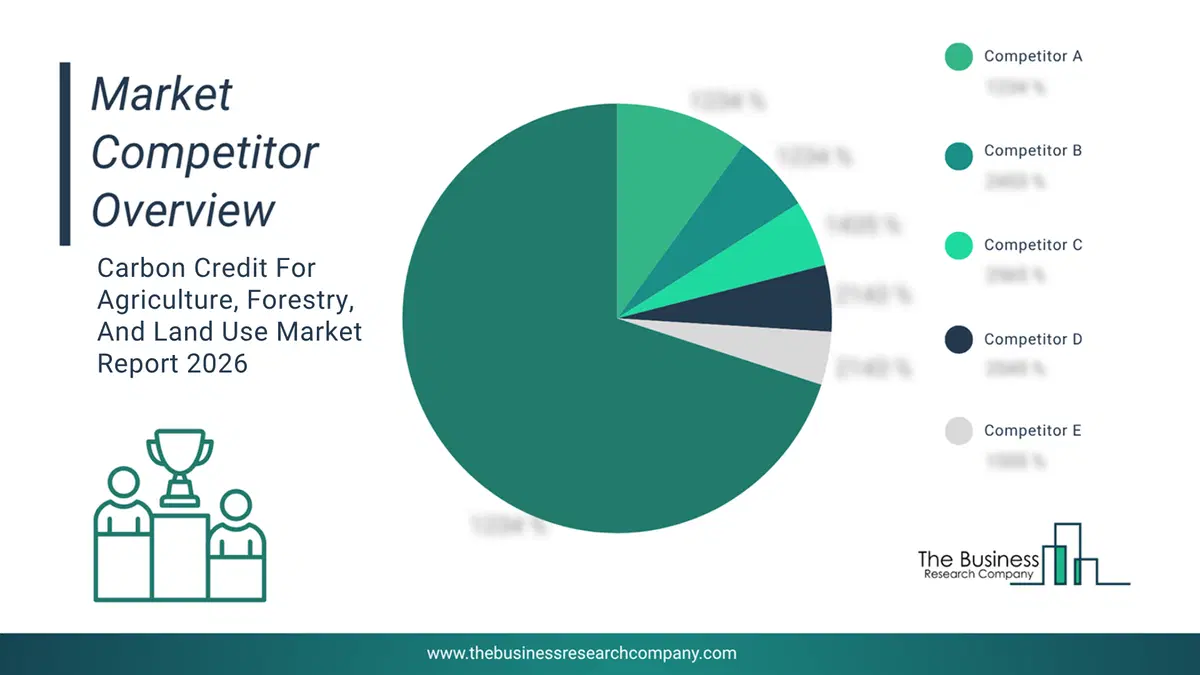
This chart is for illustrative purposes; the full report includes a detailed competitor analysis and comprehensive overview of the top 10 companies in the market.
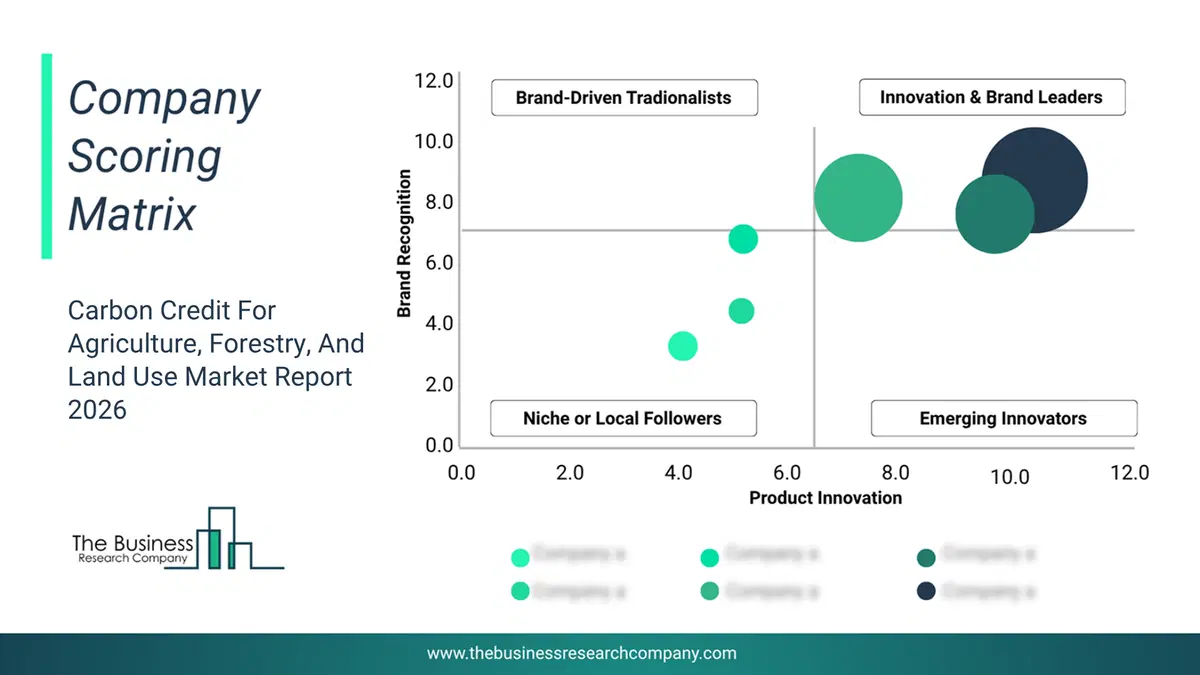
This chart maps companies by product innovation and brand strength, with bubble size indicating relative revenue, helping identify market leaders, challengers, and niche players. This is an illustrative chart; the full report provides a complete and accurate competitive analysis.
Global Carbon Credit For Agriculture, Forestry, And Land Use Market Trends and Insights
Major companies operating in the carbon credit for agriculture forestry and land use market are focusing on developing innovative technological solutions, such as the multi-activity carbon credit SaaS platform, to help the world meet its decarbonization targets. A multi-activity carbon credit SaaS platform is a software solution that generates high-quality carbon offsets from multiple mitigation activities by leveraging a variety of data sources and technologies. For instance, in September 2023, CERO Technologies, an India-based software company, launched a carbon credit generation SaaS platform. The technology is identified as the digital measurement, reporting, and verification (dMRV) platform, which tackles the market's present supply restrictions, inefficiencies, and credibility difficulties. The platform speeds up carbon credit calculation and verification by interacting with high-quality data and producing high-quality carbon credits in real-time.What Are Latest Mergers And Acquisitions In The Carbon Credit For Agriculture, Forestry, And Land Use Market?
In March 2024, TÜV SÜD, a Germany-based technical services company, acquired Forest Resource Solutions and Technologies (FRST Corp) for an undisclosed amount. With this acquisition, TÜV SÜD aims to expand its expertise and capabilities in the validation and verification of climate protection and forestry-related sustainability projects, strengthen its position in the growing market for carbon offset and wildfire mitigation solutions, and provide clients with comprehensive support in achieving their sustainability and climate goals. Forest Resource Solutions and Technologies (FRST Corp) is a US-based company that specializes in providing carbon credits for agriculture, forestry, and land use.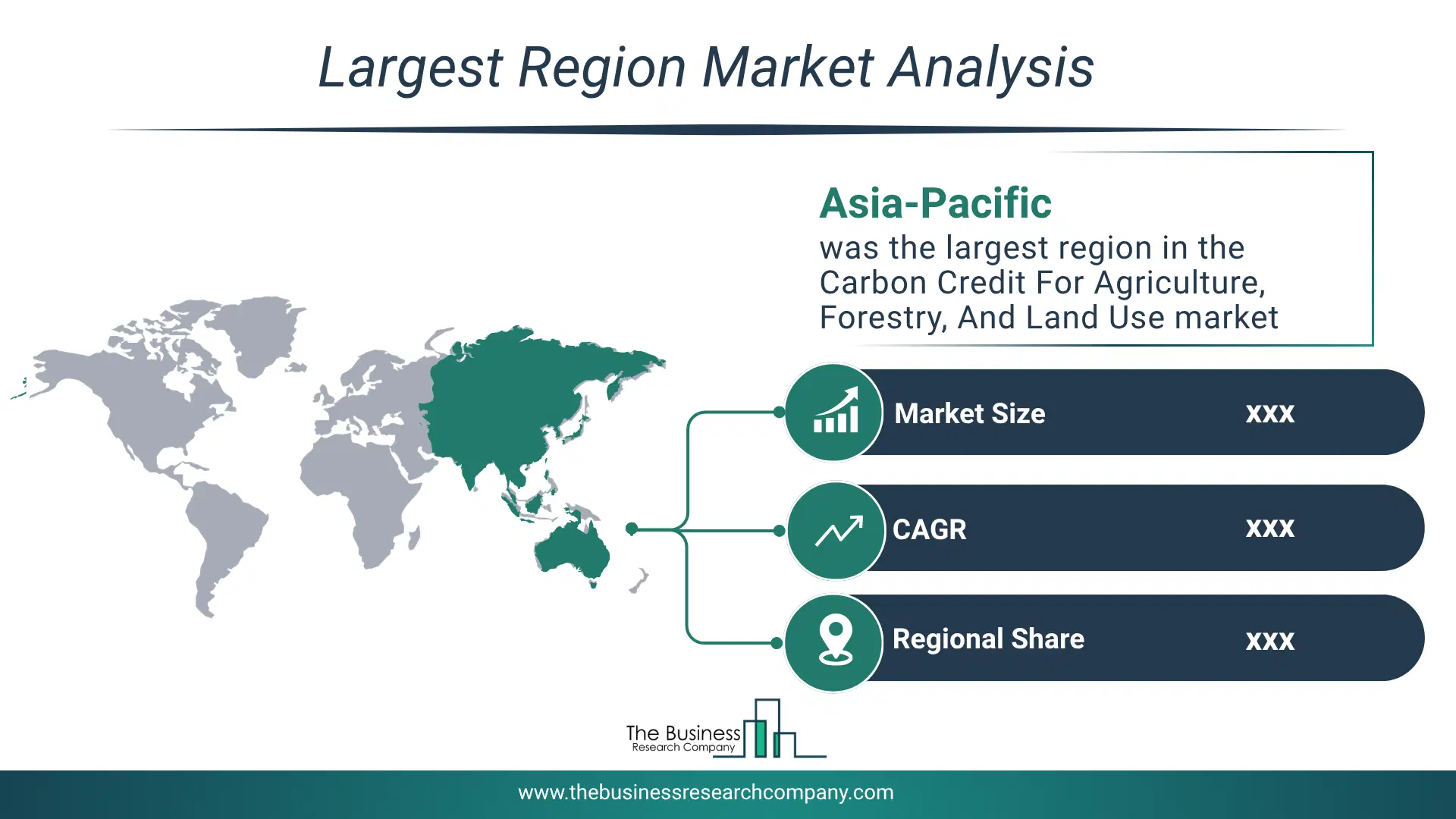
Regional Outlook
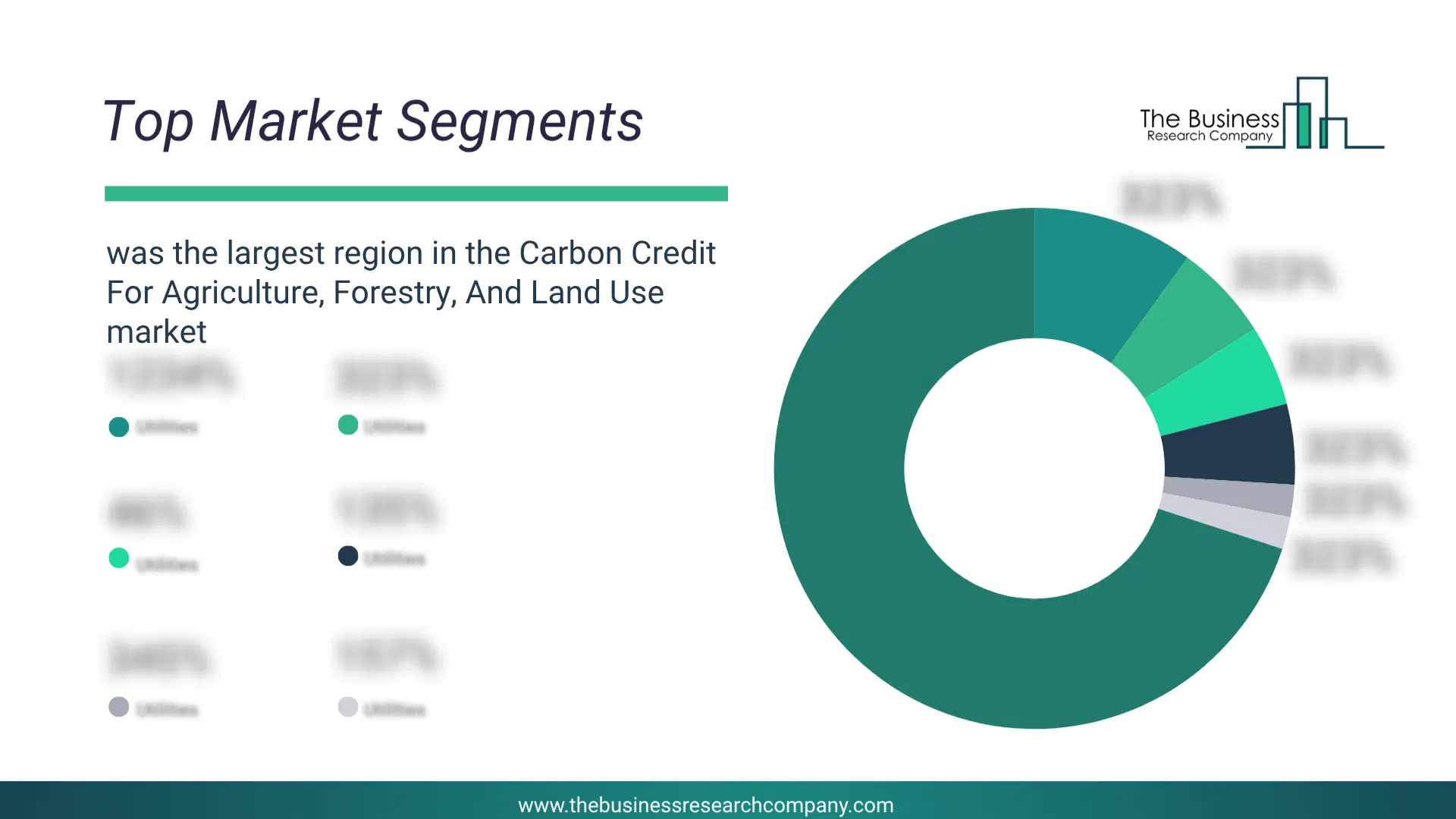
Asia-Pacific was the largest region in the carbon credit for agriculture, forestry, and land use market in 2025. The regions covered in this market report are Asia-Pacific, South East Asia, Western Europe, Eastern Europe, North America, South America, Middle East, Africa. The countries covered in this market report are Australia, Brazil, China, France, Germany, India, Indonesia, Japan, Taiwan, Russia, South Korea, UK, USA, Canada, Italy, Spain.What Defines the Carbon Credit For Agriculture, Forestry, And Land Use Market?
The carbon credit for agriculture, forestry, and land use includes revenues earned by entities by providing services such as carbon accounting and measurement, verification and validation project development and management. The market value includes the value of related goods sold by the service provider or included within the service offering. Only goods and services traded between entities or sold to end consumers are included.How is Market Value Defined and Measured?
The market value is defined as the revenues that enterprises gain from the sale of goods and/or services within the specified market and geography through sales, grants, or donations in terms of the currency (in USD unless otherwise specified). The revenues for a specified geography are consumption values that are revenues generated by organizations in the specified geography within the market, irrespective of where they are produced. It does not include revenues from resales along the supply chain, either further along the supply chain or as part of other products.
This chart presents market attractiveness based on a quantitative evaluation of growth, competition, strategic alignment, and risk, offering a clear view of opportunity areas for decision-making. This chart is for illustrative purposes; the full report contains the complete analysis.

This chart highlights the Total Addressable Market (TAM) by estimating the maximum revenue opportunity using an assumption-driven approach, supporting strategic planning and opportunity sizing across markets. The chart is illustrative; the full report provides a more comprehensive analysis.
What Key Data and Analysis Are Included in the Carbon Credit For Agriculture, Forestry, And Land Use Market Report 2026?
The carbon credit for agriculture, forestry, and land use market research report is one of a series of new reports from The Business Research Company that provides market statistics, including industry global market size, regional shares, competitors with the market share, detailed market segments, market trends and opportunities, and any further data you may need to thrive in the carbon credit for agriculture, forestry, and land use industry. The market research report delivers a complete perspective of everything you need, with an in-depth analysis of the current and future state of the industry.Carbon Credit For Agriculture, Forestry, And Land Use Market Report Forecast Analysis
| Report Attribute | Details |
|---|---|
| Market Size Value In 2026 | $9.67 billion |
| Revenue Forecast In 2030 | $26.53 billion |
| Growth Rate | CAGR of 28.7% from 2026 to 2030 |
| Base Year For Estimation | 2025 |
| Actual Estimates/Historical Data | 2020-2025 |
| Forecast Period | 2026 - 2030 |
| Market Representation | Revenue in USD Billion and CAGR from 2026 to 2030 |
| Segments Covered | Type, Project Type, Application |
| Regional Scope | Asia-Pacific, Western Europe, Eastern Europe, North America, South America, Middle East, Africa |
| Country Scope | The countries covered in the report are Australia, Brazil, China, France, Germany, India, Indonesia, Japan, Taiwan, Russia, South Korea, UK, USA, Canada, Italy, Spain. |
| Key Companies Profiled | Cargill Incorporated, Bayer AG, WGL Holdings Inc., Conservation International, Indigo AG Inc., Green Mountain Energy, The Carbon Trust, 3Degrees Group Inc., Terra Global Capital LLC, EcoAct, Verra, American Carbon Registry, Carbon Credit Capital LLC, Land Life Company, Allcot Group, Enking International, natureOffice GmbH, South Pole, Ecosystem Services Market Consortium, Sterling Planet Inc., Finite Carbon Corporation, GreenTrees LLC, Gold Standard, Nori Inc. |
| Customization Scope | Request for Customization |
| Pricing And Purchase Options | Explore Purchase Options |