
Carbon Dioxide (CO₂)-Based Ventilation Controller Market Report 2026
Global Outlook – By Product Type ( Standalone Controllers, Integrated Systems, Wireless Controllers, Wired Controllers), By Control Technology ( Demand-Controlled Ventilation, Fixed Airflow Control, Hybrid Systems), By Sensor Type ( NDIR, Chemical, Infrared, Others Sensor Types), By Application ( Commercial Buildings, Residential Buildings, Industrial Facilities, Healthcare, Educational Institutions, Others Applications), By Distribution Channel ( Direct Sales, Distributors, Online Retail, Others Distribution Channels) – Market Size, Trends, Strategies, and Forecast to 2030
Carbon Dioxide (CO2)-Based Ventilation Controller Market Overview
• Carbon Dioxide (CO2)-Based Ventilation Controller market size has reached to $2.78 billion in 2025 • Expected to grow to $4.21 billion in 2030 at a compound annual growth rate (CAGR) of 8.6% • Growth Driver: Surge In Indoor Air Quality Fueling The Growth Of The Market Due To Rising Health Awareness And Pollution Exposure • Market Trend: Advancing Indoor Air Quality Through Innovation In CO2 Sensing And Ventilation Control • North America was the largest region in 2025 and Asia-Pacific is the fastest growing region.What Is Covered Under Carbon Dioxide (CO2)-Based Ventilation Controller Market?
A carbon dioxide (CO2)-based ventilation controller is an automated system that regulates indoor ventilation according to the concentration of CO2 in the air. Using precise CO2 sensors, the system continuously monitors air quality and adjusts the ventilation rate to maintain a healthy and comfortable environment. When CO2 levels increase, typically due to higher occupancy or activity, the controller boosts ventilation to introduce more fresh air and expel stale air. Once CO2 levels return to acceptable limits, it reduces ventilation to conserve energy. The main product types of carbon dioxide (CO2)-based ventilation controllers comprise standalone controllers, integrated systems, wireless controllers, and wired controllers. Standalone controllers refer to independent ventilation management devices designed to regulate airflow, temperature, and indoor air quality within a specific zone or facility without relying on centralized building management systems. The various control technologies include demand-controlled ventilation, fixed airflow control, and hybrid systems. Based on sensor type, the systems utilize NDIR, chemical, infrared, and others. Key applications include commercial buildings, residential buildings, industrial facilities, healthcare centers, educational institutions, and others, and are distributed through direct sales, distributors, online retail, and others.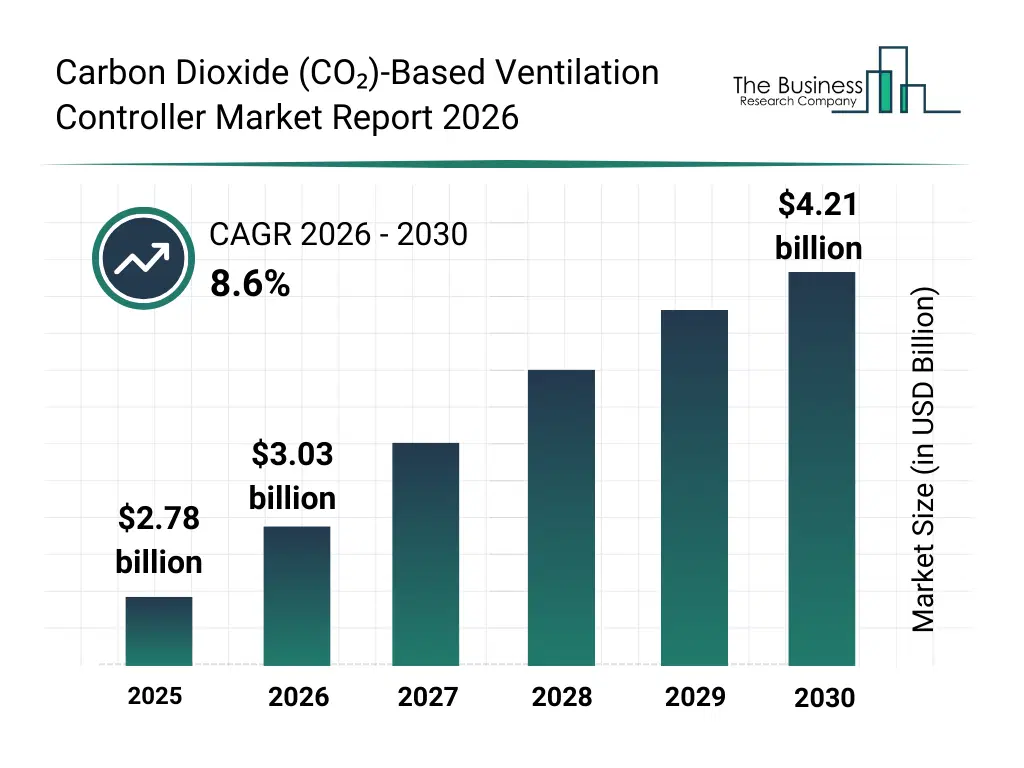
What Is The Carbon Dioxide (CO2)-Based Ventilation Controller Market Size 2026 And Growth Rate?
The carbon dioxide (co2)-based ventilation controller market size has grown strongly in recent years. It will grow from $2.78 billion in 2025 to $3.03 billion in 2026 at a compound annual growth rate (CAGR) of 8.8%. The growth in the historic period can be attributed to increasing awareness of indoor air quality issues, early adoption of hvac automation in commercial buildings, rise in occupancy-based ventilation systems, growing regulatory focus on ventilation standards, expansion of ndir sensor availability.What Is The Carbon Dioxide (CO2)-Based Ventilation Controller Market Growth Forecast?
The carbon dioxide (co2)-based ventilation controller market size is expected to see strong growth in the next few years. It will grow to $4.21 billion in 2030 at a compound annual growth rate (CAGR) of 8.6%. The growth in the forecast period can be attributed to rising demand for energy-efficient building systems, growth of smart building retrofitting, increasing integration of ai-driven ventilation control, stricter environmental and air quality regulations, rising adoption of co2 monitoring in residential buildings. Major trends in the forecast period include rising adoption of real-time ventilation optimization, increased installation of co2-responsive demand-controlled ventilation, growing preference for low-maintenance ndir sensor technologies, rising integration of automated air quality balancing in buildings, expanding deployment of zone-based ventilation control in commercial spaces.
Global Carbon Dioxide (CO2)-Based Ventilation Controller Market Segmentation
1) By Product Type: Standalone Controllers, Integrated Systems, Wireless Controllers, Wired Controllers 2) By Control Technology: Demand-Controlled Ventilation, Fixed Airflow Control, Hybrid Systems 3) By Sensor Type: NDIR, Chemical, Infrared, Others Sensor Types 4) By Application: Commercial Buildings, Residential Buildings, Industrial Facilities, Healthcare, Educational Institutions, Others Applications 5) By Distribution Channel: Direct Sales, Distributors, Online Retail, Others Distribution Channels Subsegments: 1) By Standalone Controllers: Single Zone Controllers, Multi Zone Controllers, Programmable Controllers, Non-Programmable Controllers 2) By Integrated Systems: Building Management System Integrated Controllers, HVAC Integrated Controllers, Smart Home Integrated Controllers, Energy Management Integrated Controllers 3) By Wireless Controllers: Wi-Fi Enabled Controllers, Bluetooth Enabled Controllers, Zigbee Enabled Controllers, Cellular Network Controllers 4) By Wired Controllers: Ethernet Connected Controllers, Modbus Connected Controllers, BACnet Connected Controllers, RS485 Connected ControllersWhat Is The Driver Of The Carbon Dioxide (CO2)-Based Ventilation Controller Market?
The increasing focus on indoor air quality is expected to propel the growth of the carbon dioxide (CO2)-based ventilation controller market going forward. Indoor air quality refers to the condition of the air inside buildings, including the presence of pollutants, temperature, humidity, and ventilation that affect occupants' health and comfort. The rise in indoor air quality awareness is due to increased health consciousness, as cleaner indoor air reduces respiratory issues and promotes overall well-being. CO2-based ventilation controllers help improve indoor air quality by automatically adjusting airflow based on CO2 levels, ensuring optimal ventilation and reducing the concentration of indoor pollutants. For instance, in June 2025, according to GOV.UK, a UK-based government agency, in 2024, annual mean concentrations of NO2 showed a decrease of 8% at urban background sites and a decrease of 6% at roadside sites from 2023 levels. This decline in outdoor air pollutants reflects growing awareness of air quality issues overall. Therefore, increasing focus on indoor air quality is driving the growth of the carbon dioxide (CO2)-based ventilation controller industry.Key Players In The Global Carbon Dioxide (CO₂)-Based Ventilation Controller Market
Major companies operating in the carbon dioxide (co₂)-based ventilation controller market are Siemens AG, Schneider Electric SE, Honeywell International Inc., ABB Ltd., Johnson Controls International plc, Trane Technologies plc, Delta Electronics Inc., Legrand SA, Vaisala Oyj, TROX GmbH, Dwyer Instruments Inc., Veris Industries LLC, KMC Controls Inc., Rotronic AG, Greystone Energy Systems Inc., Senseair AB, E+E Elektronik Ges.m.b.H., Belimo Holding AG, Ventilation Control Products Ltd., Calibration Technologies Inc., Sauter AG, CO2Meter.com.
This chart is for illustrative purposes; the full report includes a detailed competitor analysis and comprehensive overview of the top 10 companies in the market.
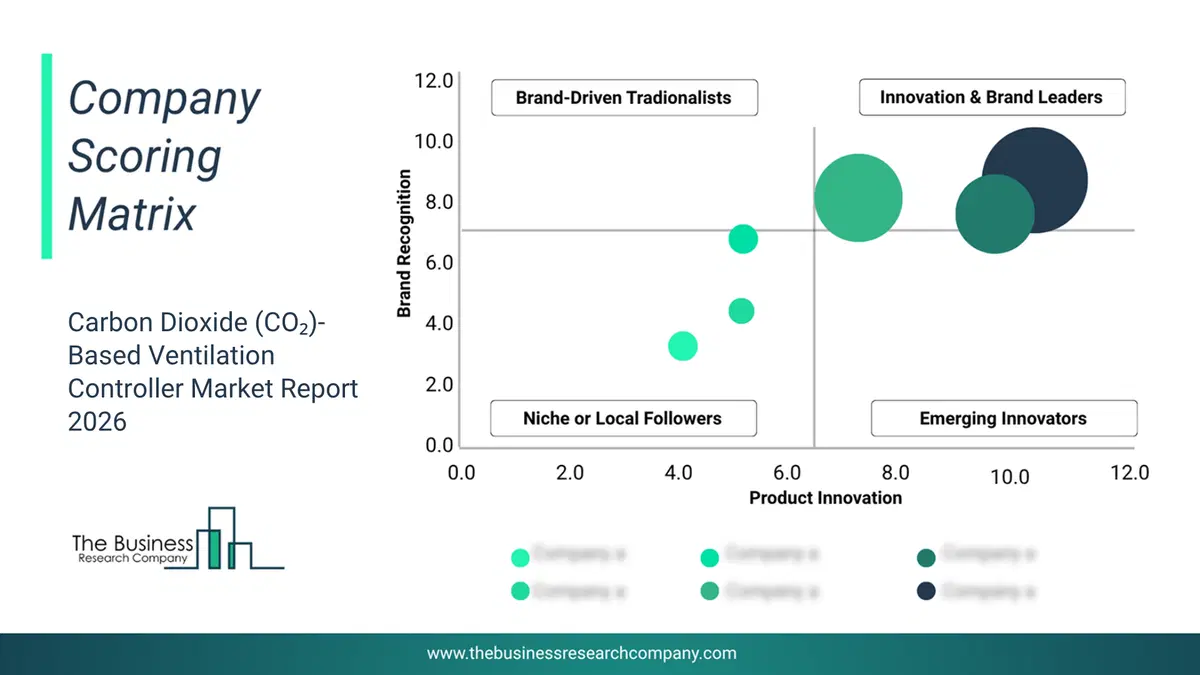
This chart maps companies by product innovation and brand strength, with bubble size indicating relative revenue, helping identify market leaders, challengers, and niche players. This is an illustrative chart; the full report provides a complete and accurate competitive analysis.
Global Carbon Dioxide (CO₂)-Based Ventilation Controller Market Trends and Insights
Major companies operating in the carbon dioxide (CO₂)-based ventilation controller market are focused on developing innovative solutions such as NDIR sensors to provide highly accurate and stable carbon dioxide measurements, enabling precise demand-controlled ventilation, improving indoor air quality, and reducing energy consumption. An NDIR sensor refers to a non-dispersive infrared sensor that measures gas concentrations, such as CO₂, by detecting the absorption of specific infrared light wavelengths. For instance, in March 2023, Vaisala Oyj, a Finland-based industrial and environmental measurement solutions company, expanded its HVAC portfolio with the launch of the GMD110 duct-mounted CO₂ transmitter. The GMD110 integrates Vaisala’s advanced CARBOCAP NDIR sensor technology, offering long-term accuracy, stability, and reduced maintenance requirements. Designed with an IP65-rated enclosure, the transmitter delivers reliable performance even in environments exposed to dust, humidity, or chemical interference. By enabling precise demand-controlled ventilation, the GMD110 enhances energy efficiency, promotes sustainability, and supports healthier indoor air quality.What Are Latest Mergers And Acquisitions In The Carbon Dioxide (CO₂)-Based Ventilation Controller Market?
In January 2024, Lindab, a Sweden-based company that provides ventilation systems for energy-efficient buildings and healthy indoor climates, acquired Airmaster A/S for an undisclosed amount. Through this acquisition, Lindab aims to expand its decentralized ventilation product portfolio, enhance energy-efficient indoor air quality solutions, and strengthen its presence in key European markets. Airmaster A/S is a Denmark-based company that provides flexible and intelligent decentralized ventilation solutions and accessories.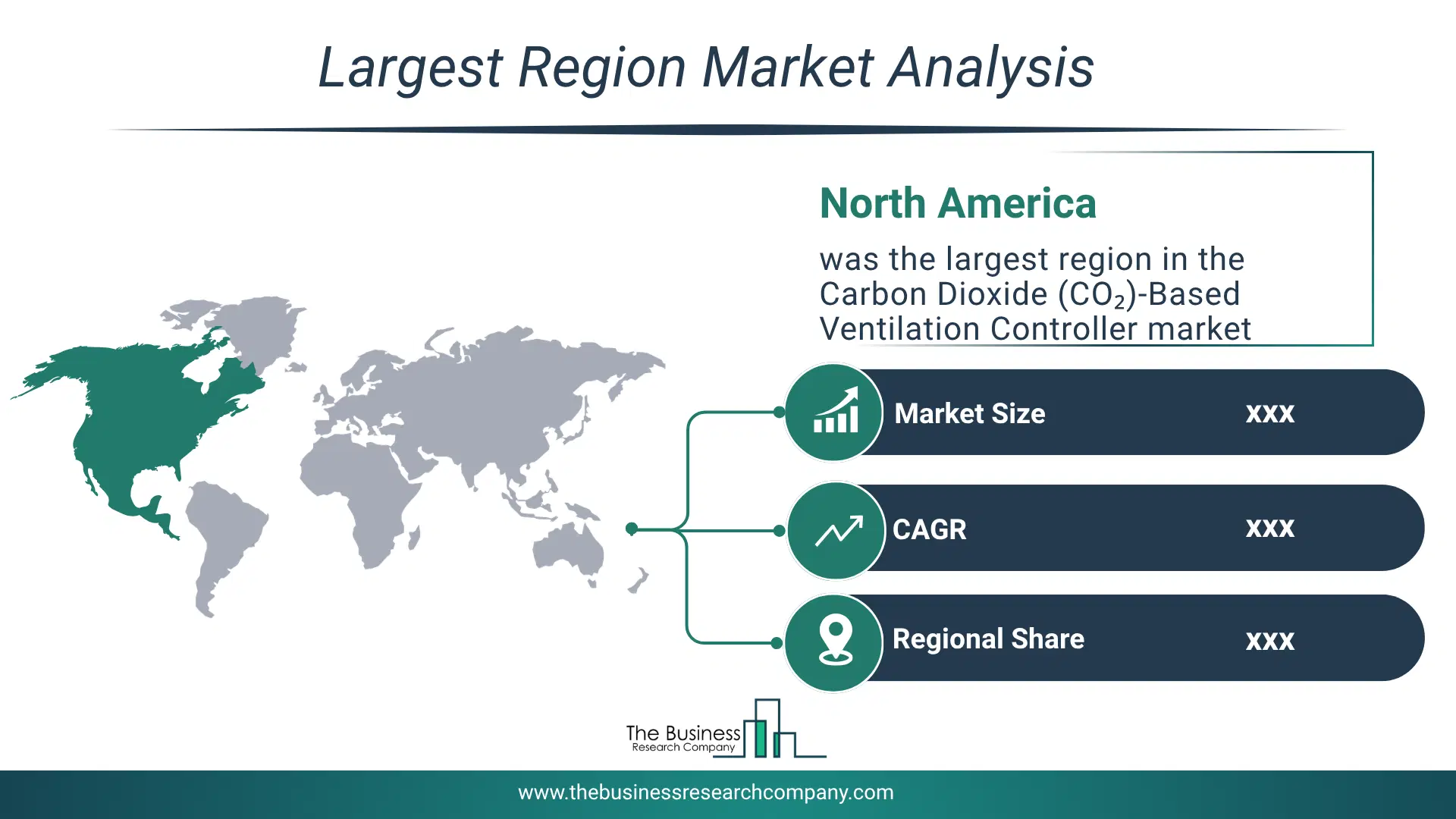
Regional Outlook
North America was the largest region in the carbon dioxide (CO₂)-based ventilation controller market in 2025. Asia-Pacific is expected to be the fastest-growing region in the forecast period. The regions covered in the carbon dioxide (co₂)-based ventilation controller market report are Asia-Pacific, South East Asia, Western Europe, Eastern Europe, North America, South America, Middle East, Africa. The countries covered in the carbon dioxide (co₂)-based ventilation controller market report are Australia, Brazil, China, France, Germany, India, Indonesia, Japan, Taiwan, Russia, South Korea, UK, USA, Canada, Italy, Spain.What Defines the Carbon Dioxide (CO₂)-Based Ventilation Controller Market?
The carbon dioxide (CO₂)-based ventilation controller market consists of sales of CO₂ sensors, ventilation controllers, air handling units, duct-mounted transmitters, demand-controlled ventilation systems, HVAC actuators, control panels, and data loggers. Values in this market are ‘factory gate’ values, that is the value of goods sold by the manufacturers or creators of the goods, whether to other entities (including downstream manufacturers, wholesalers, distributors and retailers) or directly to end customers. The value of goods in this market includes related services sold by the creators of the goods.How is Market Value Defined and Measured?
The market value is defined as the revenues that enterprises gain from the sale of goods and/or services within the specified market and geography through sales, grants, or donations in terms of the currency (in USD unless otherwise specified). The revenues for a specified geography are consumption values that are revenues generated by organizations in the specified geography within the market, irrespective of where they are produced. It does not include revenues from resales along the supply chain, either further along the supply chain or as part of other products.
This chart presents market attractiveness based on a quantitative evaluation of growth, competition, strategic alignment, and risk, offering a clear view of opportunity areas for decision-making. This chart is for illustrative purposes; the full report contains the complete analysis.

This chart highlights the Total Addressable Market (TAM) by estimating the maximum revenue opportunity using an assumption-driven approach, supporting strategic planning and opportunity sizing across markets. The chart is illustrative; the full report provides a more comprehensive analysis.
What Key Data and Analysis Are Included in the Carbon Dioxide (CO₂)-Based Ventilation Controller Market Report 2026?
The carbon dioxide (co₂)-based ventilation controller market research report is one of a series of new reports from The Business Research Company that provides market statistics, including industry global market size, regional shares, competitors with the market share, detailed market segments, market trends and opportunities, and any further data you may need to thrive in the carbon dioxide (co₂)-based ventilation controller industry. The market research report delivers a complete perspective of everything you need, with an in-depth analysis of the current and future state of the industry.Carbon Dioxide (CO₂)-Based Ventilation Controller Market Report Forecast Analysis
| Report Attribute | Details |
|---|---|
| Market Size Value In 2026 | $3.03 billion |
| Revenue Forecast In 2030 | $4.21 billion |
| Growth Rate | CAGR of 8.6% from 2026 to 2030 |
| Base Year For Estimation | 2025 |
| Actual Estimates/Historical Data | 2020-2025 |
| Forecast Period | 2026 - 2030 |
| Market Representation | Revenue in USD Billion and CAGR from 2026 to 2030 |
| Segments Covered | Product Type, Control Technology, Sensor Type, Application, Distribution Channel |
| Regional Scope | Asia-Pacific, Western Europe, Eastern Europe, North America, South America, Middle East, Africa |
| Country Scope | The countries covered in the report are Australia, Brazil, China, France, Germany, India, Indonesia, Japan, Taiwan, Russia, South Korea, UK, USA, Canada, Italy, Spain. |
| Key Companies Profiled | Siemens AG, Schneider Electric SE, Honeywell International Inc., ABB Ltd., Johnson Controls International plc, Trane Technologies plc, Delta Electronics Inc., Legrand SA, Vaisala Oyj, TROX GmbH, Dwyer Instruments Inc., Veris Industries LLC, KMC Controls Inc., Rotronic AG, Greystone Energy Systems Inc., Senseair AB, E+E Elektronik Ges.m.b.H., Belimo Holding AG, Ventilation Control Products Ltd., Calibration Technologies Inc., Sauter AG, CO2Meter.com. |
| Customization Scope | Request for Customization |
| Pricing And Purchase Options | Explore Purchase Options |