

Contact Us
  Search
The Business Research Company Logo
Carbon Dioxide Market 2025
Published :July 2025
Pages :363
Format :PDF
Delivery Time :2-3 Business Days
Why 2-3 days? We update the report with the latest data and news before delivery. Let us know if you need us to expedite.
Report Price :$4,490.00

Carbon Dioxide Market 2025

By Product Type (Liquid Carbon Dioxide, Solid Carbon Dioxide, Gaseous Carbon Dioxide), By Grade Type (Medical Grade, Food Grade, Industrial Grade, Other Grades), By Application (Food, Beverages, Oil And Gas, Medical, Metal Products Chemicals, Firefighting, Other Applications) - Market Size, Trends, And Global Forecast 2025-2034
Carbon_Dioxide_Global_Market_Opportunities_And_Strategies_To_2034_Market_2025_Graph

Carbon Dioxide Market Definition

Carbon dioxide (CO2) is an odorless, colorless gas with a slightly pungent, acid taste. Commercial carbon dioxide is recovered from industrial plants which produce hydrogen or ammonia from natural gas, coal and hydrocarbon feedstock. Corn-to-ethanol plants have been the most rapidly growing source of feed gas for CO2 recovery. CO2-rich natural gas reservoirs are another source of recoverable carbon dioxide. The carbon dioxide market consists of the sales of carbon dioxide by entities (organizations, sole traders or partnerships) that manufacture carbon dioxide gas in compressed, liquid and solid forms.
Research Expert

Book your 30 minutes free consultation with our research experts

Carbon Dioxide Market Size

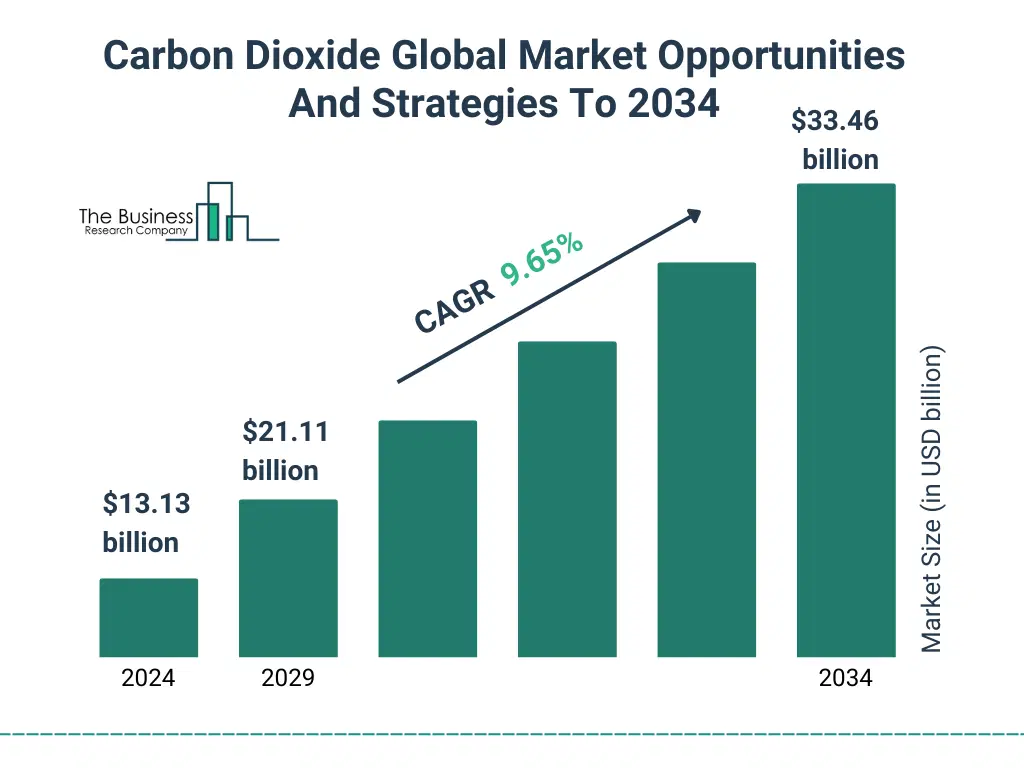
The global carbon dioxide market reached a value of nearly $13,127.20 million in 2024, having grown at a compound annual growth rate (CAGR) of 5.91% since 2019. The market is expected to grow from $13,127.20 million in 2024 to $21,113.07 million in 2029 at a rate of 9.97%. The market is then expected to grow at a CAGR of 9.65% from 2029 and reach $33,464.03 million in 2034. Growth in the historic period resulted from increasing awareness to reduce greenhouse gas emissions, rising demand from the food and beverage industry, growing government initiatives, expansion of the healthcare and medical sector and expansion of cold chain and refrigeration industries. Factors that negatively affected growth in the historic period were the uncertain regulatory landscape and safety concerns. Going forward, growth in enhanced oil recovery (EOR) projects, increasing adoption in metal fabrication and welding, expansion of chemical manufacturing industries and growing demand for firefighting support will drive growth. Factor that could hinder the growth of the carbon dioxide market in the future include were lack of CO2 infrastructure and competition from alternative gases.

Carbon Dioxide Market Drivers

The key drivers of the carbon dioxide market include: Growth In Enhanced Oil Recovery (EOR) Projects During the forecast period, the growth in enhanced oil recovery (EOR) projects are expected to propel the growth of the carbon dioxide market. Carbon dioxide (CO2) is injected into mature oil fields to enhance oil recovery by reducing viscosity and improving flow rates, a process known as CO2 flooding. As the demand for oil persists, especially from aging fields, the need for CO2 to support enhanced oil recovery (EOR) efforts is rising, driving a consistent demand for a reliable CO2 supply. EOR operations rely on long-term CO2 supply contracts, often spanning decades and creating stable, ongoing demand in regions with active projects. This has led companies in the EOR sector to establish long-term agreements with CO2 producers. The growth in enhanced oil recovery (EOR) projects growth contribution during the forecast period in 2024 is 2.50%.

Carbon Dioxide Market Restraints

The key restraints on the carbon dioxide market include: Lack Of CO2 Infrastructure The lack of CO2 infrastructure is expected to restrict the growth of the carbon dioxide market, during the forecast period. Limited transportation infrastructure for CO2, particularly in developing regions or remote areas, hampers efficient movement from capture sites to end users or storage locations. The lack of specialized pipelines, tanks, or refrigerated transport drives up costs and creates logistical challenges, limiting CO2's widespread use. Without reliable storage options, large-scale utilization and sequestration projects face feasibility challenges. Additionally, underdeveloped capture and compression systems hinder CO2 capture from industrial processes. The high capital investment required for advanced equipment and infrastructure, combined with limited government incentives in certain regions, prevents many industries from participating in the CO2 supply chain. Growth affected by lack of CO2 infrastructure during the forecast period in 2024 is -1.00%.

Need data on a specific region in this market?

Opportunities And Recommendations In The Carbon Dioxide Market

Opportunities – The top opportunities in the carbon dioxide market segmented by type will arise in the raw segment, which will gain $223,052.16 million of global annual sales by 2028. The top opportunities in the carbon dioxide market segmented by product will arise in the chicken segment, which will gain $155,104.91 million of global annual sales by 2028. The top opportunities in the carbon dioxide market segmented by distribution channel will arise in the supermarkets and hypermarkets segment, which will gain $154,564.20 million of global annual sales by 2028. The carbon dioxide market size will gain the most in Brazil at $39,788.47 million. Recommendations- To take advantage of the opportunities, The Business Research Company recommends the carbon dioxide to focus on enhancing CCUS operations through digital platform development, focus on leveraging digital platforms for carbon data management, focus on scaling innovative carbon capture technologies, focus on advancing carbon dioxide separation technologies for reuse and sustainability, focus on developing nature-based solutions for carbon sequestration, focus on solid carbon dioxide to capture high-growth opportunities, focus on medical grade carbon dioxide to maximize growth potential, expand in emerging markets, continue to focus on developed markets, focus on expanding distribution channels through strategic partnerships, focus on pricing strategies for carbon dioxide companies, focus on digital and direct marketing strategies, focus on industry-specific messaging and focus on firefighting segment to leverage highest growth in application areas.
Chat with us