
Carbon Intensity Monitoring For Shipping Market Report 2026
Global Outlook – By Component (Software; Hardware; Services), By Vessel Type (Bulk Carriers; Tankers; Container Ships; General Cargo Ships; Other Vessel Types), By Deployment Mode (On-Premises; Cloud), By Application (Fleet Management; Regulatory Compliance; Emissions Reporting; Performance Optimization; Other Applications), By End-User (Commercial Shipping; Passenger Shipping; Offshore Support Vessels; Other End-Users) – Market Size, Trends, Strategies, and Forecast to 2030
Carbon Intensity Monitoring For Shipping Market Overview
• Carbon Intensity Monitoring For Shipping market size has reached to $1.2 billion in 2025 • Expected to grow to $2.58 billion in 2030 at a compound annual growth rate (CAGR) of 16.4% • Growth Driver: Rising Vessel Traffic Fueling The Growth Of The Market Due To Increasing Need For Emissions Management And Fuel Optimization • Market Trend: Technological Innovations Enabling Reliable Emissions Assessment • Europe was the largest region in 2025 and Asia-Pacific is the fastest growing region.What Is Covered Under Carbon Intensity Monitoring For Shipping Market?
Carbon intensity monitoring for shipping refers to the process of tracking and analyzing greenhouse gas emissions generated by vessels during maritime operations. It utilizes advanced sensors, digital platforms, and analytics tools to measure fuel consumption and carbon output in real time. This monitoring enables shipping companies to optimize routes, improve energy efficiency, and comply with environmental regulations. The main components of carbon intensity monitoring for shipping include software, hardware, and services. Software refers to digital platforms and applications that collect, analyze, and report emissions data to track a vessel’s carbon intensity in compliance with international regulations. These systems are deployed across various vessel types such as bulk carriers, tankers, container ships, general cargo ships, and others, and can operate either through cloud-based or on-premises solutions. They are applied in fleet management, regulatory compliance, emissions reporting, and performance optimization, with end-users including commercial shipping, passenger shipping, offshore support vessels, and others.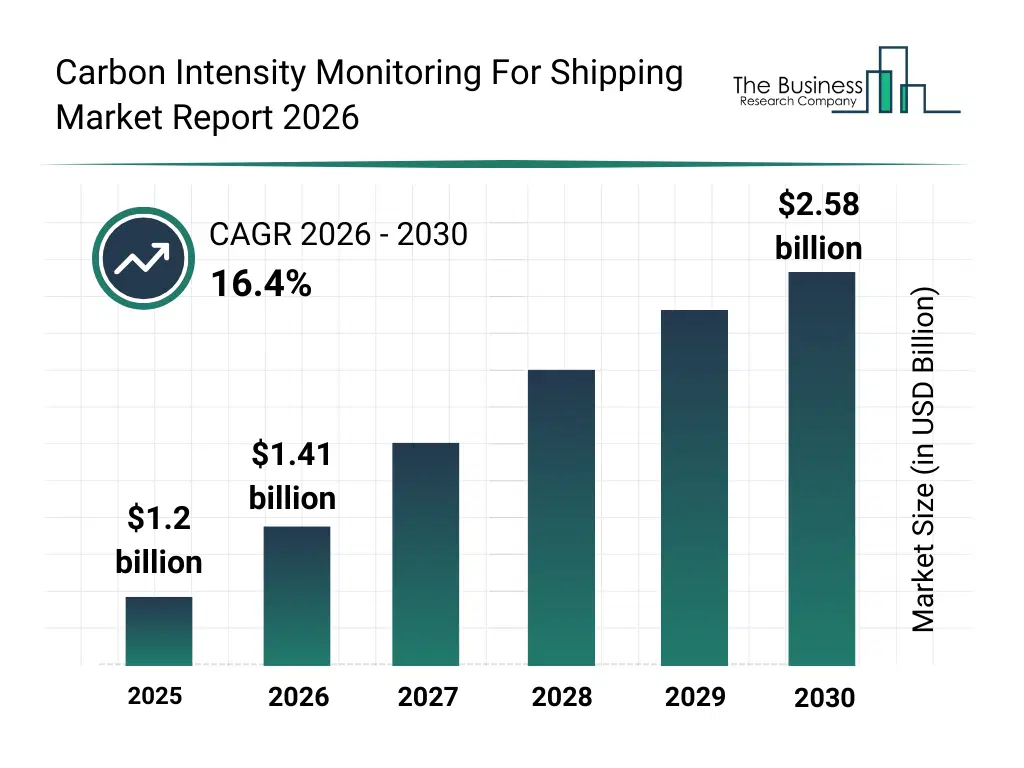
What Is The Carbon Intensity Monitoring For Shipping Market Size and Share 2026?
The carbon intensity monitoring for shipping market size has grown rapidly in recent years. It will grow from $1.2 billion in 2025 to $1.41 billion in 2026 at a compound annual growth rate (CAGR) of 16.7%. The growth in the historic period can be attributed to introduction of maritime emission regulations, rising awareness of shipping emissions, adoption of onboard fuel monitoring systems, growth of digital fleet management solutions, increasing transparency in maritime operations.What Is The Carbon Intensity Monitoring For Shipping Market Growth Forecast?
The carbon intensity monitoring for shipping market size is expected to see rapid growth in the next few years. It will grow to $2.58 billion in 2030 at a compound annual growth rate (CAGR) of 16.4%. The growth in the forecast period can be attributed to increasing enforcement of carbon intensity regulations, rising investments in low-emission shipping technologies, expansion of cloud-based monitoring platforms, growing demand for automated compliance reporting, increasing integration of ai-driven emission analytics. Major trends in the forecast period include increasing deployment of real-time emission monitoring systems, rising adoption of digital carbon reporting platforms, growing integration of fuel consumption analytics, expansion of regulatory compliance monitoring tools, enhanced focus on voyage-level emission optimization.
Global Carbon Intensity Monitoring For Shipping Market Segmentation
1) By Component: Software, Hardware, Services 2) By Vessel Type: Bulk Carriers, Tankers, Container Ships, General Cargo Ships, Other Vessel Types 3) By Deployment Mode: On-Premises, Cloud 4) By Application: Fleet Management, Regulatory Compliance, Emissions Reporting, Performance Optimization, Other Applications 5) By End-User: Commercial Shipping, Passenger Shipping, Offshore Support Vessels, Other End-Users Subsegments: 1) By Software: Emissions Tracking And Reporting Software, Data Analytics And Visualization Platforms, Compliance Management Software, Voyage Optimization Software, Predictive Maintenance And Performance Monitoring Tools, Cloud-Based Carbon Monitoring Platforms 2) By Hardware: Emission Sensors And Analyzers, Data Acquisition Systems, Satellite And Global Positioning System (GPS) Tracking Devices, Onboard Monitoring Units, Internet Of Things (IoT) Gateways And Edge Devices, Communication And Networking Equipment 3) By Services: Installation And Integration Services, Calibration And Maintenance Services, Data Collection And Validation Services, Regulatory Consulting And Compliance Services, Training And Support Services, Fleet Performance Assessment And Optimization ServicesWhat Is The Driver Of The Carbon Intensity Monitoring For Shipping Market?
The increasing vessel traffic is expected to propel the growth of the carbon intensity monitoring for shipping market going forward. Increasing vessel traffic refers to the rising number of ships calling at ports, harbors, and terminals as global trade expands. Vessel traffic is increasing because container and bulk cargo volumes surged post-pandemic, driven by growth in international trade and port throughput. Carbon intensity monitoring for shipping helps manage and reduce emissions per voyage, optimize fuel efficiency, and ensure regulatory compliance amid increasing vessel traffic. For instance, in February 2025, according to the Port Authority of New York and New Jersey, a US-based bi-state agency, monthly twenty-foot equivalent unit (TEU) volumes at its facilities reached 718,826, representing a 12% jump from February 2024, while December’s TEU total of 688,180 marked a 9% increase over December 2023. Therefore, the increasing vessel traffic is driving the growth of the carbon intensity monitoring for shipping industry.Key Players In The Global Carbon Intensity Monitoring For Shipping Market
Major companies operating in the carbon intensity monitoring for shipping market are Hanwha Group, Wärtsilä Corporation, Bureau Veritas S.A., American Bureau of Shipping (ABS), DNV AS, Lloyd’s Register Group Limited, Gaztransport & Technigaz S.A. (GTT), Kongsberg Digital AS, ZeroNorth A/S, RightShip Pty Ltd, Veson Nautical Corporation, Marine Benchmark AB, Danfoss IXA A/S, Spinergie SAS, Blue Water Trade Winds Private Limited, CargoMetrics Technologies LLC, ClassNK (Nippon Kaiji Kyokai), Everimpact SAS, Raymetrics S.A., Tunable AS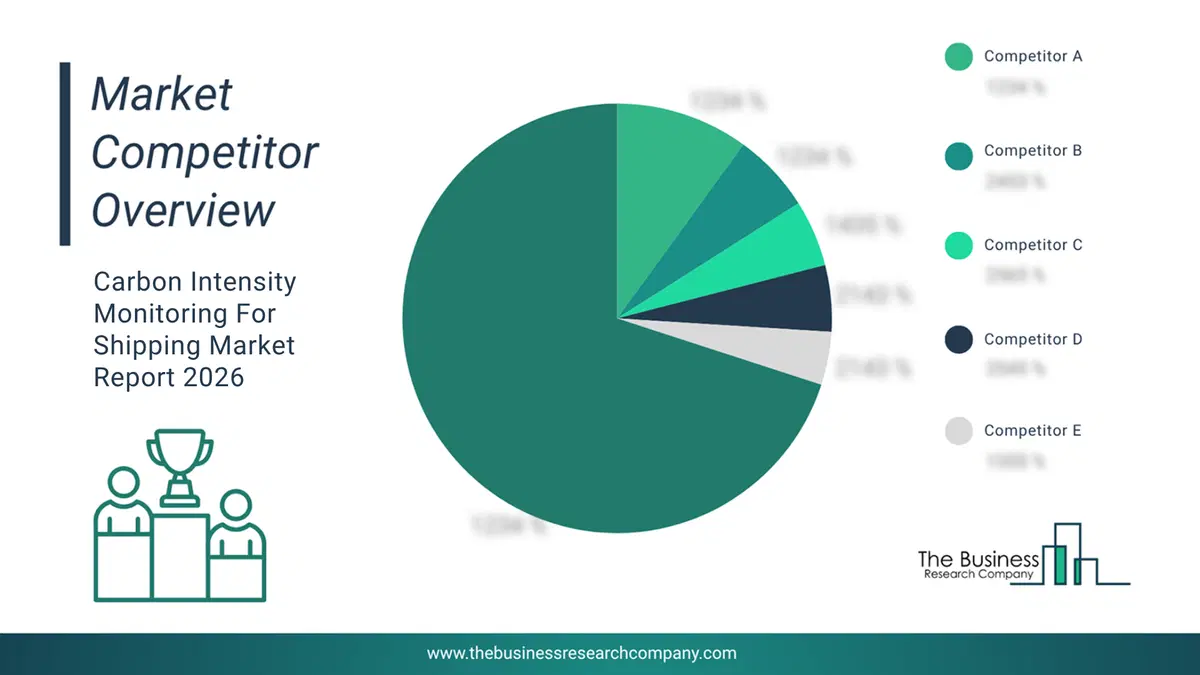
This chart is for illustrative purposes; the full report includes a detailed competitor analysis and comprehensive overview of the top 10 companies in the market.
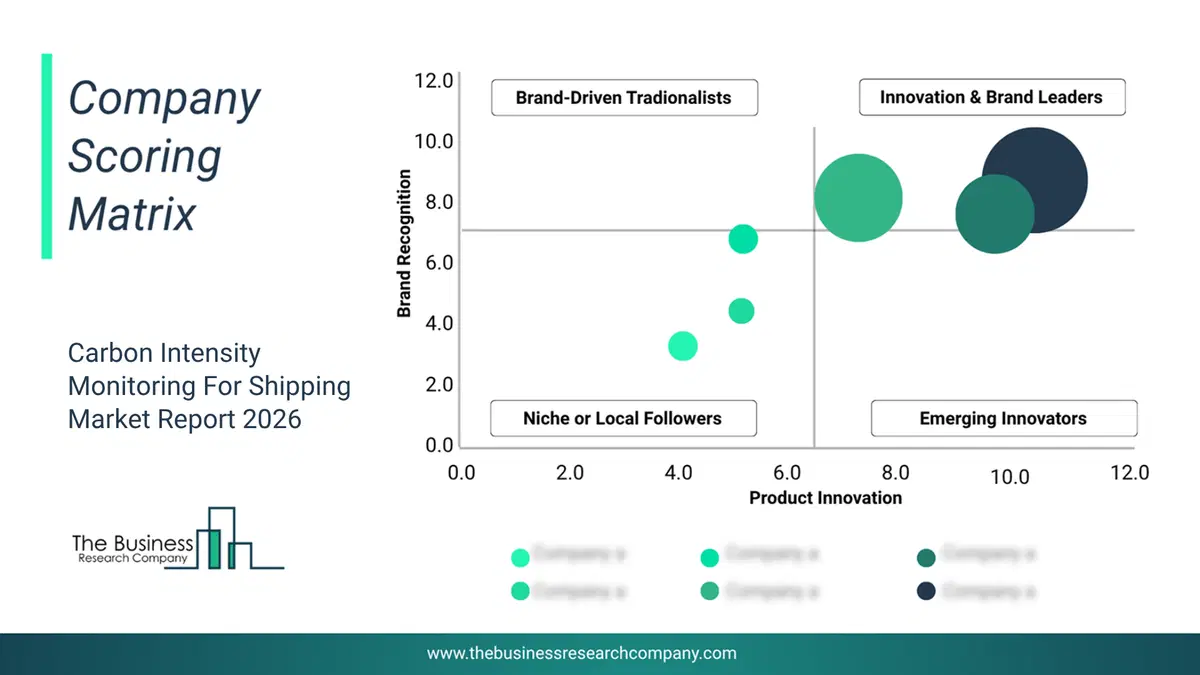
This chart maps companies by product innovation and brand strength, with bubble size indicating relative revenue, helping identify market leaders, challengers, and niche players. This is an illustrative chart; the full report provides a complete and accurate competitive analysis.
Global Carbon Intensity Monitoring For Shipping Market Trends and Insights
Major companies are operating in the carbon intensity monitoring for the shipping market, focusing on technological advancements such as reworked methodology to enhance emissions measurement accuracy, improve data transparency, and support compliance with evolving maritime decarbonization regulations. Reworked methodology refers to the updated calculation frameworks, measurement standards, and assessment criteria developed to more accurately evaluate and benchmark a vessel’s greenhouse gas emissions and carbon intensity performance. For instance, in September 2023, RightShip, a UK-based maritime risk management and environmental performance platform, launched the updated GHG 2.0 Rating, featuring an improved methodology designed to enhance transparency and accuracy in assessing the greenhouse gas performance of vessels, thereby supporting efforts toward maritime decarbonization. The revised methodology incorporates new data sources and stricter evaluation criteria to provide more reliable and meaningful insights for shipowners, charterers, and regulators aiming to reduce shipping’s carbon footprint.What Are Latest Mergers And Acquisitions In The Carbon Intensity Monitoring For Shipping Market?
In November 2023, Danelec, a Denmark-based company that offers ship performance monitoring acquired Nautilus Labs for an undisclosed amount. With this acquisition, Danelec aimed to integrate advanced AI-driven carbon intensity and voyage optimization capabilities into its ship performance monitoring solutions, enhancing its offerings for sustainable and efficient maritime operations. Nautilus Labs is a US-based company that offers carbon intensity monitoring for shipping through its AI-powered platform.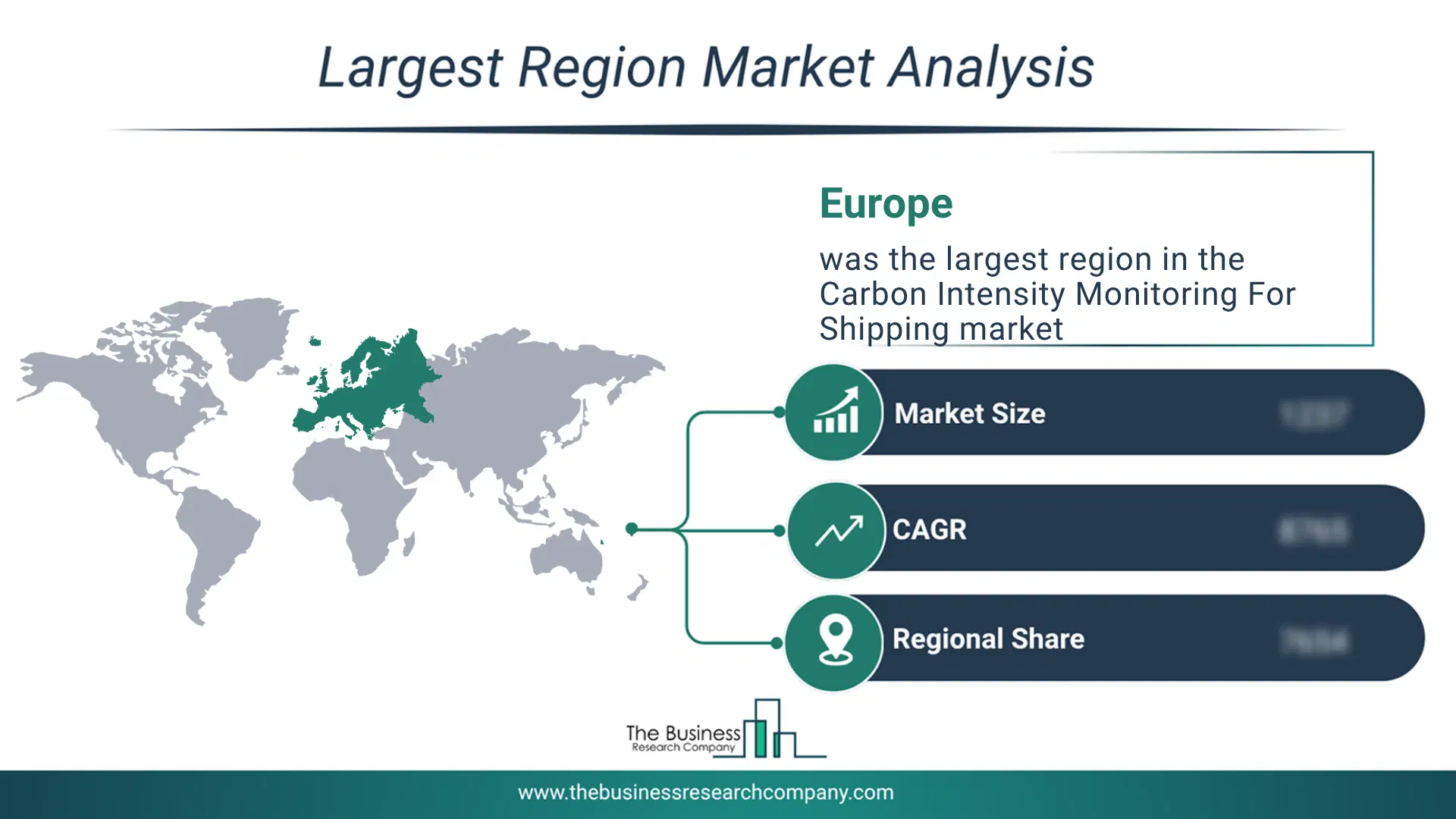
Regional Outlook
Europe was the largest region in the carbon intensity monitoring for shipping market in 2025. Asia-Pacific is expected to be the fastest-growing region in the forecast period. The regions covered in this market report are Asia-Pacific, South East Asia, Western Europe, Eastern Europe, North America, South America, Middle East, Africa. The countries covered in this market report are Australia; Brazil; China; France; Germany; India; Indonesia; Japan; Taiwan; Russia; South Korea; UK; USA; Canada; Italy; Spain.What Defines the Carbon Intensity Monitoring For Shipping Market?
The carbon intensity monitoring for shipping market consists of revenues earned by entities by providing services such as real-time emission analytics consulting, carbon footprint verification and certification, predictive maintenance for fuel efficiency, route optimization advisory and environmental impact assessment. The market value includes the value of related goods sold by the service provider or included within the service offering. The carbon intensity monitoring for shipping market also includes sales of onboard emission sensors, fuel flow meters, iot-enabled engine monitoring devices, energy efficiency management software and satellite-based voyage monitoring systems. Values in this market are ‘factory gate’ values; that is the value of goods sold by the manufacturers or creators of the goods, whether to other entities (including downstream manufacturers, wholesalers, distributors and retailers) or directly to end customers. The value of goods in this market includes related services sold by the creators of the goods.How is Market Value Defined and Measured?
The market value is defined as the revenues that enterprises gain from the sale of goods and/or services within the specified market and geography through sales, grants, or donations in terms of the currency (in USD unless otherwise specified). The revenues for a specified geography are consumption values that are revenues generated by organizations in the specified geography within the market, irrespective of where they are produced. It does not include revenues from resales along the supply chain, either further along the supply chain or as part of other products.
This chart presents market attractiveness based on a quantitative evaluation of growth, competition, strategic alignment, and risk, offering a clear view of opportunity areas for decision-making. This chart is for illustrative purposes; the full report contains the complete analysis.

This chart highlights the Total Addressable Market (TAM) by estimating the maximum revenue opportunity using an assumption-driven approach, supporting strategic planning and opportunity sizing across markets. The chart is illustrative; the full report provides a more comprehensive analysis.
What Key Data and Analysis Are Included in the Carbon Intensity Monitoring For Shipping Market Report 2026?
The carbon intensity monitoring for shipping market research report is one of a series of new reports from The Business Research Company that provides market statistics, including Market Report 2026?global market size, regional shares, competitors with the market share, detailed market segments, market trends and opportunities, and any further data you may need to thrive in the carbon intensity monitoring for shipping Market Report 2026? The market research report delivers a complete perspective of everything you need, with an in-depth analysis of the current and future state of the Market Report 2026?Carbon Intensity Monitoring For Shipping Market Report Forecast Analysis
| Report Attribute | Details |
|---|---|
| Market Size Value In 2026 | $1.41 billion |
| Revenue Forecast In 2030 | $2.58 billion |
| Growth Rate | CAGR of 16.7% from 2026 to 2030 |
| Base Year For Estimation | 2025 |
| Actual Estimates/Historical Data | 2020-2025 |
| Forecast Period | 2026 - 2030 - 2030 |
| Market Representation | Revenue in USD Billion and CAGR from 2026 to 2030 |
| Segments Covered | Component, Vessel Type, Deployment Mode, Application, End-User |
| Regional Scope | Asia-Pacific, Western Europe, Eastern Europe, North America, South America, Middle East, Africa |
| Country Scope | The countries covered in the report are Australia, Brazil, China, France, Germany, India, Indonesia, Japan, Taiwan, Russia, South Korea, UK, USA, Canada, Italy, Spain. |
| Key Companies Profiled | Hanwha Group, Wärtsilä Corporation, Bureau Veritas S.A., American Bureau of Shipping (ABS), DNV AS, Lloyd’s Register Group Limited, Gaztransport & Technigaz S.A. (GTT), Kongsberg Digital AS, ZeroNorth A/S, RightShip Pty Ltd, Veson Nautical Corporation, Marine Benchmark AB, Danfoss IXA A/S, Spinergie SAS, Blue Water Trade Winds Private Limited, CargoMetrics Technologies LLC, ClassNK (Nippon Kaiji Kyokai), Everimpact SAS, Raymetrics S.A., Tunable AS |
| Customization Scope | Request for Customization |
| Pricing And Purchase Options | Explore Purchase Options |