
Carbon Neutral Food Market Report 2026
Global Outlook – By Type (Vegetables And Fruits, Meat And Poultry, Dairy Foods, Other Types), By Carbon Footprint (Carbon Neutral, Carbon Negative, Low-Carbon), By Target Consumer (Environmentalists, Health-Conscious Consumers, Vegan And Vegetarian Consumers), By Application (Food Manufacturing, Retail, Distribution) – Market Size, Trends, Strategies, and Forecast to 2030
Carbon Neutral Food Market Overview
• Carbon Neutral Food market size has reached to $94.02 billion in 2025 • Expected to grow to $145.96 billion in 2030 at a compound annual growth rate (CAGR) of 9.2% • Growth Driver: Rising Demand For Sustainable Food Driving Growth In The Market Due To Growing Consumer Awareness And Industry Commitments • Market Trend: Advancing Sustainability Through Technological Innovations In Food Alternatives • Asia-Pacific was the largest region in 2025.What Is Covered Under Carbon Neutral Food Market?
Carbon-neutral food typically refers to food products that have a net-zero carbon footprint, meaning the emissions generated during production, processing, transportation, and disposal are fully offset. They are often produced using sustainable practices such as regenerative agriculture, renewable energy, and carbon offset programs to minimize environmental impact. The main carbon neutral foods are vegetables and fruits, meat and poultry, dairy foods, and others. Vegetables and fruits are plant-based foods that grow naturally and are rich in essential nutrients like vitamins, minerals, and fiber. It can be carbon neutral, carbon negative or low-carbon and is consumed by environmentalists, health-conscious consumers, vegan and vegetarian consumers. It is applied for food manufacturing, retail and distribution.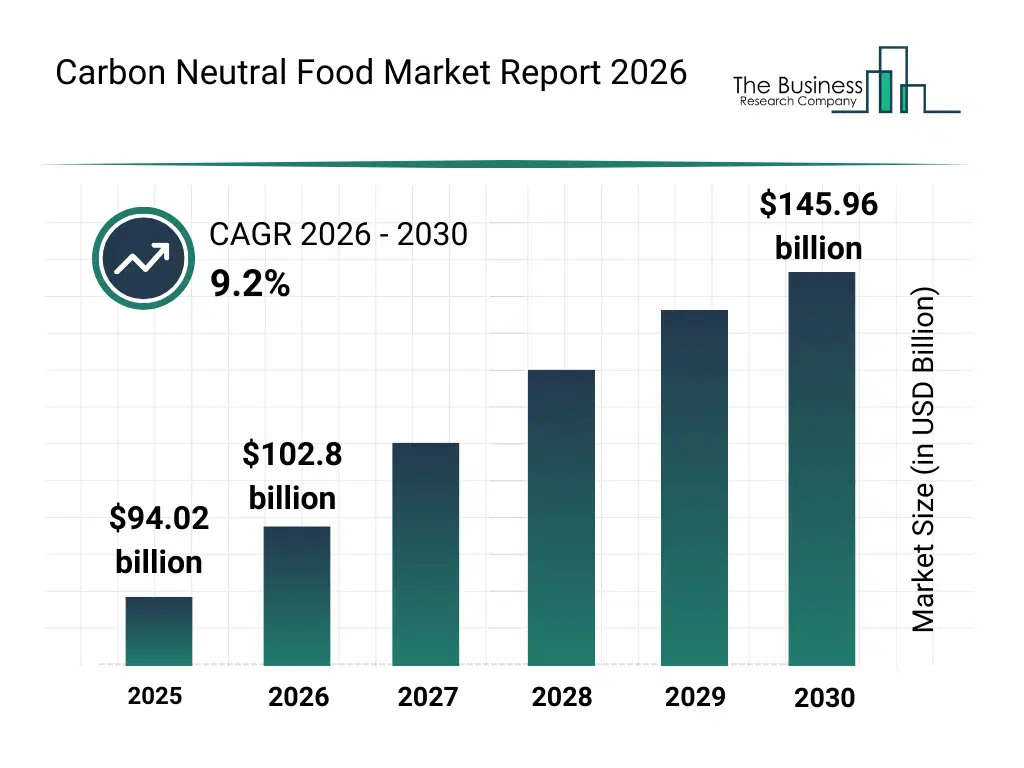
What Is The Carbon Neutral Food Market Size and Share 2026?
The carbon neutral food market size has grown strongly in recent years. It will grow from $94.02 billion in 2025 to $102.8 billion in 2026 at a compound annual growth rate (CAGR) of 9.3%. The growth in the historic period can be attributed to growth of organic and sustainable food consumption, increasing environmental awareness among consumers, early adoption of carbon offset programs, expansion of eco-labeled food products, development of sustainable farming practices.What Is The Carbon Neutral Food Market Growth Forecast?
The carbon neutral food market size is expected to see strong growth in the next few years. It will grow to $145.96 billion in 2030 at a compound annual growth rate (CAGR) of 9.2%. The growth in the forecast period can be attributed to rising demand for verified carbon-neutral foods, increasing regulatory focus on food sustainability disclosures, expansion of regenerative farming investments, growing consumer preference for low-impact diets, rising use of blockchain-based traceability. Major trends in the forecast period include expansion of regenerative agriculture food products, growing adoption of carbon footprint labeling, rising demand for sustainable protein alternatives, increased use of renewable energy in food production, enhanced supply chain transparency.
Global Carbon Neutral Food Market Segmentation
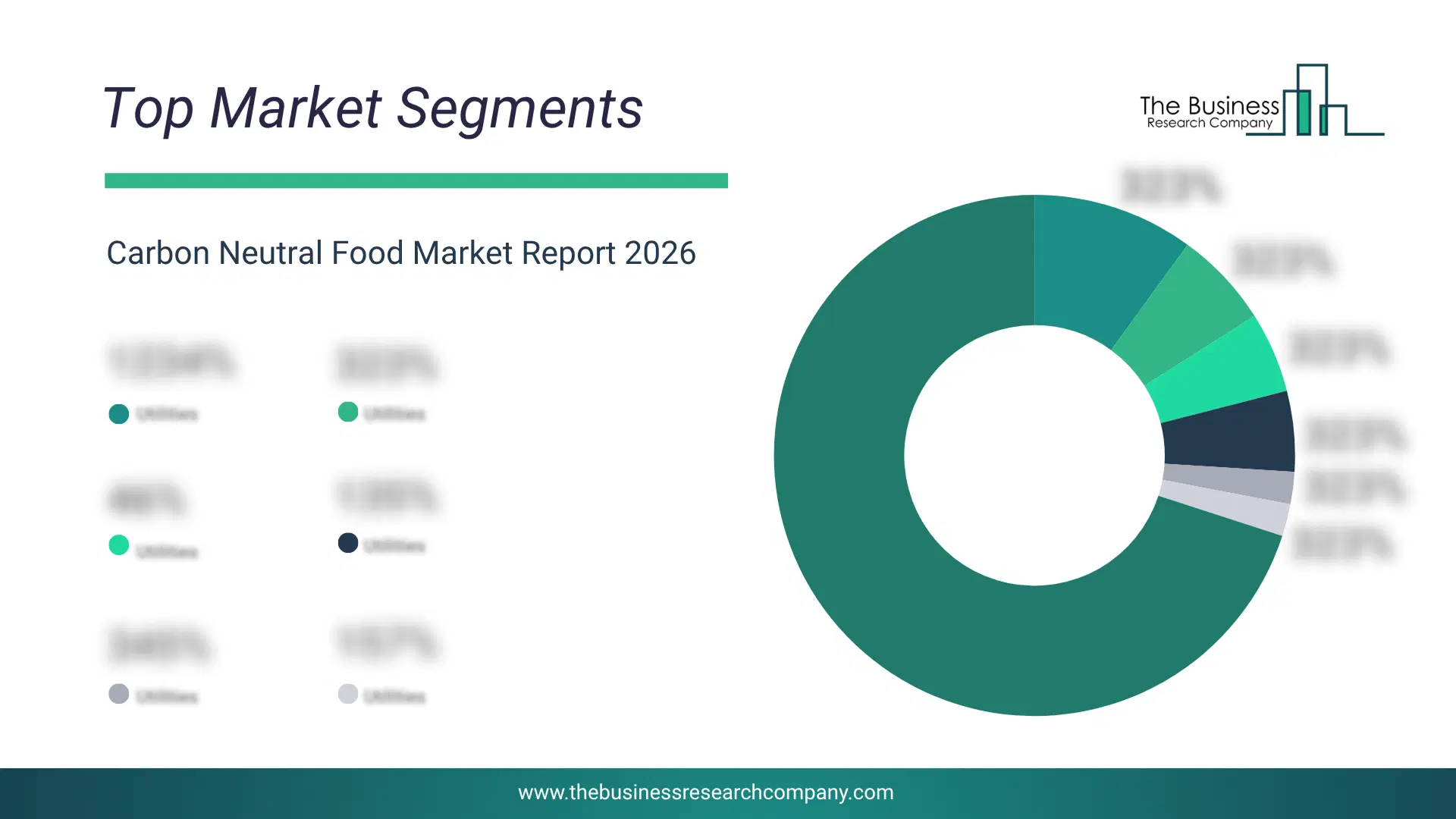
1) By Type: Vegetables And Fruits, Meat And Poultry, Dairy Foods, Other Types 2) By Carbon Footprint: Carbon Neutral, Carbon Negative, Low-Carbon 3) By Target Consumer: Environmentalists, Health-Conscious Consumers, Vegan And Vegetarian Consumers 4) By Application: Food Manufacturing, Retail, Distribution Subsegments: 1) By Vegetables And Fruits: Organic Vegetables and Fruits, Regenerative Agriculture Produce, Hydroponic and Vertical Farm Produce, Locally Sourced Seasonal Produce, Exotic and Superfoods, Carbon-Neutral Packaged Fruits And Vegetables 2) By Meat and Poultry: Grass-Fed and Pasture-Raised Meat, Free-Range Poultry, Carbon-Neutral Processed Meat, Low-Emission Feed Livestock, Lab-Grown (Cultured) Meat, Insect-Based Protein Meat Alternatives 3) By Dairy Foods: Carbon-Neutral Milk, Organic and Grass-Fed Dairy Products, Low-Emission Cheese and Butter, Regenerative Dairy Farming Products, Dairy Alternatives, Cultured Dairy Products 4) By Other Types: Carbon-Neutral Grains And Cereals, Sustainable Seafood And Aquaculture Products, Plant-Based Protein And Meat Substitutes, Carbon-Neutral Snacks And Processed Foods, Low-Carbon Beverages, Sustainable Fats And OilsWhat Is The Driver Of The Carbon Neutral Food Market?
The increasing demand for sustainable food is expected to propel the growth of the carbon-neutral food market during the forecast period. Sustainable food refers to food produced, processed, and consumed in environmentally, socially, and economically responsible ways, ensuring that future generations can meet their needs without compromising the health of the planet or its inhabitants. The demand for sustainable foods is rising due to growing awareness of traditional food production systems' environmental, social, and health impacts. Consumers are becoming more conscious of the significant carbon emissions, resource depletion, and biodiversity loss associated with conventional agriculture and industrial food systems. The rising demand for sustainable food drives the adoption of carbon-neutral food practices by encouraging producers to use renewable energy, regenerative agriculture, and carbon offset programs, ultimately reducing greenhouse gas emissions in the food supply chain. For instance, in January 2025, according to a report published by Sodexo, a France-based food services and facilities management company, in 2024, 68% of consumers continued to view sustainable food positively, nearly identical to the 69% recorded last year. The company has committed to ensuring that by 2030, 70% of its main dishes in its UK and Ireland locations will be classified as low-carbon. This goal includes reducing the carbon footprint of these dishes to just 0.9 kg CO₂e, a significant decrease from the current average of 2–2.5 kg CO₂e. Therefore, the increasing demand for sustainable food drives the carbon-neutral food market.Key Players In The Global Carbon Neutral Food Market
Major companies operating in the carbon neutral food market are Kroger, Mars Incorporated, Sodexo, Charoen Pokphand Foods PCL, Conagra Brands Inc., Maple Leaf Foods Inc., Yorkshire Tea, Quorn Foods, Gerber, Leon Restaurants Ltd., LightLife Foods Inc., Bread Alone, Alter Eco, Planet FWD, Puffin Produce, Future Farm, Alara Wholefoods Ltd., Neutral Foods Inc., Organic Tap, vEEF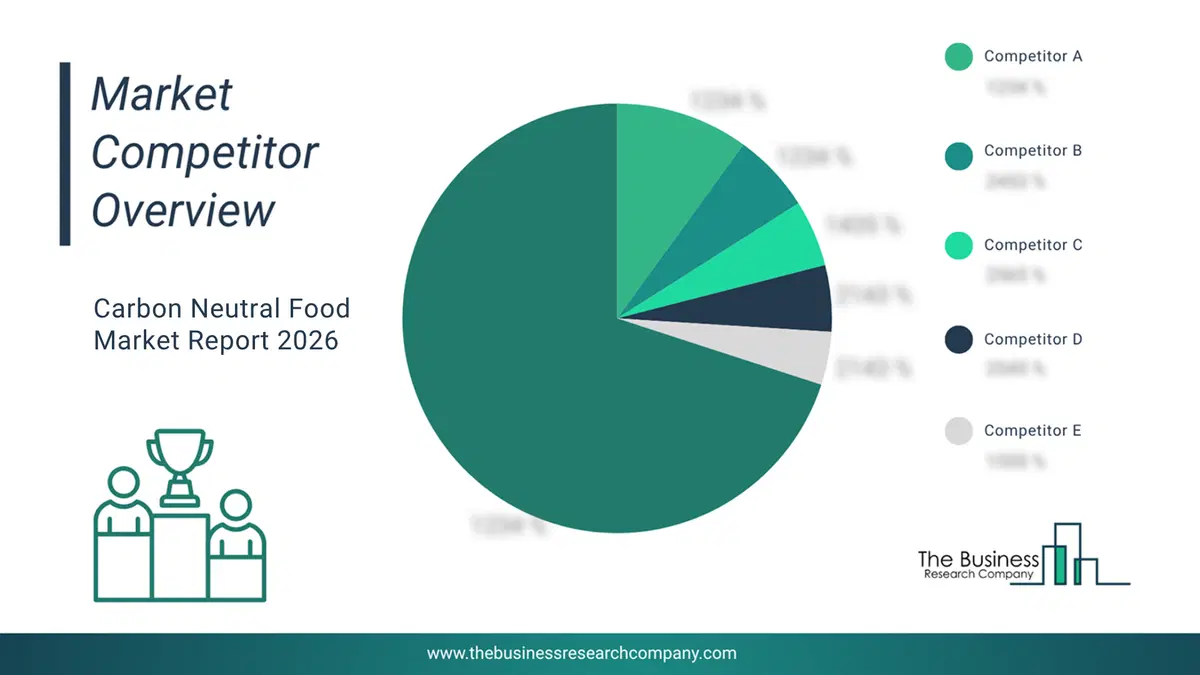
This chart is for illustrative purposes; the full report includes a detailed competitor analysis and comprehensive overview of the top 10 companies in the market.
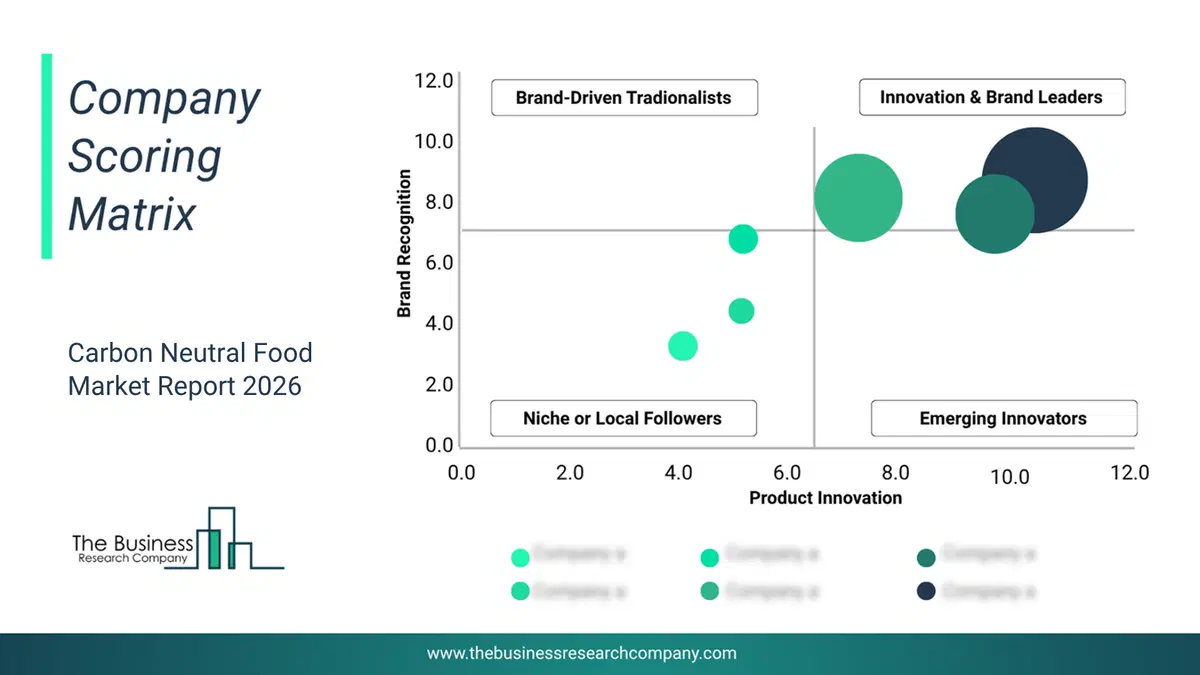
This chart maps companies by product innovation and brand strength, with bubble size indicating relative revenue, helping identify market leaders, challengers, and niche players. This is an illustrative chart; the full report provides a complete and accurate competitive analysis.
Global Carbon Neutral Food Market Trends and Insights
Major companies operating in the carbon-neutral food market are focusing on developing technologically advanced products, such as plant-based meats, to offer a sustainable, ethical, and healthier alternative to traditional meat by reducing environmental impact, eliminating animal cruelty, and often containing lower cholesterol and saturated fats. Plant-based meats are products made from plant ingredients, such as soy, peas, or wheat, designed to replicate traditional animal meat's taste, texture, and nutritional profile. For instance, in September 2024, vEEF, an Australia-based meat brand, introduced a lineup of four carbon-neutral products, all priced competitively or lower than traditional animal-based alternatives. The range includes plant-based smokey sausages, plant-based classic sausages, beef mince, and chorizo sausages. These products are chef-crafted, rich in nutrients, and have 50% less plastic packaging than previous vEEF products. It aligns with the primary reasons for reducing meat consumption: improving health, protecting the environment, and managing costs.What Are Latest Mergers And Acquisitions In The Carbon Neutral Food Market?
In October 2024, Smart Foods, an Australia-based food manufacturer, acquired The Aussie Plant-Based Co. for an undisclosed amount. With this acquisition, the company restarted operations at The Aussie Plant-Based Co.’s facility on the Sunshine Coast, aiming to expand distribution across Australia and secure listings at all major retailers. The Aussie Plant-Based Co. is an Australia-based plant-based food company that produces carbon-neutral food.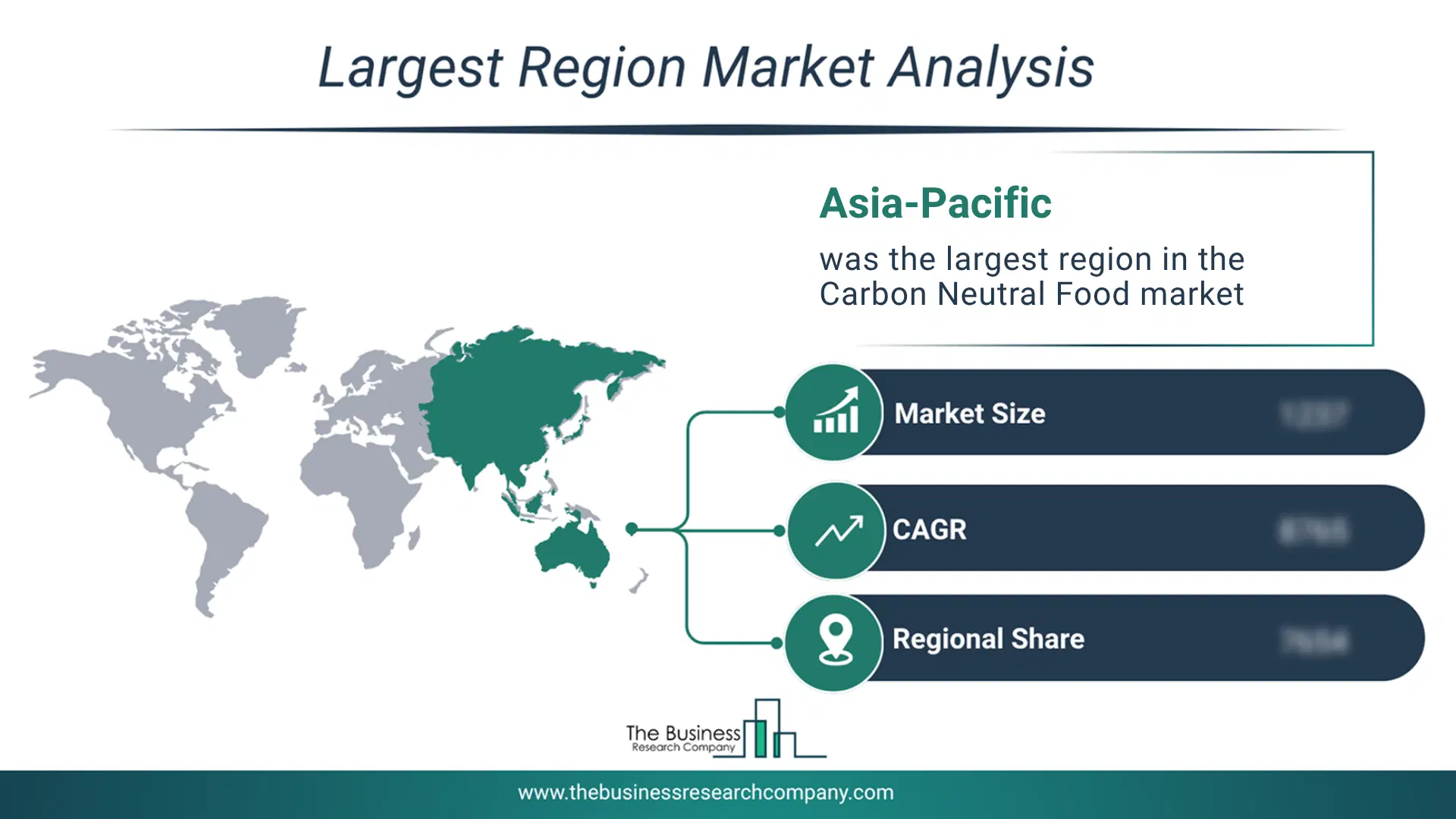
Regional Outlook
Asia-Pacific was the largest region in the canola meal market in 2025. The regions covered in this market report are Asia-Pacific, South East Asia, Western Europe, Eastern Europe, North America, South America, Middle East and Africa. The countries covered in this market report are Australia, Brazil, China, France, Germany, India, Indonesia, Japan, Taiwan, Russia, South Korea, UK, USA, Italy, Spain, CanadaWhat Defines the Carbon Neutral Food Market?
The carbon neutral food market consists of sales of sustainably produced food, plant-based products, and carbon-offset food items. Values in this market are ‘factory gate’ values, that is the value of goods sold by the manufacturers or creators of the goods, whether to other entities (including downstream manufacturers, wholesalers, distributors and retailers) or directly to end customers. The value of goods in this market includes related services sold by the creators of the goods.How is Market Value Defined and Measured?
The market value is defined as the revenues that enterprises gain from the sale of goods and/or services within the specified market and geography through sales, grants, or donations in terms of the currency (in USD unless otherwise specified). The revenues for a specified geography are consumption values that are revenues generated by organizations in the specified geography within the market, irrespective of where they are produced. It does not include revenues from resales along the supply chain, either further along the supply chain or as part of other products.
This chart presents market attractiveness based on a quantitative evaluation of growth, competition, strategic alignment, and risk, offering a clear view of opportunity areas for decision-making. This chart is for illustrative purposes; the full report contains the complete analysis.

This chart highlights the Total Addressable Market (TAM) by estimating the maximum revenue opportunity using an assumption-driven approach, supporting strategic planning and opportunity sizing across markets. The chart is illustrative; the full report provides a more comprehensive analysis.
What Key Data and Analysis Are Included in the Carbon Neutral Food Market Report 2026?
The carbon neutral food market research report is one of a series of new reports from The Business Research Company that provides market statistics, including industry global market size, regional shares, competitors with the market share, detailed market segments, market trends and opportunities, and any further data you may need to thrive in the carbon neutral food industry. The market research report delivers a complete perspective of everything you need, with an in-depth analysis of the current and future state of the industry.Carbon Neutral Food Market Report Forecast Analysis
| Report Attribute | Details |
|---|---|
| Market Size Value In 2026 | $102.8 billion |
| Revenue Forecast In 2030 | $145.96 billion |
| Growth Rate | CAGR of 9.3% from 2026 to 2030 |
| Base Year For Estimation | 2025 |
| Actual Estimates/Historical Data | 2020-2025 |
| Forecast Period | 2026 - 2030 |
| Market Representation | Revenue in USD Billion and CAGR from 2026 to 2030 |
| Segments Covered | Type, Carbon Footprint, Target Consumer, Application |
| Regional Scope | Asia-Pacific, Western Europe, Eastern Europe, North America, South America, Middle East, Africa |
| Country Scope | The countries covered in the report are Australia, Brazil, China, France, Germany, India, Indonesia, Japan, Taiwan, Russia, South Korea, UK, USA, Canada, Italy, Spain. |
| Key Companies Profiled | Kroger, Mars Incorporated, Sodexo, Charoen Pokphand Foods PCL, Conagra Brands Inc., Maple Leaf Foods Inc., Yorkshire Tea, Quorn Foods, Gerber, Leon Restaurants Ltd., LightLife Foods Inc., Bread Alone, Alter Eco, Planet FWD, Puffin Produce, Future Farm, Alara Wholefoods Ltd., Neutral Foods Inc., Organic Tap, vEEF |
| Customization Scope | Request for Customization |
| Pricing And Purchase Options | Explore Purchase Options |