
Carbon Offset Project Insurance Market Report 2026
Global Outlook – By Insurance Type (Project Performance Insurance, Carbon Credit Delivery Insurance, Environmental Liability Insurance, Political Risk Insurance, Weather Risk Insurance, Business Interruption Insurance, Natural Catastrophe Insurance, Professional Indemnity Insurance, Regulatory Compliance Insurance, Other Insurance Types), By Project Type (Forestry, Renewable Energy, Methane Capture, Energy Efficiency, Other Project Types), By Distribution Channel (Direct, Brokers, Online Platforms, Other Distribution Channels), By Application (Voluntary Carbon Market Projects, Compliance Carbon Market Projects, Carbon Credit Trading, Climate Finance Initiatives, Sustainability Investment Projects), By End User (Project Developers, Investors, Corporates, Non-Governmental Organizations, Other End Users) – Market Size, Trends, Strategies, and Forecast to 2030
Carbon Offset Project Insurance Market Overview
• Carbon Offset Project Insurance market size has reached to $0.6 billion in 2025 • Expected to grow to $1.38 billion in 2030 at a compound annual growth rate (CAGR) of 18.1% • Growth Driver: Growing Carbon Credit Registration Activities Driving The Market Growth Due To Rising Corporate Net-Zero Commitments. • Market Trend: Project-Based Underwriting Model Insurance Strengthens Risk Protection And Carbon Credit Delivery Assurance • North America was the largest region in 2025 and Asia-Pacific is the fastest growing region.What Is Covered Under Carbon Offset Project Insurance Market?
Carbon offset project insurance refers to a specialized insurance solution designed to protect carbon offset projects against financial losses arising from operational, environmental, regulatory, or performance-related risks. It provides coverage for issues such as project underperformance, reversal of carbon credits, natural disasters, verification failures, and policy changes that may impact the generation or validity of carbon offsets. Carbon offset project insurance supports project stability and investor confidence by helping ensure the continuity and financial viability of carbon reduction and sustainability initiatives. The main insurance types of carbon offset project insurance include project performance insurance, carbon credit delivery insurance, environmental liability insurance, political risk insurance, weather risk insurance, business interruption insurance, natural catastrophe insurance, professional indemnity insurance, regulatory compliance insurance, and other insurance types. Project performance insurance refers to coverage that protects stakeholders against financial losses arising from a carbon offset project's failure to achieve agreed performance targets or generate the expected carbon credits. These policies support forestry, renewable energy, methane capture, energy efficiency, and other project types and are distributed through direct channels, brokers, online platforms, and other distribution channels. The key applications of voluntary carbon market projects, compliance carbon market projects, carbon credit trading, climate finance initiatives, and sustainability investment projects, while the end-users project developers, investors, corporates, Non-Governmental Organizations, and others.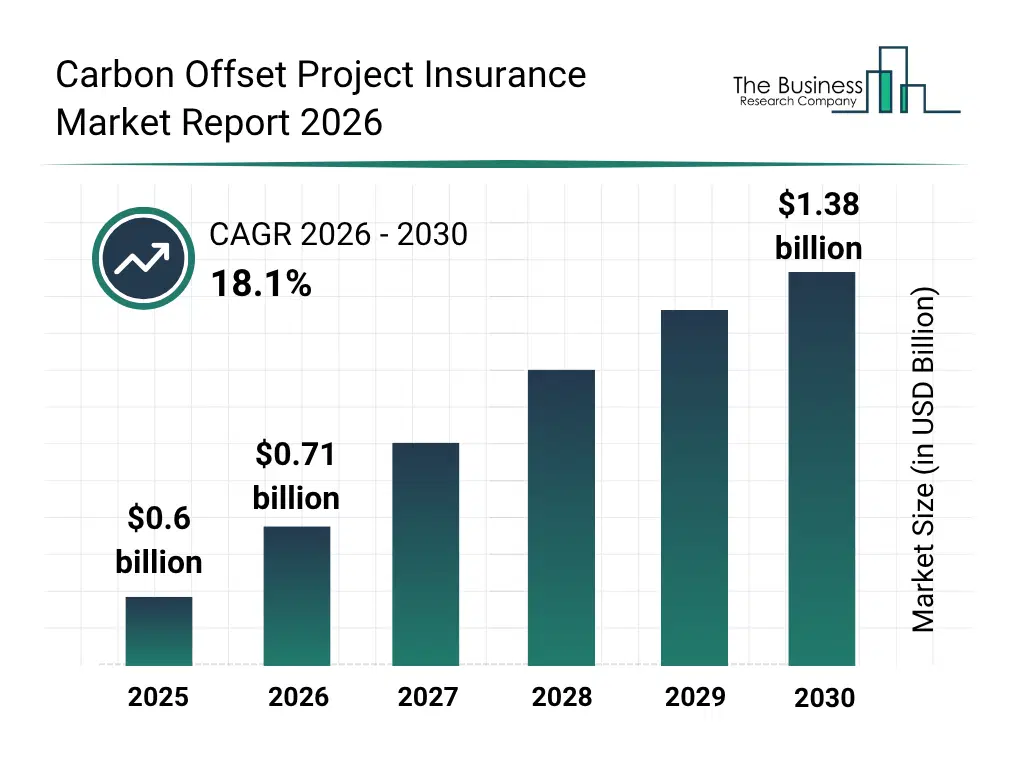
What Is The Carbon Offset Project Insurance Market Size and Share 2026?
The carbon offset project insurance market size has grown rapidly in recent years. It will grow from $0.6 billion in 2025 to $0.71 billion in 2026 at a compound annual growth rate (CAGR) of 18.5%. The growth in the historic period can be attributed to growing adoption of carbon offset projects, increasing corporate sustainability commitments, rising investments in renewable energy projects, expanding voluntary carbon markets, strengthening environmental regulations.What Is The Carbon Offset Project Insurance Market Growth Forecast?
The carbon offset project insurance market size is expected to see rapid growth in the next few years. It will grow to $1.38 billion in 2030 at a compound annual growth rate (CAGR) of 18.1%. The growth in the forecast period can be attributed to growing demand for climate risk mitigation, increasing investments in climate finance initiatives, rising adoption of carbon credit trading, expanding private sector participation in carbon markets, increasing focus on long term project resilience. Major trends in the forecast period include growing demand for carbon credit risk protection, increasing adoption of customized insurance policies for carbon projects, rising focus on regulatory compliance coverage, expansion of insurance for nature based carbon offset projects, greater emphasis on project performance and credit verification assurance.
Global Carbon Offset Project Insurance Market Segmentation
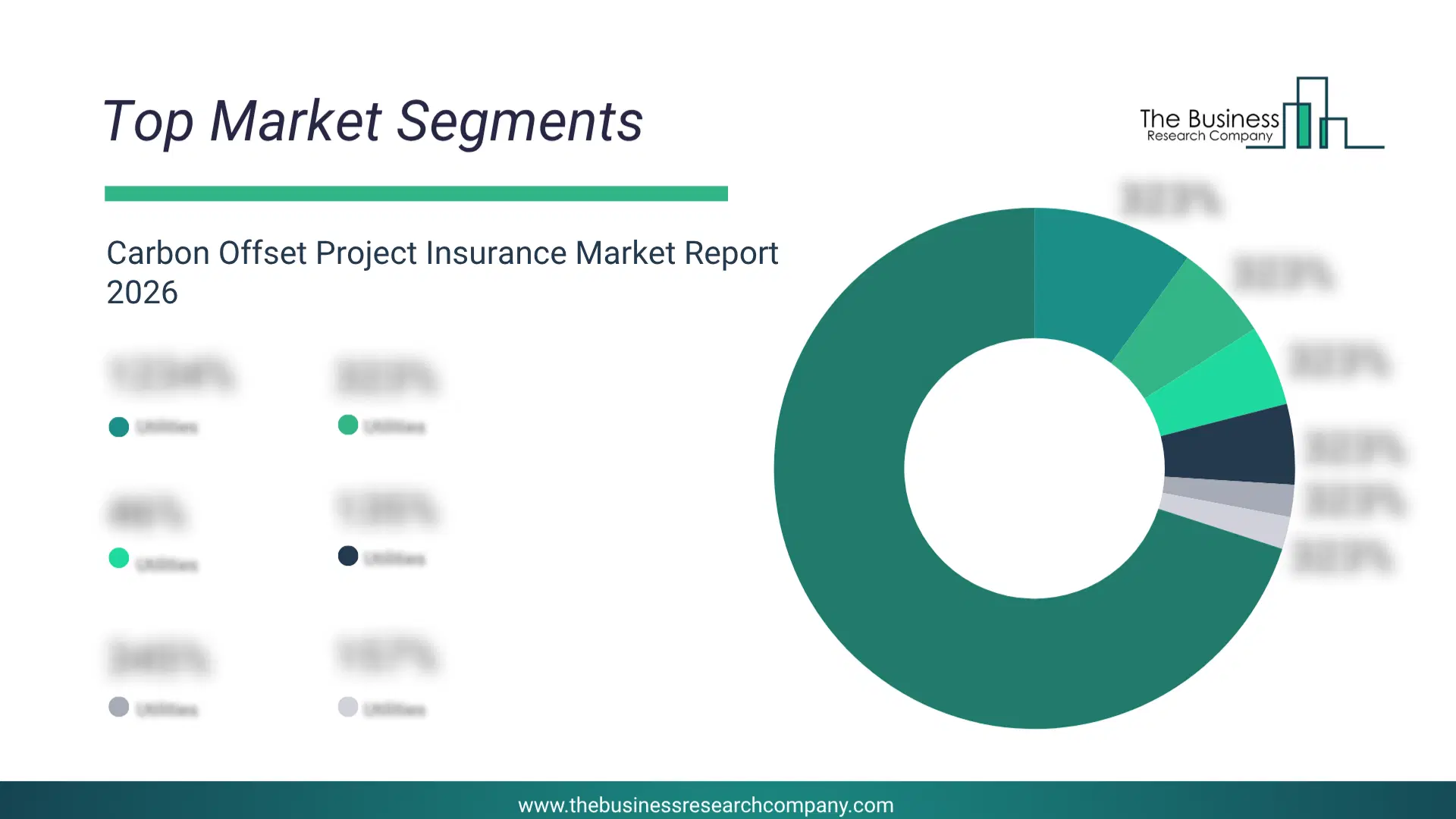
1) By Insurance Type: Project Performance Insurance, Carbon Credit Delivery Insurance, Environmental Liability Insurance, Political Risk Insurance, Weather Risk Insurance, Business Interruption Insurance, Natural Catastrophe Insurance, Professional Indemnity Insurance, Regulatory Compliance Insurance, Other Insurance Types 2) By Project Type: Forestry, Renewable Energy, Methane Capture, Energy Efficiency, Other Project Types 3) By Distribution Channel: Direct, Brokers, Online Platforms, Other Distribution Channels 4) By Application: Voluntary Carbon Market Projects, Compliance Carbon Market Projects, Carbon Credit Trading, Climate Finance Initiatives, Sustainability Investment Projects 5) By End User: Project Developers, Investors, Corporates, Non-Governmental Organizations, Other End Users Subsegments: 1) By Project Performance Insurance: Construction Delay Coverage, Technology Performance Guarantee Coverage, Contractor Default Coverage, Milestone Completion Coverage, Operational Performance Guarantee Coverage 2) By Carbon Credit Delivery Insurance: Forward Delivery Default Coverage, Credit Volume Shortfall Coverage, Verification Failure Coverage, Counterparty Non Performance Coverage, Contract Fulfillment Coverage 3) By Environmental Liability Insurance: Pollution Liability Coverage, Site Contamination Coverage, Third Party Damage Coverage, Remediation Cost Coverage, Biodiversity Damage Coverage 4) By Political Risk Insurance: Expropriation Coverage, Currency Inconvertibility Coverage, Political Violence Coverage, Contract Frustration Coverage, Government Action Coverage 5) By Weather Risk Insurance: Drought Coverage, Excess Rainfall Coverage, Temperature Variability Coverage, Windstorm Coverage, Seasonal Variability Coverage 6) By Business Interruption Insurance: Revenue Loss Coverage, Operational Downtime Coverage, Supply Chain Disruption Coverage, Asset Downtime Coverage, Contingent Business Interruption Coverage 7) By Natural Catastrophe Insurance: Flood Coverage, Earthquake Coverage, Wildfire Coverage, Hurricane Coverage, Landslide Coverage 8) By Professional Indemnity Insurance: Advisory Error Coverage, Negligence Liability Coverage, Design Defect Coverage, Documentation Error Coverage, Misrepresentation Coverage 9) By Regulatory Compliance Insurance: Carbon Regulation Non Compliance Coverage, Permit Violation Coverage, Reporting Error Coverage, Audit Failure Coverage, Legal Defense Coverage 10) By Other Insurance Types: Cyber Risk Coverage, Reputational Risk Coverage, Directors Liability Coverage, Trade Credit Coverage, Customized Risk CoverageWhat Is The Driver Of The Carbon Offset Project Insurance Market?
The growing carbon credit registration activities are expected to propel the growth of the carbon offset project insurance market going forward. Carbon credit registration activities refer to the formal process by which greenhouse gas emission reduction or removal projects are verified, documented, and enrolled in recognized carbon crediting frameworks to generate tradable carbon credits. The increasing adoption of net-zero targets by corporations across developed economies is a primary reason behind the rise in carbon credit registration activities, as companies are compelled to seek credible, registered offset projects to meet their publicly committed emissions reduction goals. The surge in registered carbon credit projects raises the demand for carbon offset project insurance as project developers and investors require coverage against verification failures, regulatory changes, and non-delivery risks associated with these projects. For instance, in March 2024, according to the Department for Environment, Food & Rural Affairs, a UK-based government department, the UK Carbon Registry included 2,037 projects, with 590 validated, led by Scotland with 886 projects averaging 74 hectares. Therefore, growing carbon credit registration activities are driving the growth of the carbon offset project insurance industry.Key Players In The Global Carbon Offset Project Insurance Market
Major companies operating in the carbon offset project insurance market are Allianz SE, AXA XL Insurance Company Limited, Munich Reinsurance Company, Zurich Insurance Group, Chubb Limited, Swiss Reinsurance Company Ltd, Tokio Marine Kiln Group Limited, Hannover Rück SE, Marsh McLennan, QBE Insurance Group Limited, SCOR SE, Aon plc, Everest Group Ltd., Sompo International Holdings Ltd, Arthur J. Gallagher & Co., RenaissanceRe, Willis Towers Watson plc, Beazley Group plc, Hiscox Ltd, Aspen Insurance Holdings Limited, Lockton Companies LLC, Chaucer Group, Gazelle Risk Solutions Ltd, Kita Earth, Oka The Carbon Insurance Company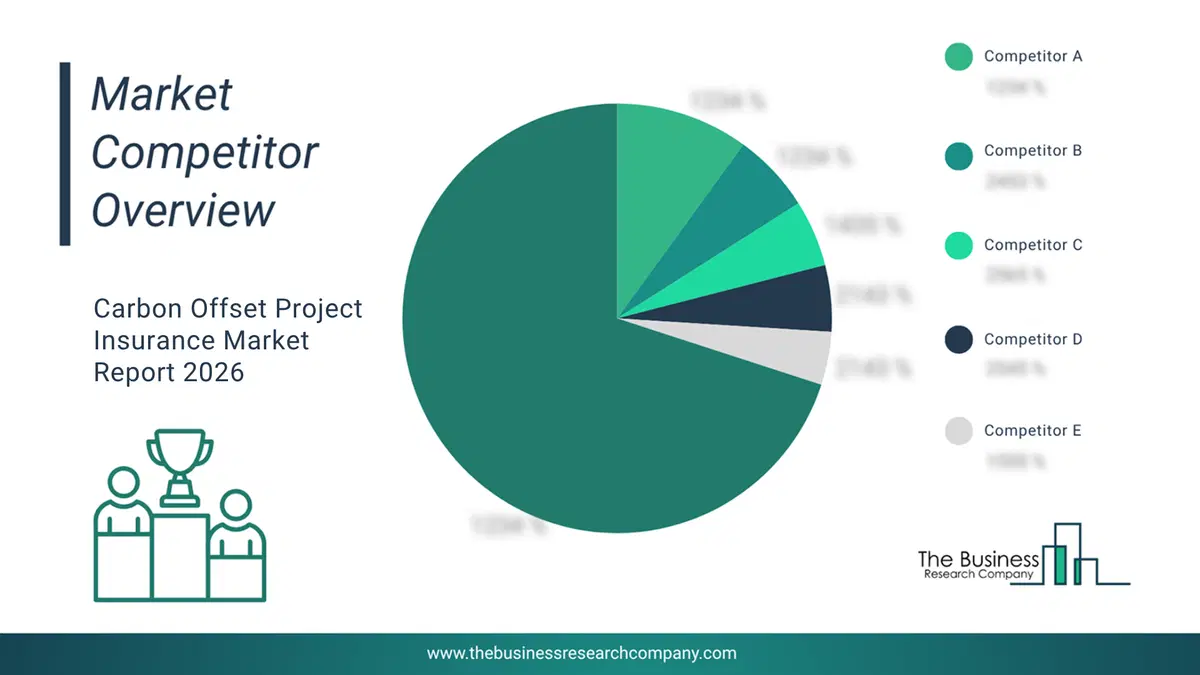
This chart is for illustrative purposes; the full report includes a detailed competitor analysis and comprehensive overview of the top 10 companies in the market.
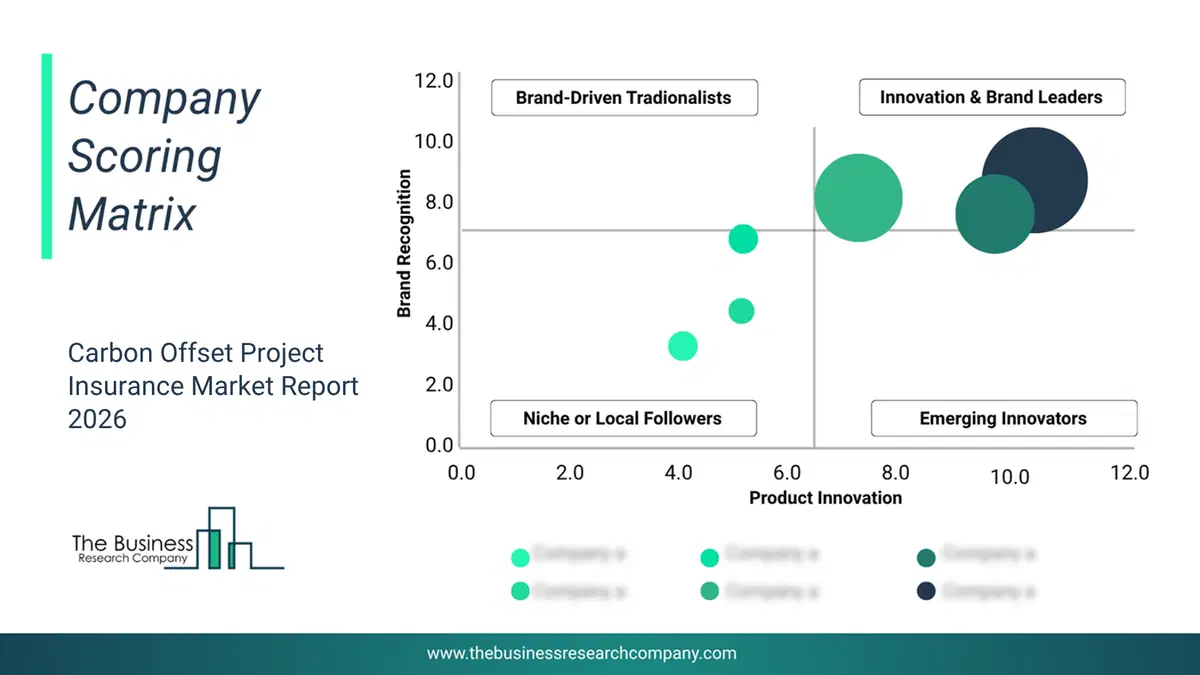
This chart maps companies by product innovation and brand strength, with bubble size indicating relative revenue, helping identify market leaders, challengers, and niche players. This is an illustrative chart; the full report provides a complete and accurate competitive analysis.
Global Carbon Offset Project Insurance Market Trends and Insights
Major companies operating in the carbon offset project insurance market are focusing on developing advanced sustainability protection solutions, such as project-based underwriting model insurance, to improve carbon credit delivery assurance and deliver optimized financial protection across voluntary carbon markets and environmental project applications. Project-based underwriting model insurance is an insurance approach that assesses project-specific risks, financials, and operational factors to provide customized coverage, pricing, and policy terms for individual projects. For instance, in March 2024, CFC, a UK-based insurance provider focused on emerging risk solutions, launched Carbon Delivery Insurance, an innovative policy designed to cover 100% of a purchaser's investment against the non-delivery of voluntary carbon credits. The solution is the first to insure both physical and political delivery risks and uses a project-based underwriting model that enables same-day quoting across more than 300 carbon projects, helping strengthen investment confidence and support the growth of high-quality voluntary carbon markets.What Are Latest Mergers And Acquisitions In The Carbon Offset Project Insurance Market?
In July 2024, Tokio Marine Kiln, a UK-based provider of specialized insurance for carbon offset projects, partnered with Kita to develop political risk coverage solutions for carbon credit project developers. Through this partnership, Tokio Marine Kiln and Kita aim to provide political risk insurance solutions that protect carbon credit project developers and investors against regulatory, policy, and sovereign risks, thereby improving the security and bankability of carbon offset projects. Kita is a UK-based provider of carbon offset project insurance.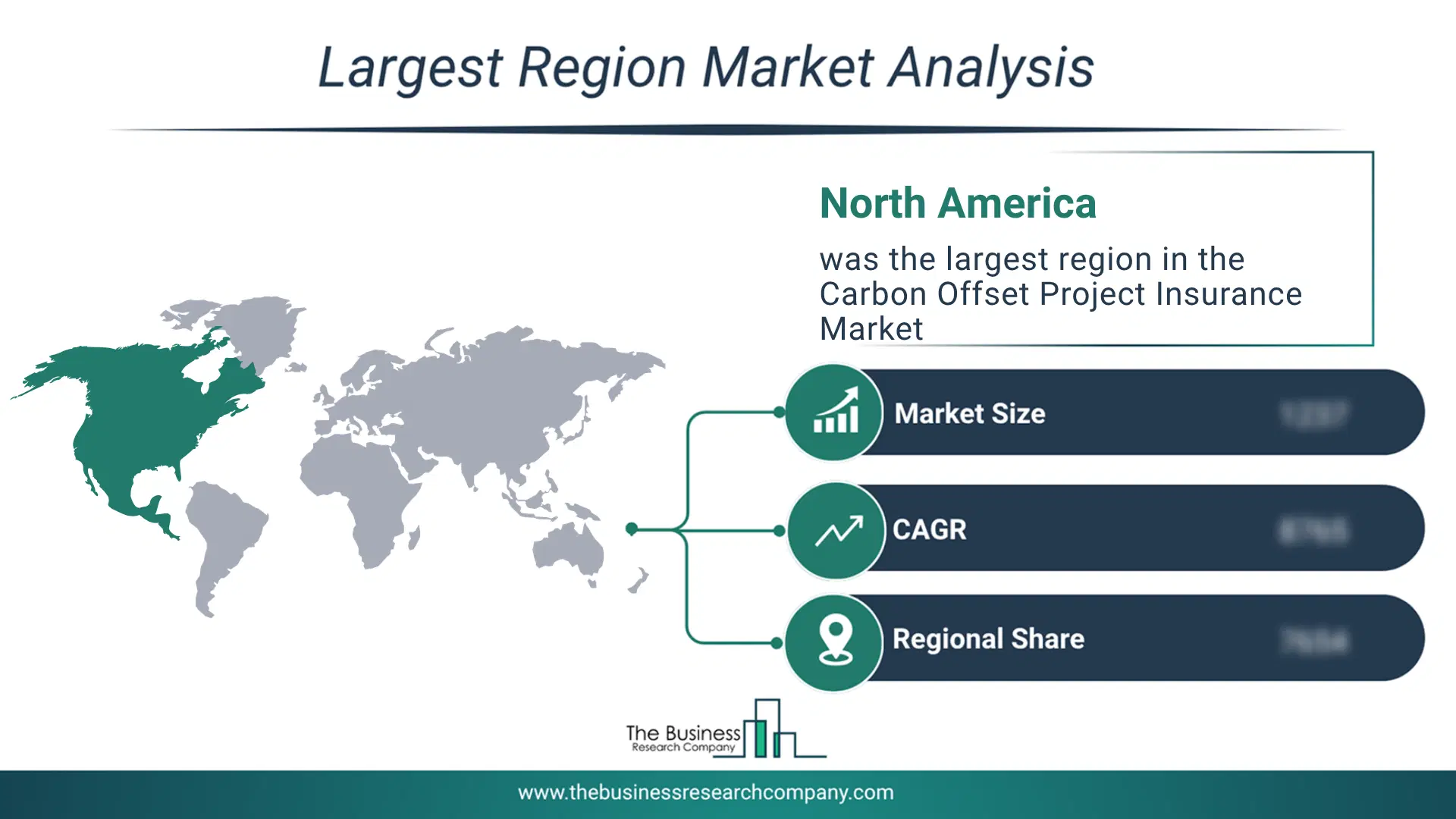
Regional Outlook
North America was the largest region in the carbon offset project insurance market in 2025. Asia-Pacific is expected to be the fastest-growing region in the forecast period. The regions covered in this market report are Asia-Pacific, South East Asia, Western Europe, Eastern Europe, North America, South America, Middle East, Africa. The countries covered in this market report are Australia, Brazil, China, France, Germany, India, Indonesia, Japan, Taiwan, Russia, South Korea, UK, USA, Canada, Italy, Spain.What Defines the Carbon Offset Project Insurance Market?
The carbon offset project insurance market includes revenues earned by entities by providing services such as disaster recovery planning, stakeholder risk communication, and portfolio risk management. The market value includes the value of related goods sold by the service provider or included within the service offering. Only goods and services traded between entities or sold to end consumers are included.How is Market Value Defined and Measured?
The market value is defined as the revenues that enterprises gain from the sale of goods and/or services within the specified market and geography through sales, grants, or donations in terms of the currency (in USD unless otherwise specified). The revenues for a specified geography are consumption values that are revenues generated by organizations in the specified geography within the market, irrespective of where they are produced. It does not include revenues from resales along the supply chain, either further along the supply chain or as part of other products.
This chart presents market attractiveness based on a quantitative evaluation of growth, competition, strategic alignment, and risk, offering a clear view of opportunity areas for decision-making. This chart is for illustrative purposes; the full report contains the complete analysis.

This chart highlights the Total Addressable Market (TAM) by estimating the maximum revenue opportunity using an assumption-driven approach, supporting strategic planning and opportunity sizing across markets. The chart is illustrative; the full report provides a more comprehensive analysis.
What Key Data and Analysis Are Included in the Carbon Offset Project Insurance Market Report 2026?
The carbon offset project insurance market research report is one of a series of new reports from The Business Research Company that provides market statistics, including industry global market size, regional shares, competitors with the market share, detailed market segments, market trends and opportunities, and any further data you may need to thrive in the carbon offset project insurance industry. The market research report delivers a complete perspective of everything you need, with an in-depth analysis of the current and future state of the industry.Carbon Offset Project Insurance Market Report Forecast Analysis
| Report Attribute | Details |
|---|---|
| Market Size Value In 2026 | $0.71 billion |
| Revenue Forecast In 2030 | $1.38 billion |
| Growth Rate | CAGR of 18.1% from 2026 to 2030 |
| Base Year For Estimation | 2025 |
| Actual Estimates/Historical Data | 2020-2025 |
| Forecast Period | 2026 - 2030 |
| Market Representation | Revenue in USD Billion and CAGR from 2026 to 2030 |
| Segments Covered | Insurance Type, Project Type, Distribution Channel, Application, End User |
| Regional Scope | Asia-Pacific, Western Europe, Eastern Europe, North America, South America, Middle East, Africa |
| Country Scope | The countries covered in the report are Australia, Brazil, China, France, Germany, India, Indonesia, Japan, Taiwan, Russia, South Korea, UK, USA, Canada, Italy, Spain. |
| Key Companies Profiled | Allianz SE, AXA XL Insurance Company Limited, Munich Reinsurance Company, Zurich Insurance Group, Chubb Limited, Swiss Reinsurance Company Ltd, Tokio Marine Kiln Group Limited, Hannover Rück SE, Marsh McLennan, QBE Insurance Group Limited, SCOR SE, Aon plc, Everest Group Ltd., Sompo International Holdings Ltd, Arthur J. Gallagher & Co., RenaissanceRe, Willis Towers Watson plc, Beazley Group plc, Hiscox Ltd, Aspen Insurance Holdings Limited, Lockton Companies LLC, Chaucer Group, Gazelle Risk Solutions Ltd, Kita Earth, Oka The Carbon Insurance Company |
| Customization Scope | Request for Customization |
| Pricing And Purchase Options | Explore Purchase Options |