

Carcinoid Syndrome Management Market Report 2026
Global Outlook – By Treatment Type (Somatostatin Analogues, Chemotherapy, Targeted Therapy, Radiopharmaceuticals, Symptom Management Therapies, Surgical Interventions, Biological Therapy), By Route Of Administration (Injectable, Oral, Intravenous), By Distribution Channel (Hospital Pharmacies, Retail Pharmacies, Online Pharmacies, Direct To Provider), By End User (Hospitals, Specialty Clinics, Research Institutions, Ambulatory Surgical Centers) – Market Size, Trends, Strategies, and Forecast to 2030
Carcinoid Syndrome Management Market Overview
• Carcinoid Syndrome Management market size has reached to $1.96 billion in 2025 • Expected to grow to $2.92 billion in 2030 at a compound annual growth rate (CAGR) of 8.3% • Growth Driver: Rising Cancer Burden Fueling The Growth Of The Market Due To Increasing Demand For Symptom Control And Supportive Care In Neuroendocrine Tumor Patients • Market Trend: Regulatory Approvals For Advanced Neuroendocrine Tumors Expand Treatment Options In Carcinoid Syndrome Management • North America was the largest region in 2025 and Asia-Pacific is the fastest growing region.What Is Covered Under Carcinoid Syndrome Management Market?
Carcinoid syndrome management refers to the medical strategies used to control symptoms and complications caused by hormone-secreting neuroendocrine tumors. It focuses on reducing excessive hormone activity and alleviating symptoms such as flushing, diarrhea, wheezing, and abdominal pain. Carcinoid syndrome management prevents disease-related complications, improves patient outcomes, and enhances quality of life. The main treatment types of carcinoid syndrome management include somatostatin analogues, chemotherapy, targeted therapy, radiopharmaceuticals, symptom management therapies, surgical interventions, and biological therapy. Somatostatin analogues refer to medications used to control hormone-related symptoms and slow disease progression in patients with carcinoid syndrome. These treatments are administered through injectable, oral, and intravenous routes. They are distributed through hospital pharmacies, retail pharmacies, online pharmacies, and direct to provider channels and are utilized by end users including hospitals, specialty clinics, research institutions, and ambulatory surgical centers.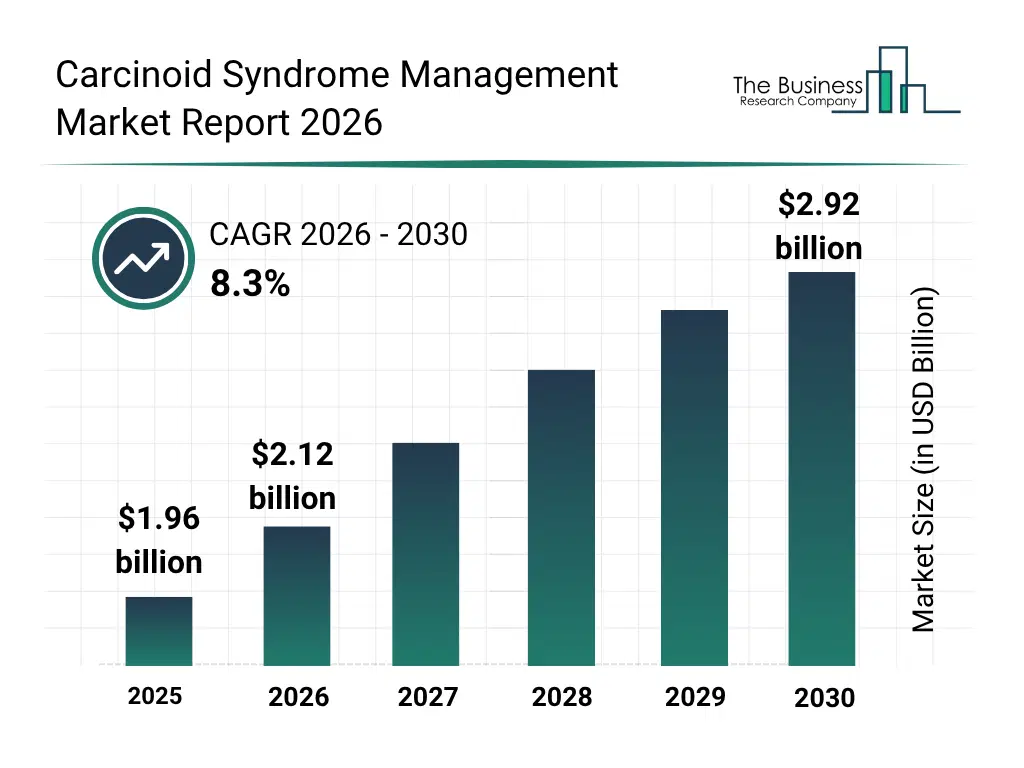
What Is The Carcinoid Syndrome Management Market Size and Share 2026?
The carcinoid syndrome management market size has grown strongly in recent years. It will grow from $1.96 billion in 2025 to $2.12 billion in 2026 at a compound annual growth rate (CAGR) of 8.1%. The growth in the historic period can be attributed to increasing diagnosis of neuroendocrine tumors, growing awareness of carcinoid syndrome symptoms, expansion of hospital oncology departments, rising adoption of somatostatin analogues, improving access to cancer diagnostic imaging.What Is The Carcinoid Syndrome Management Market Growth Forecast?
The carcinoid syndrome management market size is expected to see strong growth in the next few years. It will grow to $2.92 billion in 2030 at a compound annual growth rate (CAGR) of 8.3%. The growth in the forecast period can be attributed to advancements in precision oncology and biomarker identification, increasing investment in rare cancer research, rising adoption of targeted and immunotherapies, growing clinical trials for radiopharmaceutical treatments, expansion of personalized treatment protocols in oncology care. Major trends in the forecast period include rising adoption of targeted biologic therapies for symptom control in carcinoid syndrome, increasing use of personalized precision medicine approaches in neuroendocrine tumor management, growing demand for minimally invasive surgical interventions, expansion of radiopharmaceutical therapies for advanced-stage treatment, rising integration of combination therapy approaches for improved patient outcomes.
Global Carcinoid Syndrome Management Market Segmentation
1) By Treatment Type: Somatostatin Analogues; Chemotherapy; Targeted Therapy; Radiopharmaceuticals; Symptom Management Therapies; Surgical Interventions; Biological Therapy 2) By Route Of Administration: Injectable; Oral; Intravenous 3) By Distribution Channel: Hospital Pharmacies; Retail Pharmacies; Online Pharmacies; Direct To Provider 4) By End User: Hospitals; Specialty Clinics; Research Institutions; Ambulatory Surgical Centers Subsegments: 1) By Somatostatin Analogues: Octreotide; Lanreotide; Pasireotide 2) By Chemotherapy: Streptozocin Based Therapy; Temozolomide Therapy; Fluorouracil Therapy; Capecitabine Therapy 3) By Targeted Therapy: Everolimus; Sunitinib; Tyrosine Kinase Inhibitors 4) By Radiopharmaceuticals: Lutetium 177 Therapy; Peptide Receptor Radionuclide Therapy; Radioisotope Therapy 5) By Symptom Management Therapies: Antidiarrheal Agents; Bronchodilators; Serotonin Inhibitors; Nutritional Support 6) By Surgical Interventions: Tumor Resection; Liver Resection; Debulking Surgery; Liver Transplantation 7) By Biological Therapy: Interferon Therapy; Immunotherapy; Monoclonal Antibody TherapyWhat Is The Driver Of The Carcinoid Syndrome Management Market?
The rising cancer burden is expected to propel the growth of the carcinoid syndrome management market going forward. Cancer burden refers to the increasing incidence, prevalence, mortality, and overall health impact of cancer across populations. The rising cancer burden is driven by the growing aging population, as older individuals face a higher risk of developing cancers due to age-related cellular damage and prolonged exposure to carcinogenic factors. Carcinoid syndrome management helps address the cancer burden by managing debilitating hormone-related symptoms in patients with neuroendocrine tumors, improving patient quality of life, reducing complications, and supporting comprehensive cancer care and long-term treatment outcomes. For instance, in February 2024, according to the World Health Organization, a Switzerland-based intergovernmental organization, by 2050, over 35 million new cancer cases were projected, representing a 77% increase compared to the estimated 20 million cases in 2022. Therefore, the rising cancer burden is driving the growth of the carcinoid syndrome management industry.Key Players In The Global Carcinoid Syndrome Management Market
Major companies operating in the carcinoid syndrome management market are Pfizer Inc.; Novartis AG; The Johns Hopkins Health System Corporation; Teva Pharmaceutical Industries Ltd.; Cleveland Clinic Foundation; The Trustees of the University of Pennsylvania; Mayo Clinic; Stanford Health Care; Cedars-Sinai Medical Center; Ipsen Pharma; The University of Texas MD Anderson Cancer Center; Brigham and Women's Hospital; Apollo Hospitals Enterprise Limited; Memorial Sloan Kettering Cancer Center; University of California San Francisco Medical Center; City of Hope National Medical Center; Virginia Mason Franciscan Health; Max Healthcare Institute Limited; Dana-Farber Cancer Institute Inc.; Fred Hutchinson Cancer Center; H. Lee Moffitt Cancer Center and Research Institute Inc.; The Royal Marsden NHS Foundation Trust; Tata Memorial Centre; Oncology Consultants P.A.; Saroj Gupta Cancer Centre and Research InstituteGlobal Carcinoid Syndrome Management Market Trends and Insights
Major companies operating in the carcinoid syndrome management market are focusing on obtaining regulatory approvals for advanced neuroendocrine tumor therapies to improve disease control, delay tumor progression, and expand treatment options for patients. Regulatory approvals are official authorizations from regulatory agencies confirming that a product, service, or treatment meets required safety, quality, and efficacy standards for commercialization and market use. For instance, in March 2025, Exelixis, Inc., a US-based biotechnology company, announced that the U.S. Food and Drug Administration (FDA) approved CABOMETYX (cabozantinib) for adult and pediatric patients aged 12 years and older with previously treated, unresectable, locally advanced, or metastatic well-differentiated pancreatic neuroendocrine tumors (pNET) and extra-pancreatic neuroendocrine tumors (epNET). The approval was based on results from the Phase 3 CABINET trial, which demonstrated a statistically significant improvement in progression-free survival compared with placebo, providing a new systemic treatment option for patients with advanced neuroendocrine tumors.What Are Latest Mergers And Acquisitions In The Carcinoid Syndrome Management Market?
In February 2024, Bristol Myers Squibb Company, a US-based provider of oncology, immunology, cardiovascular, and cell therapy products, acquired RayzeBio, Inc. for approximately $4.1 billion. Through this acquisition, Bristol Myers Squibb sought to enhance its radiopharmaceutical oncology portfolio and accelerate the development of targeted radiotherapies for solid tumors, including neuroendocrine tumors associated with carcinoid syndrome management. RayzeBio, Inc. is a US-based radiopharmaceutical company specializing in targeted actinium-based therapies for gastroenteropancreatic neuroendocrine tumors and other cancers.Regional Outlook
North America was the largest region in the carcinoid syndrome management market in 2025. Asia-Pacific is expected to be the fastest-growing region in the forecast period. The regions covered in this market report are Asia-Pacific, South East Asia, Western Europe, Eastern Europe, North America, South America, Middle East, Africa. The countries covered in this market report are Australia, Brazil, China, France, Germany, India, Indonesia, Japan, Taiwan, Russia, South Korea, UK, USA, Canada, Italy, Spain.What Defines the Carcinoid Syndrome Management Market?
The carcinoid syndrome management market consists of revenues earned by entities by providing services such as diagnostic evaluation, hormone level monitoring, symptom management, and palliative care services. The market value includes the value of related goods sold by the service provider or included within the service offering. The carcinoid syndrome management market also includes sales of targeted therapy drugs, biomarker testing kits, infusion systems, and supportive care pharmaceuticals. Values in this market are ‘factory gate’ values, that is, the value of goods sold by the manufacturers or creators of the goods, whether to other entities (including downstream manufacturers, wholesalers, distributors, and retailers) or directly to end customers. The value of goods in this market includes related services sold by the creators of the goods.How is Market Value Defined and Measured?
The market value is defined as the revenues that enterprises gain from the sale of goods and/or services within the specified market and geography through sales, grants, or donations in terms of the currency (in USD unless otherwise specified). The revenues for a specified geography are consumption values that are revenues generated by organizations in the specified geography within the market, irrespective of where they are produced. It does not include revenues from resales along the supply chain, either further along the supply chain or as part of other products.What Key Data and Analysis Are Included in the Carcinoid Syndrome Management Market Report 2026?
The carcinoid syndrome management market research report is one of a series of new reports from The Business Research Company that provides market statistics, including industry global market size, regional shares, competitors with the market share, detailed market segments, market trends and opportunities, and any further data you may need to thrive in the carcinoid syndrome management industry. The market research report delivers a complete perspective of everything you need, with an in-depth analysis of the current and future state of the industry.Carcinoid Syndrome Management Market Report Forecast Analysis
| Report Attribute | Details |
|---|---|
| Market Size Value In 2026 | $2.12 billion |
| Revenue Forecast In 2030 | $2.92 billion |
| Growth Rate | CAGR of 8.3% from 2026 to 2030 |
| Base Year For Estimation | 2025 |
| Actual Estimates/Historical Data | 2020-2025 |
| Forecast Period | 2026 - 2030 |
| Market Representation | Revenue in USD Billion and CAGR from 2026 to 2030 |
| Segments Covered | Treatment Type, Route Of Administration, Distribution Channel, End User |
| Regional Scope | Asia-Pacific, Western Europe, Eastern Europe, North America, South America, Middle East, Africa |
| Country Scope | The countries covered in the report are Australia, Brazil, China, France, Germany, India, ... |
| Key Companies Profiled | Pfizer Inc.; Novartis AG; The Johns Hopkins Health System Corporation; Teva Pharmaceutical Industries Ltd.; Cleveland Clinic Foundation; The Trustees of the University of Pennsylvania; Mayo Clinic; Stanford Health Care; Cedars-Sinai Medical Center; Ipsen Pharma; The University of Texas MD Anderson Cancer Center; Brigham and Women's Hospital; Apollo Hospitals Enterprise Limited; Memorial Sloan Kettering Cancer Center; University of California San Francisco Medical Center; City of Hope National Medical Center; Virginia Mason Franciscan Health; Max Healthcare Institute Limited; Dana-Farber Cancer Institute Inc.; Fred Hutchinson Cancer Center; H. Lee Moffitt Cancer Center and Research Institute Inc.; The Royal Marsden NHS Foundation Trust; Tata Memorial Centre; Oncology Consultants P.A.; Saroj Gupta Cancer Centre and Research Institute |
| Customization Scope | Request for Customization |
| Pricing And Purchase Options | Explore Purchase Options |