
Carrier Rocket Market Report 2026
Global Outlook – By Type (Solid Rocket Boosters, Liquid Rocket Engines, Hybrid Rockets, Cryogenic Rockets), By Launch Frequency (Dedicated Launches, Rideshare Missions, Regularly Scheduled Launches), By Range (Low Earth Orbit (LEO), Medium Earth Orbit (MEO), Geostationary Earth Orbit (GEO), Other Ranges), By Launch Purpose (Satellite Deployment, Interplanetary Missions, Space Station Resupply, Scientific Research), By Industry Vertical (Government Space Agencies, Private Aerospace Companies, Educational and Research Institutions, International Space Organizations, Defense Agencies, Commercial Enterprise) – Market Size, Trends, Strategies, and Forecast to 2030
Carrier Rocket Market Overview
• Carrier Rocket market size has reached to $13.69 billion in 2025 • Expected to grow to $21.99 billion in 2030 at a compound annual growth rate (CAGR) of 9.9% • Growth Driver: Rising Space Expeditions Driving Demand In The Market Due To Increasing Launch Requirements • Market Trend: Innovations Driving Payload Capacity And Launch Efficiency • North America was the largest region in 2025 and Asia-Pacific is the fastest growing region.What Is Covered Under Carrier Rocket Market?
A carrier rocket, also known as a launch vehicle, is a rocket designed to transport payloads such as satellites, spacecraft, or scientific instruments from Earth's surface into space. It provides the necessary thrust to overcome Earth's gravity and place the payload into a desired orbit or trajectory. Carrier rockets are typically multi-stage systems that shed weight as they ascend, improving efficiency and enabling them to deliver payloads accurately and safely into space. The main types of the carrier rocket include solid rocket boosters, liquid rocket engines, hybrid rockets, and cryogenic rockets. Solid rocket boosters refer to rocket motors that use solid propellant to generate thrust, providing high reliability, simplicity, and rapid launch capabilities for initial stages of rocket flight. The launch frequency includes dedicated launches, rideshare missions, and regularly scheduled launches. Different range includes low Earth orbit (LEO), medium Earth orbit (MEO), geostationary Earth orbit (GEO), and other ranges. Multiple launch purposes include satellite deployment, interplanetary missions, space station resupply, and scientific research, and they are used by several industry verticals such as government space agencies, private aerospace companies, educational and research institutions, international space organizations, defense agencies, and commercial enterprises.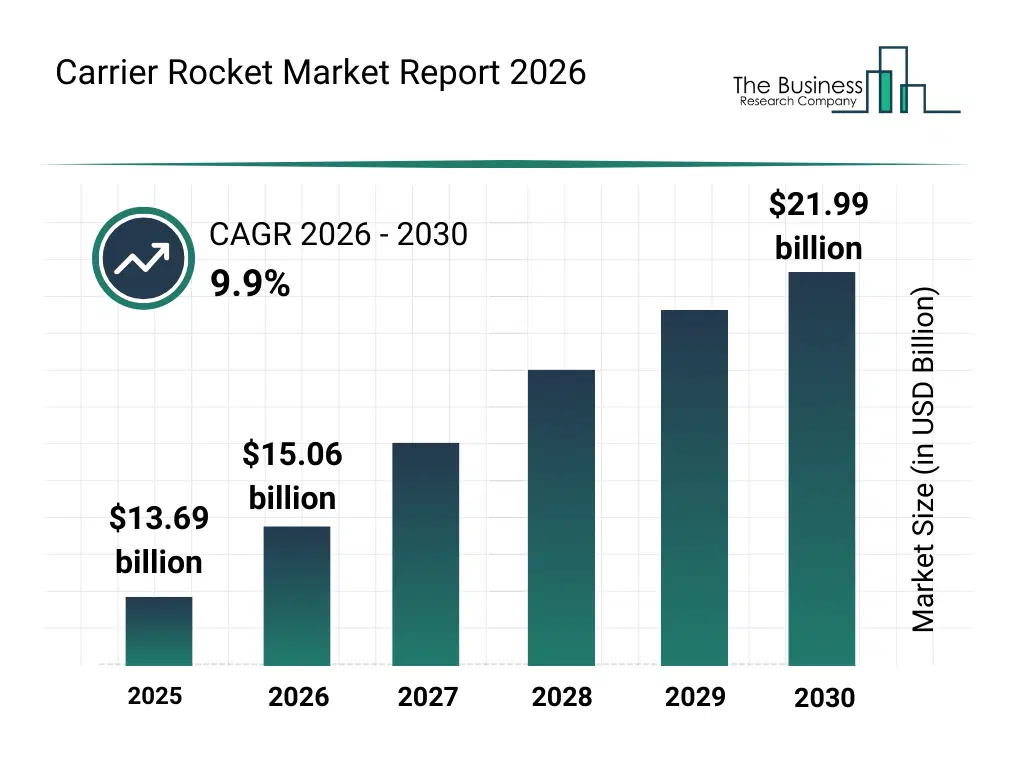
What Is The Carrier Rocket Market Size and Share 2026?
The carrier rocket market size has grown rapidly in recent years. It will grow from $13.69 billion in 2025 to $15.06 billion in 2026 at a compound annual growth rate (CAGR) of 10.0%. The growth in the historic period can be attributed to development and deployment of early orbital and suborbital rockets, advancements in multi-stage rocket technologies, growth in government-funded space programs, increasing commercial satellite launches driving demand for launch vehicles, expansion of global launch service providers and infrastructure.What Is The Carrier Rocket Market Growth Forecast?
The carrier rocket market size is expected to see strong growth in the next few years. It will grow to $21.99 billion in 2030 at a compound annual growth rate (CAGR) of 9.9%. The growth in the forecast period can be attributed to rising demand for super heavy-lift rockets for large payload deployment, growth in commercial satellite constellations and space exploration missions, advancements in reusable and cost-efficient launch vehicle technologies, increasing private sector investment in orbital and interplanetary launches, integration of ai and predictive analytics for launch optimization and mission success. Major trends in the forecast period include reusable launch vehicle development, increased demand for small satellite launches, advancement in multi-stage propulsion systems, growing commercial space launch activities, rise in ride-share launch offerings.
Global Carrier Rocket Market Segmentation
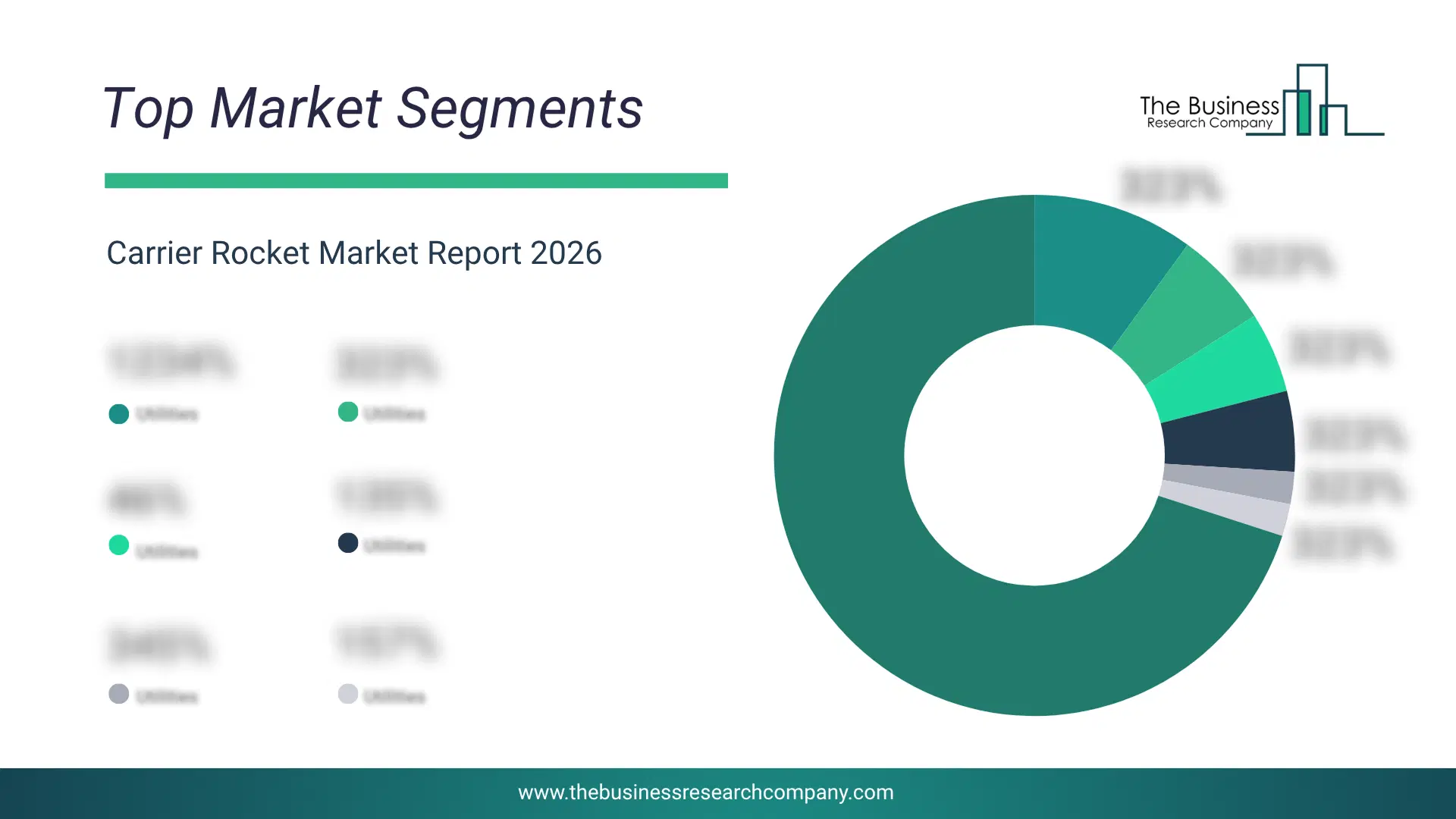
1) By Type: Solid Rocket Boosters, Liquid Rocket Engines, Hybrid Rockets, Cryogenic Rockets 2) By Launch Frequency: Dedicated Launches, Rideshare Missions, Regularly Scheduled Launches 3) By Range: Low Earth Orbit (LEO), Medium Earth Orbit (MEO), Geostationary Earth Orbit (GEO), Other Ranges 4) By Launch Purpose: Satellite Deployment, Interplanetary Missions, Space Station Resupply, Scientific Research 5) By Industry Vertical: Government Space Agencies, Private Aerospace Companies, Educational and Research Institutions, International Space Organizations, Defense Agencies, Commercial Enterprise Subsegments: 1) By Solid Rocket Boosters: Booster Staging, Suborbital Boosters 2) By Liquid Rocket Engines: Bipropellant Engines, Monopropellant Engines, Cryogenic Liquid Engines, Hypergolic Engines 3) By Hybrid Rockets: Liquid Oxidizer Hybrid Rockets, Solid Fuel Hybrid Rockets 4) By Cryogenic Rockets: Liquid Hydrogen (LH2) And Liquid Oxygen (LOX) Rockets, Liquid Methane (CH4) And Liquid Oxygen (LOX) RocketsWhat Is Driver Of The Carrier Rocket Market?
A rising number of space expeditions is expected to propel the growth of the carrier rocket market going forward. Space expeditions refer to journeys or missions to explore outer space, usually involving spacecraft and astronauts traveling beyond Earth. Space expeditions are rising due to the search for new resources and living spaces on other planets to solve Earth's challenges. Carrier rockets play a crucial role in space expeditions by transporting spacecraft, satellites, and scientific instruments from Earth into space. They provide the powerful thrust needed to overcome Earth's gravity and follow a carefully planned trajectory to place payloads into orbit or on interplanetary paths. For instance, in January 2024, according to the Space Foundation, a US-based nonprofit organization, over 2,800 satellites were deployed into orbit in 2023, marking a 23% year-over-year increase. Therefore, the rising number of space expeditions is projected to propel the growth of the carrier rocket industry.Key Players In The Global Carrier Rocket Market
Major companies operating in the carrier rocket market are Boeing Company, Lockheed Martin Corporation, China Aerospace Science and Technology Corporation, Northrop Grumman Corporation, Mitsubishi Heavy Industries Ltd., Space Exploration Technologies Corp. (SpaceX), Israel Aerospace Industries Ltd., Blue Origin LLC, United Launch Alliance LLC, Relativity Space Inc., Rocket Lab USA Inc., Firefly Aerospace Inc., ExPace Services Inc., Orbex Space Ltd., Virgin Orbit Inc., LandSpace Technology Corporation, Indian Space Research Organisation (ISRO), Eurockot Launch Services GmbH, Orbital ATK Inc., Skyrora Ltd.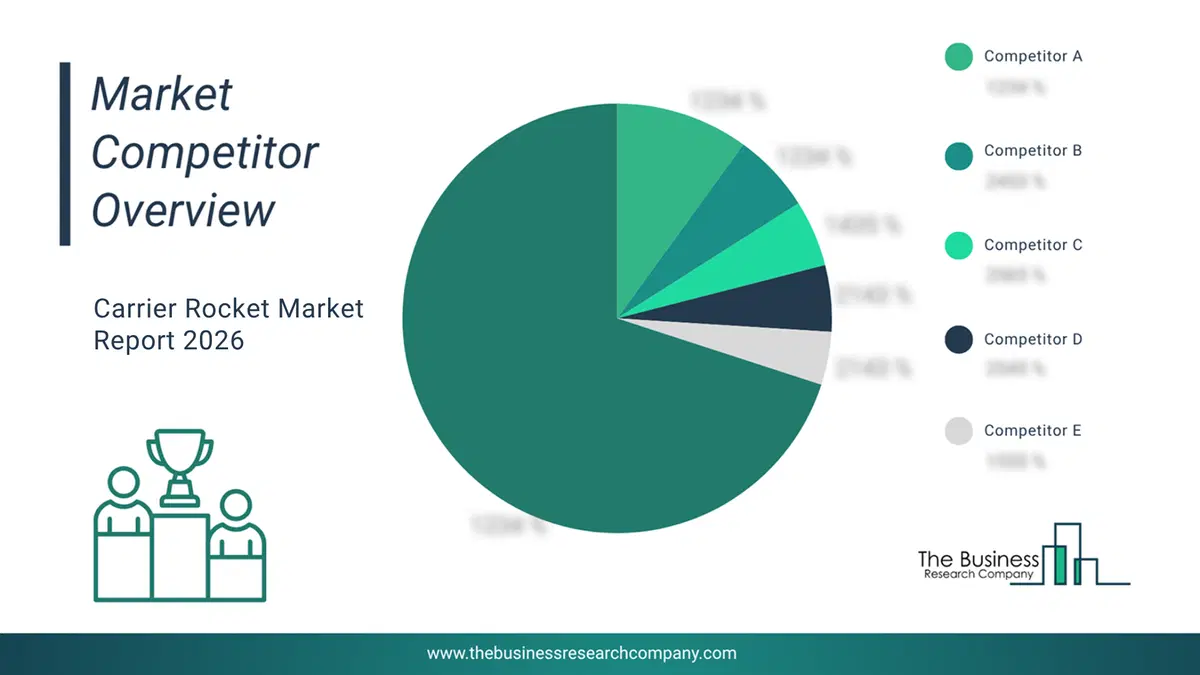
This chart is for illustrative purposes; the full report includes a detailed competitor analysis and comprehensive overview of the top 10 companies in the market.
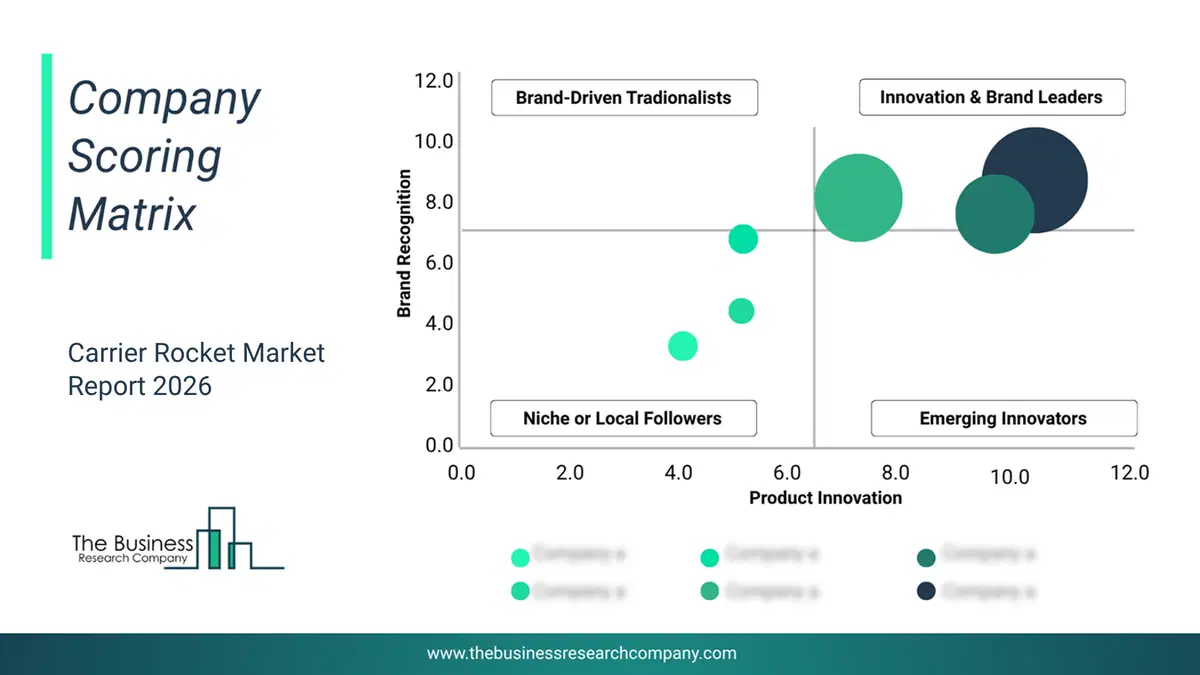
This chart maps companies by product innovation and brand strength, with bubble size indicating relative revenue, helping identify market leaders, challengers, and niche players. This is an illustrative chart; the full report provides a complete and accurate competitive analysis.
Global Carrier Rocket Market Trends and Insights
Major companies operating in the carrier rocket market are focusing on product innovation, such as solid-propellant carrier rockets, to enhance payload capacity, improve launch efficiency, and reduce costs, aiming to meet the growing demand for satellite deployment and space exploration. A solid-propellant carrier rocket uses solid fuel for propulsion, which is pre-packed in a solid form and ignited to generate thrust for launching payloads into space. For instance, in January 2025, Galactic Energy, a China-based aerospace company, successfully launched the CERES-1 Remote 16 carrier rocket from the Jiuquan Satellite Launch Center, deploying five satellites into orbit. This mission, the 16th in the Ceres-1 rocket series, highlights the platform's reliability, having deployed a total of 63 satellites and solidifying its position as one of China's leading commercial launch vehicles.What Are Latest Mergers And Acquisitions In The Carrier Rocket Market? NSIL And Arianespace Sign Landmark Agreement For Satellite Launch Services
In January 2024, NewSpace India Limited (NSIL), an India-based government company, partnered with Arianespace to establish a long-term partnership. This collaboration focuses on utilizing ISRO's LVM3 and Arianespace's Ariane 6 launch vehicles to meet the growing global demand for satellite launches, particularly for heavier communication satellites and mega-constellations. Arianespace is a France-based launch service provider.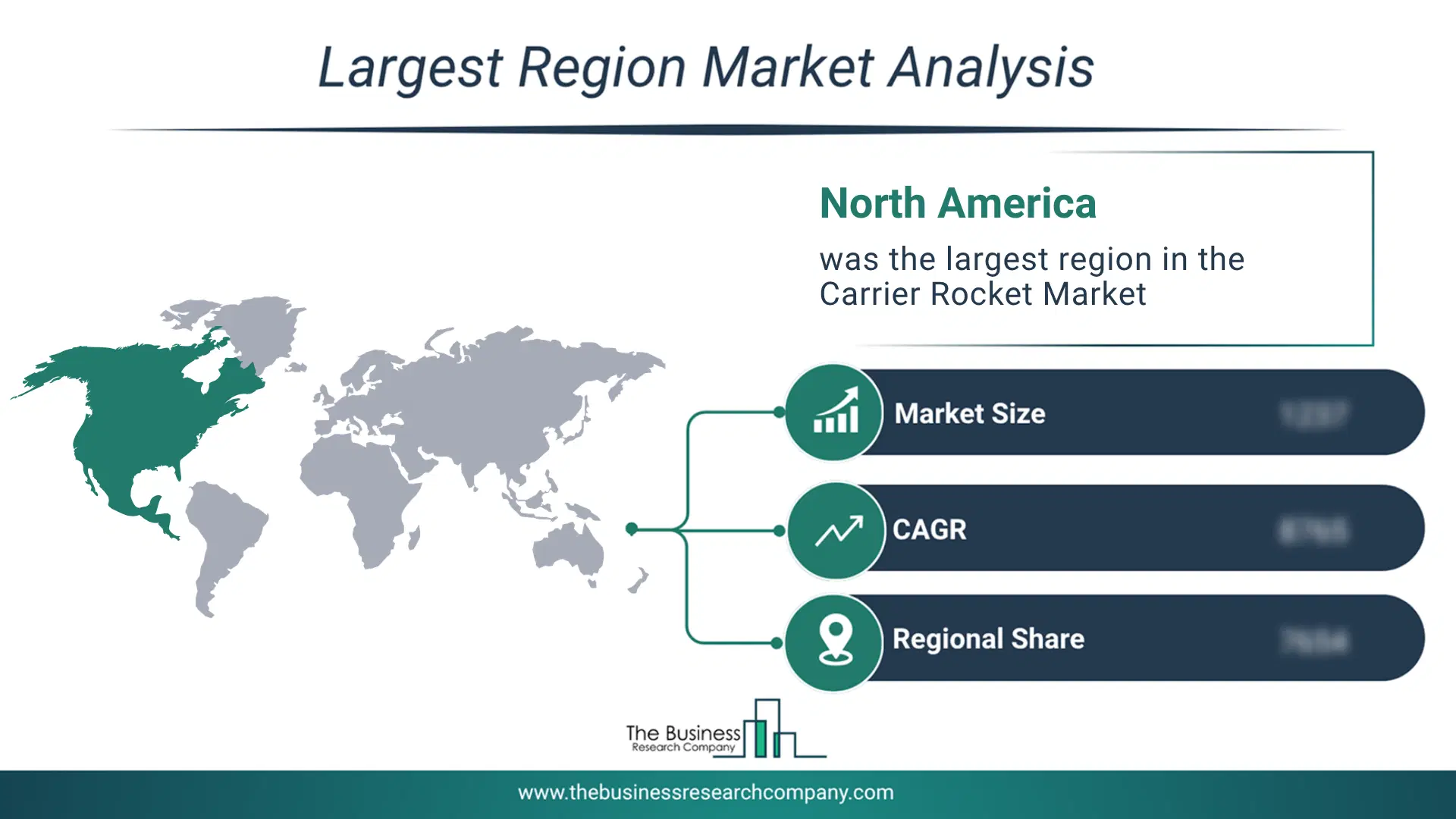
Regional Insights
North America was the largest region in the carrier rocket market in 2025. Asia-Pacific is expected to be the fastest-growing region in the forecast period. The regions covered in this market report are Asia-Pacific, South East Asia, Western Europe, Eastern Europe, North America, South America, Middle East, Africa. The countries covered in this market report are Australia, Brazil, China, France, Germany, India, Indonesia, Japan, Taiwan, Russia, South Korea, UK, USA, Canada, Italy, SpainWhat Defines the Carrier Rocket Market?
The carrier rocket market consists of sales of orbital rockets, suborbital rockets, and super heavy-lift rockets. Values in this market are ‘factory gate’ values, that is, the value of goods sold by the manufacturers or creators of the goods, whether to other entities (including satellite companies, government agencies, commercial operators, and resellers) or directly to end customers. The value of goods in this market includes related services sold by the creators of the goods, such as launch integration support and associated pre-launch services.How is Market Value Defined and Measured?
The market value is defined as the revenues that enterprises gain from the sale of goods and/or services within the specified market and geography through sales, grants, or donations in terms of the currency (in USD unless otherwise specified). The revenues for a specified geography are consumption values that are revenues generated by organizations in the specified geography within the market, irrespective of where they are produced. It does not include revenues from resales along the supply chain, either further along the supply chain or as part of other products.
This chart presents market attractiveness based on a quantitative evaluation of growth, competition, strategic alignment, and risk, offering a clear view of opportunity areas for decision-making. This chart is for illustrative purposes; the full report contains the complete analysis.

This chart highlights the Total Addressable Market (TAM) by estimating the maximum revenue opportunity using an assumption-driven approach, supporting strategic planning and opportunity sizing across markets. The chart is illustrative; the full report provides a more comprehensive analysis.
What Key Data and Analysis Are Included in the Carrier Rocket Market Report 2026?
The carrier rocket market research report is one of a series of new reports from The Business Research Company that provides market statistics, including industry global market size, regional shares, competitors with the market share, detailed market segments, market trends and opportunities, and any further data you may need to thrive in the carrier rocket industry. The market research report delivers a complete perspective of everything you need, with an in-depth analysis of the current and future state of the industry.Carrier Rocket Market Report Forecast Analysis
| Report Attribute | Details |
|---|---|
| Market Size Value In 2026 | $15.06 billion |
| Revenue Forecast In 2030 | $21.99 billion |
| Growth Rate | CAGR of 9.9% from 2026 to 2030 |
| Base Year For Estimation | 2025 |
| Actual Estimates/Historical Data | 2020-2025 |
| Forecast Period | 2026 - 2030 |
| Market Representation | Revenue in USD Billion and CAGR from 2026 to 2030 |
| Segments Covered | Type, Launch Frequency, Range, Launch Purpose, Industry Vertical |
| Regional Scope | Asia-Pacific, Western Europe, Eastern Europe, North America, South America, Middle East, Africa |
| Country Scope | The countries covered in the carrier rocket market report are Australia, Brazil, China, France, Germany, India, Indonesia, Japan, Taiwan, Russia, South Korea, UK, USA, Canada, Italy, Spain |
| Key Companies Profiled | Boeing Company, Lockheed Martin Corporation, China Aerospace Science and Technology Corporation, Northrop Grumman Corporation, Mitsubishi Heavy Industries Ltd., Space Exploration Technologies Corp. (SpaceX), Israel Aerospace Industries Ltd., Blue Origin LLC, United Launch Alliance LLC, Relativity Space Inc., Rocket Lab USA Inc., Firefly Aerospace Inc., ExPace Services Inc., Orbex Space Ltd., Virgin Orbit Inc., LandSpace Technology Corporation, Indian Space Research Organisation (ISRO), Eurockot Launch Services GmbH, Orbital ATK Inc., Skyrora Ltd. |
| Customization Scope | Request for Customization |
| Pricing And Purchase Options | Explore Purchase Options |