
CBRNE Detection Technologies Market Report 2026
Global Outlook – By Product Type (Portable Detection Devices, Fixed Detection Systems, Mobile Detection Platforms, Laboratory Equipment, Software Solutions), By Technology Type (Chemical Detection, Biological Detection, Radiological Detection, Nuclear Detection, Explosives Detection), By Detection Method (Optical Detection, Mass Spectrometry, Electrochemical Detection, Immunoassay Methods, Gas Chromatography), By Threat (Chemical Threat, Biological Threat, Nuclear Threat, Other Threats), By End-Use Industry (Defense And Military, Healthcare, Environmental Monitoring, Industrial Safety, Emergency Services) – Market Size, Trends, Strategies, and Forecast to 2030
CBRNE Detection Technologies Market Overview
• CBRNE Detection Technologies market size has reached to $19.48 billion in 2025 • Expected to grow to $25.94 billion in 2030 at a compound annual growth rate (CAGR) of 6% • Growth Driver: The Rising Adoption Of Cloud-Based Solutions Driving The Growth Of The Market Due To Enhancing Scalability, Real-Time Data Sharing, And Cost Efficiency • Market Trend: Advanced Spectrometry Solutions Enhancing Radiological Threat Detection • North America was the largest region in 2025 and Asia-Pacific is the fastest growing region.What Is Covered Under CBRNE Detection Technologies Market?
Chemical, biological, radiological, nuclear, and explosive (CBRNE) detection technologies are specialized systems designed to identify and analyze hazardous agents or materials that pose threats to safety and security. These technologies use advanced sensors, analytical tools, and monitoring techniques to detect dangerous substances in air, water, soil, or on surfaces. Their primary purpose is to provide timely alerts and accurate information that help mitigate risks, enable rapid response, and protect public health and critical infrastructure. The main product types of chemical, biological, radiological, nuclear, and explosive (CBRNE) detection technologies are portable detection devices, fixed detection systems, mobile detection platforms, laboratory equipment, and software solutions. Portable detection devices are compact, mobile instruments designed to quickly identify, measure, or monitor specific substances, signals, or hazards on-site without the need for a fixed laboratory setup. The different technology types are chemical detection, biological detection, radiological detection, nuclear detection, and explosives detection. The multiple detection methods are optical detection, mass spectrometry, electrochemical detection, immunoassay methods, and gas chromatography. The various threats involved are chemical threat, biological threat, nuclear threat, and others, and they are used by several end-uses such as defense and military, healthcare, environmental monitoring, industrial safety, and emergency services.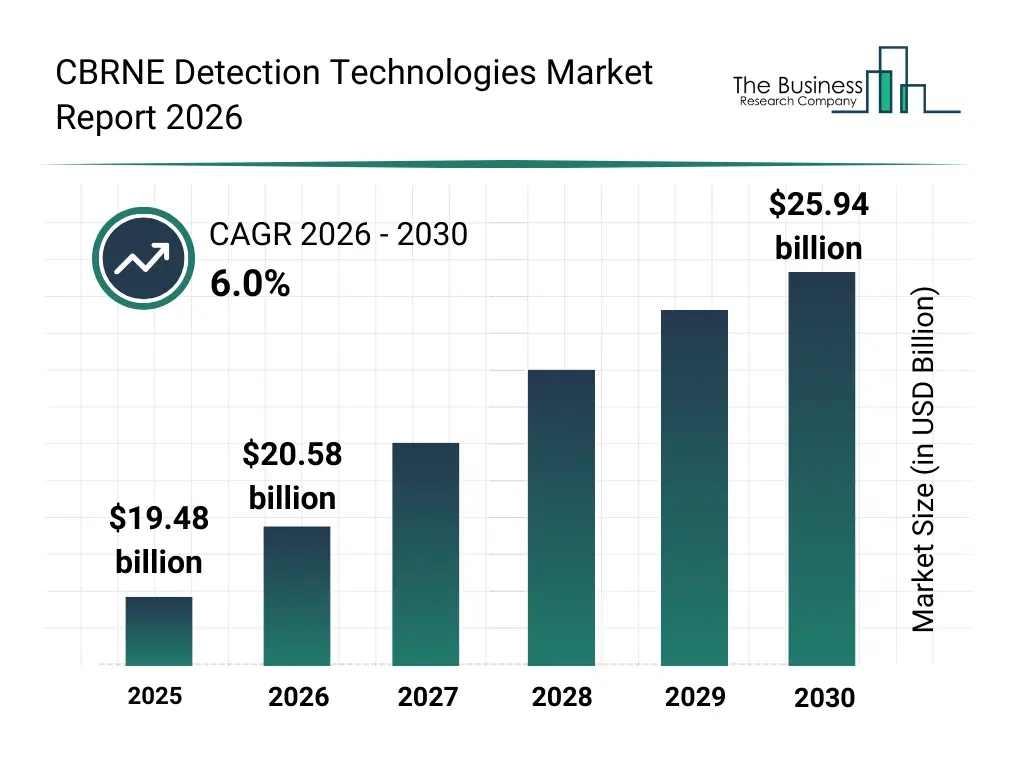
What Is The CBRNE Detection Technologies Market Size and Share 2026?
The cbrne detection technologies market size has grown strongly in recent years. It will grow from $19.48 billion in 2025 to $20.58 billion in 2026 at a compound annual growth rate (CAGR) of 5.6%. The growth in the historic period can be attributed to increased terrorist and chemical threats, adoption of handheld chemical and biological detectors, integration with emergency response protocols, growth in public safety regulations, advancements in sensor accuracy and detection range.What Is The CBRNE Detection Technologies Market Growth Forecast?
The cbrne detection technologies market size is expected to see strong growth in the next few years. It will grow to $25.94 billion in 2030 at a compound annual growth rate (CAGR) of 6.0%. The growth in the forecast period can be attributed to development of portable multi-threat detection systems, integration with ai-driven threat analysis, expansion in critical infrastructure protection, adoption in border security and military applications, growth in real-time environmental monitoring networks. Major trends in the forecast period include growing demand for multi-threat detection platforms, increasing adoption of portable and rapid field-testing devices, expansion of integrated surveillance and monitoring networks, rising focus on decontamination and emergency response capabilities, strengthening emphasis on critical infrastructure protection.
Global CBRNE Detection Technologies Market Segmentation
1) By Product Type: Portable Detection Devices, Fixed Detection Systems, Mobile Detection Platforms, Laboratory Equipment, Software Solutions 2) By Technology Type: Chemical Detection, Biological Detection, Radiological Detection, Nuclear Detection, Explosives Detection 3) By Detection Method: Optical Detection, Mass Spectrometry, Electrochemical Detection, Immunoassay Methods, Gas Chromatography 4) By Threat: Chemical Threat, Biological Threat, Nuclear Threat, Other Threats 5) By End-Use Industry: Defense And Military, Healthcare, Environmental Monitoring, Industrial Safety, Emergency Services Subsegments: 1) By Portable Detection Devices: Handheld Chemical Detector, Wearable Radiation Sensor, Portable Biological Analyzer, Compact Explosive Identifier 2) By Fixed Detection Systems: Wall Mounted Chemical Sensor, Stationary Radiation Monitor, Fixed Biological Screening Unit, Permanent Explosive Detection Panel 3) By Mobile Detection Platforms: Vehicle Mounted Chemical Detector, Mobile Radiation Surveillance Unit, Biological Detection Rover, Explosive Detection Drone 4) By Laboratory Equipment: Chemical Analysis Apparatus, Radiological Testing Instrument, Biological Sample Analyzer, Explosive Forensic Kit 5) By Software Solutions: Threat Detection Software, Data Analysis Platform, Incident Management System, Simulation And Modeling ToolWhat Is Driver Of The CBRNE Detection Technologies Market?
The rising adoption of cloud-based solutions is expected to propel the growth of the chemical, biological, radiological, nuclear, and explosive (CBRNE) detection technologies market going forward. Cloud-based solutions refer to software, services, or resources that are delivered and accessed over the internet rather than being installed locally on a user’s device or on-premises servers. The rising adoption of cloud-based solutions is due to organizations’ need for scalable resources that can quickly adjust to changing workloads and business demands. Cloud-based solutions enhance chemical, biological, radiological, nuclear, and explosive (CBRNE) detection technologies by enabling real-time data collection, centralized analysis, and seamless information sharing across agencies to improve threat detection and response. For instance, in September 2025, according to the Microsoft Corporation, a US-based technology company, accelerating cloud adoption and modernizing IT infrastructure by just five years could allow the Australian Government to save an average of $1.4 billion annually, equating to a 13% reduction in total IT expenditures. Therefore, the rising adoption of cloud-based solutions is driving the growth of the chemical, biological, radiological, nuclear, and explosive (CBRNE) detection technologies market.Key Players In The Global CBRNE Detection Technologies Market
Major companies operating in the cbrne detection technologies market are Teledyne FLIR LLC, Smiths Detection Group Limited, Bruker Detection Corporation, Honeywell International Incorporated, Thales Group, Rheinmetall Defence AG, Leidos Holdings,Incorporated, QinetiQ Group plc, Drägerwerk Aktiengesellschaft & Compagnie Kommanditgesellschaft auf Aktien, Saab Aktiebolag, Battelle Memorial Institute, Chemring Group plc, MSA Safety Incorporated, Avon Protection, Northrop Grumman Corporation, Mirion Technologies Inc., Thermo Fisher Scientific Inc., OSI Systems,Incorporated, Tracerco Limited, Proengin Inc., Kromek Group plc, AirBoss Defense Group Inc., Elbit Systems Limited, Morphix Technologies Incorporated, First Line Technology LLC, Detectachem Inc., Arktis Radiation Detectors AG, S.E. International Inc.
This chart is for illustrative purposes; the full report includes a detailed competitor analysis and comprehensive overview of the top 10 companies in the market.
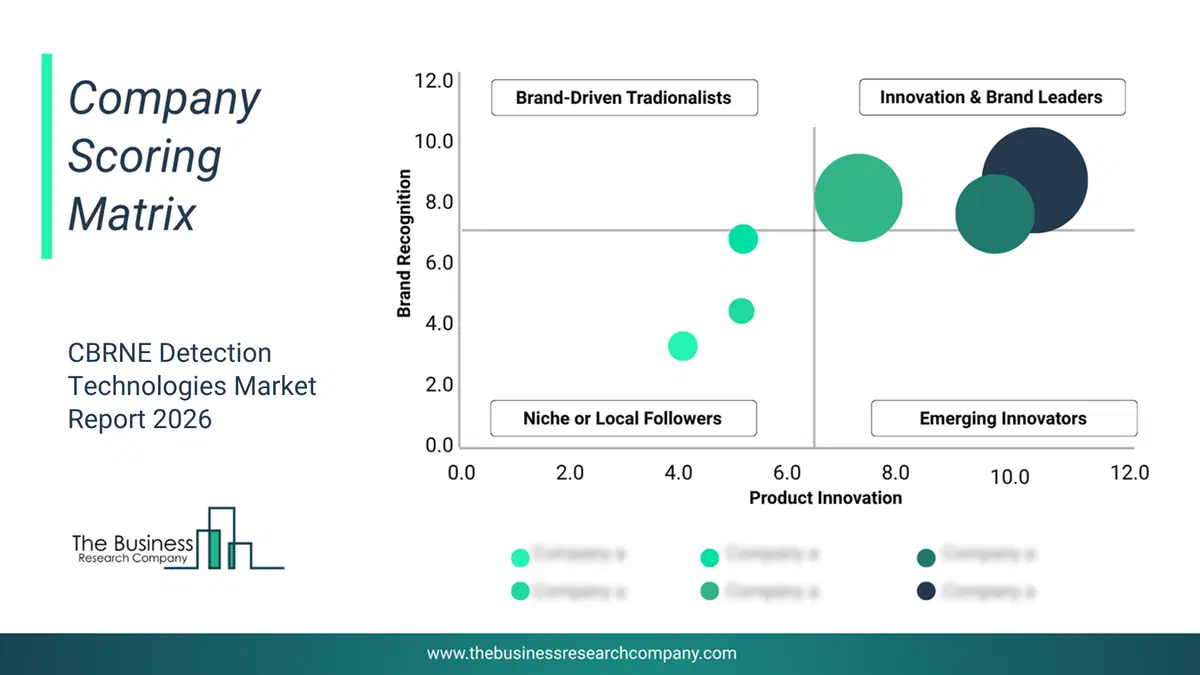
This chart maps companies by product innovation and brand strength, with bubble size indicating relative revenue, helping identify market leaders, challengers, and niche players. This is an illustrative chart; the full report provides a complete and accurate competitive analysis.
Global CBRNE Detection Technologies Market Trends and Insights
Major companies operating in the chemical, biological, radiological, nuclear, and explosive (CBRNE) detection technologies market are focusing on developing handheld gamma spectrometers to strengthen field radiological threat identification. Handheld gamma spectrometers are portable devices that detect and analyze gamma radiation by measuring its energy spectra, enabling rapid identification of radionuclides and assessment of radiological threats directly in the field. For instance, in May 2024, Kromek, a UK-based radiation detection company, launched its new generation RayMon handheld detector, equipped with interchangeable cadmium zinc telluride (CZT), sodium iodide (NaI), and alpha/beta probes for enhanced versatility, a built-in library of 94 radionuclides, real-time dose rate and counts-per-second readouts, a search mode with visual graphs to guide users to radiation sources, and convenient data export options via USB or email. The RayMon detector is designed for deployment in critical infrastructure protection, homeland security, and emergency response operations, supporting improved detection precision, greater operational flexibility across varied radiation scenarios, and faster, more informed decision-making in complex environments.What Are Latest Mergers And Acquisitions In The CBRNE Detection Technologies Market? V2X Inc. Acquires Qinetiq Group To Expand National Security And CBRNE Capabilities
In September 2025, V2X Inc., a US-based aerospace and defense company, acquired QinetiQ Group plc for $24 million. With this acquisition, V2X Inc. aims to strengthen its national security capabilities by expanding its intelligence, cyber, and data-driven mission support solutions. QinetiQ Group plc is a UK-based company that provides chemical, biological, radiological, nuclear, and explosive (CBRNE) detection technologies.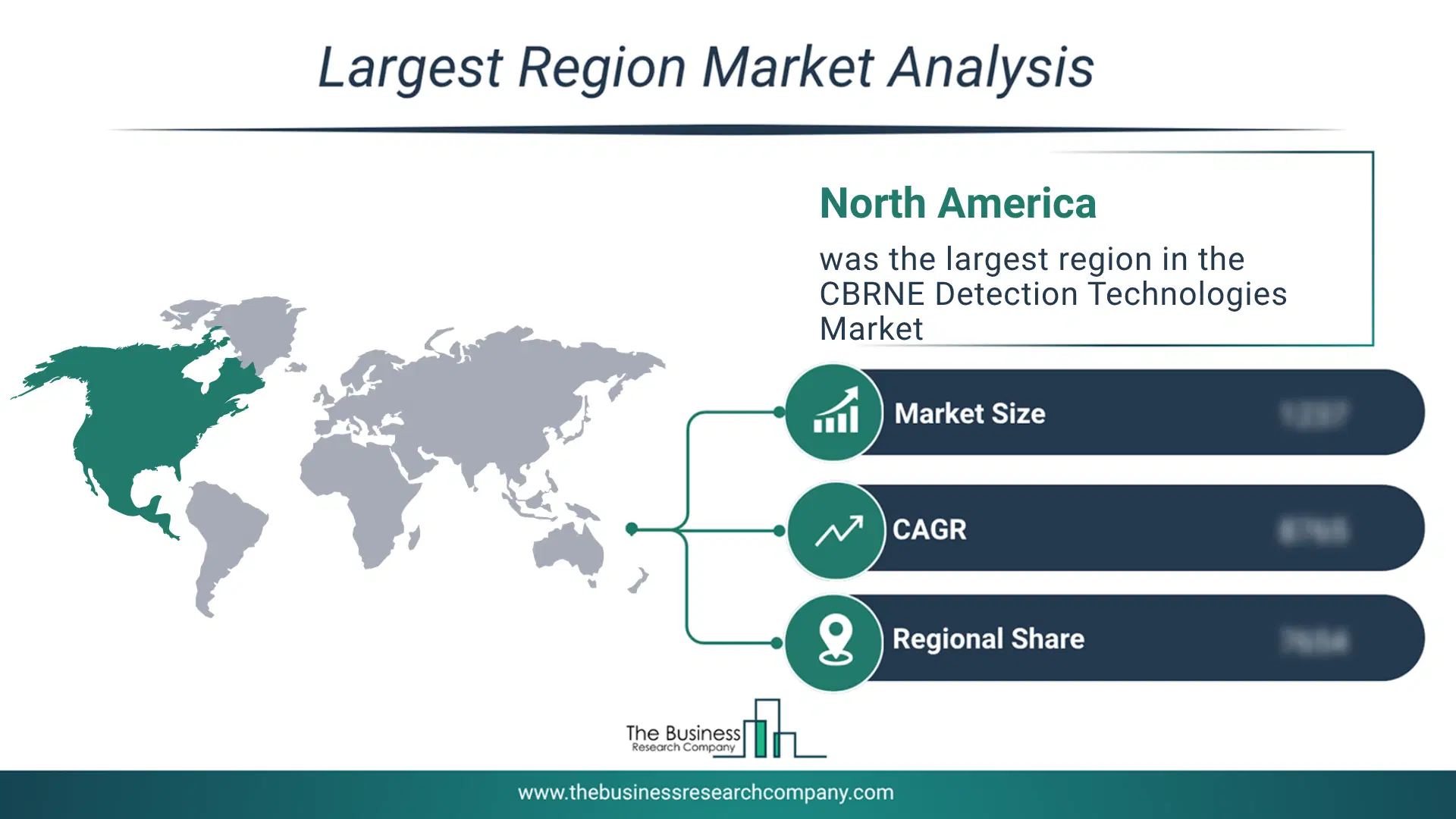
Regional Insights
North America was the largest region in the chemical, biological, radiological, nuclear, and explosive (CBRNE) detection technologies market in 2025. Asia-Pacific is expected to be the fastest-growing region in the forecast period. The regions covered in this market report are Asia-Pacific, South East Asia, Western Europe, Eastern Europe, North America, South America, Middle East, Africa. The countries covered in this market report are Australia, Brazil, China, France, Germany, India, Indonesia, Japan, Taiwan, Russia, South Korea, UK, USA, Canada, Italy, SpainWhat Defines the CBRNE Detection Technologies Market?
The chemical, biological, radiological, nuclear, and explosive (CBRNE) detection technologies market consists of revenues earned by entities by providing services such as threat detection, monitoring and surveillance, decontamination support, emergency response solutions, and security and risk management. The market value includes the value of related goods sold by the service provider or included within the service offering. The chemical, biological, radiological, nuclear, and explosive (CBRNE) detection technologies market also includes sales of handheld chemical detectors, biosensors, radiation dosimeters, geiger counters, handheld spectrometers, explosive trace detectors, decontamination kits, protective masks, and air sampling devices. Values in this market are ‘factory gate’ values, that is, the value of goods sold by the manufacturers or creators of the goods, whether to other entities (including downstream manufacturers, wholesalers, distributors, and retailers) or directly to end customers. The value of goods in this market includes related services sold by the creators of the goods.How is Market Value Defined and Measured?
The market value is defined as the revenues that enterprises gain from the sale of goods and/or services within the specified market and geography through sales, grants, or donations in terms of the currency (in USD unless otherwise specified). The revenues for a specified geography are consumption values that are revenues generated by organizations in the specified geography within the market, irrespective of where they are produced. It does not include revenues from resales along the supply chain, either further along the supply chain or as part of other products.
This chart presents market attractiveness based on a quantitative evaluation of growth, competition, strategic alignment, and risk, offering a clear view of opportunity areas for decision-making. This chart is for illustrative purposes; the full report contains the complete analysis.

This chart highlights the Total Addressable Market (TAM) by estimating the maximum revenue opportunity using an assumption-driven approach, supporting strategic planning and opportunity sizing across markets. The chart is illustrative; the full report provides a more comprehensive analysis.
What Key Data and Analysis Are Included in the CBRNE Detection Technologies Market Report 2026?
The cbrne detection technologies market research report is one of a series of new reports from The Business Research Company that provides market statistics, including industry global market size, regional shares, competitors with the market share, detailed market segments, market trends and opportunities, and any further data you may need to thrive in the cbrne detection technologies industry. The market research report delivers a complete perspective of everything you need, with an in-depth analysis of the current and future state of the industry.CBRNE Detection Technologies Market Report Forecast Analysis
| Report Attribute | Details |
|---|---|
| Market Size Value In 2026 | $20.58 billion |
| Revenue Forecast In 2030 | $25.94 billion |
| Growth Rate | CAGR of 6% from 2026 to 2030 |
| Base Year For Estimation | 2025 |
| Actual Estimates/Historical Data | 2020-2025 |
| Forecast Period | 2026 - 2030 |
| Market Representation | Revenue in USD Billion and CAGR from 2026 to 2030 |
| Segments Covered | Product Type, Technology Type, Detection Method, Threat, End-Use Industry |
| Regional Scope | Asia-Pacific, Western Europe, Eastern Europe, North America, South America, Middle East, Africa |
| Country Scope | The countries covered in the cbrne detection technologies market report are Australia, Brazil, China, France, Germany, India, Indonesia, Japan, Taiwan, Russia, South Korea, UK, USA, Canada, Italy, Spain |
| Key Companies Profiled | Teledyne FLIR LLC, Smiths Detection Group Limited, Bruker Detection Corporation, Honeywell International Incorporated, Thales Group, Rheinmetall Defence AG, Leidos Holdings,Incorporated, QinetiQ Group plc, Drägerwerk Aktiengesellschaft & Compagnie Kommanditgesellschaft auf Aktien, Saab Aktiebolag, Battelle Memorial Institute, Chemring Group plc, MSA Safety Incorporated, Avon Protection, Northrop Grumman Corporation, Mirion Technologies Inc., Thermo Fisher Scientific Inc., OSI Systems,Incorporated, Tracerco Limited, Proengin Inc., Kromek Group plc, AirBoss Defense Group Inc., Elbit Systems Limited, Morphix Technologies Incorporated, First Line Technology LLC, Detectachem Inc., Arktis Radiation Detectors AG, S.E. International Inc. |
| Customization Scope | Request for Customization |
| Pricing And Purchase Options | Explore Purchase Options |