

Contact Us
  Search
The Business Research Company Logo
Ceiling Tiles Global Market Opportunities And Strategies To 2035
Published :June 2026
Pages :231
Format :PDF
Delivery Time :2-3 Business Days
Why 2-3 days? We update the report with the latest data and news before delivery. Let us know if you need us to expedite.
Report Price :$4,490.00

Ceiling Tiles Global Market Opportunities And Strategies To 2035

By Installation (Surface Mount, Drop or Suspended), By Material Type (Mineral Wool, Metal, Gypsum, Other Materials), By Form (Laminated, Fissured, Patterned, Plain, Textured, Coffered, Other Forms), By Application (Residential, Commercial, Industrial, Institutional), And By Region, Opportunities And Strategies – Global Forecast To 2035

Ceiling Tiles Market Definition

Ceiling tiles are lightweight panels installed in ceilings to create a finished surface and conceal structural elements, wiring, or ductwork. The primary purpose of ceiling tiles is to improve interior aesthetics, acoustics, and functionality. They help reduce noise, enhance thermal insulation, provide easy access to utilities above the ceiling, and contribute to fire resistance and indoor comfort in residential, commercial, and industrial buildings. The ceiling tiles market consists of sales by entities (organizations, sole traders, or partnerships) of prefabricated panels designed to cover ceilings. These tiles are typically made from materials like mineral fiber, gypsum, metal, fiberglass, or polyvinyl chloride (PVC), offering acoustic control, thermal insulation, fire resistance, and aesthetic appeal.
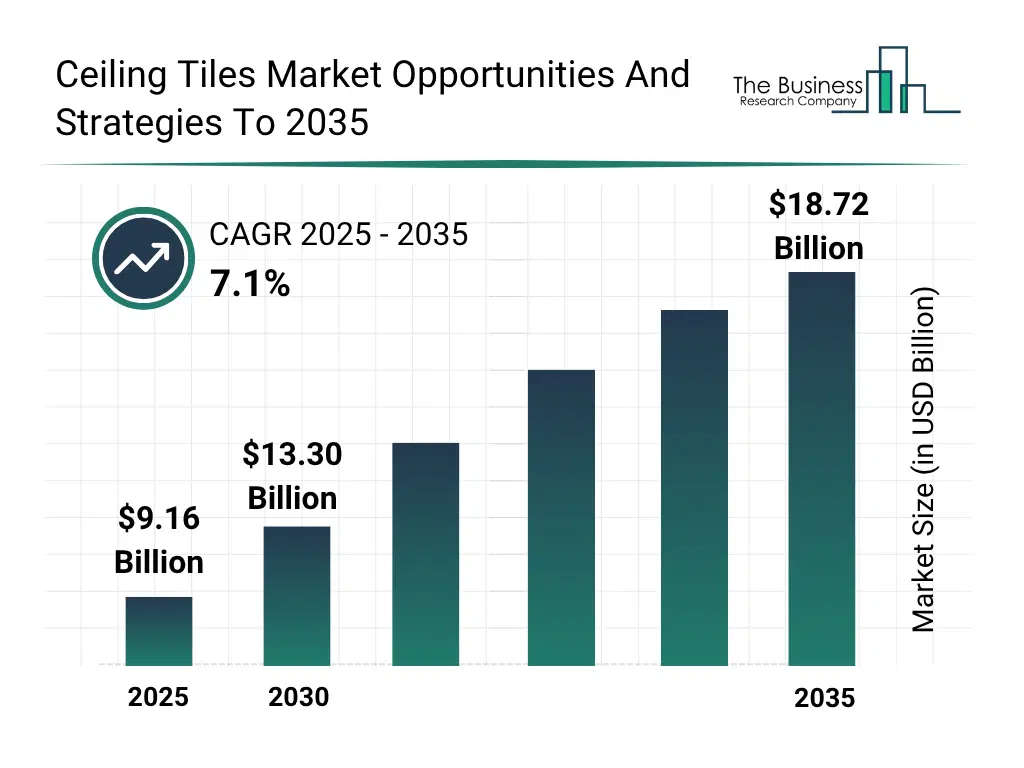
Ceiling Tiles Global Market Opportunities And Strategies To 2035 Market Size and growth rate 2026 to 2030: Graph

Ceiling Tiles Market Size

The global ceiling tiles market reached a value of nearly $9,155.5 million in 2025, having grown at a compound annual growth rate (CAGR) of 9.0% since 2020. The market is expected to grow from $9,155.5 million in 2025 to $13,303.3 million in 2030 at a rate of 7.8%. The market is then expected to grow at a CAGR of 7.1% from 2030 and reach $18,716.6 million in 2035. Growth in the historic period resulted from expansion of smart city initiative projects, growing renovation and remodeling activities, rise in demand for moisture and antimicrobial resistant products and growth of acoustic panel demand. Factors that negatively affected growth in the historic period were stringent building codes and environmental regulations and volatility in raw-material prices. Going forward, increase in demand for green buildings, increasing focus on infrastructure development, expansion of residential and commercial construction and increasing demand for energy-efficient solutions will drive the growth. Factors that could hinder the growth of the ceiling tiles market in the future include high production and manufacturing costs, competition from alternative ceiling solutions and impact of trade war and tariffs.
Research Expert

Book your 30 minutes free consultation with our research experts

Ceiling Tiles Market Segmentation

The ceiling tiles market is segmented by installation, by material type, by form and by application.

By Installation –
The ceiling tiles market is segmented by installation into:
    • a) Surface Mount
    • b) Drop or Suspended
The drop or suspended market was the largest segment of the ceiling tiles market segmented by installation, accounting for 67.1% or $6,146.2 million of the total in 2025. Going forward, the surface mount segment is expected to be the fastest-growing segment in the ceiling tiles market segmented by installation, at a CAGR of 7.9% during 2025-2030.

By Material Type –
The ceiling tiles market is segmented by material type into:
    • a) Mineral Wool
    • b) Metal
    • c) Gypsum
    • d) Other Materials
The mineral wool was the largest segment of the ceiling tiles market segmented by material type, accounting for 40.0% or $3,661.9 million of the total in 2025. Going forward, the gypsum segment is expected to be the fastest-growing segment in the ceiling tiles market segmented by material type, at a CAGR of 12.9% during 2025-2030.

By Form –
The ceiling tiles market is segmented by form into:
    • a) Laminated
    • b) Fissured
    • c) Patterned
    • d) Plain
    • e) Textured
    • f) Coffered
    • g) Other Forms
The plain market was the largest segment of the ceiling tiles market segmented by form, accounting for 29.1% or $2,664.9 million of the total in 2025. Going forward, the textured segment is expected to be the fastest-growing segment in the ceiling tiles market segmented by form, at a CAGR of 9.7% during 2025-2030.

By Application –
The ceiling tiles market is segmented by application into:
  1. a) Residential
  2. b) Commercial
  3. c) Industrial
  4. d) Institutional
The commercial market was the largest segment of the ceiling tiles market segmented by application, accounting for 55.4% or $5,075.3 million of the total in 2025. Going forward, the residential segment is expected to be the fastest-growing segment in the ceiling tiles market segmented by application, at a CAGR of 9.6% during 2025-2030.

By Geography - The ceiling tiles market is segmented by geography into:
      o Asia Pacific
      • China
      • India
      • Japan
      • Australia
      • Taiwan
      • South Korea
        • o South East Asia
          • Indonesia
          o North America
          • USA
          • Canada
          o South America
          • Brazil
          o Western Europe
          • France
          • Germany
          • UK
          • Italy
          • Spain
          o Eastern Europe
          • Russia
          o Middle East
          o Africa
North America was the largest region in the ceiling tiles market, accounting for 36.4% or $3,268.6 million of the total in 2025. It was followed by Asia Pacific, Western Europe and then the other regions. Going forward, the fastest-growing regions in the ceiling tiles market will be Asia Pacific and Middle East where growth will be at CAGRs of 9.04% and 8.99% respectively. These will be followed by Africa and North America where the markets are expected to grow at CAGRs of 8.4% and 7.7% respectively.

Ceiling Tiles Market Competitive Landscape

Major Competitors are:

  • Armstrong World Industries Inc.
  • USG Corporation
  • Saint Gobain SA (Gyproc, CertainTeed)
  • Knauf Gips KG
  • ROCKWOOL International A/S (Rockfon)
  • Other Competitors Include:

  • Georgia‑Pacific LLC
  • Hunter Douglas N.V.
  • OWA Odenwald Faserplattenwerk GmbH
  • National Gypsum Company
  • Everest Industries
  • Ecolite Industries Limited
  • Balaji Gypsum Private Limited
  • PARÉ Innovations Pvt. Ltd
  • Ecophon
  • HIL Limited
  • Zhongshan Starleigh Building Materials Co., Ltd.
  • Foshan Ron Building Material Trading Co., Ltd.
  • Guangzhou Titan (Tital) Commercial Co., Ltd
  • Haining Chaodi Plastic Co., Ltd
  • Shandong Huamei Building Materials Co., Ltd
  • Daiken Corporation
  • Aica Kogyo Co., Ltd
  • Hunter Douglas N.V.
  • KCC Corporation
  • Tae Lim CO., LTD
  • Shinhwa B & C Co., Ltd.
  • Hangil Co., Inc.
  • Tornex Korea Corp.
  • PT SHERA Building Solutions Indonesia
  • EcoTile Solutions
  • The Siam Gypsum Industry
  • Vinh Tuong Industrial Group
  • Motion Tech Asia
  • Knauf Gips KG
  • Compagnie de Saint‑Gobain S.A
  • RENOLIT Ondex S.A.S
  • Zentia
  • SAS International Ltd.
  • Odenwald Faserplattenwerk GmbH
  • CertainTeed Corporation
  • New Ceiling Tiles LLC
  • BŌK Modern, LLC
  • 3form, LLC
  • A. Zahner Company
  • Building Products of Canada Corp.
  • Geometrik Manufacturing Inc.
  • Decoustics Limited
  • Altispace Inc.
  • Innovative Cast Inc
  • Tensolite S.A.
  • PLACO
  • Ceiling Tiles Market Drivers

    The key drivers of the ceiling tiles market include: Increasing Demand For Energy-Efficient Solutions Increasing demand for energy-efficient solutions are expected to be a key driver of the ceiling tiles market during the forecast period. Ceiling tiles contribute to energy efficiency by supporting thermal insulation, reducing heat loss or gain, and enhancing the performance of lighting and HVAC (heating, ventilation, and air conditioning) systems. Their ability to integrate with energy-efficient building designs and support optimized indoor climate control makes them an important component of energy-conscious construction. As energy efficiency becomes a priority in both new construction and renovation projects, ceiling tiles that support lower energy usage and improved indoor comfort are expected to experience sustained demand growth. Energy-efficient ceiling systems also help reduce long-term operating costs for building owners and occupants. This reinforces their role as a functional and cost-effective solution in modern building design. The increasing demand for energy-efficient solutions growth contribution during the forecast period in 2025 is 1.5%.

    Ceiling Tiles Market Restraints

    The key restraints on the ceiling tiles market include: High Production And Manufacturing Costs High production and manufacturing costs are restricting the growth of the ceiling tiles market during the forecast period. Ceiling tile manufacturing relies on energy-intensive processes, specialized equipment, and raw materials such as gypsum, mineral wool, metals, and coatings, all of which contribute to elevated production expenses. Rising costs can limit manufacturers’ ability to compete on price, particularly in large-scale commercial and institutional projects where budget constraints are significant. As a result, higher production costs may slow adoption in price-sensitive markets and delay investment in capacity expansion or product innovation. Manufacturers may also face challenges in passing cost increases on to customers without affecting demand. This cost pressure can reduce the pace of technological upgrades and operational expansion across the industry. Growth affected by the high production and manufacturing costs during the forecast period in 2025 is -1.8%.

    Need data on a specific region in this market?

    Opportunities And Recommendations In The Ceiling Tiles Market

    Opportunities – The top opportunities in the ceiling tiles market segmented by installation will arise in the drop or suspended segment, which will gain $2,748.8 million of global annual sales by 2030. The top opportunities in the ceiling tiles market segmented by material type will arise in the gypsum segment, which will gain $1,580.8 million of global annual sales by 2030. The top opportunities in the ceiling tiles market segmented by form will arise in the plain segment, which will gain $1,523.7 million of global annual sales by 2030.The top opportunities in the ceiling tiles market segmented by application will arise in the commercial segment, which will gain $2,274.6 million of global annual sales by 2030. The ceiling tiles market size will gain the most in the USA at $1,223.0 million. Recommendations- To take advantage of the opportunities, The Business Research Company recommends the ceiling tiles companies to focus on aesthetic and high-performance ceiling tile development, focus on low-emission and circular economy ceiling tile solutions, focus on advanced acoustic ceiling tile solutions for occupant comfort, focus on drop or suspended ceiling tile systems for large-scale commercial projects, focus on gypsum and mineral wool ceiling tile materials to capture high-growth segments, focus on textured and plain ceiling tile forms to address divergent market demands, expand in emerging markets, focus on expanding distribution channels to strengthen market reach, focus on tiered pricing strategies to capture demand across market segments, focus on specification-led promotional strategies to drive commercial project wins, focus on digital and trade promotions to accelerate residential and retail channel growth and focus on commercial and residential end-use segments to drive ceiling tile volume growth.
    Chat with us