
Ceramic Fiber Cloth Market Report 2026
Global Outlook – By Product Type (Needle-Punched Ceramic Fiber Cloth, Woven Ceramic Fiber Cloth, Braided Ceramic Fiber Cloth), By Form (Rolls, Sheets, Custom Shapes), By Application (Thermal Insulation, Fire Protection, High-Temperature Filtration, Welding Blankets, Other Applications), By End-User Industry (Aerospace, Automotive, Power Generation, Petrochemical, Metal Processing, Other End Users) – Market Size, Trends, Strategies, and Forecast to 2030
Ceramic Fiber Cloth Market Overview
• Ceramic Fiber Cloth market size has reached to $1.61 billion in 2025 • Expected to grow to $2.39 billion in 2030 at a compound annual growth rate (CAGR) of 8.1% • Growth Driver: Rising Infrastructure Development Driving The Market Growth Due To High-Temperature Insulation And Fire Protection Needs • Market Trend: Leading Companies Driving Advanced Thermal And Mechanical Solutions Through Innovative Fiber Reinforcement • North America was the largest region in 2025 and Asia-Pacific is the fastest growing region.What Is Covered Under Ceramic Fiber Cloth Market?
Ceramic fiber cloth refers to a high-temperature, woven fabric made from ceramic fibers, often reinforced with fiberglass or stainless-steel wire to enhance strength and durability. It is designed to provide excellent thermal insulation, chemical resistance, and flexibility, making it suitable for applications such as heat shields, furnace curtains, welding blankets, and protective covers in industrial environments. The main product types of ceramic fiber cloth are needle-punched ceramic fiber cloth, woven ceramic fiber cloth, and braided ceramic fiber cloth. Needle-punched ceramic fiber cloth is produced by mechanically interlocking fibers with needles to create a dense and durable structure. It is available in various forms, such as rolls, sheets, and custom shapes. Its applications span thermal insulation, fire protection, high-temperature filtration, welding blankets, and others, and this material is widely used across end-user industries, including aerospace, automotive, power generation, petrochemical, metal processing, and others.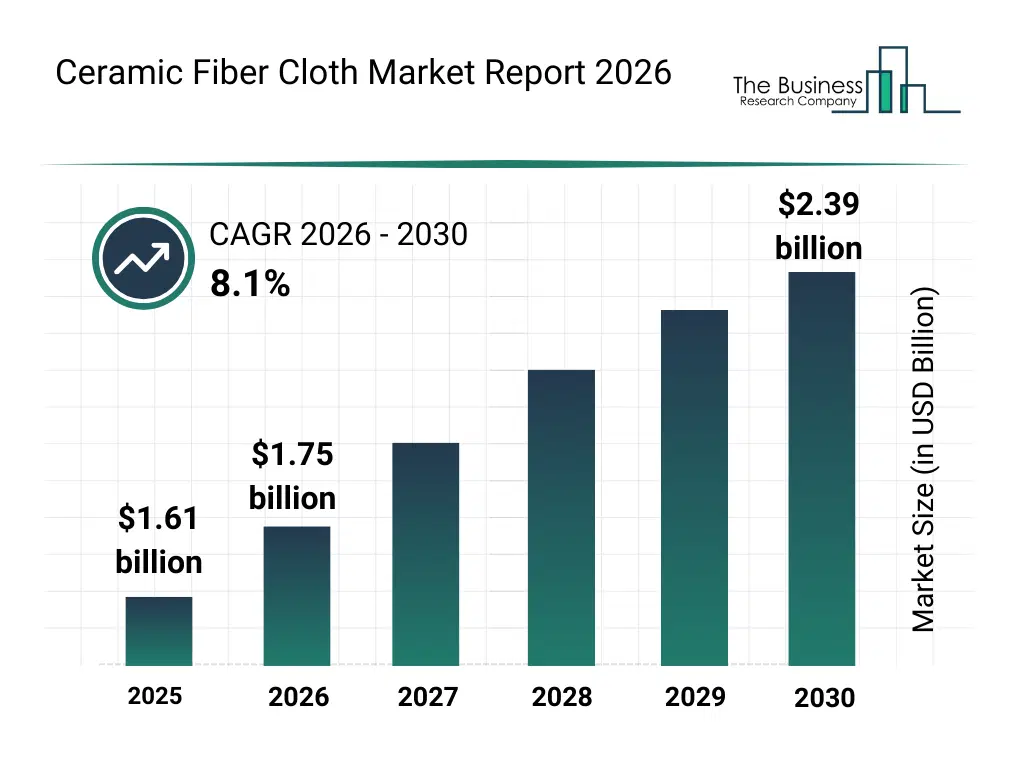
What Is The Ceramic Fiber Cloth Market Size and Share 2026?
The ceramic fiber cloth market size has grown strongly in recent years. It will grow from $1.61 billion in 2025 to $1.75 billion in 2026 at a compound annual growth rate (CAGR) of 8.4%. The growth in the historic period can be attributed to expansion of industrial furnace installations, growth in metal processing industries, rising use of thermal insulation materials, increased safety standards in industrial operations, availability of advanced ceramic fiber materials.What Is The Ceramic Fiber Cloth Market Growth Forecast?
The ceramic fiber cloth market size is expected to see strong growth in the next few years. It will grow to $2.39 billion in 2030 at a compound annual growth rate (CAGR) of 8.1%. The growth in the forecast period can be attributed to increasing investments in high-efficiency thermal systems, rising demand from aerospace and defense sectors, expansion of renewable energy infrastructure, growing focus on fire protection solutions, innovation in lightweight high-temperature fabrics. Major trends in the forecast period include increasing demand for high-temperature insulation materials, rising use of ceramic fiber cloth in industrial safety, growing adoption in aerospace and power generation applications, expansion of reinforced ceramic fiber fabrics, enhanced focus on thermal efficiency and durability.
Global Ceramic Fiber Cloth Market Segmentation
1) By Product Type: Needle-Punched Ceramic Fiber Cloth, Woven Ceramic Fiber Cloth, Braided Ceramic Fiber Cloth 2) By Form: Rolls, Sheets, Custom Shapes 3) By Application: Thermal Insulation, Fire Protection, High-Temperature Filtration, Welding Blankets, Other Applications 4) By End-User Industry: Aerospace, Automotive, Power Generation, Petrochemical, Metal Processing, Other End Users Subsegments: 1) By Needle-Punched Ceramic Fiber Cloth: Standard Needling, High-Density Needling 2) By Woven Ceramic Fiber Cloth: Plain Weave, Twill Weave, Satin Weave 3) By Braided Ceramic Fiber Cloth: Single Braid, Double Braid, Hollow BraidWhat Are The Drivers Of The Ceramic Fiber Cloth Market?
The increasing infrastructure development is expected to propel the growth of the ceramic fiber cloth market going forward. Infrastructure development refers to the construction and improvement of essential facilities such as transportation, utilities, and communication systems that support economic growth and societal well-being. Increasing infrastructure development is driven by the growing need to support urbanization and industrialization, as expanding cities and industries require improved transportation networks, energy systems, and utilities to sustain economic growth and enhance living standards. Ceramic fiber cloth supports infrastructure development by providing high-temperature insulation and fire protection for industrial equipment, pipelines, and construction materials, ensuring safety, energy efficiency, and durability in large-scale projects such as power plants, refineries, and commercial buildings. For instance, in October 2024, according to the Infrastructure Partnerships Australia, an Australia-based government organization, Australian general government infrastructure funding across all states and territories is USD 176 billion (A$270.4 billion) over the four years to FY 2027-28, representing a modest increase of USD 9.04 billion (A$13.8 billion) from the FY 2023-24 period. Therefore, increasing infrastructure development is driving the growth of the ceramic fiber cloth industry. The growing demand for automotive industry is expected to propel the growth of the ceramic fiber cloth market going forward. The automotive industry is a broad sector that encompasses the design, development, manufacturing, marketing, and sale of motor vehicles, including cars, trucks, and motorcycles, along with the associated services and supply chains that support transportation innovation, safety, and sustainability worldwide. The growing demand for the automotive industry is due to an increasing reliance on personal and commercial transportation that enhances mobility, convenience, and economic productivity in modern society. Ceramic fiber cloth supports the automotive industry by providing high-temperature insulation and heat protection for components such as exhaust systems, engines, and braking mechanisms, thereby enhancing vehicle efficiency, durability, and safety under extreme operating conditions. For instance, in December 2024, according to the Eurostat, a Luxembourg-based government agency, in 2023, renewable energy represented 24.5% of total energy consumption in the EU, up from 23.0% in 2022. Therefore, the growing demand for automotive industry drives the ceramic fiber cloth industry.Key Players In The Global Ceramic Fiber Cloth Market
Major companies operating in the ceramic fiber cloth market are 3M Company, IBIDEN Co. Ltd., Morgan Advanced Materials plc, Luyang Energy‑Saving Materials Co. Ltd., RATH Group, NUTEC Incorporated, Specialty Products & Insulation, Shree Ceramic Fibers Pvt. Ltd., Mid‑Mountain Materials Inc., Ningbo Gteek Technology Co. Ltd., ZIRCAR Ceramics Inc., CeraMaterials, CeramSource Inc., Mineral Seal Corporation, Yeso Insulating Products Co. Ltd., Unifrax I LLC, Fibrecast Inc., PTI Thermal Solutions, Great Lakes Textiles, Isolite Insulating Products Co. Ltd., HarbisonWalker International, Pyrotek In.
This chart is for illustrative purposes; the full report includes a detailed competitor analysis and comprehensive overview of the top 10 companies in the market.
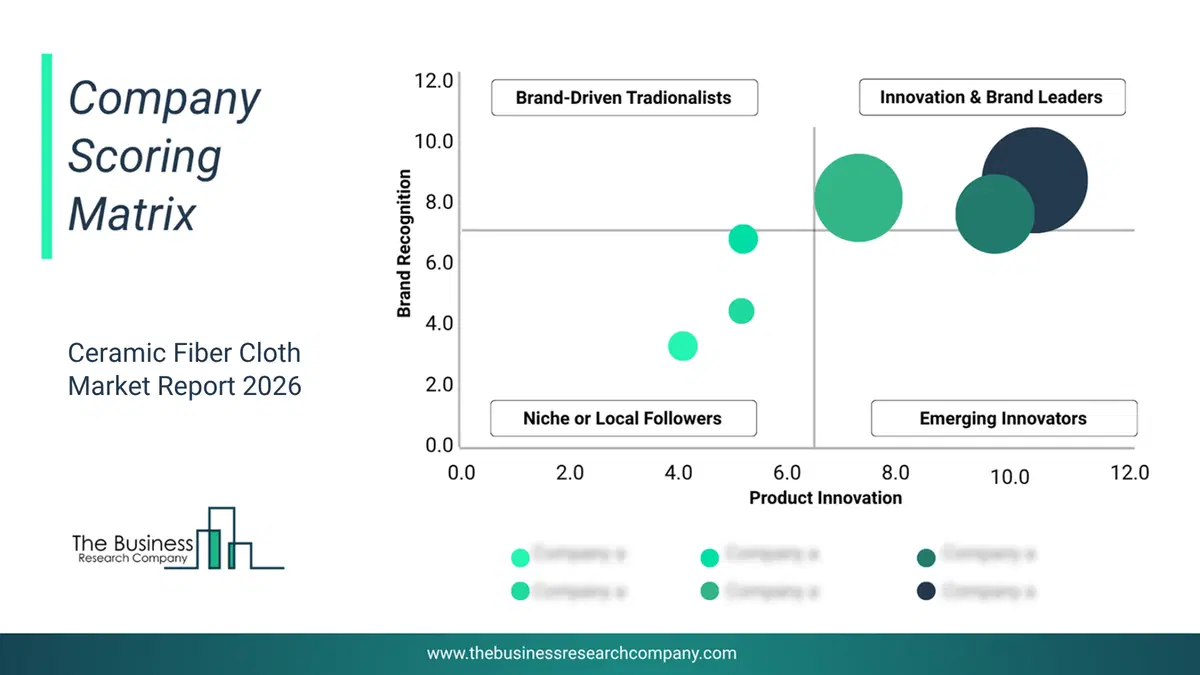
This chart maps companies by product innovation and brand strength, with bubble size indicating relative revenue, helping identify market leaders, challengers, and niche players. This is an illustrative chart; the full report provides a complete and accurate competitive analysis.
Global Ceramic Fiber Cloth Market Trends and Insights
Major companies operating in the ceramic fiber cloth market are focusing on developing innovative solutions such as ceramic matrix composite (CMC) reinforcement to enhance thermal resistance, mechanical strength, and durability for advanced industrial applications. Ceramic Matrix composite (CMC) reinforcement refers to the use of ceramic fibers embedded within a ceramic matrix to improve the material’s toughness, thermal stability, and resistance to cracking under high temperatures or mechanical stress. For instance, in December 2024, RATH Group, an Australia-based manufacturing company, successfully started up a production plant for innovative oxide ceramic continuous fibers at its Mönchengladbach site in Germany. Fibers that combine high strength and flexibility at temperatures up to 1200°C, with outstanding thermal shock resistance and dimensional stability. These fibers are vital for reinforcing advanced composites in demanding applications across energy, aerospace, and automotive sectors, enabling lightweight, damage-tolerant, and long-lasting materials. As the first European supplier, RATH enhances supply security and supports the development of high-performance, energy-efficient technologies for the future.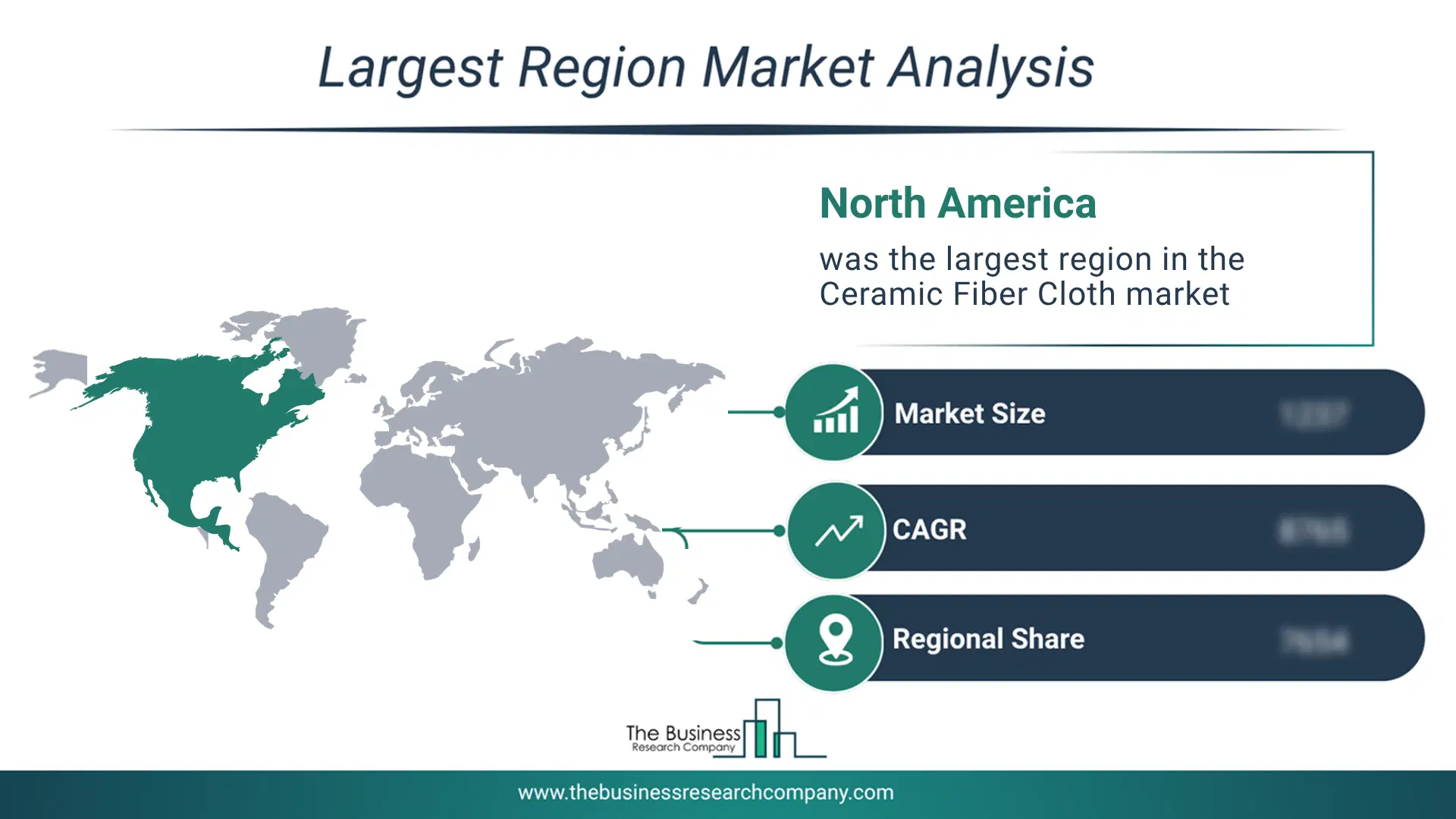
Regional Outlook
North America was the largest region in the ceramic fiber cloth market in 2025. Asia-Pacific is expected to be the fastest-growing region in the forecast period. The regions covered in this market report are Asia-Pacific, South East Asia, Western Europe, Eastern Europe, North America, South America, Middle East, Africa. The countries covered in this market report are Australia, Brazil, China, France, Germany, India, Indonesia, Japan, Taiwan, Russia, South Korea, UK, USA, Canada, Italy, Spain.What Defines the Ceramic Fiber Cloth Market?
The ceramic fiber cloth market consists of sales of ceramic fiber paper, ceramic fiber board, ceramic fiber tape, ceramic fiber ropes, and ceramic fiber modules. Values in this market are ‘factory gate’ values, that is, the value of goods sold by the manufacturers or creators of the goods, whether to other entities (including downstream manufacturers, wholesalers, distributors, and retailers) or directly to end customers. The value of goods in this market includes related services sold by their creators.How is Market Value Defined and Measured?
The market value is defined as the revenues that enterprises gain from the sale of goods and/or services within the specified market and geography through sales, grants, or donations in terms of the currency (in USD unless otherwise specified). The revenues for a specified geography are consumption values that are revenues generated by organizations in the specified geography within the market, irrespective of where they are produced. It does not include revenues from resales along the supply chain, either further along the supply chain or as part of other products.
This chart presents market attractiveness based on a quantitative evaluation of growth, competition, strategic alignment, and risk, offering a clear view of opportunity areas for decision-making. This chart is for illustrative purposes; the full report contains the complete analysis.

This chart highlights the Total Addressable Market (TAM) by estimating the maximum revenue opportunity using an assumption-driven approach, supporting strategic planning and opportunity sizing across markets. The chart is illustrative; the full report provides a more comprehensive analysis.
What Key Data and Analysis Are Included in the Ceramic Fiber Cloth Market Report 2026?
The ceramic fiber cloth market research report is one of a series of new reports from The Business Research Company that provides market statistics, including Market Report 2026?global market size, regional shares, competitors with the market share, detailed market segments, market trends and opportunities, and any further data you may need to thrive in the ceramic fiber cloth Market Report 2026? The market research report delivers a complete perspective of everything you need, with an in-depth analysis of the current and future state of the Market Report 2026?Ceramic Fiber Cloth Market Report Forecast Analysis
| Report Attribute | Details |
|---|---|
| Market Size Value In 2026 | $1.75 billion |
| Revenue Forecast In 2030 | $2.39 billion |
| Growth Rate | CAGR of 8.4% from 2026 to 2030 |
| Base Year For Estimation | 2025 |
| Actual Estimates/Historical Data | 2020-2025 |
| Forecast Period | 2026 - 2030 |
| Market Representation | Revenue in USD Billion and CAGR from 2026 to 2030 |
| Segments Covered | Product Type, Form, Application, End-User Industry |
| Regional Scope | Asia-Pacific, Western Europe, Eastern Europe, North America, South America, Middle East, Africa |
| Country Scope | The countries covered in the report are Australia, Brazil, China, France, Germany, India, Indonesia, Japan, Taiwan, Russia, South Korea, UK, USA, Canada, Italy, Spain. |
| Key Companies Profiled | 3M Company, IBIDEN Co. Ltd., Morgan Advanced Materials plc, Luyang Energy‑Saving Materials Co. Ltd., RATH Group, NUTEC Incorporated, Specialty Products & Insulation, Shree Ceramic Fibers Pvt. Ltd., Mid‑Mountain Materials Inc., Ningbo Gteek Technology Co. Ltd., ZIRCAR Ceramics Inc., CeraMaterials, CeramSource Inc., Mineral Seal Corporation, Yeso Insulating Products Co. Ltd., Unifrax I LLC, Fibrecast Inc., PTI Thermal Solutions, Great Lakes Textiles, Isolite Insulating Products Co. Ltd., HarbisonWalker International, Pyrotek In. |
| Customization Scope | Request for Customization |
| Pricing And Purchase Options | Explore Purchase Options |