
Certificate Lifecycle Management Software Market Report 2026
Global Outlook – By Certificate Type (Secure Sockets Layer (SSL) Or Transport Layer Security (TLS) Certificates, Code Signing Certificates, Email Certificates, Client Certificates), By Deployment Model (On-Premises, Cloud-Based), By Organization Size (Large Enterprises, Small And Medium-Sized Enterprises), By Vertical Industry (Finance, Healthcare, Government, Information Technology (IT) and Telecom, Manufacturing) – Market Size, Trends, Strategies, and Forecast to 2030
Certificate Lifecycle Management Software Market Overview
• Certificate Lifecycle Management Software market size has reached to $5.23 billion in 2025 • Expected to grow to $11.05 billion in 2030 at a compound annual growth rate (CAGR) of 15.6% • Growth Driver: Cloud Computing Adoption Fueling Growth In The Certificate Lifecycle Management Software Market • Market Trend: Innovative Solutions In The Certificate Lifecycle Management Market • North America was the largest region in 2025.Market Gains By 2030 – Top Opportunities By Segment
Market Gain identifies the most promising market opportunities by highlighting the segments or products expected to generate the highest incremental revenue growth over the next five years.
What Is Covered Under Certificate Lifecycle Management Software Market?
Certificate lifecycle management software refers to a comprehensive set of tools and processes designed to facilitate the automated issuance, renewal, monitoring, and management of digital certificates, ensuring their secure and compliant lifecycle across organizational infrastructures, devices, and applications. It centralizes certificate management tasks, reducing manual efforts, enhancing security, and ensuring uninterrupted operations. The main types of certificates included in certificate lifecycle management software are secure socket layer (SSL) or transport layer security (TLS) certificates, code signing certificates, email certificates, and client certificates. Secure socket layer (SSL) or transport layer security (TLS) certificates are digital certificates that authenticate the identity of websites and encrypt information transmitted between a web server and a browser, ensuring secure online communication. It can be deployed on-premises and in the cloud for various applications, including large enterprises and small and medium-sized enterprises. It is used by a variety of vertical industries, such as finance, healthcare, government, information technology (IT), telecom, and manufacturing.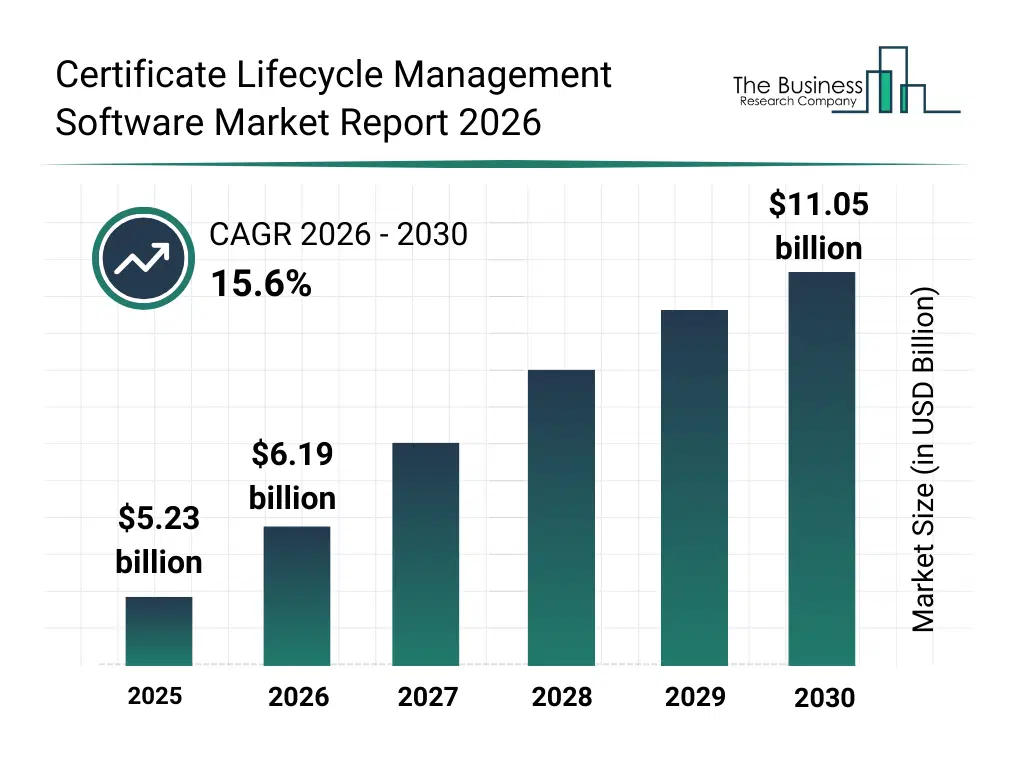
What Is The Certificate Lifecycle Management Software Market Size and Share 2026?
The certificate lifecycle management software market size has grown rapidly in recent years. It will grow from $5.23 billion in 2025 to $6.19 billion in 2026 at a compound annual growth rate (CAGR) of 18.5%. The growth in the historic period can be attributed to rising cyber threats and data breaches, increasing adoption of ssl/tls certificates, growing cloud-based infrastructure, regulatory compliance requirements, expansion of enterprise it networks.What Is The Certificate Lifecycle Management Software Market Growth Forecast?
The certificate lifecycle management software market size is expected to see rapid growth in the next few years. It will grow to $11.05 billion in 2030 at a compound annual growth rate (CAGR) of 15.6%. The growth in the forecast period can be attributed to increasing demand for automated certificate management, integration with ai-driven security tools, growth in fintech and government sectors, adoption of zero-trust security frameworks, rising enterprise digital transformation initiatives. Major trends in the forecast period include automated certificate issuance and renewal, centralized certificate monitoring, compliance and regulatory management, integration with identity and access management (iam) systems, risk assessment and threat mitigation for certificates.
Global Certificate Lifecycle Management Software Market Segmentation
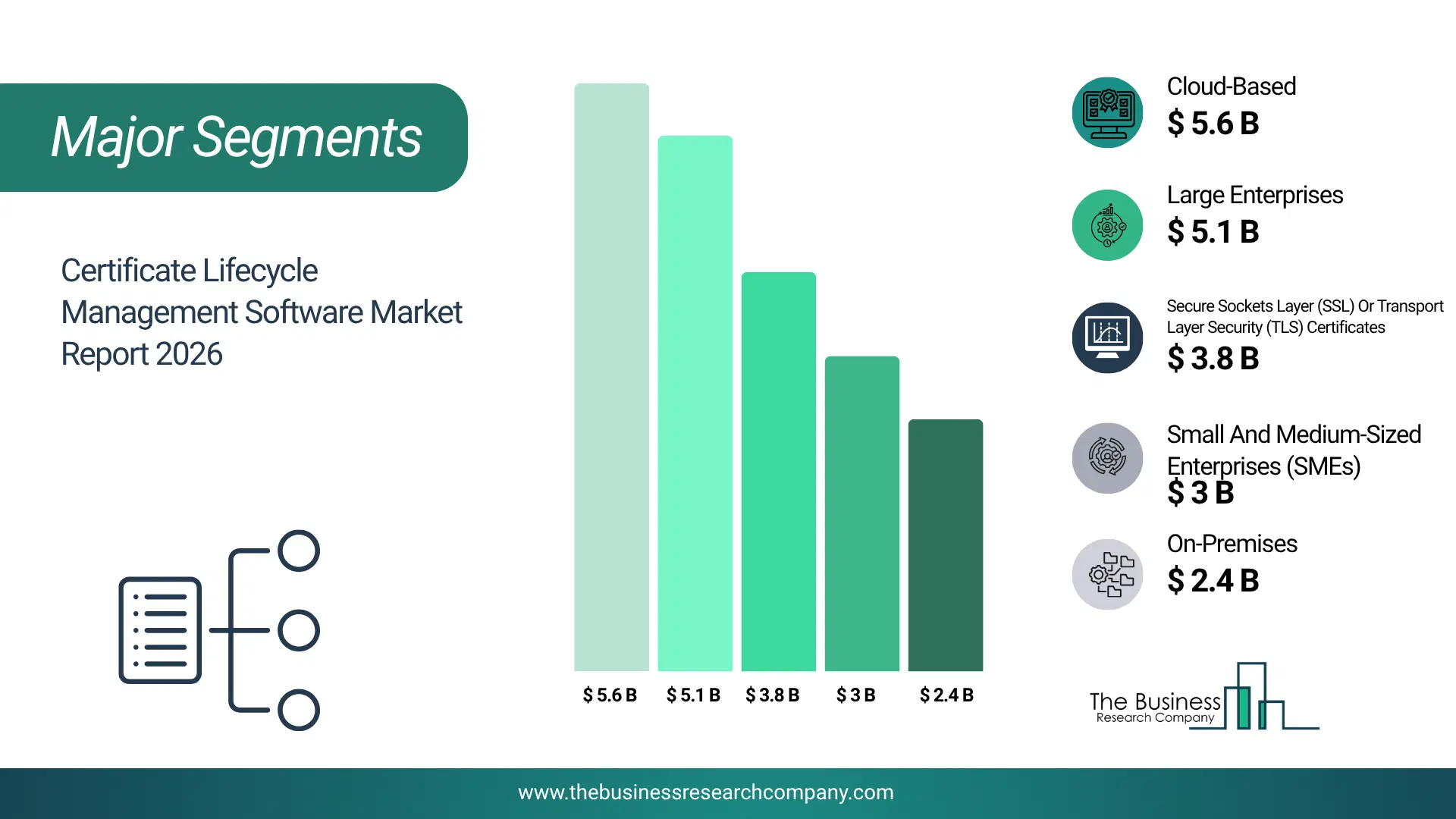
1) By Certificate Type: Secure Sockets Layer (SSL) Or Transport Layer Security (TLS) Certificates, Code Signing Certificates, Email Certificates, Client Certificates 2) By Deployment Model: On-Premises, Cloud-Based 3) By Organization Size: Large Enterprises, Small And Medium-Sized Enterprises 4) By Vertical Industry: Finance, Healthcare, Government, Information Technology (IT) and Telecom, Manufacturing Subsegments: 1) By Secure Sockets Layer (SSL) Or Transport Layer Security (TLS) Certificates: Domain Validated (DV) SSL Or TLS Certificates, Organization Validated (OV) SSL Or TLS Certificates, Extended Validation (EV) SSL Or TLS Certificates 2) By Code Signing Certificates: Individual Code Signing Certificates, Enterprise Code Signing Certificates 3) By Email Certificates: Secure Or Encrypted Email Certificates (S Or MIME), Digital Signature Email Certificates 4) By Client Certificates: Authentication Certificates, Identity And Access Management (IAM) Certificates The top segments in the certificate lifecycle management software market will be: • Cloud-Based will reach $5671.47 Million by 2030. • Large Enterprises will reach $5098.78 Million by 2030. • Secure Sockets Layer (SSL) Or Transport Layer Security (TLS) Certificates will reach $3877.08 Million by 2030. • Small And Medium-Sized Enterprises (SMEs) will reach $2997.75 Million by 2030. • On-Premises will reach $2425.07 Million by 2030.What Is The Driver Of The Certificate Lifecycle Management Software Market?
The increasing adoption of cloud computing is expected to propel the growth of the certificate lifecycle management software market going forward. Cloud computing refers to services, applications, or resources that are delivered, accessed, and managed over the Internet, utilizing remote servers and computing infrastructure hosted by third-party providers. The growing utilization of cloud-based solutions is attributed to the services they provide, including scalability, accessibility, and security for businesses. Certificate lifecycle management software automates the deployment of digital certificates, ensuring efficient provisioning across various cloud environments as required. For instance, in December 2023, according to Eurostat, a Luxembourg-based intergovernmental organization, 45.2% of EU enterprises purchased cloud computing services, mostly to host their email systems and store electronic files. Purchases of cloud computing services by EU enterprises increased by 4.2% in 2023 compared to 2021. Therefore, the increasing adoption of cloud computing is driving the growth of the certificate lifecycle management software industry.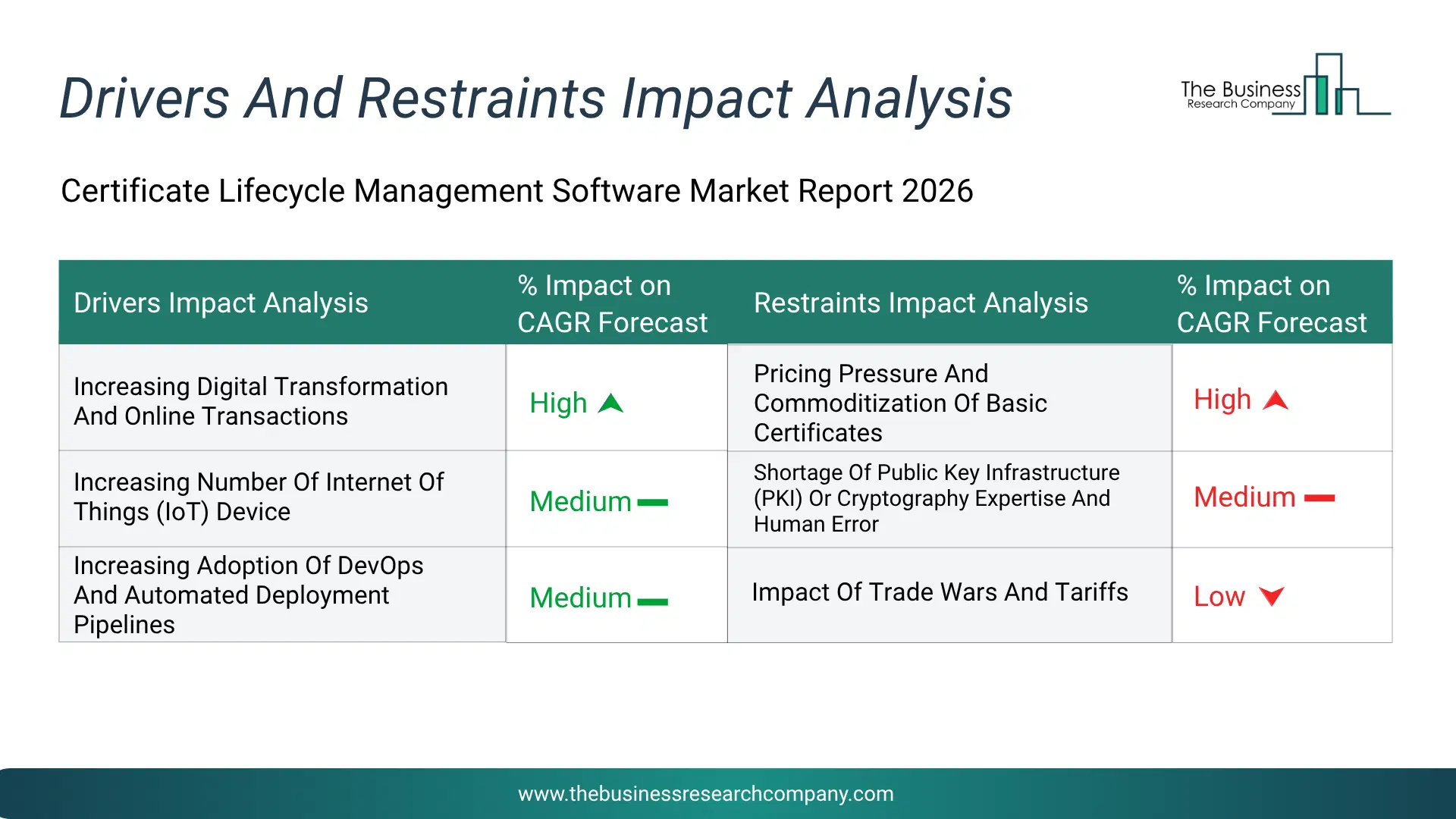
Infographic Chart Showing Key Market Drivers Analysis And Restraints For Certificate Lifecycle Management Software Market
The chart presents an impact analysis of key drivers and restraints, quantifying their relative influence on the market's growth rate and helping assess the balance between growth enablers and limiting factors. This chart offers a high-level perspective; the full report contains more detailed insights.
How Will The Drivers Impact Growth In The Global Certificate Lifecycle Management Software Market?
• Increasing Digital Transformation And Online Transactions (High) – During the forecast period, increasing digital transformation and online transactions are expected to be key drivers propelling growth in the certificate lifecycle management software market. Digital transformation is driven by the single factor of technology integration, enabling organizations to digitize processes, data and customer interactions. Online transactions are enabled by the single factor of secure digital connectivity, allowing financial and data exchanges over internet-based platforms. Certificate lifecycle management software supports digital transformation and online transactions by automating the issuance, renewal and monitoring of digital certificates, ensuring encrypted communication, identity authentication and uninterrupted secure digital operations across enterprise ecosystems. Therefore, increasing digital transformation and online transactions may drive the growth of the certificate lifecycle management software market. The increasing digital transformation and online transactions growth contribution during the forecast period in 2025 is 2.0%. • Increasing Number Of Internet Of Things (IoT) Device (Medium) – During the forecast period, an increasing number of Internet of Things (IoT) devices is expected to be a key driver propelling growth in the certificate lifecycle management software market. An IoT device operates through its ability to autonomously connect to a network and exchange data without human intervention. It integrates embedded sensors, software and communication modules to capture and transmit real-time information across systems. Certificate lifecycle management software supports IoT environments by automating the issuance, renewal and monitoring of digital certificates that authenticate device identities. This strengthens secure communication, prevents certificate expiration risks and ensures uninterrupted connectivity across connected networks. Therefore, the increasing number of IoT devices may drive the growth of the certificate lifecycle management software market. The increasing number of Internet of Things (IoT) devices growth contribution during the forecast period in 2025 is 1.5%. • Increasing Adoption Of DevOps And Automated Deployment Pipelines (Medium) – During the forecast period, increasing adoption of DevOps and automated deployment pipelines are expected to be key drivers propelling growth in the certificate lifecycle management software market. DevOps is a collaborative approach that integrates software development and IT operations to accelerate application delivery, improve quality and ensure continuous integration and continuous deployment through automation and shared accountability. Automated deployment pipelines are structured workflows that automatically build, test, validate and release code changes across environments, reducing manual intervention and minimizing errors. However, as these pipelines rely heavily on secure communications, APIs and encrypted connections, managing digital certificates becomes increasingly complex. Certificate Lifecycle Management software supports DevOps and automated deployment pipelines by automating certificate issuance, renewal, monitoring and revocation, ensuring uninterrupted secure deployments. This integration prevents certificate-related outages, strengthens compliance and enables faster, secure release cycles. Therefore, increasing adoption of DevOps and automated deployment pipelines may drive the growth of the certificate lifecycle management software market. The increasing adoption of DevOps and automated deployment pipelines growth contribution during the forecast period in 2025 is 1.0%. • Growing Shift Towards Software as a Service (SaaS) Security Solutions (Low) – During the forecast period, the growing shift towards SaaS security solutions is expected to be a key driver propelling growth in the certificate lifecycle management software market. SaaS security solutions are technologies and frameworks designed to protect software delivered through the cloud by safeguarding user identities, application access, data integrity and communication channels from cyber threats. They encompass capabilities such as identity and access management, encryption, threat detection, compliance monitoring and zero trust enforcement to ensure secure multi-tenant environments. certificate lifecycle management software strengthens SaaS security solutions by automating the issuance, renewal, monitoring and revocation of digital certificates that enable encrypted communication and authenticated access. By preventing certificate expirations, misconfigurations and unauthorized certificate usage, it ensures continuous encryption and trust, thereby reinforcing the overall security posture of SaaS platforms. Therefore, the growing shift towards SaaS security solutions may drive the growth of the certificate lifecycle management software market. The growing shift towards SaaS security solutions growth contribution during the forecast period in 2025 is 0.5%.How Will The Restraints Impact Growth In The Global Certificate Lifecycle Management Software Market?
• Pricing Pressure And Commoditization Of Basic Certificates (High) – During the forecast period, pricing pressure and commoditization of basic certificates are restricting the growth of the certificate lifecycle management software market. Pricing pressure and commoditization of basic certificates refer to the declining differentiation and shrinking profit margins of standard digital certificates as they become widely available at low or no cost from multiple certificate authorities. As basic certificates are increasingly perceived as interchangeable utilities rather than strategic security assets, organizations tend to prioritize cost savings over structured lifecycle governance. This shift reduces the urgency to invest in advanced certificate lifecycle management software, particularly among small and midsized enterprises that rely heavily on free or low-cost certificates. When certificates are viewed as inexpensive and easily replaceable, businesses may continue with manual tracking or fragmented tools instead of adopting centralized automation platforms. Consequently, weakened value perception and tighter pricing dynamics can slow enterprise spending on comprehensive certificate lifecycle management solutions and limit market expansion. Growth affected by the pricing pressure and commoditization of basic certificates during the forecast period in 2025 is -2.0%. • Shortage Of Public Key Infrastructure (PKI) Or Cryptography Expertise And Human Error (Medium) – During the forecast period, a shortage of PKI or cryptography expertise and human error are restricting the growth of the certificate lifecycle management software market. Shortage of PKI or cryptography expertise and human error refers to the limited availability of skilled professionals capable of managing public key infrastructure environments, combined with operational mistakes arising from manual certificate handling and misconfigurations. The complexity of certificate issuance, renewal, revocation, key storage and compliance monitoring increases the likelihood of expired certificates, weak encryption practices and improper deployments when expertise is lacking. This skill gap hampers the adoption of certificate lifecycle management software as organizations struggle with integration, automation setup and policy configuration. Consequently, enterprises may delay implementation, underutilize advanced features and rely on fragmented manual processes, thereby restraining overall market growth and scalability. Growth affected by the shortage of PKI or cryptography expertise and human error during the forecast period in 2025 is -1.0%. • Impact Of Trade Wars And Tariffs (Medium) – During the forecast period, the impact of trade wars and tariffs is restricting the growth of the certificate lifecycle management software market. The impact of trade wars and tariffs refers to the economic and regulatory disruptions caused by increased import duties, cross-border restrictions and retaliatory trade measures between countries, which raise operational costs and create uncertainty in global technology markets. In the context of certificate lifecycle management software, such measures can increase the cost of imported IT hardware, security infrastructure and cloud services that support digital certificate deployment and automation. Heightened geopolitical tensions may also delay cross-border data flows, restrict collaboration with international technology vendors and slow multinational cybersecurity investments. As a result, enterprises may postpone upgrades, limit spending on advanced automation tools and adopt conservative procurement strategies, thereby hampering the growth of the certificate lifecycle management software market. Growth affected by the impact of trade wars and tariffs during the forecast period in 2025 is -0.3%.Key Players In The Global Certificate Lifecycle Management Software Market
Major companies operating in the certificate lifecycle management software market are Entrust Corporation; DigiCert Inc.; GlobalSign Inc.; Venafi Inc.; AppViewX Inc.; Keyfactor LLC; Sectigo Limited; PrimeKey Solutions AB; QuoVadis Limited; Xolphin B.V.; Versasec AB; ManageEngine; Nexus AG; KeyTalk; DigitalBerry; Evertrust; Cogito Group; Savyint; Akeyless; SecureSME; D‑Trust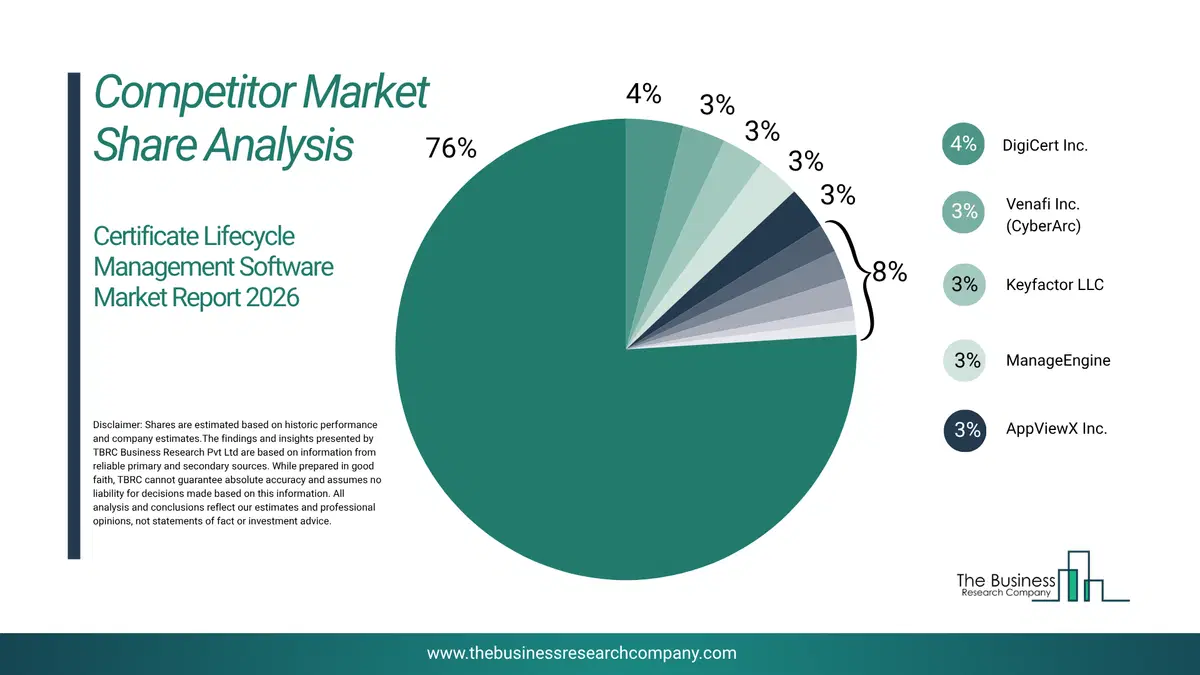
This chart is for illustrative purposes; the full report includes a detailed competitor analysis and comprehensive overview of the top 10 companies in the market.
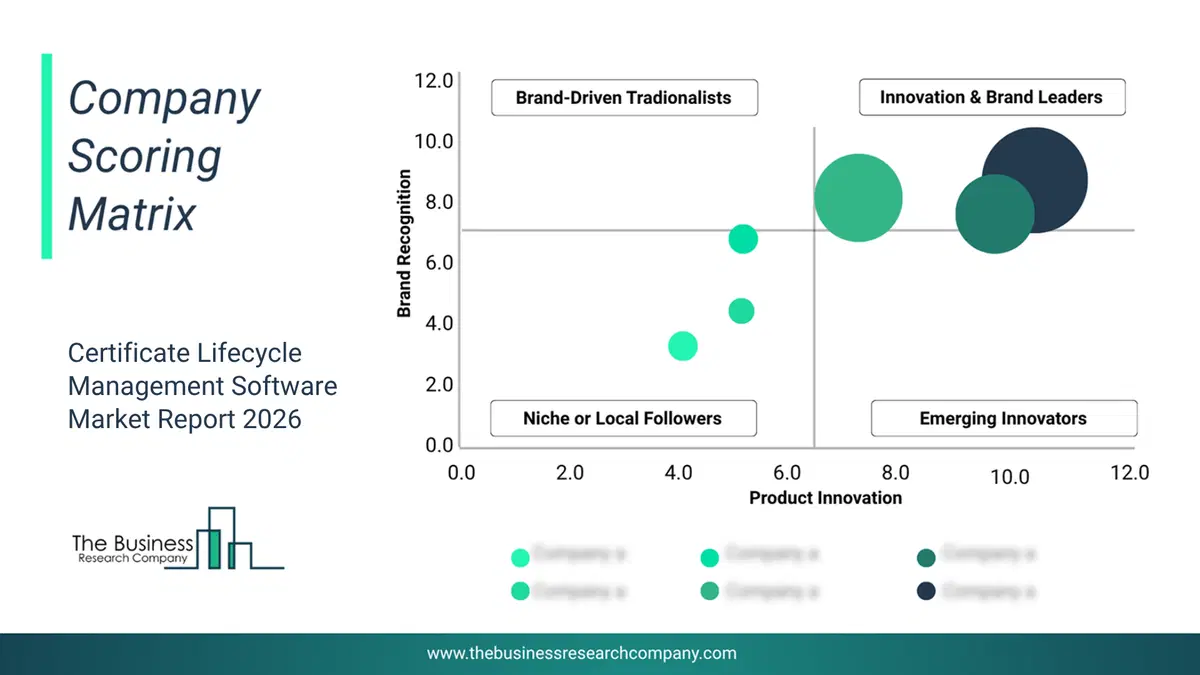
This chart maps companies by product innovation and brand strength, with bubble size indicating relative revenue, helping identify market leaders, challengers, and niche players. This is an illustrative chart; the full report provides a complete and accurate competitive analysis.
Global Certificate Lifecycle Management Software Market Trends and Insights
Major companies operating in the certificate lifecycle management software market are developing advanced technologies, such as automated certificate lifecycle management solutions, to gain a competitive edge in the market. An automated certificate lifecycle management solution is a comprehensive software platform or set of tools designed to streamline and automate the management of digital certificates within an organization. For instance, in October 2023, AppViewX, a US-based software company, launched AppViewX KUBE+, an automated certificate lifecycle management service for the Kubernetes environment that provides complete certificate visibility, end-to-end automation, and policy control, simplifying certificate lifecycle management to secure containerized workloads at scale while supporting DevOps speed and agility. It reduces application outages, service disruptions, and security and compliance issues by addressing the operational and security challenges of certificate management in complicated Kubernetes settings.What Are Latest Mergers And Acquisitions In The Certificate Lifecycle Management Software Market?
In January 2024, HID Global Corporation, a US-based provider of secure identity solutions, acquired ZeroSSL GmbH, for an undisclosed amount. With this acquisition, HID Global aims to enhance its public key infrastructure (PKI) offerings by integrating ZeroSSL’s expertise in SSL certificate lifecycle management, thereby enhancing HID’s ability to provide secure, encrypted communication solutions that ensure privacy and authentication for online transactions across a wide range of industries. ZeroSSL GmbH is an Austria-based SSL certificate provider specializes in certificate lifecycle management.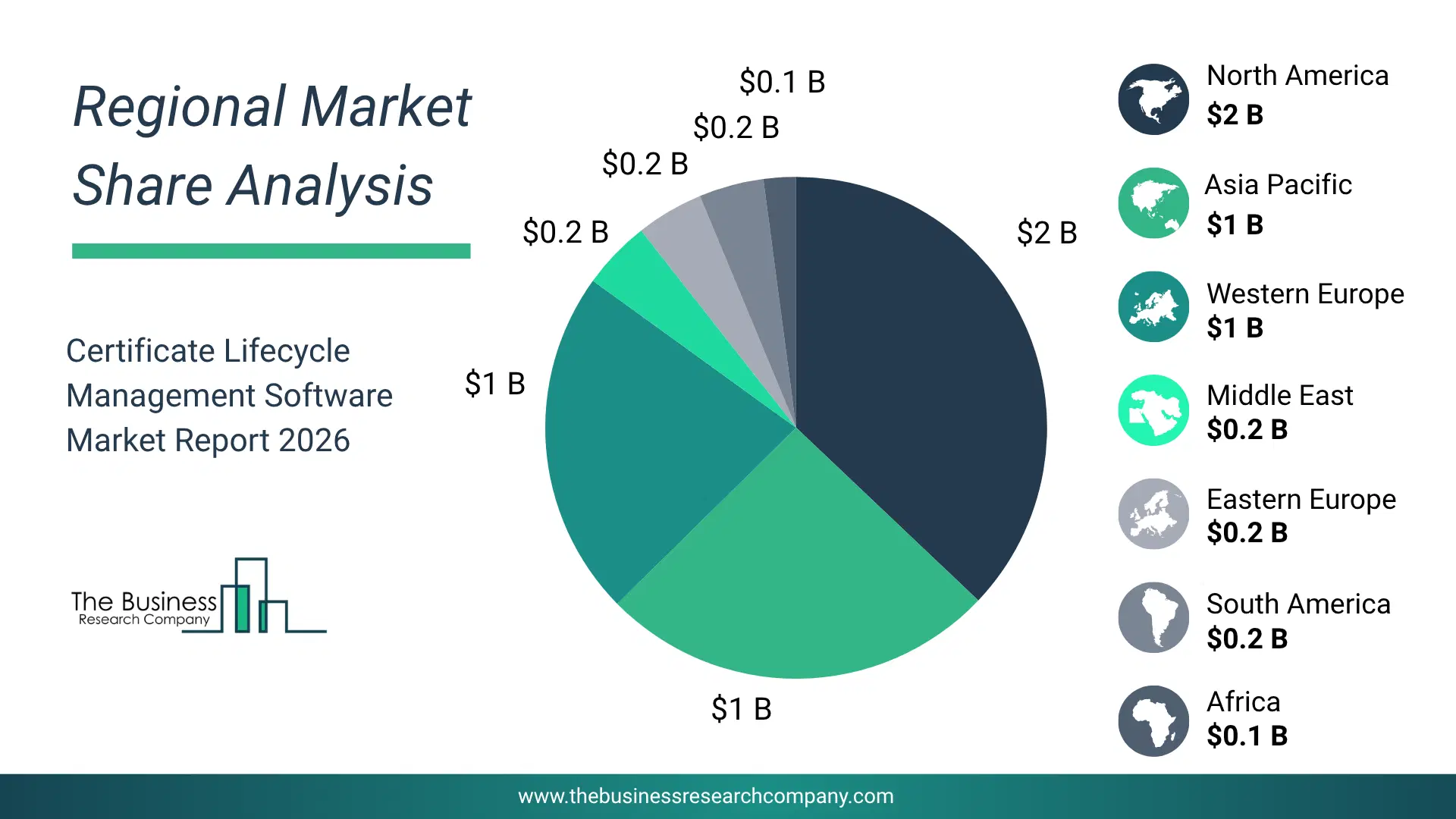
Regional Insights
North America was the largest region in the certificate lifecycle management software market in 2025. The regions covered in this market report are Asia-Pacific, South East Asia, Western Europe, Eastern Europe, North America, South America, Middle East, Africa. The countries covered in this market report are Australia, Brazil, China, France, Germany, India, Indonesia, Japan, Taiwan, Russia, South Korea, UK, USA, Canada, Italy, SpainWhat Defines the Certificate Lifecycle Management Software Market?
The certificate lifecycle management software market consists of revenues earned by entities by providing services such as scalability and performance, API integration, certificate inventory, key management, automation, and orchestration. The market value includes the value of related goods sold by the service provider or included within the service offering. The certificate lifecycle management software market also includes sales of monitoring and logging hardware, virtualization infrastructure, hardware security modules (HSMS), and authentication devices. Values in this market are ‘factory gate’ values, that is, the value of goods sold by the manufacturers or creators of the goods, whether to other entities (including downstream manufacturers, wholesalers, distributors, and retailers) or directly to end customers. The value of goods in this market includes related services sold by the creators of the goods.How is Market Value Defined and Measured?
The market value is defined as the revenues that enterprises gain from the sale of goods and/or services within the specified market and geography through sales, grants, or donations in terms of the currency (in USD unless otherwise specified). The revenues for a specified geography are consumption values that are revenues generated by organizations in the specified geography within the market, irrespective of where they are produced. It does not include revenues from resales along the supply chain, either further along the supply chain or as part of other products.
This chart presents market attractiveness based on a quantitative evaluation of growth, competition, strategic alignment, and risk, offering a clear view of opportunity areas for decision-making. This chart is for illustrative purposes; the full report contains the complete analysis.

This chart highlights the Total Addressable Market (TAM) by estimating the maximum revenue opportunity using an assumption-driven approach, supporting strategic planning and opportunity sizing across markets. The chart is illustrative; the full report provides a more comprehensive analysis.
What Key Data and Analysis Are Included in the Certificate Lifecycle Management Software Market Report 2026?
The certificate lifecycle management software market research report is one of a series of new reports from The Business Research Company that provides market statistics, including industry global market size, regional shares, competitors with the market share, detailed market segments, market trends and opportunities, and any further data you may need to thrive in the certificate lifecycle management software industry. The market research report delivers a complete perspective of everything you need, with an in-depth analysis of the current and future state of the industry.Certificate Lifecycle Management Software Market Report Forecast Analysis
| Report Attribute | Details |
|---|---|
| Market Size Value In 2026 | $6.19 billion |
| Revenue Forecast In 2030 | $11.05 billion |
| Growth Rate | CAGR of 18.5% from 2026 to 2030 |
| Base Year For Estimation | 2025 |
| Actual Estimates/Historical Data | 2020-2025 |
| Forecast Period | 2026 - 2030 - 2035 |
| Market Representation | Revenue in USD Billion and CAGR from 2026 to 2030 |
| Segments Covered | Certificate Type, Deployment Model, Organization Size, Vertical Industry |
| Regional Scope | Asia-Pacific, Western Europe, Eastern Europe, North America, South America, Middle East, Africa |
| Country Scope | The countries covered in the report are Australia, Brazil, China, France, Germany, India, Indonesia, Japan, Taiwan, Russia, South Korea, UK, USA, Canada, Italy, Spain. |
| Key Companies Profiled | Entrust Corporation; DigiCert Inc.; GlobalSign Inc.; Venafi Inc.; AppViewX Inc.; Keyfactor LLC; Sectigo Limited; PrimeKey Solutions AB; QuoVadis Limited; Xolphin B.V.; Versasec AB; ManageEngine; Nexus AG; KeyTalk; DigitalBerry; Evertrust; Cogito Group; Savyint; Akeyless; SecureSME; D‑Trust |
| Customization Scope | Request for Customization |
| Pricing And Purchase Options | Explore Purchase Options |