

Certificate Lifecycle Management Software Global Market Opportunities And Strategies To 2035
By Certificate Type (Secure Sockets Layer (SSL) Or Transport Layer Security (TLS) Certificates, Code Signing Certificates, Email Certificates, Client Certificates), By Deployment Model (On-Premises, Cloud-Based), By Organization Size (Large Enterprises, Small And Medium-Sized Enterprises), By Vertical Industry (Finance, Healthcare, Government, Information Technology (IT) And Telecom, Manufacturing, Other Verticals), And By Region, Opportunities And Strategies – Global Forecast To 2035
Certificate Lifecycle Management Software Market Definition
Certificate lifecycle management (CLM) software is a cybersecurity solution designed to automate, monitor and manage the entire lifecycle of digital certificates, including issuance, deployment, renewal, revocation and expiration tracking. The primary purpose of CLM software is to prevent certificate-related outages, enhance security and maintain compliance. The certificate lifecycle management software market consists of revenues generated by entities (organizations, sole traders and partnerships) that develop and provide software solutions for discovering, issuing, provisioning, monitoring, renewing and revoking digital certificates across enterprise networks and cloud environments. It integrates with public key infrastructure (PKI), certificate authorities (CAs) and enterprise IT systems to ensure secure communication and identity verification across networks.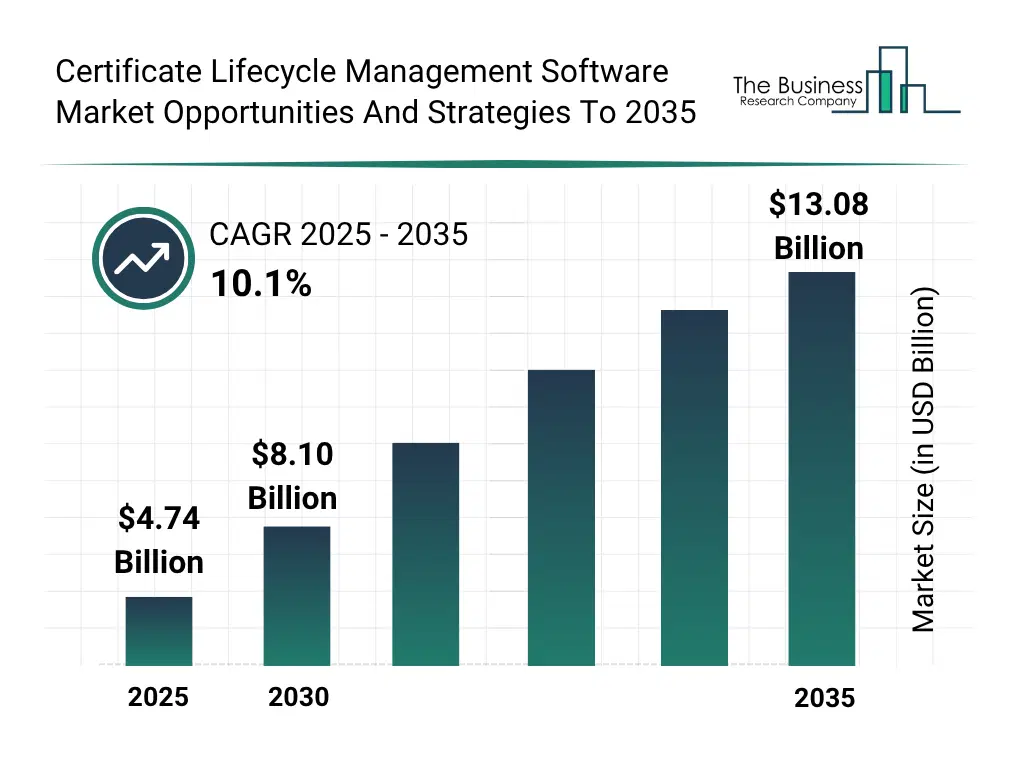
Certificate Lifecycle Management Software Market Size
The global certificate lifecycle management software market reached a value of nearly $4,736.2 million in 2025, having grown at a compound annual growth rate (CAGR) of 12.2% since 2020. The market is expected to grow from $4,736.2 million in 2025 to $8,096.5 million in 2030 at a rate of 11.3%. The market is then expected to grow at a CAGR of 10.1% from 2030 and reach $13,080.2 million in 2035. Growth in the historic period resulted from rising cybersecurity incidents, increasing adoption of cloud computing, shift toward zero-trust security frameworks and growing focus on digital trust and brand protection. Factors that negatively affected growth in the historic period were operational complexity and integration challenges and rapid certificate-lifetime changes and mandatory automation. Going forward, increasing digital transformation and online transactions, increasing number of internet of things (IoT) device, increasing adoption of DevOps and automated deployment pipelines and growing shift towards SaaS security solutions will drive the growth. Factors that could hinder the growth of the certificate lifecycle management software market in the future include pricing pressure and commoditization of basic certificates shortage of PKI or cryptography expertise and human error and impact of trade wars and tariffs.
Certificate Lifecycle Management Software Market Segmentation
The certificate lifecycle management software market is segmented by certificate type, by deployment model, by organization size, and by vertical industry.By Certificate Type –
The certificate lifecycle management software market is segmented by certificate type into:
- a) Secure Sockets Layer (SSL) Or Transport Layer Security (TLS) Certificates
- b) Code Signing Certificates
- c) Email Certificates
- d) Client Certificates
By Deployment Model –
The certificate lifecycle management software market is segmented by deployment model into:
- a) On-Premises
- b) Cloud-Based
By Organization Size –
The certificate lifecycle management software market is segmented by organization size into:
- a) Large Enterprises
- b) Small And Medium-Sized Enterprises
By Vertical Industry –
The certificate lifecycle management software market is segmented by vertical industry into:
- a) Finance
- b) Healthcare
- c) Government
- d) Information Technology (IT) And Telecom
- e) Manufacturing
- f) Other Verticals
By Geography - The certificate lifecycle management software market is segmented by geography into:
- China
- India
- Japan
- Australia
- Indonesia
- South Korea
- USA
- Canada
- Brazil
- France
- Germany
- UK
- Italy
- Spain
- Russia
-
o Asia Pacific
o Africa