
Chemical Catalyst Global Market Opportunities And Strategies To 2035
By Type (Homogeneous, Heterogeneous, Heterogenized Homogeneous Catalyst, Biocatalyst), By Material (Metal And Metal Oxides, Zeolites, Other Materials), By Application (Petrochemicals, Chemical Synthesis, Environmental Catalysis, Polymerization, Refining, Pharmaceuticals, Other Applications), And By Region, Opportunities And Strategies – Global Forecast To 2035
Chemical Catalyst Market Definition
Chemical catalysts refer to substances that increase the rate of a chemical reaction without being consumed in the process. They are widely used across industrial, commercial, and laboratory settings to improve reaction efficiency, selectivity, and yield. Catalysts are utilized by a broad range of end users including chemical manufacturers, oil and gas companies, pharmaceutical producers, and environmental management firms. The chemical catalyst market consists of sales by entities (organizations, sole traders and partnerships) of chemical catalyst that are employed whenever chemical reactions require optimization, particularly in large-scale industrial processes where time, cost, and energy efficiency are critical. Catalysts often work alongside complementary inputs such as reactants, solvents, and process equipment, while in some cases alternative technologies such as non-catalytic thermal processing or biological processes may act as substitutes.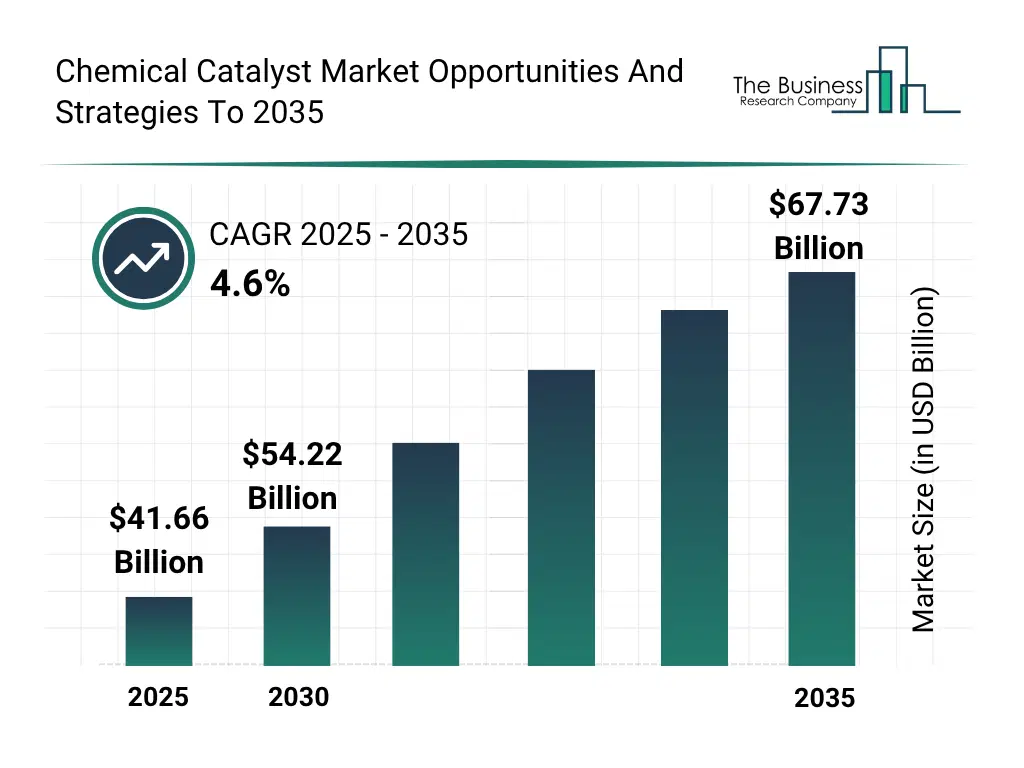
Chemical Catalyst Market Size
The global chemical catalyst market reached a value of nearly $41,655.5 million in 2025, having grown at a compound annual growth rate (CAGR) of 6.4% since 2020. The market is expected to grow from $41,655.5 million in 2025 to $54,219.5 million in 2030 at a rate of 5.4%. The market is then expected to grow at a CAGR of 4.6% from 2030 and reach $67,734.5 million in 2035. Growth in the historic period resulted from stringent environmental regulations and emission standards, growing polymer and plastics demand, expansion of the chemical manufacturing sector and growth in hydrogen production and energy transition technologies. Factors that negatively affected growth in the historic period were waste disposal and toxicity concerns and stringent environmental regulations on chemicals. Going forward, expansion of manufacturing sectors, increasing global fuel consumption and cleaner fuel demand, growing demand from petrochemical and refining industries and growing demand for green hydrogen production will drive the growth. Factors that could hinder the growth of the chemical catalyst market in the future include currency fluctuations impacting global trade and pricing, volatility in raw material prices and impact of trade war and tariff.
Chemical Catalyst Market Segmentation
The chemical catalyst market is segmented by type, by material and by application.By Type –
The chemical catalyst market is segmented by type into:
- a) Homogeneous
- b) Heterogeneous
- c) Heterogenized Homogeneous Catalyst
- d) Biocatalyst
By Material –
The chemical catalyst market is segmented by material into:
- a) Metal And Metal Oxides
- b) Zeolites
- c) Other Materials
By Application –
The chemical catalyst market is segmented by application into:
- a) Petrochemicals
- b) Chemical Synthesis
- c) Environmental Catalysis
- d) Polymerization
- e) Refining
- f) Pharmaceuticals
- g) Other Applications
By Geography - The chemical catalyst market is segmented by geography into:
- China
- India
- Japan
- Australia
- Taiwan
- South Korea
- Indonesia
- USA
- Canada
- Brazil
- France
- Germany
- UK
- Italy
- Spain
- Russia
-
o Asia Pacific
o Africa