
Chemical Intermediates Market Report 2026
Global Outlook – By Product Type (Organic Chemical Intermediates, Inorganic Chemical Intermediates), By Source (Petrochemical Based Intermediates, Bio Based Intermediates), By Function (Building Block Intermediates, Reactive Intermediates, Specialty Intermediates), By Distribution Channel (Direct Sales, Distributors And Wholesalers, Online Business To Business Platforms), By End Use Industry (Pharmaceuticals, Agrochemicals, Polymers And Plastics) – Market Size, Trends, Strategies, and Forecast to 2035
Chemical Intermediates Market Overview
• Chemical Intermediates market size has reached to $118.17 billion in 2025 • Expected to grow to $187.27 billion in 2030 at a compound annual growth rate (CAGR) of 9.6% • Growth Driver: Increasing Automotive Production Is Fueling The Growth Of The Market Through Higher Demand For Performance Chemicals • Market Trend: Advancements In Stabilized Diisobutylene Solutions For Enhanced Oxidation Resistance And Industrial Performance • North America was the largest region in 2025 and Asia-Pacific is the fastest growing region.What Is Covered Under Chemical Intermediates Market?
Chemical intermediates are compounds produced during chemical manufacturing that serve as essential raw materials or building blocks for the synthesis of other chemicals, materials, and finished products. They are used to manufacture a wide range of products, enabling efficient and scalable industrial production. The main product types of chemical intermediates include organic chemical intermediates and inorganic chemical intermediates. Organic chemical intermediates refer to carbon based chemical compounds used as essential building blocks in the synthesis and production of various downstream chemical products. These intermediates are sourced from petrochemical based intermediates and bio based intermediates and perform functions as building block intermediates, reactive intermediates, and specialty intermediates. They are distributed through direct sales, distributors and wholesalers, and online business to business platforms and are used end use industries by pharmaceuticals, agrochemicals, and polymers and plastics industries.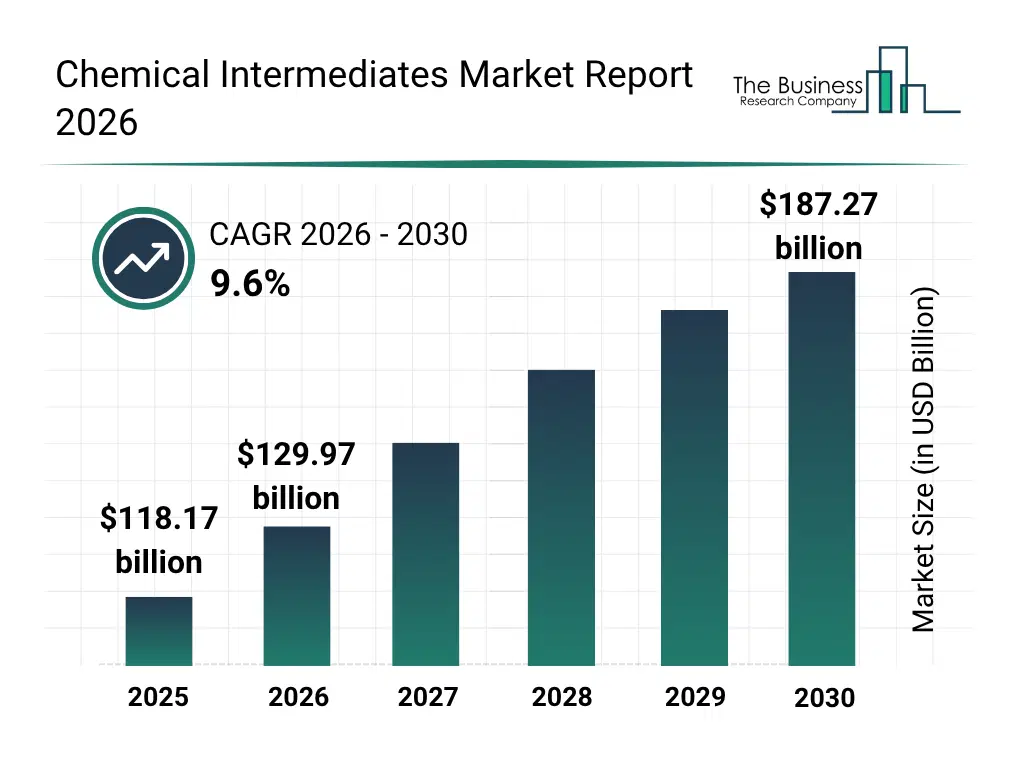
What Is The Chemical Intermediates Market Size and Share 2026?
The chemical intermediates market size has grown strongly in recent years. It will grow from $118.17 billion in 2025 to $129.97 billion in 2026 at a compound annual growth rate (CAGR) of 10.0%. The growth in the historic period can be attributed to expansion of pharmaceutical manufacturing, rising agrochemical production, increasing polymer and plastics production, growth in petrochemical processing capacity, rising demand for industrial chemical feedstocks.What Is The Chemical Intermediates Market Growth Forecast?
The chemical intermediates market size is expected to see strong growth in the next few years. It will grow to $187.27 billion in 2030 at a compound annual growth rate (CAGR) of 9.6%. The growth in the forecast period can be attributed to increasing adoption of bio-based intermediates, growing demand for specialty chemicals, expansion of pharmaceutical and healthcare production, rising demand for advanced polymers and materials, increasing investment in domestic chemical manufacturing capacity. Major trends in the forecast period include bio-based chemical intermediates, high-purity chemical intermediates, specialty chemical intermediate development, process intensification in chemical manufacturing, regionalization of chemical intermediate supply chains.Tariff Impact On Chemical Intermediates Market
Tariffs are impacting the chemical intermediates market by increasing the cost of imported feedstocks, petrochemical derivatives, specialty chemicals, and chemical processing equipment. Organic and petrochemical-based intermediates are particularly exposed, with manufacturers and downstream industries in North America, Europe, and Asia-Pacific facing higher input costs due to globally interconnected supply chains. These pressures can increase production costs for pharmaceuticals, agrochemicals, polymers, and plastics, while tariffs may also encourage local sourcing, domestic production expansion, and diversification of chemical supply chains.
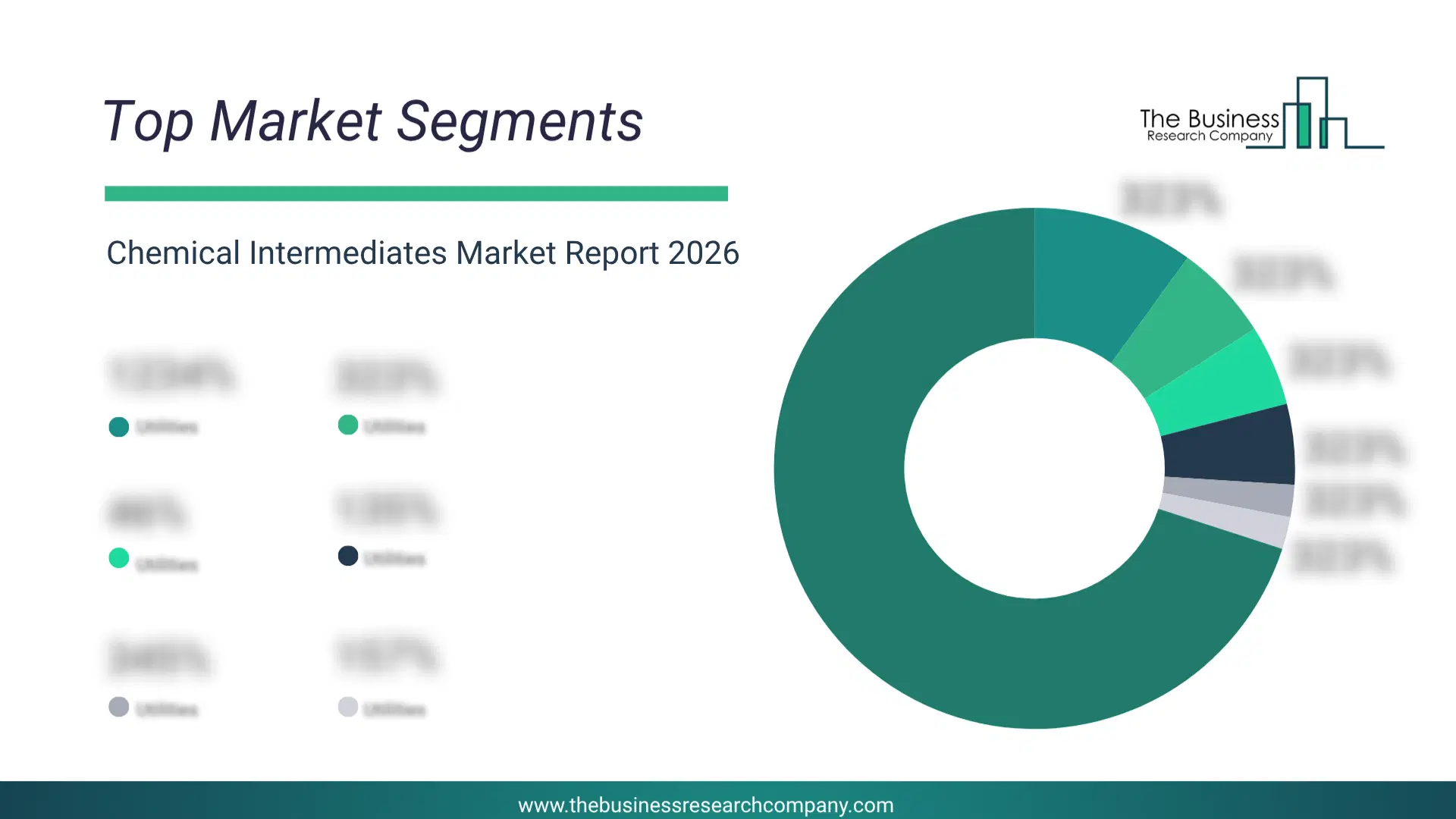
Global Chemical Intermediates Market Segmentation
2) By Source: Petrochemical Based Intermediates, Bio Based Intermediates 3) By Function: Building Block Intermediates, Reactive Intermediates, Specialty Intermediates 4) By Distribution Channel: Direct Sales, Distributors And Wholesalers, Online Business To Business Platforms 5) By End Use Industry: Pharmaceuticals, Agrochemicals, Polymers And Plastics Subsegments: 1) By Organic Chemical Intermediates: Alcohols, Aldehydes, Ketones, Carboxylic Acids 2) By Inorganic Chemical Intermediates: Acids, Alkalis, Salts, OxidesWhat Is The Driver Of The Chemical Intermediates Market?
The increasing automotive production is expected to propel the growth of the chemical intermediates market going forward. Automotive production refers to the process of manufacturing passenger cars, commercial vehicles, and other motor vehicles using raw materials and industrial components through integrated production processes. Automotive production is rising due to increasing consumer demand for personal mobility, driven by population growth, urbanization, and improving disposable incomes. The increasing automotive production drives demand for chemical intermediates as they are essential raw materials for manufacturing automotive plastics, synthetic rubber, coatings, adhesives, lubricants, and performance chemicals used in vehicle production. For instance, in April 2026, according to the International Organization of Motor Vehicle Manufacturers, a France-based trade association, global vehicle production increased from 92.7 million units in 2024 to 96.4 million units in 2025, marking a 3.9% rise, while global sales grew from 95.3 million to 99.8 million units, reflecting a 4.7% increase. Therefore, the increasing automotive production is driving the growth of the chemical intermediates industry.Key Players In The Global Chemical Intermediates Market
Major companies operating in the chemical intermediates market are Lonza Group AG, EMS-CHEMIE Holding AG, Stepan Company, SRF Limited, Divis Laboratories Limited, Deepak Nitrite Limited, Aarti Industries Limited, Atul Limited, Rossari Biotech Limited, Vinati Organics Limited, Inventys Research Company Private Limited, Hikal Limited, Navin Fluorine International Limited, Anupam Rasayan India Limited, Altra Pharma-Chem Private Limited, Privi Speciality Chemicals Limited, Deccan Fine Chemicals (India) Private Limited, Tatva Chintan Pharma Chem Limited, GRK Fine Chem Private Limited, NSR Laboratories Private Limited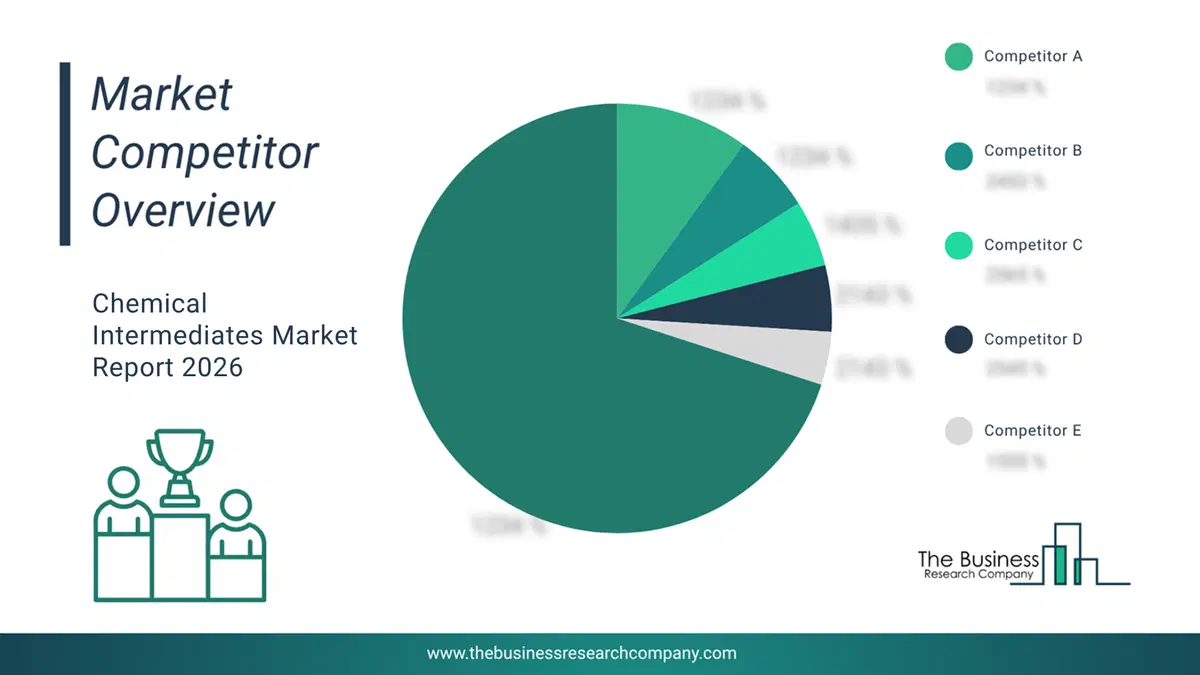
This chart is for illustrative purposes; the full report includes a detailed competitor analysis and comprehensive overview of the top 10 companies in the market.
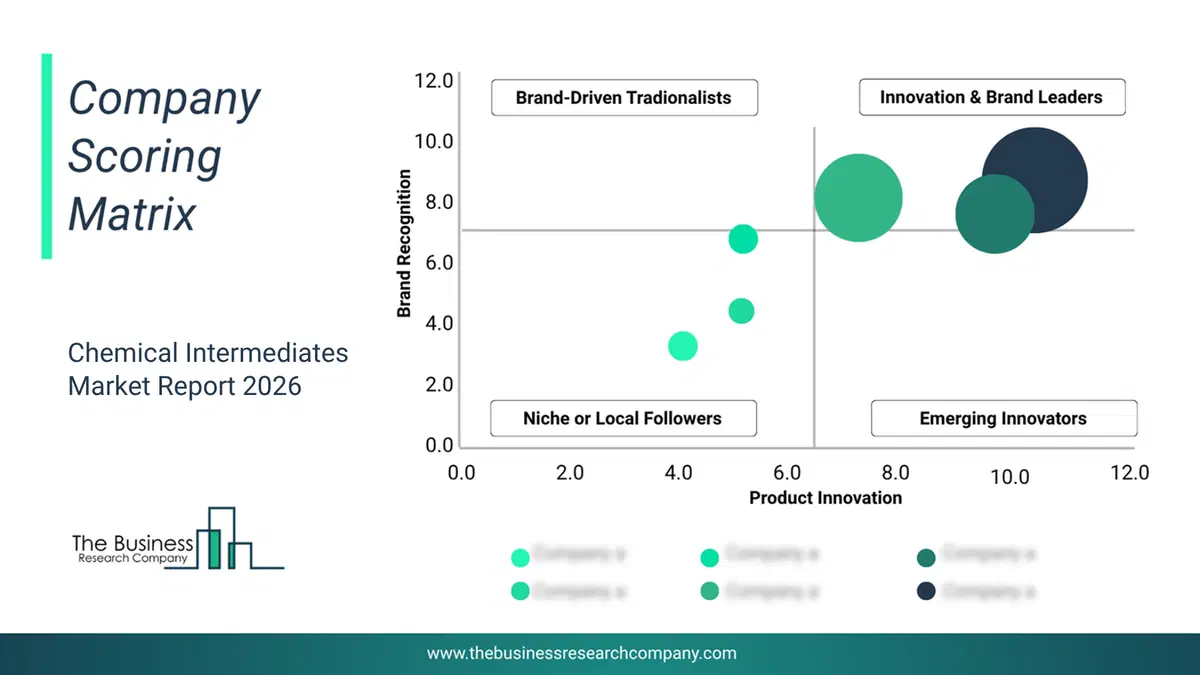
This chart maps companies by product innovation and brand strength, with bubble size indicating relative revenue, helping identify market leaders, challengers, and niche players. This is an illustrative chart; the full report provides a complete and accurate competitive analysis.
Global Chemical Intermediates Market Trends and Insights
Major companies operating in the chemical intermediates market are focusing on developing innovative chemical solutions such as, stabilized high-purity diisobutylene to improve oxidation resistance, storage stability, shelf life, processing consistency, and performance in specialty chemical applications. Stabilized high-purity diisobutylene is a high-purity hydrocarbon olefin stabilized with an antioxidant to minimize oxidative degradation and maintain chemical integrity during storage, transportation, and downstream processing. For instance, in June 2026, INEOS Oligomers, a UK-based chemical manufacturer, launched DIB99S, a high-purity stabilized diisobutylene containing butylated hydroxytoluene (BHT). The product combines highly purified diisobutylene with BHT to improve resistance to oxidation and preserve material quality over extended storage periods. DIB99S contains a high concentration of 2,4,4-trimethylpentene-1, supporting predictable reactivity and improved efficiency in specialty chemical synthesis and industrial formulations. Manufactured through the dimerization of isobutene, the product is designed for applications including polymer modification, lubricant additive production, and specialty chemical manufacturing. Its enhanced stability, high purity, and consistent composition can help downstream manufacturers improve processing reliability, reduce material losses, and maintain product quality across the supply chain.What Are Latest Mergers And Acquisitions In The Chemical Intermediates Market?
In May 2026, Lone Star Funds, a US-based private investment firm, acquired DOMO Engineered Materials for an undisclosed amount. With this acquisition, Lone Star aims to create a leading independent global compounding platform, broaden its engineering materials portfolio, expand its geographic reach, strengthen manufacturing and technological capabilities, enhance industrial resilience, accelerate innovation, and support long-term growth across automotive, construction, consumer, electrical and electronics, and industrial applications. DOMO Chemicals GmbH is a Belgium-based manufacturing company that specializes in providing chemical intermediates.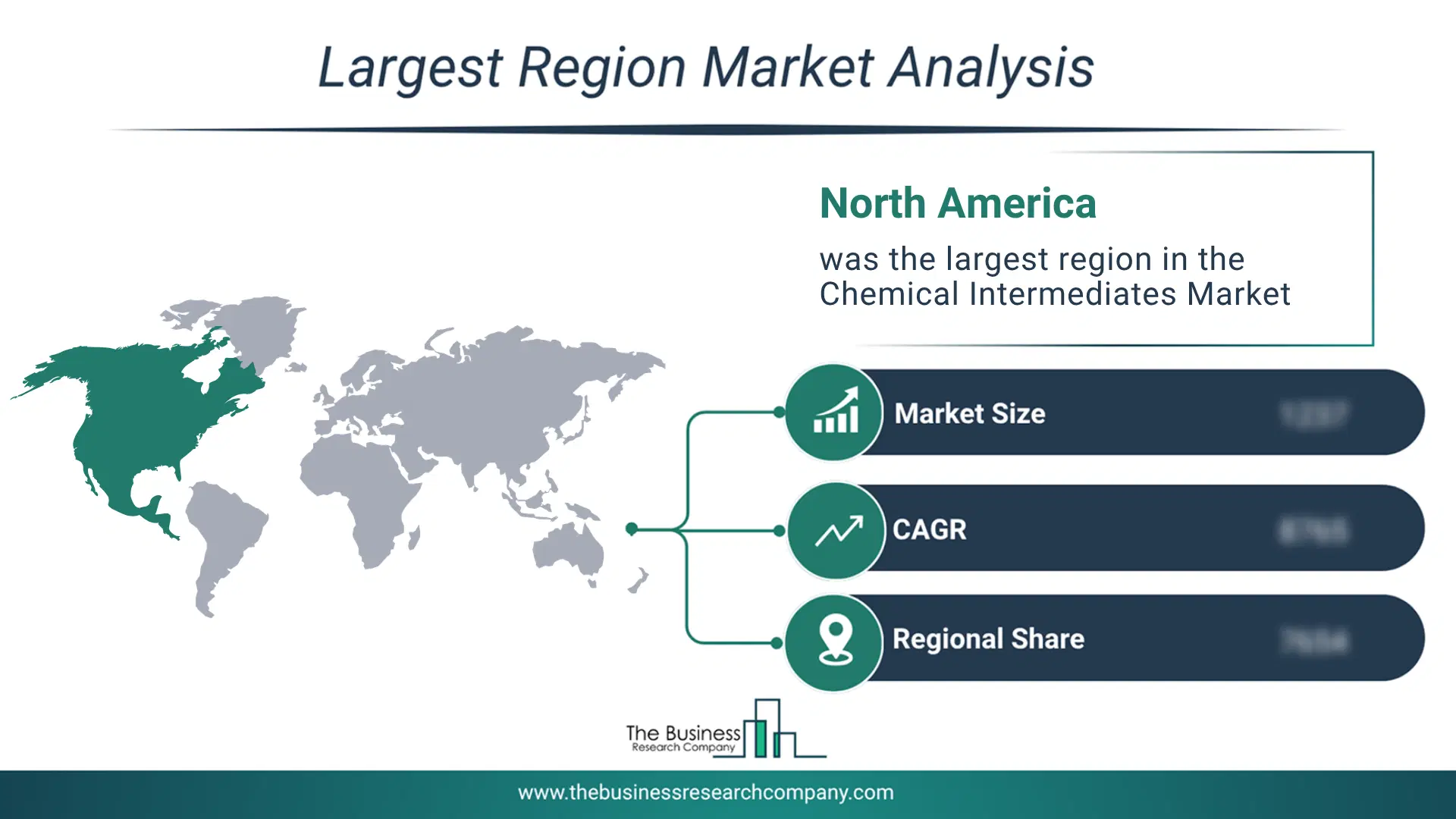
Regional Outlook/Insights
North America was the largest region in the chemical intermediates market in 2025. Asia-Pacific is expected to be the fastest-growing region in the forecast period. The regions covered in this market report are Asia-Pacific, South East Asia, Western Europe, Eastern Europe, North America, South America, Middle East, Africa. The countries covered in this market report are Australia, Brazil, China, France, Germany, India, Indonesia, Japan, Taiwan, Russia, South Korea, UK, USA, Canada, Italy, Spain.What Defines the Chemical Intermediates Market?
The chemical intermediates market consists of sales of petrochemical intermediates, fine chemical intermediates, pharmaceutical intermediates, agrochemical intermediates, specialty chemical intermediates, and performance chemical intermediates. Values in this market are ‘factory gate’ values, that is, the value of goods sold by the manufacturers or creators of the goods, whether to other entities (including downstream manufacturers, wholesalers, distributors, and retailers) or directly to end customers. The value of goods in this market includes related services sold by the creators of the goods.How is Market Value Defined and Measured?
The market value is defined as the revenues that enterprises gain from the sale of goods and/or services within the specified market and geography through sales, grants, or donations in terms of the currency (in USD unless otherwise specified). The revenues for a specified geography are consumption values that are revenues generated by organizations in the specified geography within the market, irrespective of where they are produced. It does not include revenues from resales along the supply chain, either further along the supply chain or as part of other products.
This chart presents market attractiveness based on a quantitative evaluation of growth, competition, strategic alignment, and risk, offering a clear view of opportunity areas for decision-making. This chart is for illustrative purposes; the full report contains the complete analysis.

This chart highlights the Total Addressable Market (TAM) by estimating the maximum revenue opportunity using an assumption-driven approach, supporting strategic planning and opportunity sizing across markets. The chart is illustrative; the full report provides a more comprehensive analysis.
What Key Data and Analysis Are Included in the Chemical Intermediates Market Report 2026?
The chemical intermediates market research report is one of a series of new reports from The Business Research Company that provides market statistics, including industry global market size, regional shares, competitors with the market share, detailed market segments, market trends and opportunities, and any further data you may need to thrive in the chemical intermediates industry. The market research report delivers a complete perspective of everything you need, with an in-depth analysis of the current and future state of the industry.Chemical Intermediates Market Report Forecast Analysis
| Report Attribute | Details |
|---|---|
| Market Size Value In 2026 | $129.97 billion |
| Revenue Forecast In 2030 | $187.27 billion |
| Growth Rate | CAGR of 9.6% from 2026 to 2035 |
| Base Year For Estimation | 2025 |
| Actual Estimates/Historical Data | 2020-2025 |
| Forecast Period | 2026 - 2030 |
| Market Representation | Revenue in USD Billion and CAGR from 2026 to 2030 |
| Segments Covered | Product Type, Source, Function, Distribution Channel, End Use Industry |
| Regional Scope | Asia-Pacific, Western Europe, Eastern Europe, North America, South America, Middle East, Africa |
| Country Scope | The countries covered in the report are Australia, Brazil, China, France, Germany, India, Indonesia, Japan, Taiwan, Russia, South Korea, UK, USA, Canada, Italy, Spain. |
| Customization Scope | Request for Customization |
| Pricing And Purchase Options | Explore Purchase Options |