
Chemical Tanker Coatings Market Report 2026
Global Outlook – By Product Type (Epoxy Phenolic Coatings, Pure Epoxy Coatings, Zinc Silicate Coatings, Other Product Types), By Vessel Type (Inland Chemical Tankers, Coastal Chemical Tankers, Deep Sea Chemical Tankers), By Application (Cargo Tanks, Ballast Tanks, Slop Tanks, Fuel Tanks, Pipelines And Pump Systems, Other Applications), By End User (Shipping Companies, Chemical Manufacturers, Other End Users) – Market Size, Trends, Strategies, and Forecast to 2030
Chemical Tanker Coatings Market Overview
• Chemical Tanker Coatings market size has reached to $2.7 billion in 2025 • Expected to grow to $4.01 billion in 2030 at a compound annual growth rate (CAGR) of 8.1% • Growth Driver: Expansion Of Chemical Tanker Fleet Capacity Driving The Growth Of The Market Due To Increasing Global Chemical Trade • Market Trend: Bio-Based Epoxy Resin Coatings Enhance Sustainable Corrosion Protection For Chemical Tanker Applications • Asia-Pacific was the largest region and fastest growing region.What Is Covered Under Chemical Tanker Coatings Market?
Chemical tanker coatings refer to specialized protective coatings applied to the internal and external surfaces of chemical tankers to protect them from corrosion, abrasion, and chemical attack. These coatings help maintain cargo purity, extend tanker service life, and withstand exposure to aggressive chemicals and harsh marine environments. The main product types of chemical tanker coatings include epoxy phenolic coatings, pure epoxy coatings, zinc silicate coatings, and other product types. Epoxy phenolic coatings are protective coating formulations that combine epoxy resin with phenolic components to provide strong chemical resistance and durability in demanding tanker environments. These coatings are used across inland chemical tankers, coastal chemical tankers, and deep-sea chemical tankers. The key applications include cargo tanks, ballast tanks, slop tanks, fuel tanks, and pipelines and pump systems, while the end-users include shipping companies, chemical manufacturers, and others.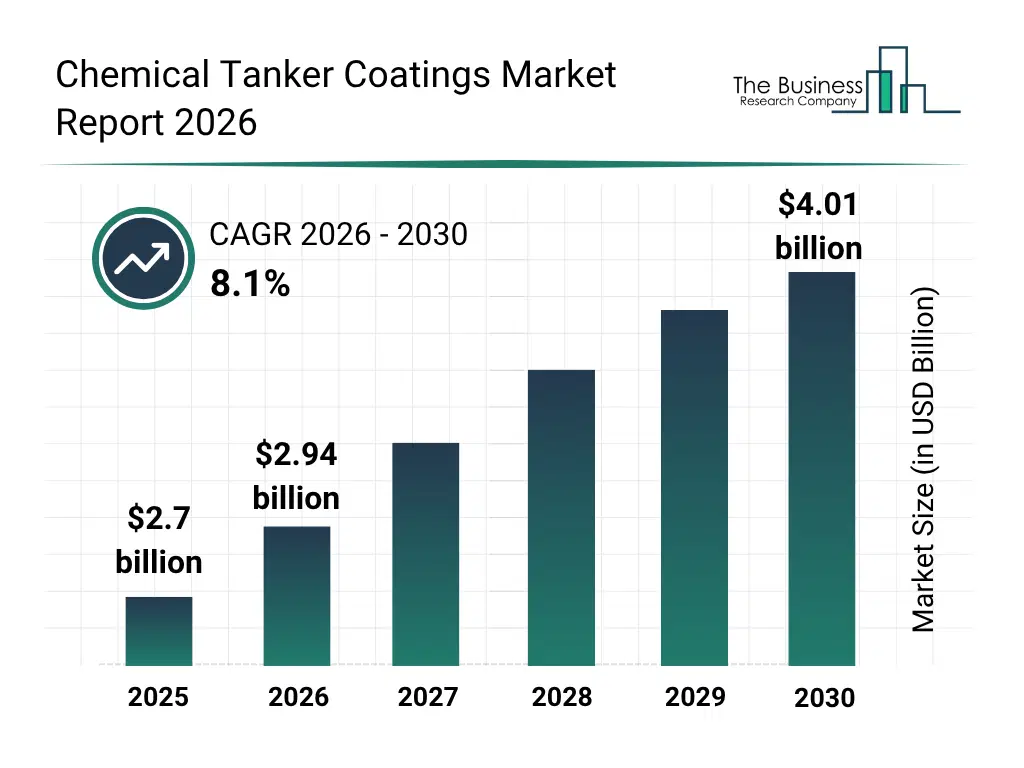
What Is The Chemical Tanker Coatings Market Size and Share 2026?
The chemical tanker coatings market size has grown strongly in recent years. It will grow from $2.7 billion in 2025 to $2.94 billion in 2026 at a compound annual growth rate (CAGR) of 8.8%. The growth in the historic period can be attributed to rising chemical tanker fleet expansion, increasing transportation of corrosive chemicals, growing need for corrosion protection, increasing chemical tanker maintenance activities, rising demand for cargo contamination prevention.What Is The Chemical Tanker Coatings Market Growth Forecast?
The chemical tanker coatings market size is expected to see strong growth in the next few years. It will grow to $4.01 billion in 2030 at a compound annual growth rate (CAGR) of 8.1%. The growth in the forecast period can be attributed to increasing seaborne chemical trade, rising replacement of aging chemical tankers, growing demand for extended vessel service life, increasing adoption of high-performance tank linings, expanding chemical tanker construction activities. Major trends in the forecast period include rising demand for high chemical resistance in tank coatings, increasing use of coatings for cargo purity protection, growing demand for longer coating service life, rising adoption of high-solids tank coating formulations, increasing demand for faster curing protective coatings.Tariff Impact On Chemical Tanker Coatings Market
Tariffs are impacting the chemical tanker coatings market by increasing the cost of imported epoxy resins, zinc, pigments, additives, solvents, and other specialty raw materials used in protective marine coating formulations. This is raising coating costs and affecting vessel construction, maintenance, and refurbishment activities, particularly for inland, coastal, and deep-sea chemical tankers in regions dependent on imported coating materials such as Asia-Pacific and Europe. Epoxy phenolic coatings, pure epoxy coatings, and zinc silicate coatings are most affected due to their dependence on specialized raw materials and international supply chains. However, tariffs are also encouraging local coating production, regional supplier diversification, and increased investment in domestic raw material capacity, strengthening supply-chain resilience in the market.
Global Chemical Tanker Coatings Market Segmentation
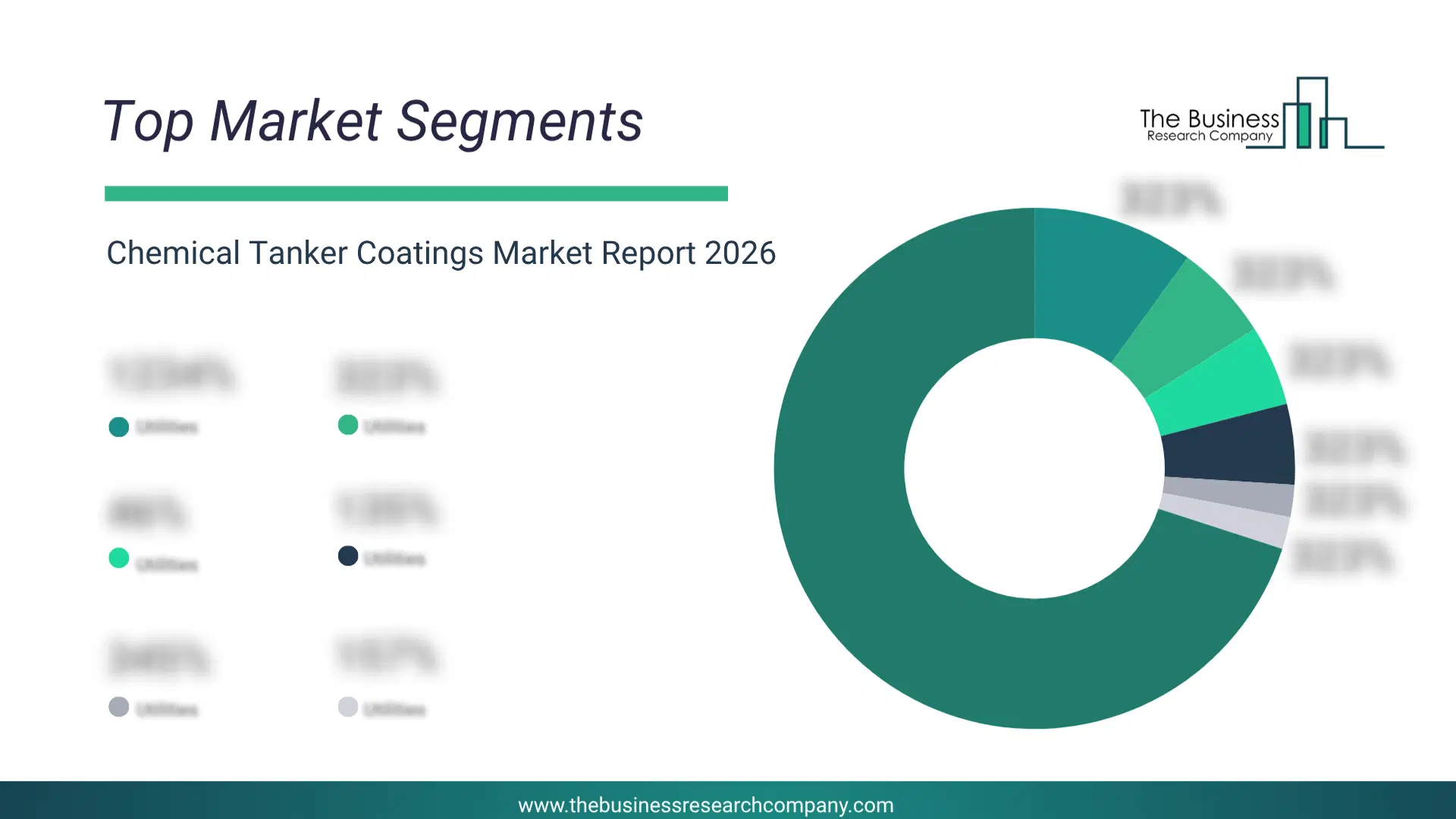
1) By Product Type: Epoxy Phenolic Coatings, Pure Epoxy Coatings, Zinc Silicate Coatings, Other Product Types 2) By Vessel Type: Inland Chemical Tankers, Coastal Chemical Tankers, Deep Sea Chemical Tankers 3) By Application: Cargo Tanks, Ballast Tanks, Slop Tanks, Fuel Tanks, Pipelines And Pump Systems, Other Applications 4) By End User: Shipping Companies, Chemical Manufacturers, Other End Users Subsegments: 1) By Epoxy Phenolic Coatings: Standard Epoxy Phenolic Coatings, High Temperature Epoxy Phenolic Coatings, High Solids Epoxy Phenolic Coatings, Fast Curing Epoxy Phenolic Coatings, High Chemical Resistance Epoxy Phenolic Coatings 2) By Pure Epoxy Coatings: Solvent Borne Pure Epoxy Coatings, Waterborne Pure Epoxy Coatings, Solvent Free Pure Epoxy Coatings, High Solids Pure Epoxy Coatings, High Build Pure Epoxy Coatings 3) By Zinc Silicate Coatings: Inorganic Zinc Silicate Coatings, Organic Zinc Silicate Coatings, Solvent Borne Zinc Silicate Coatings, Waterborne Zinc Silicate Coatings, High Zinc Content Zinc Silicate Coatings 4) By Other Product Types: Polyurethane Tank Coatings, Vinyl Ester Tank Coatings, Rubber Based Tank Linings, Glass Flake Tank Coatings, Ceramic Reinforced Tank CoatingsWhat Is The Driver Of The Chemical Tanker Coatings Market?
The expansion of chemical tanker fleet capacity is expected to propel the growth of the chemical tanker coatings market going forward. Chemical tanker fleet capacity refers to the total carrying capability of all chemical tankers in operation, typically measured in deadweight tonnage (DWT), which represents the maximum weight of cargo, fuel, provisions, and supplies that these vessels can safely transport. Expansion of chemical tanker fleet capacity is due to increasing global chemical trade, which has created a greater need for additional vessels to transport growing volumes of chemicals across international markets. Expansion of chemical tanker fleet capacity drives the demand for chemical tanker coatings by increasing the need for durable protective solutions that enhance vessel corrosion resistance, cargo compatibility, and operational efficiency. For instance, in April 2025, according to Quincannon Associates, a US-based ship brokering firm from 2024 to 2025, the global chemical tanker fleet grew by over 5% to 5,838 vessels, with 809 newbuild vessels on order for delivery between 2025 and 2027, representing nearly 14% of the existing fleet, while total fleet capacity reached just under 140 million DWT. Therefore, the expansion of chemical tanker fleet capacity is driving the growth of the chemical tanker coatings industry.Key Players In The Global Chemical Tanker Coatings Market
Major companies operating in the chemical tanker coatings market are Akzo Nobel N.V., PPG Industries Inc., The Sherwin-Williams Company, Jotun A/S, Hempel A/S, Nippon Paint Holdings Co. Ltd., RPM International Inc., Kansai Paint Co. Ltd., KCC Corporation, Chugoku Marine Paints Ltd., Advanced Polymer Coatings Inc., NOROO Holdings Co. Ltd., Teknos Group Oy, Transocean Coatings Corporation, TOA Paint Public Company Limited, Belzona International Limited, Corrocoat Limited, Baril Coatings B.V., Chemco International Ltd., ENECON Corporation, Berger Paints India Limited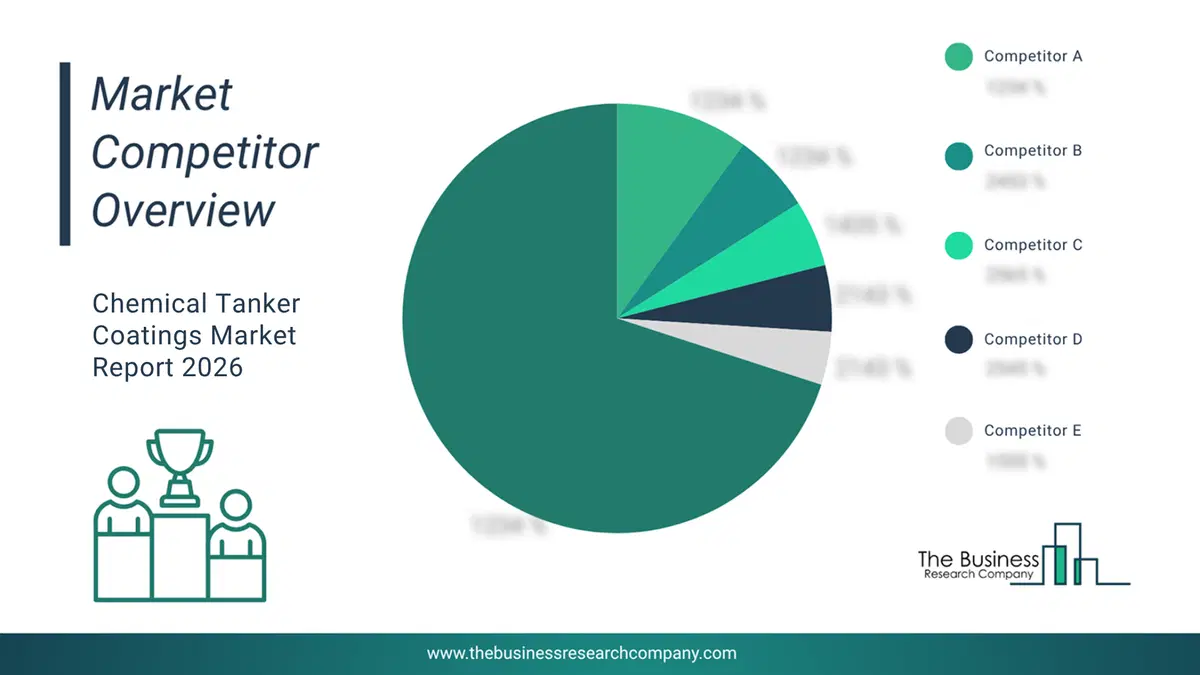
This chart is for illustrative purposes; the full report includes a detailed competitor analysis and comprehensive overview of the top 10 companies in the market.
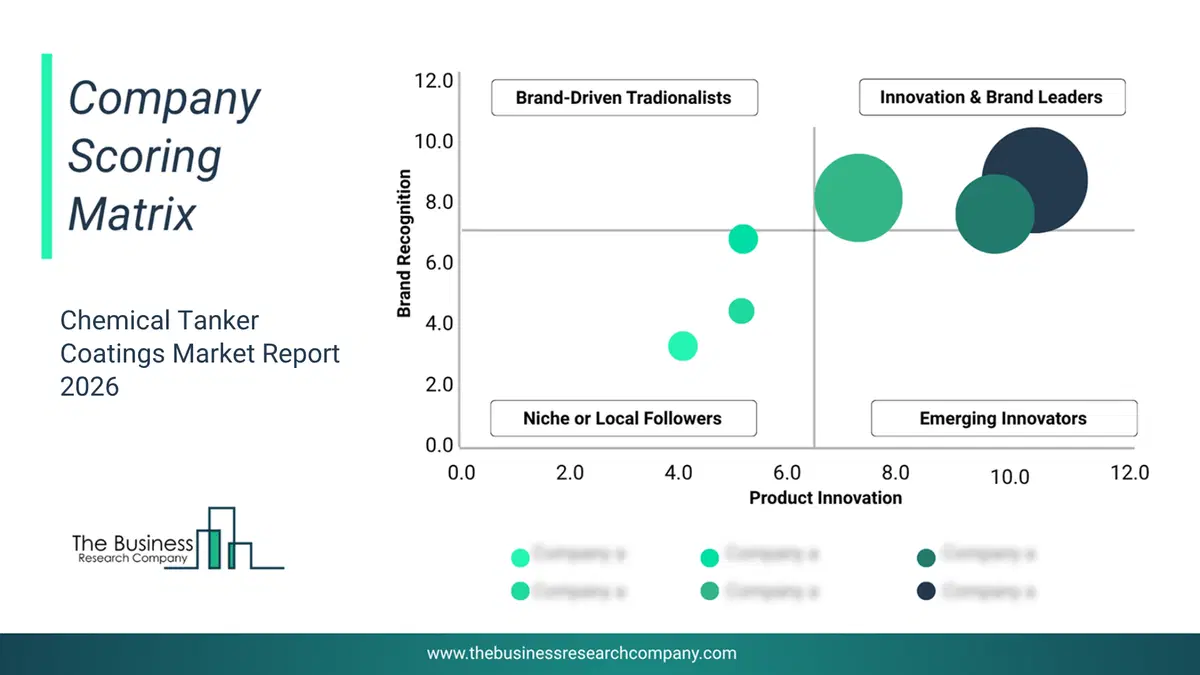
This chart maps companies by product innovation and brand strength, with bubble size indicating relative revenue, helping identify market leaders, challengers, and niche players. This is an illustrative chart; the full report provides a complete and accurate competitive analysis.
Global Chemical Tanker Coatings Market Trends and Insights
Major companies operating in the chemical tanker coatings market are focusing on developing innovative solutions, such as bio-based epoxy resin coatings, to enhance sustainability, reduce carbon emissions, and improve corrosion protection performance in chemical tanker applications. Bio-based epoxy resin coatings are advanced protective coatings formulated using renewable raw materials instead of conventional petroleum-based epoxy components, offering similar mechanical strength, chemical resistance, and durability while lowering environmental impact. For instance, in July 2025, Chugoku Marine Paints Ltd., a Japan-based marine coatings manufacturer, launched CMP NOVA 2000 (Bio), an ISCC PLUS-certified bio-based epoxy resin coating developed for marine vessel applications, including chemical tankers. The coating uses Mitsui Chemicals’ ISCC PLUS-certified bio-based epoxy resin produced through the mass balance method, enabling reduced CO₂ emissions compared with conventional epoxy resin systems. CMP NOVA 2000 (Bio) provides corrosion protection and durability required for ballast water tanks in liquefied ammonia tankers and other chemical vessel applications. The product was selected for use on a liquefied ammonia tanker constructed by Kegoya Dock Co., Ltd., representing one of the first reported applications of a bio-based epoxy resin coating on a marine vessel. Alongside the coating, Chugoku Marine Paints’ fuel-efficient antifouling coating SEA PREMIER 2000 PLUS was also applied to improve vessel efficiency and further reduce operational emissions.What Are Latest Mergers And Acquisitions In The Chemical Tanker Coatings Market?
In November 2025, Advanced Polymer Coatings (APC), a US-based manufacturer specializing in advanced protective coating solutions for marine and industrial applications, partnered with Asyad Shipping Company to provide its MarineLINE cargo tank coating system for two newbuild chemical tankers. Through this partnership, Advanced Polymer Coatings and Asyad Shipping Company aim to enhance chemical tanker operational efficiency by improving cargo compatibility, corrosion resistance, tank durability, and reducing maintenance requirements. Asyad Shipping Company SAOG is an Oman-based maritime transportation company providing shipping and logistics services across global trade routes.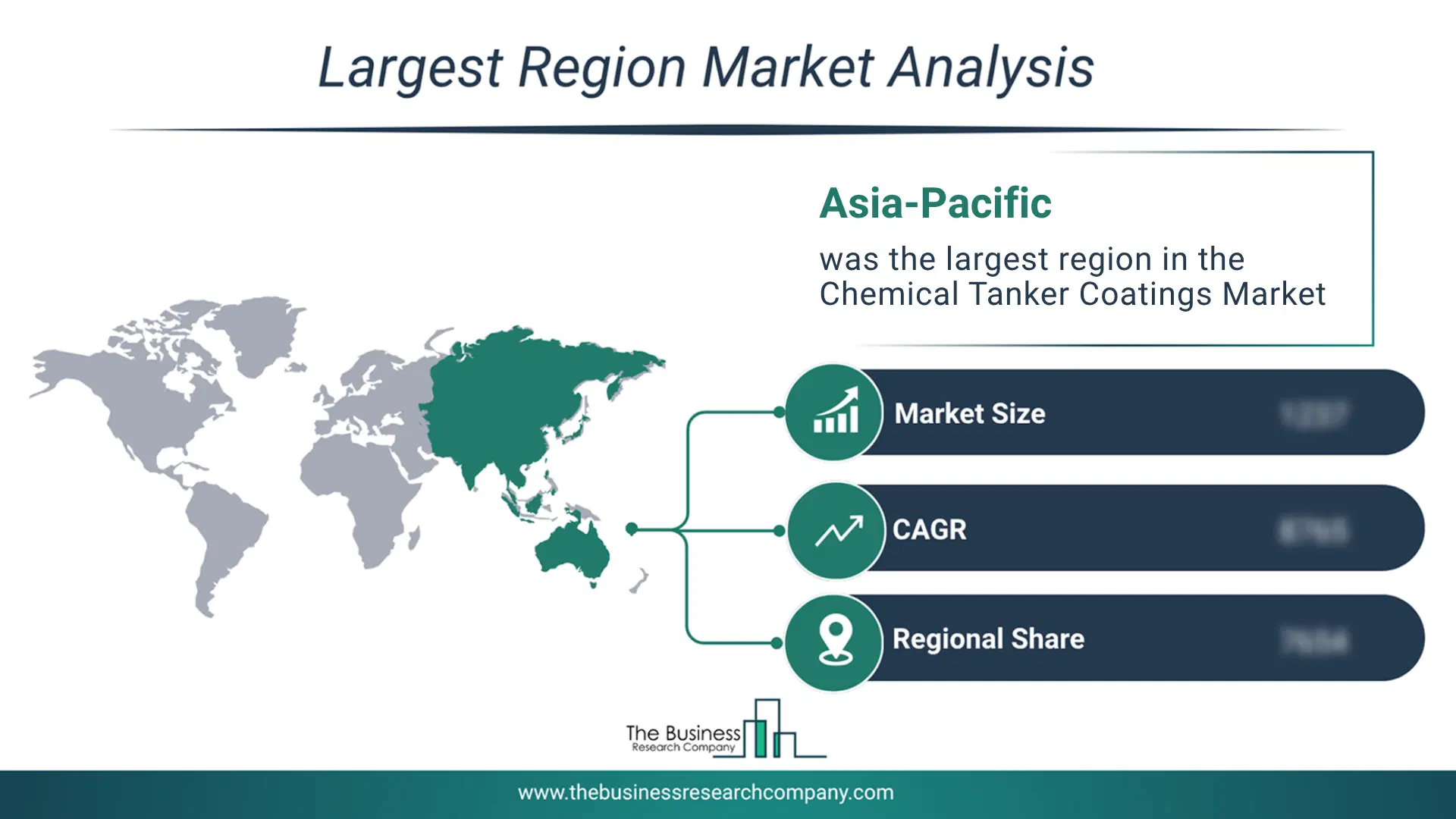
Regional Outlook
Asia-Pacific was the largest region in the chemical tanker coatings market in 2025. Asia-Pacific is expected to be the fastest-growing region in the forecast period. The regions covered in this market report are Asia-Pacific, South East Asia, Western Europe, Eastern Europe, North America, South America, Middle East, Africa. The countries covered in this market report are Australia, Brazil, China, France, Germany, India, Indonesia, Japan, Taiwan, Russia, South Korea, UK, USA, Canada, Italy, Spain.What Defines the Chemical Tanker Coatings Market?
The chemical tanker coatings market consists of sales of polyurethane coatings, vinyl ester coatings, glass flake coatings, acrylic coatings, and fluoropolymer coatings. Values in this market are ‘factory gate’ values, that is, the value of goods sold by the manufacturers or creators of the goods, whether to other entities (including downstream manufacturers, wholesalers, distributors, and retailers) or directly to end customers. The value of goods in this market includes related services sold by the creators of the goods.How is Market Value Defined and Measured?
The market value is defined as the revenues that enterprises gain from the sale of goods and/or services within the specified market and geography through sales, grants, or donations in terms of the currency (in USD unless otherwise specified). The revenues for a specified geography are consumption values that are revenues generated by organizations in the specified geography within the market, irrespective of where they are produced. It does not include revenues from resales along the supply chain, either further along the supply chain or as part of other products.
This chart presents market attractiveness based on a quantitative evaluation of growth, competition, strategic alignment, and risk, offering a clear view of opportunity areas for decision-making. This chart is for illustrative purposes; the full report contains the complete analysis.

This chart highlights the Total Addressable Market (TAM) by estimating the maximum revenue opportunity using an assumption-driven approach, supporting strategic planning and opportunity sizing across markets. The chart is illustrative; the full report provides a more comprehensive analysis.
What Key Data and Analysis Are Included in the Chemical Tanker Coatings Market Report 2026?
The chemical tanker coatings market research report is one of a series of new reports from The Business Research Company that provides market statistics, including industry global market size, regional shares, competitors with the market share, detailed market segments, market trends and opportunities, and any further data you may need to thrive in the chemical tanker coatings industry. The market research report delivers a complete perspective of everything you need, with an in-depth analysis of the current and future state of the industry.Chemical Tanker Coatings Market Report Forecast Analysis
| Report Attribute | Details |
|---|---|
| Market Size Value In 2026 | $2.94 billion |
| Revenue Forecast In 2030 | $4.01 billion |
| Growth Rate | CAGR of 8.1% from 2026 to 2030 |
| Base Year For Estimation | 2025 |
| Actual Estimates/Historical Data | 2020-2025 |
| Forecast Period | 2026 - 2030 |
| Market Representation | Revenue in USD Billion and CAGR from 2026 to 2030 |
| Segments Covered | Product Type, Vessel Type, Application, End User |
| Regional Scope | Asia-Pacific, Western Europe, Eastern Europe, North America, South America, Middle East, Africa |
| Country Scope | The countries covered in the report are Australia, Brazil, China, France, Germany, India, Indonesia, Japan, Taiwan, Russia, South Korea, UK, USA, Canada, Italy, Spain. |
| Key Companies Profiled | Akzo Nobel N.V., PPG Industries Inc., The Sherwin-Williams Company, Jotun A/S, Hempel A/S, Nippon Paint Holdings Co. Ltd., RPM International Inc., Kansai Paint Co. Ltd., KCC Corporation, Chugoku Marine Paints Ltd., Advanced Polymer Coatings Inc., NOROO Holdings Co. Ltd., Teknos Group Oy, Transocean Coatings Corporation, TOA Paint Public Company Limited, Belzona International Limited, Corrocoat Limited, Baril Coatings B.V., Chemco International Ltd., ENECON Corporation, Berger Paints India Limited |
| Customization Scope | Request for Customization |
| Pricing And Purchase Options | Explore Purchase Options |