
Chemical Warfare Agent Detectors Market Report 2026
Global Outlook – By Product (Portable Detectors, Fixed Detectors, Wearable Detectors), By Detection Technology (Electrochemical Sensors, Infrared Sensors, Mass Spectrometry, Chromatography, Optical Detection), By Deployment Method (Standalone Deployment, Integrated Systems, Robotic Systems), By Application (Military Applications, Civil Defense, Industrial Safety, Laboratory Research, Aerospace And Aviation), By End User (Government And Defense Agencies, Research Institutions, Healthcare Organizations, Manufacturing And Industrial Sectors) – Market Size, Trends, Strategies, and Forecast to 2030
Chemical Warfare Agent Detectors Market Overview
• Chemical Warfare Agent Detectors market size has reached to $1.42 billion in 2025 • Expected to grow to $2.31 billion in 2030 at a compound annual growth rate (CAGR) of 10.3% • Growth Driver: Rising Geopolitical Tensions Driving The Growth Of The Market Due To Heightened National Security And Defense Preparedness • Market Trend: Innovative Thermal Desorption Instruments Boost Trace-Level Chemical Warfare Agent Detection • North America was the largest region in 2025 and Asia-Pacific is the fastest growing region.What Is Covered Under Chemical Warfare Agent Detectors Market?
Chemical warfare agent detectors are sophisticated devices engineered to identify and analyze toxic chemical substances that may be deployed as weapons, ensuring early detection in potentially hazardous environments. These detectors monitor air, water, or surfaces and provide rapid alerts, allowing for timely protective actions and effective decontamination to safeguard personnel and civilians. The main types of products in chemical warfare agent detectors are portable detectors, fixed detectors, and wearable detectors. Portable detectors are compact, lightweight devices designed to be easily carried and used in various locations to detect specific substances, chemicals, or environmental hazards. It includes various detection technologies, such as electrochemical sensors, infrared sensors, mass spectrometry, chromatography, optical detection, and deployment through standalone deployment, integrated systems, smartphone applications, and robotic systems. It finds applications in military applications, civil defense, industrial safety, laboratory research, aerospace, and aviation, serving end-users including government and defense agencies, research institutions, healthcare organizations, and manufacturing and industrial sectors.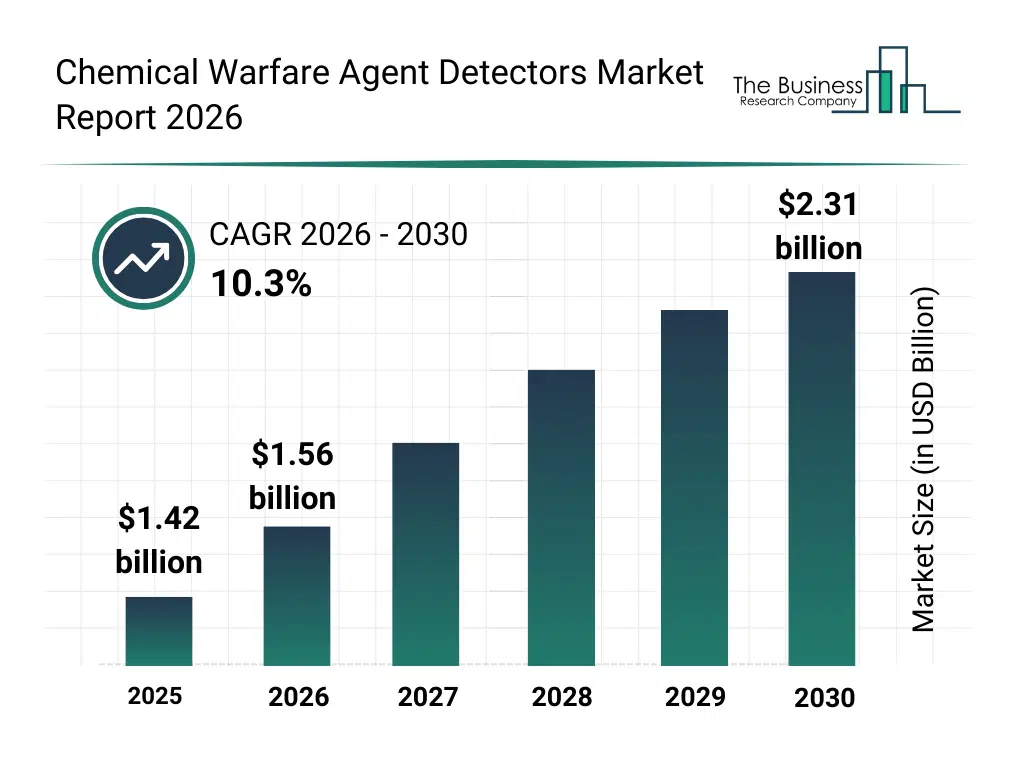
What Is The Chemical Warfare Agent Detectors Market Size and Share 2026?
The chemical warfare agent detectors market size has grown rapidly in recent years. It will grow from $1.42 billion in 2025 to $1.56 billion in 2026 at a compound annual growth rate (CAGR) of 10.3%. The growth in the historic period can be attributed to military modernization programs, global security threats, demand for early warning systems, advancements in sensor technologies, regulatory safety requirements.What Is The Chemical Warfare Agent Detectors Market Growth Forecast?
The chemical warfare agent detectors market size is expected to see rapid growth in the next few years. It will grow to $2.31 billion in 2030 at a compound annual growth rate (CAGR) of 10.3%. The growth in the forecast period can be attributed to smart defense infrastructure development, urban security investments, growth of autonomous detection platforms, international safety collaborations, increased homeland security funding. Major trends in the forecast period include rising deployment of portable detection devices, growing integration of ai based threat analysis, expansion of wearable chemical detection systems, increasing demand for rapid response sensors, higher focus on civil defense preparedness.
Global Chemical Warfare Agent Detectors Market Segmentation
1) By Product: Portable Detectors, Fixed Detectors, Wearable Detectors 2) By Detection Technology: Electrochemical Sensors, Infrared Sensors, Mass Spectrometry, Chromatography, Optical Detection 3) By Deployment Method: Standalone Deployment, Integrated Systems, Robotic Systems 4) By Application: Military Applications, Civil Defense, Industrial Safety, Laboratory Research, Aerospace And Aviation 5) By End User: Government And Defense Agencies, Research Institutions, Healthcare Organizations, Manufacturing And Industrial Sectors Subsegments: 1) By Portable Detectors: Handheld Multi-Gas Chemical Detectors, Portable Ion Mobility Spectrometry (IMS) Detectors, Portable Mass Spectrometry Detectors, Portable Infrared And Raman Spectroscopy Detectors, Portable Colorimetric And Paper-Based Detectors 2) By Fixed Detectors: Fixed Area Chemical Monitoring Systems, Perimeter And Facility Chemical Detection Systems, Continuous Air Monitoring (CAM) Systems, Networked Fixed Sensor Arrays 3) By Wearable Detectors: Personal Chemical Exposure Monitors, Badge-Type Chemical Detectors, Clip-On And Wrist-Mounted Chemical SensorsWhat Is The Driver Of The Chemical Warfare Agent Detectors Market?
The increasing geopolitical tensions are expected to propel the growth of the chemical warfare agent detectors market going forward. Geopolitical tensions refer to the political, economic, or military strains and rivalries between nations that often arise from conflicts of interest, territorial disputes, security concerns, or competition for influence and resources. Geopolitical tensions are rising as major powers intensify their competition for vital resources such as oil, natural gas, and rare earth elements, turning resource-rich regions into focal points of strategic rivalry and growing military presence. Chemical warfare agent detectors help governments and defense forces monitor and respond to chemical threats, enhancing national security and deterring hostile actions. For instance, in June 2023, according to the Stockholm International Peace Research Institute, a Sweden-based independent international institute, the worldwide stockpile of nuclear warheads totaled around 12,512, with about 9,576 warheads actively maintained in military reserves for possible deployment, marking an increase of 86 warheads compared to 2022. Therefore, increasing geopolitical tensions are driving the growth of the chemical warfare agent detectors industry.Key Players In The Global Chemical Warfare Agent Detectors Market
Major companies operating in the chemical warfare agent detectors market are Thermo Fisher Scientific, Rheinmetall AG, Agilent Technologies, Saab AB, Drägerwerk AG & Co. KGaA, Smiths Detection, Bruker Corporation, Teledyne FLIR, Metrohm AG, 908 Devices, Bertin Environics, Tofwerk AG, Block Engineering, Morphix Technologies, Airsense Analytics, Ouvry S.A.S., Serstech AB, SEC Technologies, Proengin S.A.S., ENMET, Owlstone Medical, Shenzhen Xinyuantong Electronics, Honeywell International Inc., QinetiQ Group plc, Chemring Group plc, MSA Safety Incorporated, Opgal Optronic Industries Ltd., Argon Electronics Ltd., Polimaster, Defiant Technologies
This chart is for illustrative purposes; the full report includes a detailed competitor analysis and comprehensive overview of the top 10 companies in the market.
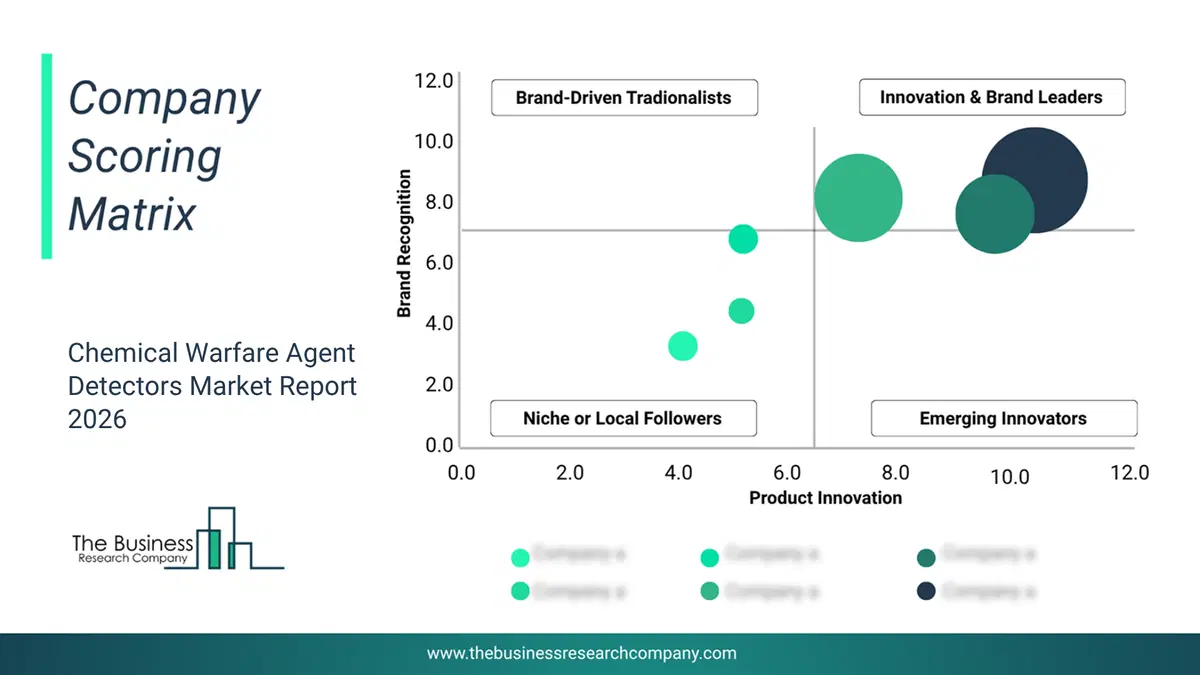
This chart maps companies by product innovation and brand strength, with bubble size indicating relative revenue, helping identify market leaders, challengers, and niche players. This is an illustrative chart; the full report provides a complete and accurate competitive analysis.
Global Chemical Warfare Agent Detectors Market Trends and Insights
Major companies in the chemical warfare agent (CWA) detectors market are increasingly focusing on developing innovative solutions to enhance detection capabilities, thereby driving market growth. One notable advancement is the use of thermal desorption (TD) instruments, which collect trace chemicals onto a sorbent and release them through heating for highly sensitive analysis, often using gas chromatography or mass spectrometry. For instance, in December 2023, Markes International, a UK-based manufacturer and supplier of specialist analytical instrumentation, launched the TT24-7NRT, its third-generation TD instrument designed for continuous, near-real-time detection and monitoring of airborne CWAs at trace levels. The device employs proprietary twin-trapping technology to ensure complete sample coverage without gaps, providing highly reliable detection. Its multi-gas capability compatible with helium, nitrogen, or hydrogen enables on-site hydrogen generation and discreet, unattended operation in remote locations. This example illustrates how technological innovation in CWA detection instruments is a key market trend, enhancing operational efficiency and meeting the evolving demands of defense and security agencies.What Are Latest Mergers And Acquisitions In The Chemical Warfare Agent Detectors Market?
In April 2024, 908 Devices Inc., a US-based technology company that designs and manufactures devices for chemical and biochemical analysis, acquired RedWave Technology for an undisclosed amount. Through this strategic acquisition, 908 Devices aims to broaden, diversify, and enhance its product portfolio by integrating long-term capabilities in the rapidly expanding forensics and security markets, specifically focusing on advanced handheld chemical identification instruments that address critical detection and analysis needs. RedWave Technology is a US-based manufacturer of handheld Fourier transform infrared spectrometers designed to detect and identify chemical threats, including chemical warfare agents.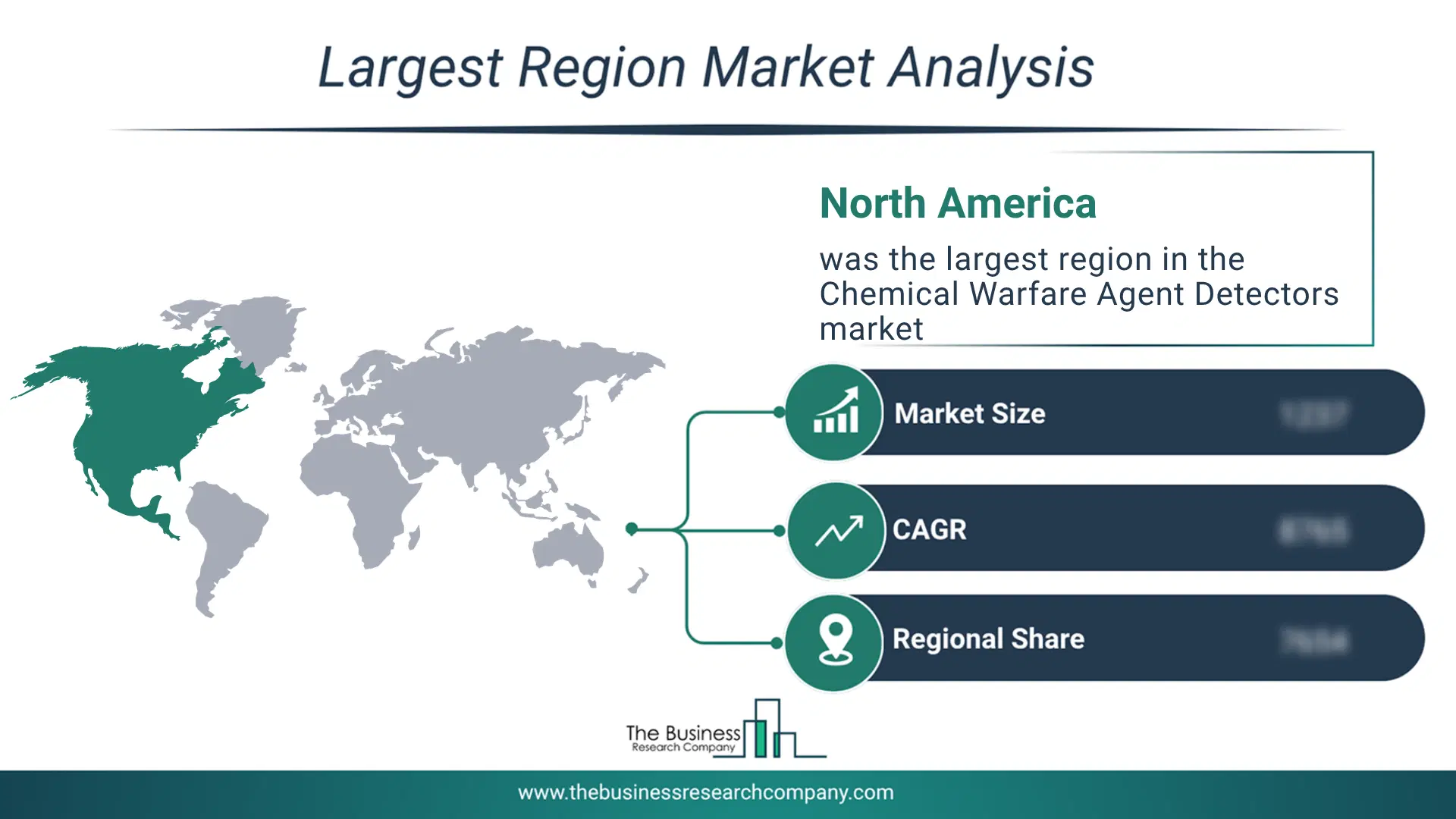
Regional Insights
North America was the largest region in the chemical warfare agent detectors market in 2025. Asia-Pacific is expected to be the fastest-growing region in the forecast period. The regions covered in this market report are Asia-Pacific, South East Asia, Western Europe, Eastern Europe, North America, South America, Middle East, Africa The countries covered in this market report are Australia, Brazil, China, France, Germany, India, Indonesia, Japan, Taiwan, Russia, South Korea, UK, USA, Canada, Italy, SpainWhat Defines the Chemical Warfare Agent Detectors Market?
The chemical warfare agent detectors market consists of sales of portable detection devices, fixed monitoring systems, handheld chemical sensors, vehicle-mounted detectors, and unmanned aerial vehicle-based detection systems. Values in this market are ‘factory gate’ values, that is, the value of goods sold by the manufacturers or creators of the goods, whether to other entities (including downstream manufacturers, wholesalers, distributors, and retailers) or directly to end customers. The value of goods in this market includes related services sold by the creators of the goods.How is Market Value Defined and Measured?
The market value is defined as the revenues that enterprises gain from the sale of goods and/or services within the specified market and geography through sales, grants, or donations in terms of the currency (in USD unless otherwise specified). The revenues for a specified geography are consumption values that are revenues generated by organizations in the specified geography within the market, irrespective of where they are produced. It does not include revenues from resales along the supply chain, either further along the supply chain or as part of other products.
This chart presents market attractiveness based on a quantitative evaluation of growth, competition, strategic alignment, and risk, offering a clear view of opportunity areas for decision-making. This chart is for illustrative purposes; the full report contains the complete analysis.

This chart highlights the Total Addressable Market (TAM) by estimating the maximum revenue opportunity using an assumption-driven approach, supporting strategic planning and opportunity sizing across markets. The chart is illustrative; the full report provides a more comprehensive analysis.
What Key Data and Analysis Are Included in the Chemical Warfare Agent Detectors Market Report 2026?
The chemical warfare agent detectors market research report is one of a series of new reports from The Business Research Company that provides market statistics, including industry global market size, regional shares, competitors with the market share, detailed market segments, market trends and opportunities, and any further data you may need to thrive in the chemical warfare agent detectors industry. The market research report delivers a complete perspective of everything you need, with an in-depth analysis of the current and future state of the industry.Chemical Warfare Agent Detectors Market Report Forecast Analysis
| Report Attribute | Details |
|---|---|
| Market Size Value In 2026 | $1.56 billion |
| Revenue Forecast In 2030 | $2.31 billion |
| Growth Rate | CAGR of 10.3% from 2026 to 2030 |
| Base Year For Estimation | 2025 |
| Actual Estimates/Historical Data | 2020-2025 |
| Forecast Period | 2026 - 2030 |
| Market Representation | Revenue in USD Billion and CAGR from 2026 to 2030 |
| Segments Covered | Product, Detection Technology, Deployment Method, Application, End User |
| Regional Scope | Asia-Pacific, Western Europe, Eastern Europe, North America, South America, Middle East, Africa |
| Country Scope | The countries covered in this market report are Australia, Brazil, China, France, Germany, India, Indonesia, Japan, Taiwan, Russia, South Korea, UK, USA, Canada, Italy, Spain |
| Key Companies Profiled | Thermo Fisher Scientific, Rheinmetall AG, Agilent Technologies, Saab AB, Drägerwerk AG & Co. KGaA, Smiths Detection, Bruker Corporation, Teledyne FLIR, Metrohm AG, 908 Devices, Bertin Environics, Tofwerk AG, Block Engineering, Morphix Technologies, Airsense Analytics, Ouvry S.A.S., Serstech AB, SEC Technologies, Proengin S.A.S., ENMET, Owlstone Medical, Shenzhen Xinyuantong Electronics, Honeywell International Inc., QinetiQ Group plc, Chemring Group plc, MSA Safety Incorporated, Opgal Optronic Industries Ltd., Argon Electronics Ltd., Polimaster, Defiant Technologies |
| Customization Scope | Request for Customization |
| Pricing And Purchase Options | Explore Purchase Options |