
Child Education Insurance Market Report 2026
Global Outlook – By Product Type (Traditional Child Education Plans, Unit Linked Insurance Plans (ULIPs), Endowment Plans, Term Insurance Plans With Education Riders), By Premium Payment Mode (One-Time Premium Payment, Annual Premium Payment, Semi-Annual Premium Payment, Monthly Premium Payment), By Policy Term (Short-Term Plans (1–5 Years), Medium-Term Plans (6–10 Years), Long-Term Plans (11+ Years)), By Distribution Channel (Insurance Agents Or Brokers, Direct Sales, Online Platforms, Bancassurance, Other Distribution Channels), By Application (Education Funding, Tuition Fee Coverage, Scholarship Support, Exam Fee Coverage, Living Expenses) – Market Size, Trends, Strategies, and Forecast to 2030
Child Education Insurance Market Overview
• Child Education Insurance market size has reached to $3.5 billion in 2025 • Expected to grow to $5.63 billion in 2030 at a compound annual growth rate (CAGR) of 9.9% • Growth Driver: The Rising Demand For International Education Is Fueling The Growth Of The Market Due To Increasing Parental Focus On Global Academic Exposure And Financial Preparedness • Market Trend: Innovative Insurance Solutions Empower Long-Term Educational And Career Goals For Children • North America was the largest region in 2025 and Asia-Pacific is the fastest growing region.What Is Covered Under Child Education Insurance Market?
Child education insurance is a dedicated financial plan that ensures a child's education is financially protected, even if a parent faces death, disability, or other emergencies. It blends life insurance with savings or investment features to accumulate a corpus by the time the child reaches higher education age. This policy supports parents in managing increasing education expenses to ensure the child’s education continues smoothly, regardless of life’s uncertainties. The main product types of child education insurance are traditional child education plans, unit-linked insurance plans (ULIPs), endowment plans, and term insurance plans with education riders. Traditional child education plans provide life coverage and guaranteed savings, helping parents fund their child’s education with stability and protection from market risks. It provides various premium payment modes, such as one-time premium payment, annual premium payment, semi-annual premium payment, and monthly premium payment, with several policy terms, including short-term plans (1–5 years), medium-term plans (6–10 years), and long-term plans (11+ years). It is distributed through various distribution channels, such as insurance agents or brokers, direct sales, online platforms, bancassurance, and others, for several applications, including education funding, tuition fee coverage, scholarship support, exam fee coverage, and living expenses.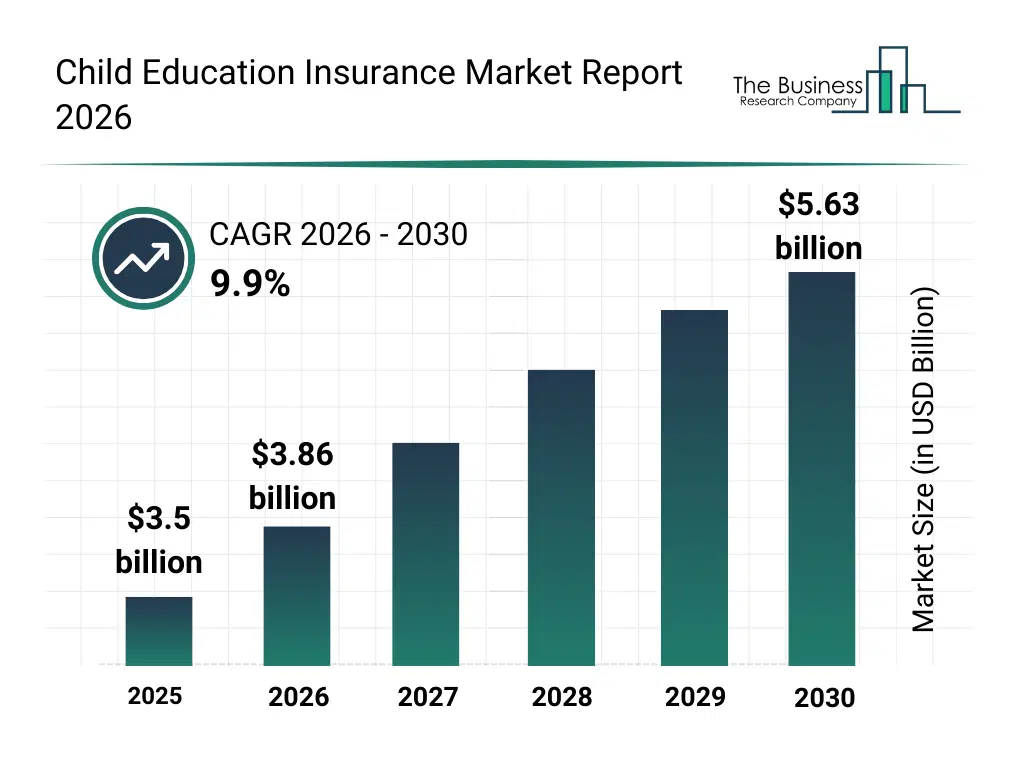
What Is The Child Education Insurance Market Size and Share 2026?
The child education insurance market size has grown rapidly in recent years. It will grow from $3.5 billion in 2025 to $3.86 billion in 2026 at a compound annual growth rate (CAGR) of 10.3%. The growth in the historic period can be attributed to rising education costs, increasing awareness of financial protection for children, growth in life insurance penetration, expanding middle-class population, wider availability of structured education plans.What Is The Child Education Insurance Market Growth Forecast?
The child education insurance market size is expected to see strong growth in the next few years. It will grow to $5.63 billion in 2030 at a compound annual growth rate (CAGR) of 9.9%. The growth in the forecast period can be attributed to increasing focus on higher education planning, growing adoption of digitally enabled insurance products, rising demand for flexible premium structures, expansion of personalized financial planning tools, increasing regulatory emphasis on policy transparency. Major trends in the forecast period include increasing demand for goal-based child education insurance plans, rising adoption of unit linked education policies, growing preference for premium waiver and protection riders, expansion of digital policy distribution channels, enhanced focus on long-term education cost planning.
Global Child Education Insurance Market Segmentation
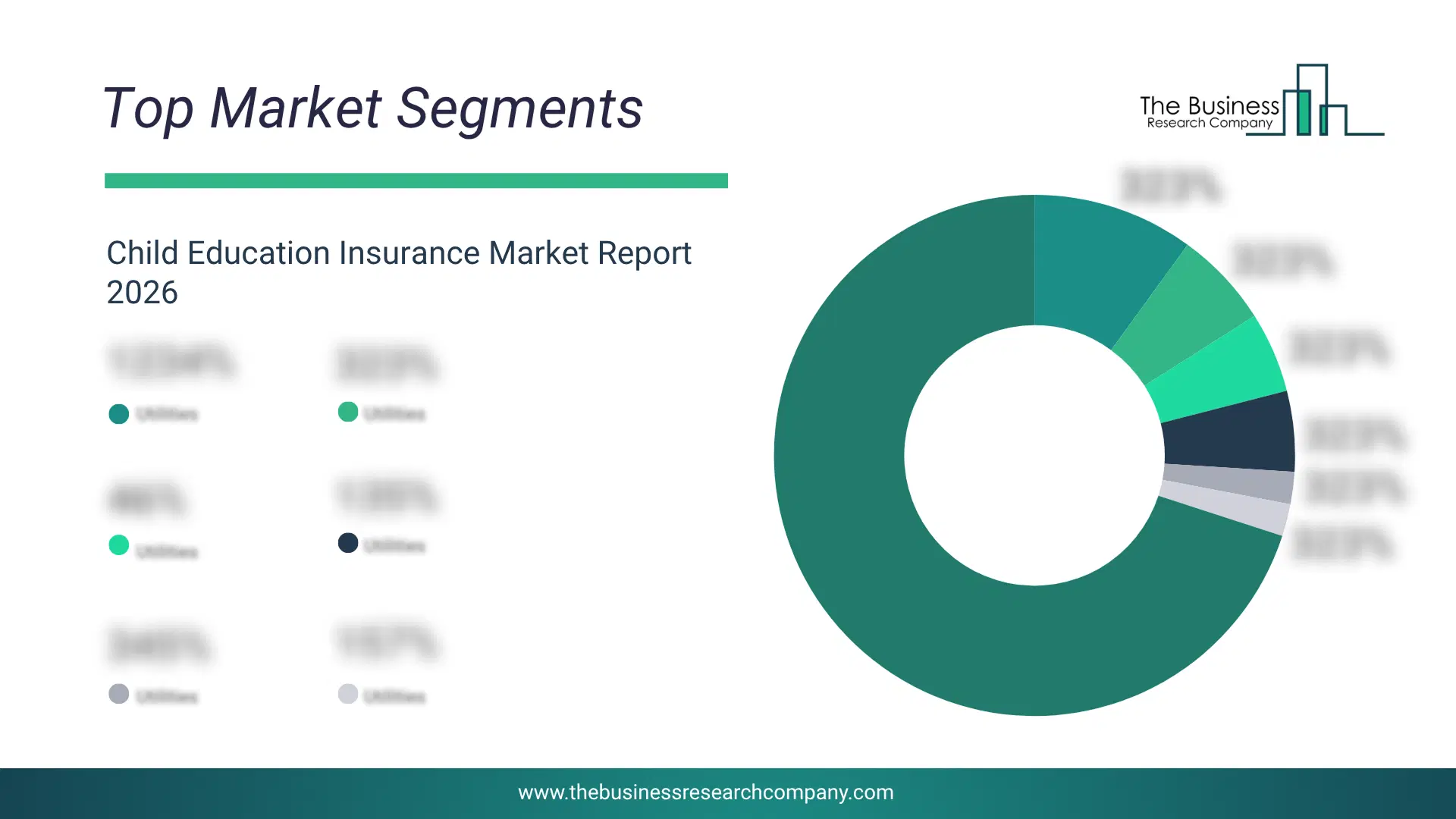
1) By Product Type: Traditional Child Education Plans, Unit Linked Insurance Plans (ULIPs), Endowment Plans, Term Insurance Plans With Education Riders 2) By Premium Payment Mode: One-Time Premium Payment, Annual Premium Payment, Semi-Annual Premium Payment, Monthly Premium Payment 3) By Policy Term: Short-Term Plans (1–5 Years), Medium-Term Plans (6–10 Years), Long-Term Plans (11+ Years) 4) By Distribution Channel: Insurance Agents Or Brokers, Direct Sales, Online Platforms, Bancassurance, Other Distribution Channels 5) By Application: Education Funding, Tuition Fee Coverage, Scholarship Support, Exam Fee Coverage, Living Expenses Subsegments: 1) By Traditional Child Education Plans: Guaranteed Returns Plans, Money Back Education Plans, Bonus-Based Plans 2) By Unit-Linked Insurance Plans: Equity Oriented Unit Linked Plans, Debt-Oriented Unit-Linked Plans, Balanced Unit Linked Plans 3) By Endowment Plans: Participating Endowment Plans, Non-Participating Endowment Plans, With Profit Endowment Plans, 4) By Term Insurance Plans With Education Riders: Term Plans With Lump Sum Education Benefit, Term Plans With Staggered Education Benefit, Term Plans With Premium Waiver On Parents’ DeathWhat Are The Drivers Of The Child Education Insurance Market?
The rising demand for international education is expected to propel the growth of the child education insurance market going forward. International education refers to the pursuit of academic programs in foreign countries by students seeking global exposure, quality education, or better career opportunities. The international education demand is increasing as more families prioritize overseas education for their children due to the perceived higher standards and global career prospects, especially in developed nations. Child education insurance supports international education by creating a financial reserve through savings and returns, ensuring coverage for tuition fees, travel, and living costs even during unforeseen disruptions to parental income. For instance, in November 2024, according to the Institute of International Education, a US-based non-profit organization, during the 2023/2024 academic year, U.S. higher education institutions hosted 1,126,690 international students from over 210 countries and regions, marking a 7% rise compared to the previous year. Therefore, the rising demand for international education is driving the growth of the child education insurance industry. Rising education expenses are expected to propel the growth of the child education insurance market going forward. Education expenses include costs for school supplies, textbooks, reference materials, and other academic necessities that families must budget for each year. The rise in education costs is due to persistent increases in consumer prices for school-related items, placing additional financial pressure on households. Child education insurance supports financial planning by enabling parents and guardians to secure funds for their children’s education and mitigate the impact of rising costs. For instance, in August 2025, according to the U.S. Bureau of Labor Statistics, a US-based federal government agency, as of July 2025, daycare and preschool costs rose by 5.7 percent compared to the previous year, while tuition and fees for elementary and high schools increased by 3.1 percent. Over the same period, college tuition recorded a 2.4 percent year-over-year increase. Therefore, rising education expenses are driving the growth of the child education insurance industry.Key Players In The Global Child Education Insurance Market
Major companies operating in the child education insurance market are Allianz SE, Ping An Insurance Group Co of China Ltd, AXA SA, MetLife Inc., Prudential plc, Nippon Life Insurance Company, Manulife Financial Corporation, Life Insurance Corporation of India LIC, New York Life Insurance Company, Northwestern Mutual, Lincoln National Corporation, Aegon N V, Dai‑ichi Life Holdings Inc., Great‑West Lifeco Inc., CNP Assurances, Japan Post Insurance Co Ltd, Ameritas Life Insurance Corp, National Life Group Inc., Primerica Inc.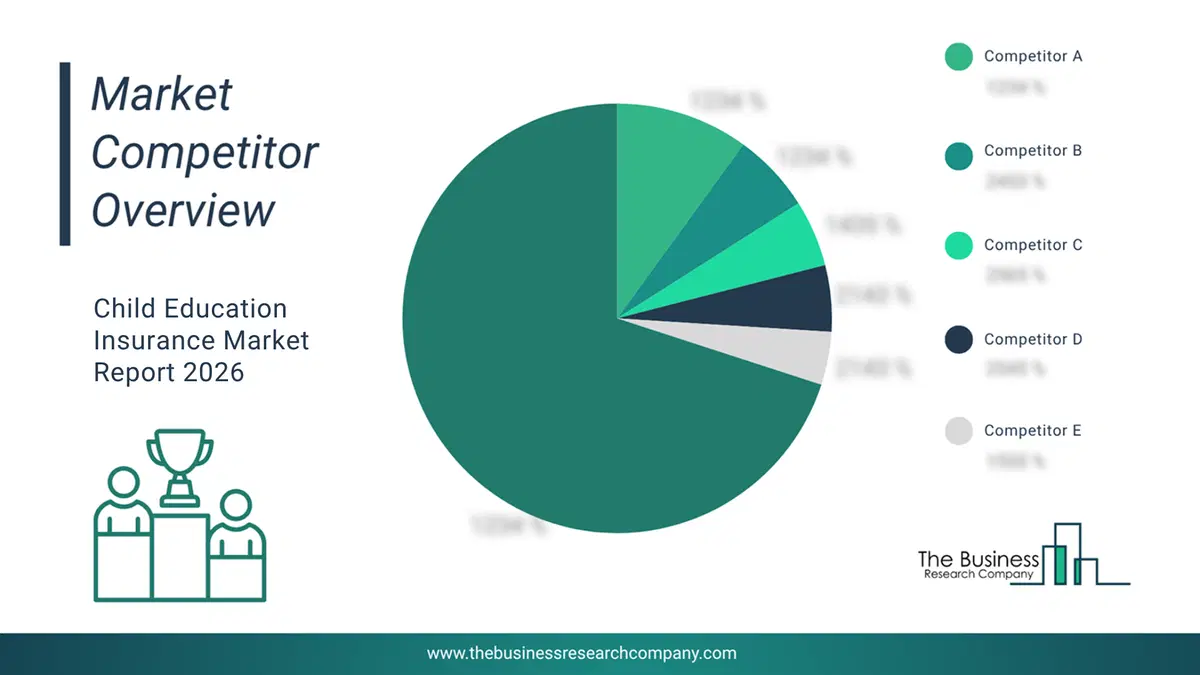
This chart is for illustrative purposes; the full report includes a detailed competitor analysis and comprehensive overview of the top 10 companies in the market.
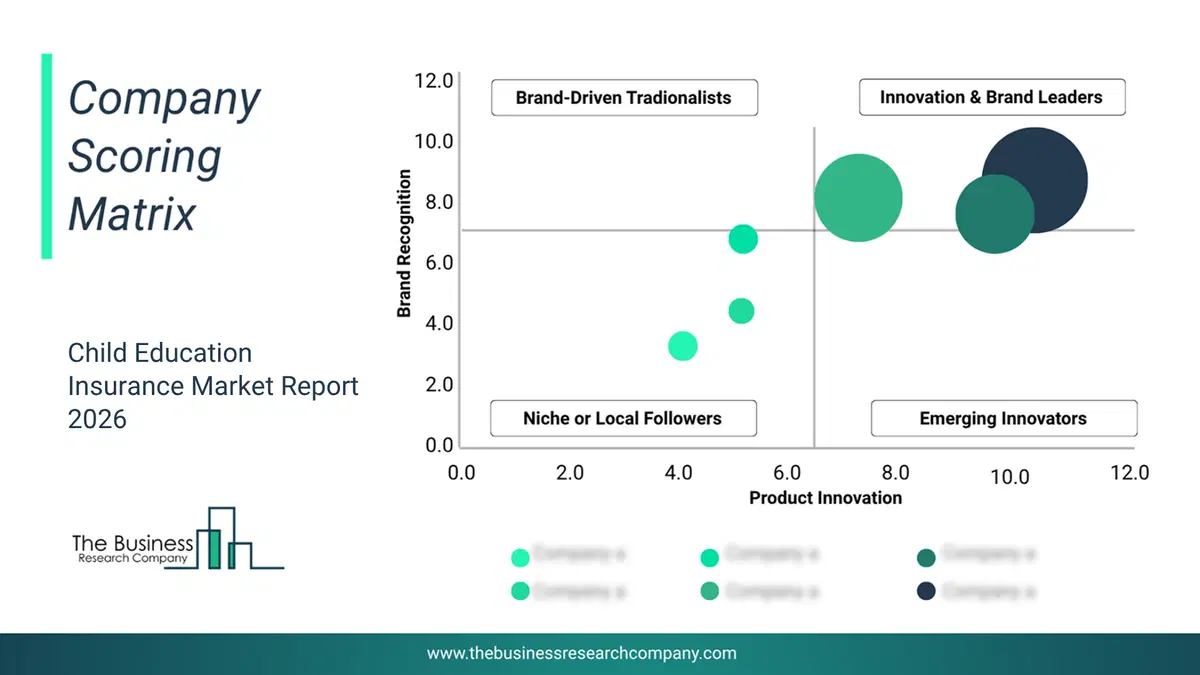
This chart maps companies by product innovation and brand strength, with bubble size indicating relative revenue, helping identify market leaders, challengers, and niche players. This is an illustrative chart; the full report provides a complete and accurate competitive analysis.
Global Child Education Insurance Market Trends and Insights
Major companies operating in the child education insurance market are focusing on developing advanced solutions, such as children's future aspiration insurance, to ensure comprehensive financial support for children's long-term goals and ambitions. Child's future aspiration insurance is a financial plan that secures funding for a child’s long-term goals, like education, career, or business, ensuring support even during unexpected family income disruptions. For instance, in March 2025, SBI Life Insurance Company Limited, an India-based life insurance company, launched SBI Life-Smart Future Star and SBI Life Smart Platina Young Achiever. These plans provide adaptable premium and payout structures that correspond with key educational milestones, along with a built-in premium waiver in the event of the parent’s death or disability. They aim to ensure long-term wealth accumulation through guaranteed returns or bonuses while offering life coverage and promoting disciplined savings. The core intent of these products is to equip parents with flexible insurance solutions that evolve with their child’s educational journey and their own financial situation.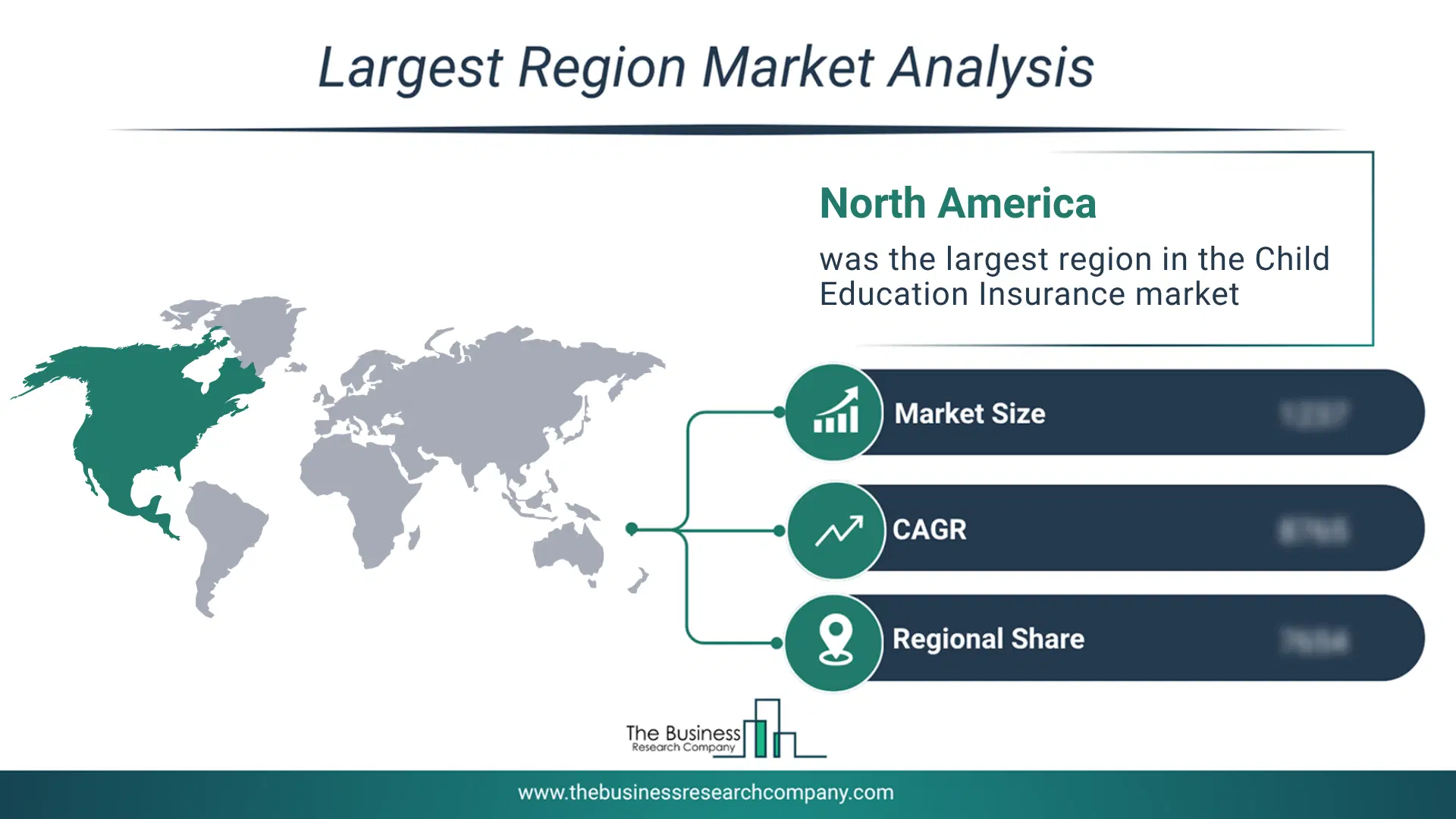
Regional Outlook
North America was the largest region in the child education insurance market in 2025. Asia-Pacific is expected to be the fastest-growing region in the forecast period. The regions covered in this market report are Asia-Pacific, South East Asia, Western Europe, Eastern Europe, North America, South America, Middle East, Africa. The countries covered in this market report are Australia, Brazil, China, France, Germany, India, Indonesia, Japan, Taiwan, Russia, South Korea, UK, USA, Canada, Italy, Spain.What Defines the Child Education Insurance Market?
The child education insurance market includes revenues earned by entities by providing services such as premium waiver benefit, lump sum payout on maturity, partial withdrawal facility, milestone-based payouts, and tax saving benefits. The market value includes the value of related goods sold by the service provider or included within the service offering. Only goods and services traded between entities or sold to end consumers are included.How is Market Value Defined and Measured?
The market value is defined as the revenues that enterprises gain from the sale of goods and/or services within the specified market and geography through sales, grants, or donations in terms of the currency (in USD unless otherwise specified). The revenues for a specified geography are consumption values that are revenues generated by organizations in the specified geography within the market, irrespective of where they are produced. It does not include revenues from resales along the supply chain, either further along the supply chain or as part of other products.
This chart presents market attractiveness based on a quantitative evaluation of growth, competition, strategic alignment, and risk, offering a clear view of opportunity areas for decision-making. This chart is for illustrative purposes; the full report contains the complete analysis.

This chart highlights the Total Addressable Market (TAM) by estimating the maximum revenue opportunity using an assumption-driven approach, supporting strategic planning and opportunity sizing across markets. The chart is illustrative; the full report provides a more comprehensive analysis.
What Key Data and Analysis Are Included in the Child Education Insurance Market Report 2026?
The child education insurance market research report is one of a series of new reports from The Business Research Company that provides market statistics, including Market Report 2026?global market size, regional shares, competitors with the market share, detailed market segments, market trends and opportunities, and any further data you may need to thrive in the child education insurance Market Report 2026? The market research report delivers a complete perspective of everything you need, with an in-depth analysis of the current and future state of the Market Report 2026?Child Education Insurance Market Report Forecast Analysis
| Report Attribute | Details |
|---|---|
| Market Size Value In 2026 | $3.86 billion |
| Revenue Forecast In 2030 | $5.63 billion |
| Growth Rate | CAGR of 10.3% from 2026 to 2030 |
| Base Year For Estimation | 2025 |
| Actual Estimates/Historical Data | 2020-2025 |
| Forecast Period | 2026 - 2030 |
| Market Representation | Revenue in USD Billion and CAGR from 2026 to 2030 |
| Segments Covered | Product Type, Premium Payment Mode, Policy Term, Distribution Channel, Application |
| Regional Scope | Asia-Pacific, Western Europe, Eastern Europe, North America, South America, Middle East, Africa |
| Country Scope | The countries covered in the report are Australia, Brazil, China, France, Germany, India, Indonesia, Japan, Taiwan, Russia, South Korea, UK, USA, Canada, Italy, Spain. |
| Key Companies Profiled | Allianz SE, Ping An Insurance Group Co of China Ltd, AXA SA, MetLife Inc., Prudential plc, Nippon Life Insurance Company, Manulife Financial Corporation, Life Insurance Corporation of India LIC, New York Life Insurance Company, Northwestern Mutual, Lincoln National Corporation, Aegon N V, Dai‑ichi Life Holdings Inc., Great‑West Lifeco Inc., CNP Assurances, Japan Post Insurance Co Ltd, Ameritas Life Insurance Corp, National Life Group Inc., Primerica Inc. |
| Customization Scope | Request for Customization |
| Pricing And Purchase Options | Explore Purchase Options |