

Chromatography Resins Global Market Opportunities And Strategies To 2035
By Product Type (Natural, Synthetic, Inorganic), By Technology Type (Ion Exchange, Affinity Chromatography, Anion Exchange Chromatography, Cation Exchange Chromatography, Size Exclusion, Hydrophobic Interaction, Other Technologies), By Application (Pharmaceutical And Biotechnology, Clinical Research And Diagnostics, Food And Beverage Processing, Water And Environmental Analysis, Other Applications), And By Region, Opportunities And Strategies – Global Forecast To 2035
Chromatography Resins Market Definition
Chromatography resins are specialized porous materials used as the stationary phase in chromatography processes to separate, purify and analyze molecules from complex mixtures. These resins are typically made from natural or synthetic polymer matrices such as agarose, silica, dextran, or polymethacrylate and are functionalized with specific chemical groups that enable selective binding of target compounds. Their primary purpose is to achieve high-purity separation based on properties such as size, charge, hydrophobicity, or molecular affinity, thereby improving product type quality, process efficiency and regulatory compliance in research and industrial manufacturing applications. The chromatography resins market consist of sales by entities (organizations, sole traders and partnerships) by manufacturing and supplying chromatography resins and related separation materials used in purification, analytical testing and biochemical processing applications.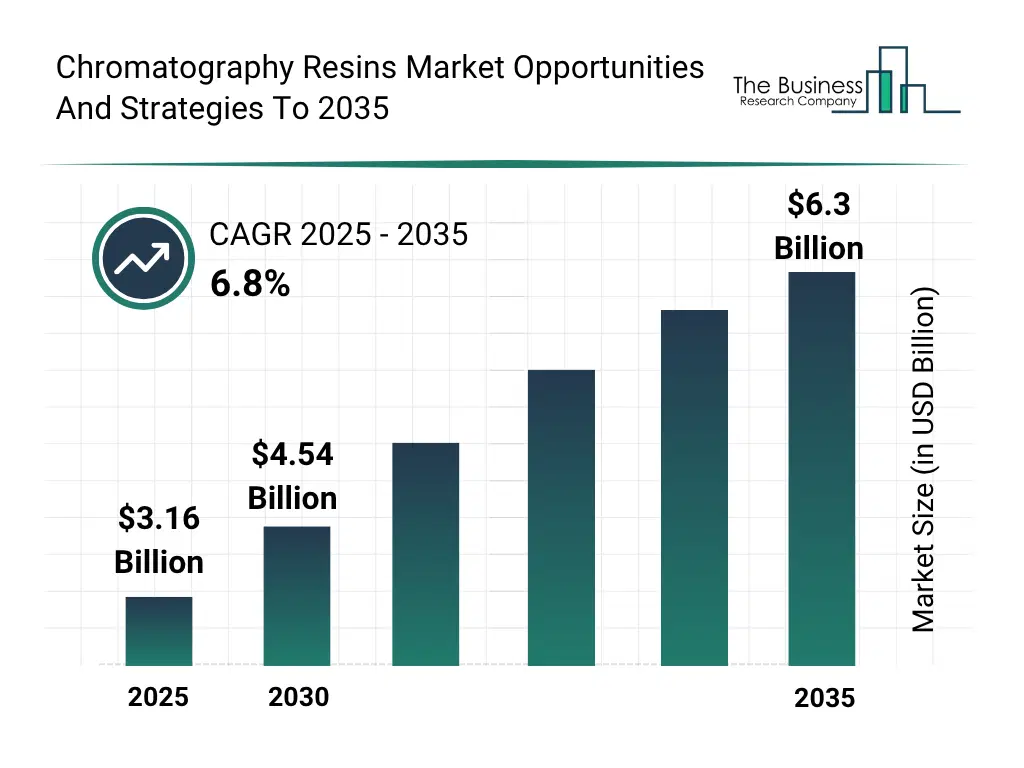
Chromatography Resins Market Size
The global chromatography resins market reached a value of nearly $3,156.0 million in 2025, having grown at a compound annual growth rate (CAGR) of 8.0% since 2020. The market is expected to grow from $3,156.0 million in 2025 to $4,539.7 million in 2030 at a rate of 7.5%. The market is then expected to grow at a CAGR of 6.8% from 2030 and reach $6,299.0 million in 2035. Growth in the historic period resulted from growth in vaccine production, expansion of contract manufacturing organizations (CMOs) and CDMOs in bioprocessing, rise in adoption of personalized medicine and expansion of cell and gene therapy. Factors that negatively affected growth in the historic period were high cost of advanced chromatography resins and limited reusability and resins lifespan. Going forward, increasing adoption of affinity chromatography techniques, rising adoption of single-use bioprocessing systems, increasing focus on process efficiency and yield optimization in biomanufacturing and expansion of academic and clinical research activities in life sciences will drive the growth. Factors that could hinder the growth of the chromatography resins market in the future include stringent regulatory compliance requirements and supply chain disruptions and raw material volatility and impact of trade wars and tariffs.
Chromatography Resins Market Segmentation
The chromatography resins market is segmented by product type, by technology type and by application.By Product Type –
The chromatography resins market is segmented by product type into:
- a) Natural
- b) Synthetic
- c) Inorganic
By Technology Type –
The chromatography resins market is segmented by technology type into:
- a) Ion Exchange
- b) Affinity Chromatography
- c) Anion Exchange Chromatography
- d) Cation Exchange Chromatography
- e) Size Exclusion
- f) Hydrophobic Interaction
- g) Other Technologies
By Application –
The chromatography resins market is segmented by application into:
- a) Pharmaceutical And Biotechnology
- b) Clinical Research And Diagnostics
- c) Food And Beverage Processing
- d) Water And Environmental Analysis
- e) Other Applications
By Geography - The chromatography resins market is segmented by geography into:
- China
- India
- Japan
- Australia
- South Korea
- Indonesia
- USA
- Canada
- Brazil
- France
- Germany
- UK
- Italy
- Spain
- Russia
-
o Asia Pacific
o Africa