
Chromosomal Microarray Reflex Testing Market Report 2026
Global Outlook – By Technology (Array Comparative Genomic Hybridization, Single Nucleotide Polymorphism Arrays, Other Technologies), By Product Type (Consumables, Instruments, Software), By Application (Genetic Disease Diagnosis, Oncology, Pre- And Post-Natal Testing, Other Applications), By End-User (Hospitals And Clinics, Diagnostic Laboratories, Research And Academic Institutes, Other End-Users) – Market Size, Trends, Strategies, and Forecast to 2030
Chromosomal Microarray Reflex Testing Market Overview
• Chromosomal Microarray Reflex Testing market size has reached to $1.39 billion in 2025 • Expected to grow to $2.15 billion in 2030 at a compound annual growth rate (CAGR) of 9.1% • Growth Driver: Increasing Prevalence of Genetic Disorders Driving The Market Growth Due To Rising Demand for Advanced Chromosomal Diagnostic Testing • North America was the largest region in 2025 and Asia-Pacific is the fastest growing region.What Is Covered Under Chromosomal Microarray Reflex Testing Market?
Chromosomal microarray reflex testing is an advanced molecular diagnostic method used to examine the genome for copy number variations and chromosomal irregularities. It offers high-resolution identification of deletions, duplications, and structural genomic alterations linked to genetic conditions. This approach delivers detailed and accurate genomic insights, aiding informed clinical decisions and effective genetic counseling. The main technologies of chromosomal microarray reflex testing include array comparative genomic hybridization, single nucleotide polymorphism arrays, and others. Array comparative genomic hybridization (aCGH) is a genomic technique that detects DNA copy number variations across the entire genome by comparing a sample’s DNA to a reference. The various product types include consumables, instruments, and software. The various applications involved are genetic disease diagnosis, oncology, pre- and post-natal testing, and other applications, and they are used by several end users, such as hospitals and clinics, diagnostic laboratories, research and academic institutes, and other end-users.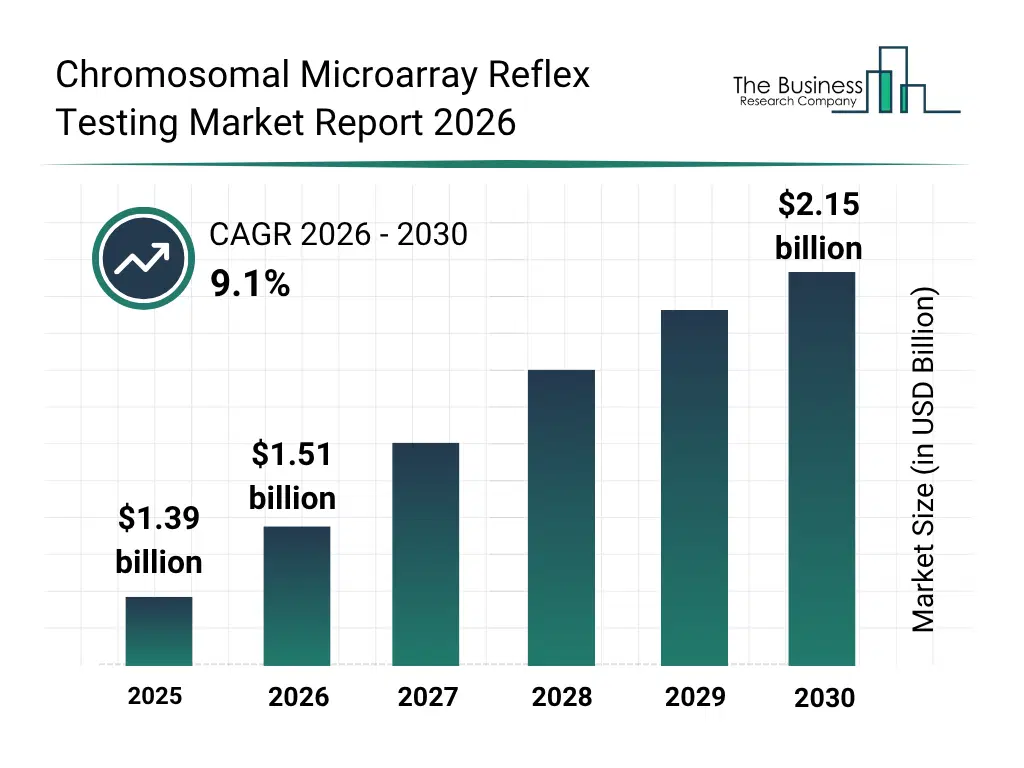
What Is The Chromosomal Microarray Reflex Testing Market Size and Share 2026?
The chromosomal microarray reflex testing market size has grown strongly in recent years. It will grow from $1.39 billion in 2025 to $1.51 billion in 2026 at a compound annual growth rate (CAGR) of 8.9%. The growth in the historic period can be attributed to growing awareness of genetic disorders, adoption of array comparative genomic hybridization, increasing investment in molecular diagnostics, expansion of hospital and laboratory infrastructure, rising demand for accurate prenatal testing.What Is The Chromosomal Microarray Reflex Testing Market Growth Forecast?
The chromosomal microarray reflex testing market size is expected to see strong growth in the next few years. It will grow to $2.15 billion in 2030 at a compound annual growth rate (CAGR) of 9.1%. The growth in the forecast period can be attributed to growing adoption of next-generation sequencing based arrays, increasing demand for personalized medicine applications, expansion of oncology and rare disease diagnostics, rising integration of software for genomic data analysis, growing focus on high-throughput and automated array platforms. Major trends in the forecast period include increasing adoption of high-resolution arrays, rising demand for pre- and post-natal genetic testing, growing integration of snp arrays with clinical workflows, expansion of oncology and rare disease applications, rising focus on custom and multiplexed array designs.
Global Chromosomal Microarray Reflex Testing Market Segmentation
1) By Technology: Array Comparative Genomic Hybridization, Single Nucleotide Polymorphism Arrays, Other Technologies 2) By Product Type: Consumables, Instruments, Software 3) By Application: Genetic Disease Diagnosis, Oncology, Pre- And Post-Natal Testing, Other Applications 4) By End-User: Hospitals And Clinics, Diagnostic Laboratories, Research And Academic Institutes, Other End-Users Subsegments: 1) By Array Comparative Genomic Hybridization: Oligonucleotide Arrays, Bacterial Artificial Chromosome Arrays, cDNA Arrays, Custom Designed Arrays 2) By Single Nucleotide Polymorphism Arrays: High Density SNP Arrays, Low Density SNP Arrays, Genome Wide SNP Arrays, Targeted SNP Arrays 3) By Other Technologies: Multiplex Ligation Dependent Probe Amplification, Next Generation Sequencing Based Arrays, Fluorescence In Situ Hybridization, Quantitative PCR Based ArraysWhat Are The Drivers Of The Chromosomal Microarray Reflex Testing Market?
The increasing prevalence of genetic disorders is expected to propel the growth of the chromosomal microarray (CMA) reflex testing market going forward. Genetic disorders are conditions caused by abnormalities in an individual's DNA or chromosomes that can be inherited or occur due to spontaneous mutations. The growing prevalence of genetic disorders is largely driven by the trend of delayed childbearing, as advanced maternal age significantly increases the likelihood of chromosomal abnormalities such as Down syndrome and other trisomies, leading to a broader at-risk population requiring genetic evaluation. The rising prevalence of genetic disorders boosts demand for chromosomal microarray testing, as it enables high-resolution detection of submicroscopic deletions, duplications, and copy number variants that cannot be identified through conventional karyotyping, allowing more accurate diagnosis across a wider patient population. For instance, in October 2024, according to the Cystic Fibrosis Trust, a UK-based national charity, there were 11,148 people living with cystic fibrosis (CF) in the UK in 2022, increasing to 11,318 in 2023. Therefore, the increasing prevalence of genetic disorders is driving the growth of the chromosomal microarray (CMA) reflex testing market. The growing prenatal screening is expected to propel the growth of the chromosomal microarray reflex testing market going forward. Prenatal screening refers to medical tests conducted during pregnancy to assess the risk of fetal abnormalities or genetic conditions. The growth in prenatal screening is driven by early detection, as it allows timely identification of fetal abnormalities and enables better-informed healthcare decisions. Chromosomal microarray reflex testing helps prenatal screening by providing a detailed genetic analysis of the fetus, enabling the detection of chromosomal abnormalities that may be missed by standard tests. For instance, in January 2026, according to the National Health Service, a UK-based government department, the national performance rate for fetal anomaly ultrasound screening reached 97.0% in the second quarter of 2024–2025. Therefore, the growing prenatal screening is driving the growth of the chromosomal microarray reflex testing industry. The rising demand for personalized medicine is expected to propel the growth of the chromosomal microarray reflex testing market going forward. Precision medicine refers to a medical approach that customizes prevention, diagnosis, and treatment based on an individual’s genetic makeup, environment, and lifestyle. The demand for precision medicine is growing due to the increasing use of genetic and molecular data in healthcare, which allows doctors to provide more targeted and effective treatments for individual patients. Chromosomal Microarray Reflex Testing enhances precision medicine by rapidly identifying submicroscopic chromosomal imbalances and copy number variations that may underlie a patient’s unique clinical presentation, enabling clinicians to tailor diagnostic, prognostic, and therapeutic strategies with unprecedented specificity and reducing the need for sequential or invasive testing. For instance, in February 2024, according to the Personalized Medicine Coalition (PMC), a US-based organization, in 2023, the U.S. Food and Drug Administration (FDA) granted approval to 16 novel personalized therapies designed for rare disease patients, an increase from the six such treatments approved in 2022. Therefore, the rising demand for personalized medicine is driving the growth of the chromosomal microarray reflex testing industry.Key Players In The Global Chromosomal Microarray Reflex Testing Market
Major companies operating in the chromosomal microarray reflex testing market are Thermo Fisher Scientific Inc., Laboratory Corporation of America Holdings (LabCorp), Quest Diagnostics Incorporated, Agilent Technologies Inc., Illumina Inc., Natera Inc., Redcliffe Labs Inc., ARUP Laboratories LLC, Invitae Corporation, MedGenome Labs Ltd., Centogene N.V., Variantyx Inc., Baylor Genetics Laboratories LLC, Ganesh Diagnostic Pvt. Ltd., Partek Incorporated, ReproSource Inc., Paragon Genomics Inc., CURA4U Inc., Lucid Diagnostics Inc., Progenics Laboratories Pvt. Ltd.
This chart is for illustrative purposes; the full report includes a detailed competitor analysis and comprehensive overview of the top 10 companies in the market.
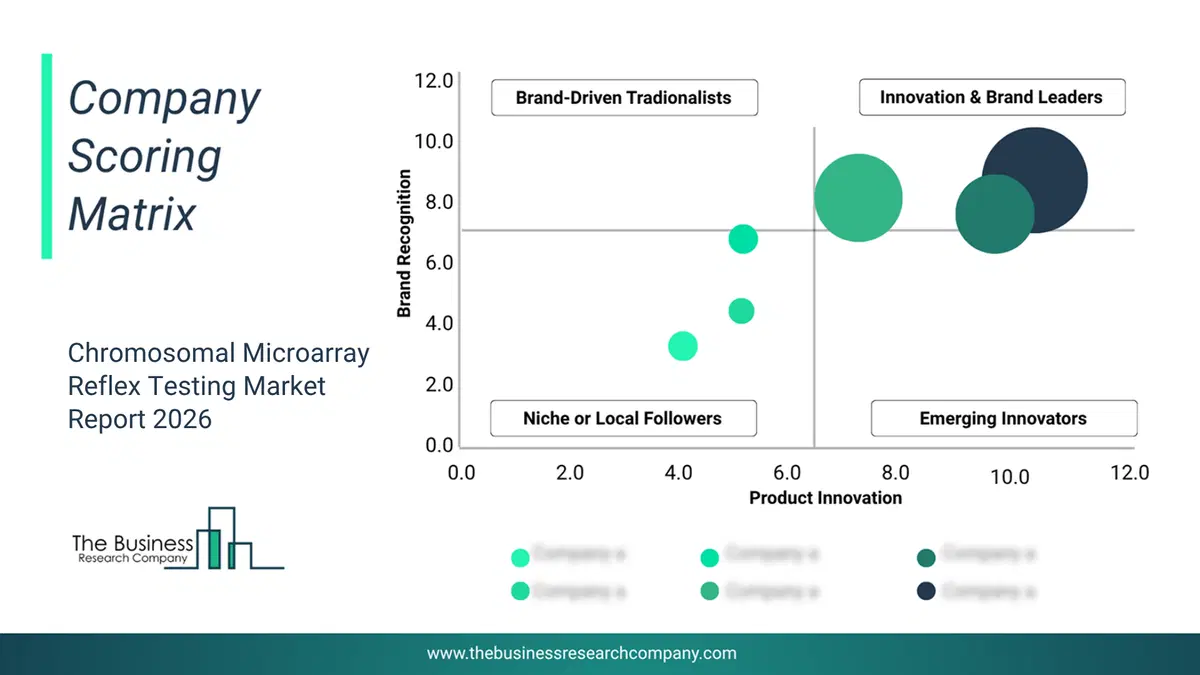
This chart maps companies by product innovation and brand strength, with bubble size indicating relative revenue, helping identify market leaders, challengers, and niche players. This is an illustrative chart; the full report provides a complete and accurate competitive analysis.
Regional Insights
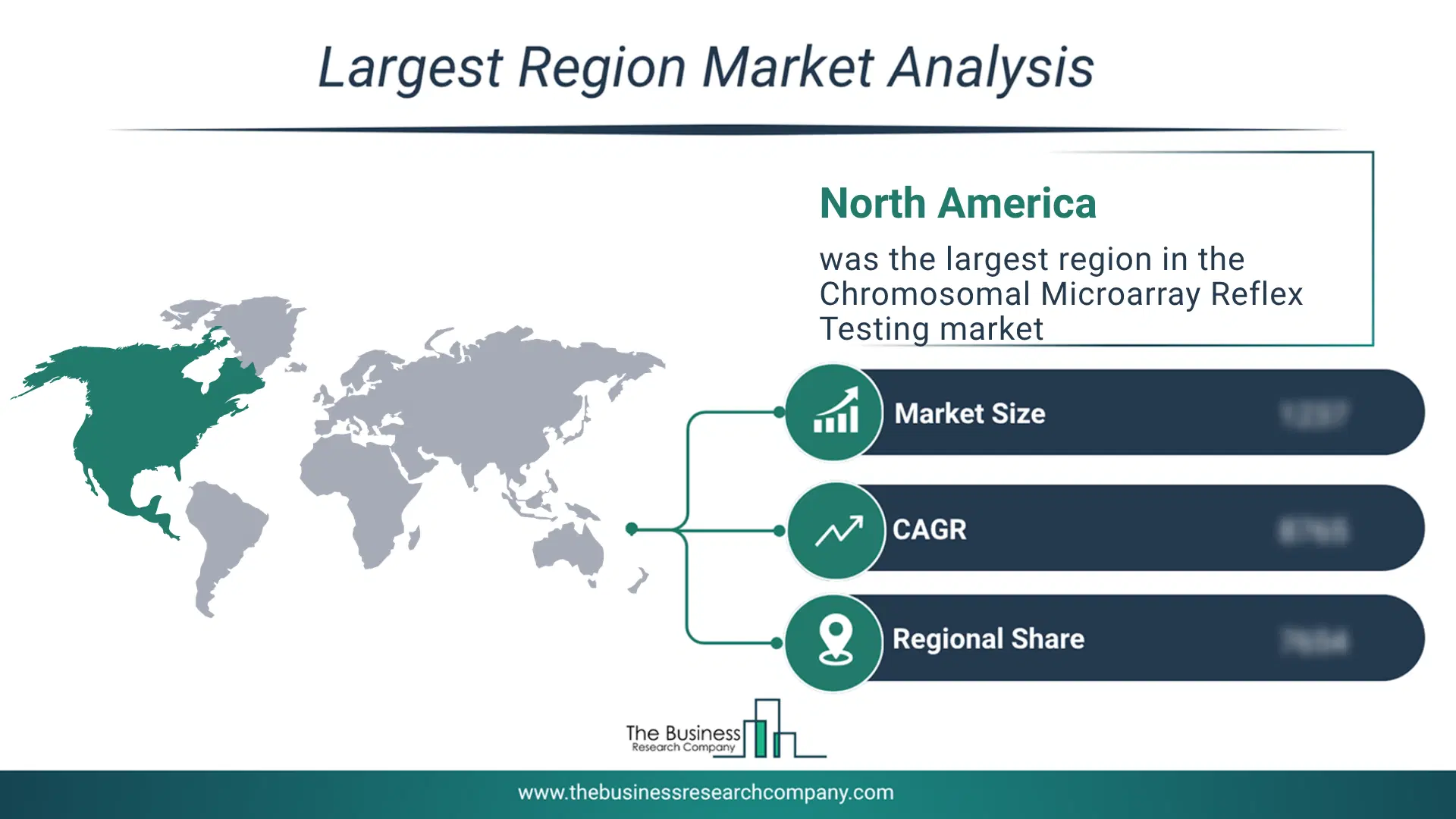
North America was the largest region in the chromosomal microarray reflex testing market in 2025. Asia-Pacific is expected to be the fastest-growing region in the forecast period. The regions covered in this market report are Asia-Pacific, South East Asia, Western Europe, Eastern Europe, North America, South America, Middle East, Africa. The countries covered in this market report are Australia, Brazil, China, France, Germany, India, Indonesia, Japan, Taiwan, Russia, South Korea, UK, USA, Canada, Italy, Spain.What Defines the Chromosomal Microarray Reflex Testing Market?
The chromosomal microarray reflex testing market consists of revenues earned by entities by providing services such as copy number variation (CNV) detection, microdeletion and microduplication syndrome analysis, uniparental disomy (UPD) assessment, and regions of homozygosity (ROH) evaluation. The market value includes the value of related goods sold by the service provider or included within the service offering. The chromosomal microarray reflex testing market also includes sales of prenatal aneuploidy reflex panels, postnatal developmental delay microarray panels, products of conception (POC) chromosomal analysis panels, and oncology-associated copy number variation (CNV) reflex assays. Values in this market are ‘factory gate’ values, that is, the value of goods sold by the manufacturers or creators of the goods, whether to other entities (including downstream manufacturers, wholesalers, distributors, and retailers) or directly to end customers. The value of goods in this market includes related services sold by the creators of the goods.How is Market Value Defined and Measured?
The market value is defined as the revenues that enterprises gain from the sale of goods and/or services within the specified market and geography through sales, grants, or donations in terms of the currency (in USD unless otherwise specified). The revenues for a specified geography are consumption values that are revenues generated by organizations in the specified geography within the market, irrespective of where they are produced. It does not include revenues from resales along the supply chain, either further along the supply chain or as part of other products.
This chart presents market attractiveness based on a quantitative evaluation of growth, competition, strategic alignment, and risk, offering a clear view of opportunity areas for decision-making. This chart is for illustrative purposes; the full report contains the complete analysis.

This chart highlights the Total Addressable Market (TAM) by estimating the maximum revenue opportunity using an assumption-driven approach, supporting strategic planning and opportunity sizing across markets. The chart is illustrative; the full report provides a more comprehensive analysis.
What Key Data And Analysis Are Included In The Chromosomal Microarray Reflex Testing Market Report 2026?
The chromosomal microarray reflex testing market research report is one of a series of new reports from The Business Research Company that provides market statistics, including industry global market size, regional shares, competitors with the market share, detailed market segments, market trends and opportunities, and any further data you may need to thrive in the chromosomal microarray reflex testing industry. The market research report delivers a complete perspective of everything you need, with an in-depth analysis of the current and future state of the industry.Chromosomal Microarray Reflex Testing Market Report Forecast Analysis
| Report Attribute | Details |
|---|---|
| Market Size Value In 2026 | $1.51 billion |
| Revenue Forecast In 2030 | $2.15 billion |
| Growth Rate | CAGR of 9.1% from 2026 to 2030 |
| Base Year For Estimation | 2025 |
| Actual Estimates/Historical Data | 2020-2025 |
| Forecast Period | 2026 - 2030 |
| Market Representation | Revenue in USD Billion and CAGR from 2026 to 2030 |
| Segments Covered | Technology, Product Type, Application, End-User |
| Regional Scope | Asia-Pacific, Western Europe, Eastern Europe, North America, South America, Middle East, Africa |
| Country Scope | The countries covered in the report are Australia, Brazil, China, France, Germany, India, Indonesia, Japan, Taiwan, Russia, South Korea, UK, USA, Canada, Italy, Spain |
| Key Companies Profiled | Thermo Fisher Scientific Inc., Laboratory Corporation of America Holdings (LabCorp), Quest Diagnostics Incorporated, Agilent Technologies Inc., Illumina Inc., Natera Inc., Redcliffe Labs Inc., ARUP Laboratories LLC, Invitae Corporation, MedGenome Labs Ltd., Centogene N.V., Variantyx Inc., Baylor Genetics Laboratories LLC, Ganesh Diagnostic Pvt. Ltd., Partek Incorporated, ReproSource Inc., Paragon Genomics Inc., CURA4U Inc., Lucid Diagnostics Inc., Progenics Laboratories Pvt. Ltd. |
| Customization Scope | Request for Customization |
| Pricing And Purchase Options | Explore Purchase Options |